

 登录
登录
中考趋势 Ⅵ.短文还原
从方框中选出能填入空白处的最佳选项。选项中有两项多余。
(2025·重庆一模)Life keeps changing. While some changes are exciting, others may make us feel nervous.
1 Whether you like them or not, changes cannot be avoided. Having a good understanding of them may make it easier for us to deal with changes.
What are life changes? Many new things happen in life. Some are good choices you make, like joining a team or meeting friends. 2 They can be big things like moving schools, a friend going away or the death of your beloved one. Smaller changes might include having a new teacher or adapting(适应) to parents' new work schedules. All these can create strong emotions, but that's normal.
3 Changes can be difficult because we can't predict results. Emily Hanlon, a psychologist(心理学家), says, "Our brains like familiar things because they feel safe. When something changes, like starting a new school or moving to a new home, it can feel like stepping into the unknown. 4" Changes can also be hard if you don't feel quite ready for them or you are not in control of whatever is happening.
Can change be a good thing? 5 Trying new things helps discover what you like and dislike, such as tasting new ice cream flavours(味道) to find favourites. Changes also help us grow and learn skills. Hanlon says, "Though changes can be scary, they often bring new experiences, friendships, and strengths. So face the changes and believe in yourself."
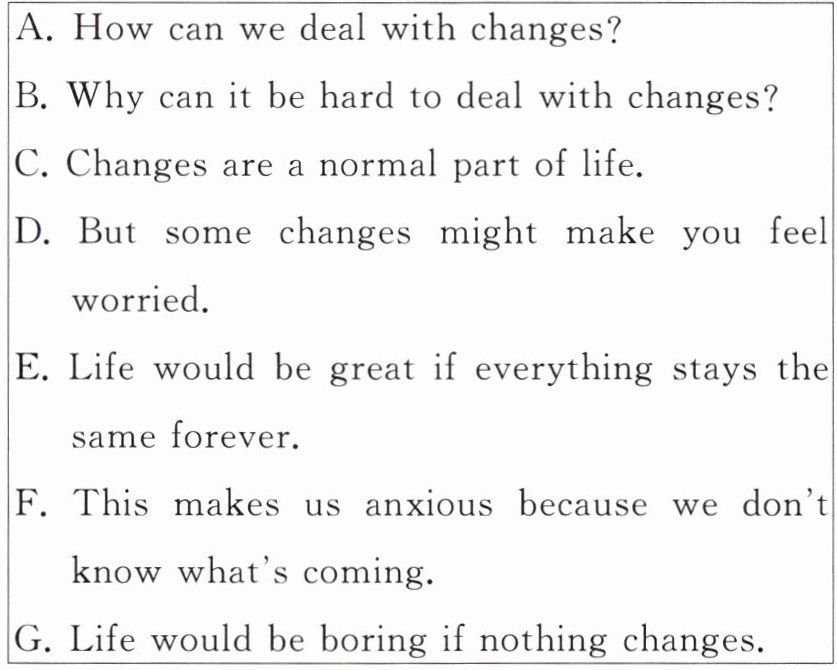
1.
2.
3.
4.
5.
从方框中选出能填入空白处的最佳选项。选项中有两项多余。
(2025·重庆一模)Life keeps changing. While some changes are exciting, others may make us feel nervous.
1 Whether you like them or not, changes cannot be avoided. Having a good understanding of them may make it easier for us to deal with changes.
What are life changes? Many new things happen in life. Some are good choices you make, like joining a team or meeting friends. 2 They can be big things like moving schools, a friend going away or the death of your beloved one. Smaller changes might include having a new teacher or adapting(适应) to parents' new work schedules. All these can create strong emotions, but that's normal.
3 Changes can be difficult because we can't predict results. Emily Hanlon, a psychologist(心理学家), says, "Our brains like familiar things because they feel safe. When something changes, like starting a new school or moving to a new home, it can feel like stepping into the unknown. 4" Changes can also be hard if you don't feel quite ready for them or you are not in control of whatever is happening.
Can change be a good thing? 5 Trying new things helps discover what you like and dislike, such as tasting new ice cream flavours(味道) to find favourites. Changes also help us grow and learn skills. Hanlon says, "Though changes can be scary, they often bring new experiences, friendships, and strengths. So face the changes and believe in yourself."
1.
2.
3.
4.
5.
答案
Ⅵ. 1.C 2.D 3.B 4.F 5.G
【语篇解读】本文是一篇说明文。文章主要介绍了改变是生活中正常的一部分。
1. C 解析:根据“Whether you like them or not, changes cannot be avoided.”可知,不管你喜不喜欢,改变是不可避免的。C 项“改变是生活中正常的一部分。”符合语境。故选 C。
2. D 解析:根据“Some are good choices you make, like joining a team or meeting friends.”和“They can be big things like moving schools, a friend going away or the death of your beloved one.”可知,此处是表达不好的一面。D项“但是有些改变可能会让你感到担心。”符合语境。故选 D。
3. B 解析:根据“Changes can be difficult because we can't predict results.”可知,本段主要讲述的是改变是困难的。B项“为什么改变会很难处理?”符合语境。故选 B。
4. F 解析:根据“When something changes, like starting a new school or moving to a new home, it can feel like stepping into the unknown.”可知,改变是未知的,所以我们会担心。F项“这让我们担心,因为我们不知道接下来会发生什么。”符合语境。故选 F。
5. G 解析:根据“Trying new things helps discover what you like and dislike, such as tasting new ice cream flavours to find favourites.”可知,改变可以让我们尝试新事物。G项“如果什么都没有改变,生活会很无聊。”符合语境。故选 G。
【语篇解读】本文是一篇说明文。文章主要介绍了改变是生活中正常的一部分。
1. C 解析:根据“Whether you like them or not, changes cannot be avoided.”可知,不管你喜不喜欢,改变是不可避免的。C 项“改变是生活中正常的一部分。”符合语境。故选 C。
2. D 解析:根据“Some are good choices you make, like joining a team or meeting friends.”和“They can be big things like moving schools, a friend going away or the death of your beloved one.”可知,此处是表达不好的一面。D项“但是有些改变可能会让你感到担心。”符合语境。故选 D。
3. B 解析:根据“Changes can be difficult because we can't predict results.”可知,本段主要讲述的是改变是困难的。B项“为什么改变会很难处理?”符合语境。故选 B。
4. F 解析:根据“When something changes, like starting a new school or moving to a new home, it can feel like stepping into the unknown.”可知,改变是未知的,所以我们会担心。F项“这让我们担心,因为我们不知道接下来会发生什么。”符合语境。故选 F。
5. G 解析:根据“Trying new things helps discover what you like and dislike, such as tasting new ice cream flavours to find favourites.”可知,改变可以让我们尝试新事物。G项“如果什么都没有改变,生活会很无聊。”符合语境。故选 G。
解析
【分析】
做短文还原题需结合上下文语境和语义逻辑选择句子。第1空后提到“改变不可避免”,对应“改变是生活正常部分”;第2空前说有些是好的变化,后接不好的变化例子,需选转折句;第3空后讲改变难的原因,对应“为什么改变难处理”;第4空前说改变像踏入未知,对应“不知道来什么导致焦虑”;第5空前问改变是好事吗,后讲尝试新事物,对应“没改变会无聊”。
【解析】
1. 第1空:根据后句“Whether you like them or not, changes cannot be avoided.”(不管喜不喜欢,改变不可避免),可知此处强调改变是生活的正常部分,对应选项C。
2. 第2空:前句提到“有些是好的选择”,后句举例不好的变化,需选转折句,对应选项D(有些改变让人担心)。
3. 第3空:后句“Changes can be difficult because we can't predict results.”(改变难因为不能预测结果),说明本段讲改变难的原因,对应选项B(为什么改变难处理)。
4. 第4空:前句“it can feel like stepping into the unknown”(像踏入未知),对应选项F(不知道接下来发生什么导致焦虑)。
5. 第5空:前句问“改变是好事吗”,后句讲尝试新事物,对应选项G(没改变会无聊)。
【答案】
1.C 2.D 3.B 4.F 5.G
【知识点】
英语短文还原;句子逻辑衔接
【点评】
本题为中考常见的短文还原题型,侧重考查学生对语篇上下文语义逻辑的理解能力,需结合前后句关联选句,整体难度适中。
【难度系数】
0.6
做短文还原题需结合上下文语境和语义逻辑选择句子。第1空后提到“改变不可避免”,对应“改变是生活正常部分”;第2空前说有些是好的变化,后接不好的变化例子,需选转折句;第3空后讲改变难的原因,对应“为什么改变难处理”;第4空前说改变像踏入未知,对应“不知道来什么导致焦虑”;第5空前问改变是好事吗,后讲尝试新事物,对应“没改变会无聊”。
【解析】
1. 第1空:根据后句“Whether you like them or not, changes cannot be avoided.”(不管喜不喜欢,改变不可避免),可知此处强调改变是生活的正常部分,对应选项C。
2. 第2空:前句提到“有些是好的选择”,后句举例不好的变化,需选转折句,对应选项D(有些改变让人担心)。
3. 第3空:后句“Changes can be difficult because we can't predict results.”(改变难因为不能预测结果),说明本段讲改变难的原因,对应选项B(为什么改变难处理)。
4. 第4空:前句“it can feel like stepping into the unknown”(像踏入未知),对应选项F(不知道接下来发生什么导致焦虑)。
5. 第5空:前句问“改变是好事吗”,后句讲尝试新事物,对应选项G(没改变会无聊)。
【答案】
1.C 2.D 3.B 4.F 5.G
【知识点】
英语短文还原;句子逻辑衔接
【点评】
本题为中考常见的短文还原题型,侧重考查学生对语篇上下文语义逻辑的理解能力,需结合前后句关联选句,整体难度适中。
【难度系数】
0.6
Ⅶ. 首字母填空
根据短文内容及首字母提示,在空格处填入一个适当的词使短文完整。
原创 傈僳服饰亮相时装周$ Photographer Ren Peng remembers the experience as if it was only yesterday. Five years ago he v\underline{1} the hometown of his friend Gu Yan, a member of the Lisu ethnic group, in Yanbian County, Panzhihua, Sichuan Province. Ren was impressed by the labour-consuming traditional techniques of making Lisu costumes($装束).
$Leaves of fire grass, a special plant that often g\underline{2} in the mountainous area of southwestern China, are used to make the costumes. “People can get fibers by rubbing($揉搓$) the leaves, and then spin to make threads and weave cloth. The whole process has more than 20 steps and takes 8 to 12 months to c\underline{3}, during which more than 10,000 leaves are required to make just one costume,” says Ren. He was a\underline{4} by the craftsmanship involved in making the clothing.$
$The clothing made from the fire grass offers excellent breath ability, insect protection and moisture resistance. As a result, they meet the n\underline{5} of traditional Lisu people's lives in the mountains.$
$H\underline{6}, these skills and crafted products are now less famous. To draw greater public attention for this valuable cultural heritage, Ren and Gu have brought them to a bigger stage—they organised a fashion show themed on Lisu clothing at the China Fashion Week in March 2025. “The show displayed not only traditional handmade Lisu costumes, b\underline{7} haute couture($高级时装) and ready-to-wear items inspired by Lisu clothes,” says Ren.
$The major promoter of this activity is Gu, for whom telling the stories of Lisu group has long been a wish, also director of a Lisu ethnic group research association in Yanbian. She believes clothing is a starting point from which people can get to k\underline{8} her group.$
$Without written records, Lisu people record their stories on their costumes. “Lisu clothing is m\underline{9} historically. The flower patterns on our clothing represent flowers from 77 mountains, the belt around our waists represents the rainbow in the sky, the alternating white and red on the pleated skirt is the s\underline{10} of the 99 rivers and 12 mountain ranges, while the white patterns below signify the path our ancestors took (in their migration),” says Gu.$
1. 2. 3.
4. 5. 6.
7. 8. 9.
10.
根据短文内容及首字母提示,在空格处填入一个适当的词使短文完整。
原创 傈僳服饰亮相时装周$ Photographer Ren Peng remembers the experience as if it was only yesterday. Five years ago he v\underline{1} the hometown of his friend Gu Yan, a member of the Lisu ethnic group, in Yanbian County, Panzhihua, Sichuan Province. Ren was impressed by the labour-consuming traditional techniques of making Lisu costumes($装束).
$Leaves of fire grass, a special plant that often g\underline{2} in the mountainous area of southwestern China, are used to make the costumes. “People can get fibers by rubbing($揉搓$) the leaves, and then spin to make threads and weave cloth. The whole process has more than 20 steps and takes 8 to 12 months to c\underline{3}, during which more than 10,000 leaves are required to make just one costume,” says Ren. He was a\underline{4} by the craftsmanship involved in making the clothing.$
$The clothing made from the fire grass offers excellent breath ability, insect protection and moisture resistance. As a result, they meet the n\underline{5} of traditional Lisu people's lives in the mountains.$
$H\underline{6}, these skills and crafted products are now less famous. To draw greater public attention for this valuable cultural heritage, Ren and Gu have brought them to a bigger stage—they organised a fashion show themed on Lisu clothing at the China Fashion Week in March 2025. “The show displayed not only traditional handmade Lisu costumes, b\underline{7} haute couture($高级时装) and ready-to-wear items inspired by Lisu clothes,” says Ren.
$The major promoter of this activity is Gu, for whom telling the stories of Lisu group has long been a wish, also director of a Lisu ethnic group research association in Yanbian. She believes clothing is a starting point from which people can get to k\underline{8} her group.$
$Without written records, Lisu people record their stories on their costumes. “Lisu clothing is m\underline{9} historically. The flower patterns on our clothing represent flowers from 77 mountains, the belt around our waists represents the rainbow in the sky, the alternating white and red on the pleated skirt is the s\underline{10} of the 99 rivers and 12 mountain ranges, while the white patterns below signify the path our ancestors took (in their migration),” says Gu.$
1. 2. 3.
4. 5. 6.
7. 8. 9.
10.
答案
Ⅶ.【语篇解读】本文是一篇说明文。文章主要介绍了傈僳族火草服饰的制作工艺及登上时装周的传承故事。
1. visited 解析:根据“Five years ago(五年前)”可知,用一般过去时,结合首字母 v 以及“拜访朋友家乡”的句意可知,填 visited。
2. grows 解析:根据“a special plant that often(一种常……的特殊植物)”可知,定语从句时态为一般现在时,主语为 that。故填 grows。
3. complete 解析:根据“takes 8 to 12 months to(花 8~12 个月去……)”可知。故填 complete 表示“完成”,不定式后接动词原形。
4. amazed 解析:根据“by the craftsmanship(这种工艺)”和首字母 a 可知,be amazed by 表示“对……感到惊讶”。故填amazed。
5. needs 解析:根据“meet the ... of traditional Lisu people's lives(满足傈僳族生活的……)”和首字母 n 可知,meet theneeds of 表示“满足……的需求”。故填 needs。
6. However 解析:前文介绍火草服饰的优点,后文说“lessfamous(名气小)”,表示转折且首字母是 H。故填However。
7. but 解析:固定搭配 not only ... but (also) ... 表示“不仅……而且……”。故填 but。
8. know 解析:根据“get to ... her group(去……她的民族)”和首字母 k 可知,get to know 表示“了解”。故填 know。
9. meaningful 解析:根据后文介绍服饰的图案意义且首字母是 m 可知,填 meaningful 表示“有意义的”。
10. symbol 解析:根据“the ... of the 99 rivers and 12 mountain ranges(99 条河和 12 座山的……)”和首字母 s可知,the symbol of 表示“……的象征”。故填 symbol。
1. visited 解析:根据“Five years ago(五年前)”可知,用一般过去时,结合首字母 v 以及“拜访朋友家乡”的句意可知,填 visited。
2. grows 解析:根据“a special plant that often(一种常……的特殊植物)”可知,定语从句时态为一般现在时,主语为 that。故填 grows。
3. complete 解析:根据“takes 8 to 12 months to(花 8~12 个月去……)”可知。故填 complete 表示“完成”,不定式后接动词原形。
4. amazed 解析:根据“by the craftsmanship(这种工艺)”和首字母 a 可知,be amazed by 表示“对……感到惊讶”。故填amazed。
5. needs 解析:根据“meet the ... of traditional Lisu people's lives(满足傈僳族生活的……)”和首字母 n 可知,meet theneeds of 表示“满足……的需求”。故填 needs。
6. However 解析:前文介绍火草服饰的优点,后文说“lessfamous(名气小)”,表示转折且首字母是 H。故填However。
7. but 解析:固定搭配 not only ... but (also) ... 表示“不仅……而且……”。故填 but。
8. know 解析:根据“get to ... her group(去……她的民族)”和首字母 k 可知,get to know 表示“了解”。故填 know。
9. meaningful 解析:根据后文介绍服饰的图案意义且首字母是 m 可知,填 meaningful 表示“有意义的”。
10. symbol 解析:根据“the ... of the 99 rivers and 12 mountain ranges(99 条河和 12 座山的……)”和首字母 s可知,the symbol of 表示“……的象征”。故填 symbol。
解析
【分析】
解答首字母填空题时,首先需通读全文,把握文章主旨(本文围绕傈僳族火草服饰的制作工艺与传承故事展开);接着逐句分析空格处的词性、时态、固定搭配等语法规则,结合上下文语境及首字母提示推断合适的单词;最后检查单词形式是否符合语法要求(如时态、单复数等)。
【解析】
1. visited:由时间状语“Five years ago”可知,此处用一般过去时,结合语境“拜访朋友家乡”及首字母v,填visited。
2. grows:定语从句先行词为单数名词“a special plant”,时态为一般现在时,故从句谓语用第三人称单数形式,结合首字母g,填grows。
3. complete:固定结构“take + 时间 + to do sth”表示“花费时间做某事”,结合语境“完成整个制作过程”及首字母c,填complete。
4. amazed:固定搭配“be amazed by”意为“对……感到惊讶”,结合语境对傈僳族工艺的感受及首字母a,填amazed。
5. needs:固定搭配“meet the needs of”意为“满足……的需求”,结合语境“满足傈僳族生活需求”及首字母n,填needs。
6. However:前文介绍火草服饰的优点,后文转折说明其名气小,结合首字母H,填表示转折的However。
7. but:固定搭配“not only...but (also)...”意为“不仅……而且……”,此处省略also,结合首字母b,填but。
8. know:固定搭配“get to know”意为“逐渐了解”,结合语境“了解傈僳族”及首字母k,填know。
9. meaningful:后文介绍服饰图案的文化意义,结合首字母m,填表示“有意义的”meaningful。
10. symbol:固定搭配“the symbol of”意为“……的象征”,结合语境“图案是山河的象征”及首字母s,填symbol。
【答案】
1.visited 2.grows 3.complete 4.amazed 5.needs 6.However 7.but 8.know 9.meaningful 10.symbol
【知识点】
首字母填空解题技巧、动词时态运用、固定搭配
【点评】
本题以傈僳族服饰文化为背景,将语言知识考查与文化常识结合,既需要学生掌握基础的语法规则、固定搭配,也需理解上下文语境,兼具实用性与文化性,难度适中。
【难度系数】
0.6
解答首字母填空题时,首先需通读全文,把握文章主旨(本文围绕傈僳族火草服饰的制作工艺与传承故事展开);接着逐句分析空格处的词性、时态、固定搭配等语法规则,结合上下文语境及首字母提示推断合适的单词;最后检查单词形式是否符合语法要求(如时态、单复数等)。
【解析】
1. visited:由时间状语“Five years ago”可知,此处用一般过去时,结合语境“拜访朋友家乡”及首字母v,填visited。
2. grows:定语从句先行词为单数名词“a special plant”,时态为一般现在时,故从句谓语用第三人称单数形式,结合首字母g,填grows。
3. complete:固定结构“take + 时间 + to do sth”表示“花费时间做某事”,结合语境“完成整个制作过程”及首字母c,填complete。
4. amazed:固定搭配“be amazed by”意为“对……感到惊讶”,结合语境对傈僳族工艺的感受及首字母a,填amazed。
5. needs:固定搭配“meet the needs of”意为“满足……的需求”,结合语境“满足傈僳族生活需求”及首字母n,填needs。
6. However:前文介绍火草服饰的优点,后文转折说明其名气小,结合首字母H,填表示转折的However。
7. but:固定搭配“not only...but (also)...”意为“不仅……而且……”,此处省略also,结合首字母b,填but。
8. know:固定搭配“get to know”意为“逐渐了解”,结合语境“了解傈僳族”及首字母k,填know。
9. meaningful:后文介绍服饰图案的文化意义,结合首字母m,填表示“有意义的”meaningful。
10. symbol:固定搭配“the symbol of”意为“……的象征”,结合语境“图案是山河的象征”及首字母s,填symbol。
【答案】
1.visited 2.grows 3.complete 4.amazed 5.needs 6.However 7.but 8.know 9.meaningful 10.symbol
【知识点】
首字母填空解题技巧、动词时态运用、固定搭配
【点评】
本题以傈僳族服饰文化为背景,将语言知识考查与文化常识结合,既需要学生掌握基础的语法规则、固定搭配,也需理解上下文语境,兼具实用性与文化性,难度适中。
【难度系数】
0.6
