

 登录
登录
一、完形填空
It's been five years since I came to America. The year before I arrived, every weekend I was woken up by a piece of music called “Spring River in the Flower Moon Night (《春江花月夜》)”, 1 by my mother on the guzheng.
My mum liked the beauty of Chinese 2 music very much. But she grew up in a poor family when she was young, so she never had the chance to learn a musical 3 properly. In 2019, she got a guzheng from a friend and 4 parctised playing when she had spare time. Sometimes when I miss her, I search for the songs she used to play on the internet. I expected to 5 them here in Boston.
Earlier this year, as I looked 6 a new house to live in, I met Mr Lin, the director of the Boston Musicians Community. At Lin's house, I heard the 7 of the erhu for the first time. It was beautiful and powerful—it 8 brought me back to my hometown in China.
Teaching is also part of Lin's daily life. As a teacher, he passed on his love of the erhu to his 9. I went to one of Lin's classes and met a 9-year-old boy. I asked him 10 he chose to learn the erhu. “It's much 11 to learn than the violin,” he said. “Perhaps he hasn't really started to understand the beauty of the erhu as a little kid. There are so many beautiful things in Chinese 12: the music, the language and the art. So I just try my best to let him have a place to discover it. It's my job,” Mr Lin said.
I 13 my mum for giving me a chance to immerse (使沉浸) myself in the Chinese musical world. Music makes me feel 14. If you listen to one piece, you will 15 its peace, power, and beauty.
()1. A. directed B. written C. played D. invented
()2. A. traditional B. modern C. electronic D. western
()3. A. product B. instrument C. language D. trick
()4. A. hardly B. seldom C. never D. always
()5. A. hear B. create C. check D. meet
()6. A. after B. at C. up D. for
()7. A. cry B. noise C. sound D. voice
()8. A. suddenly B. recently C. correctly D. secretly
()9. A. relatives B. friends C. parents D. students
()10. A. how B. where C. when D. why
()11. A. longer B. easier C. safer D. smarter
()12. A. culture B. paintings C. inventions D. medicine
()13. A. praise B. hate C. pay D. thank
()14. A. nervous B. worried C. relaxed D. down
()15. A. sense B. doubt C. express D. require
二、阅读理解
Do you know what music people like listening to? If you ask them, you may get many different answers. Why do different people have different musical preferences? What do these differences say about us?
Researchers from Cambridge University tried to answer these questions. They asked 350,000 people from 50 different countries. Then, they found that musical preferences depend on personality. Outgoing people prefer danceable music with strong beats such as rap. Country music fans are shown to be more serious in their jobs. One of the findings is quite interesting. The researchers thought that people with much stress should like sad music or rhythmic music. But it turned out that these people dislike these two kinds. Instead, they like loud music better. Maybe they like to listen to this kind of music to lower their stress.
The researchers also found that climate may affect people's musical preferences and personalities, too. People in hot weather prefer danceable music. They are more outgoing. This may be a result of longer daylight hours. They advised people to go outdoors to dance.
Of course, nothing is clear-cut. We may not group people simply by their musical tastes. The study just showed us that people of different cultures are more similar than we think. “People are grouped by language and culture,” said Dr David Greenberg. “But if an outgoing person in one place likes the same music as outgoing people in other places, then we can say that music is really like a bridge.”
( )1. How does the writer begin this topic?
A. By asking questions.
B. By telling stories.
C. By giving examples.
D. By listing numbers.
()2. What kind of music do people who are more serious in their jobs like better?
A. Sad music. B. Loud music.
C. Country music. D. Danceable music.
()3. 新考法 图文转换 In which season do people most probably like danceable music?
A.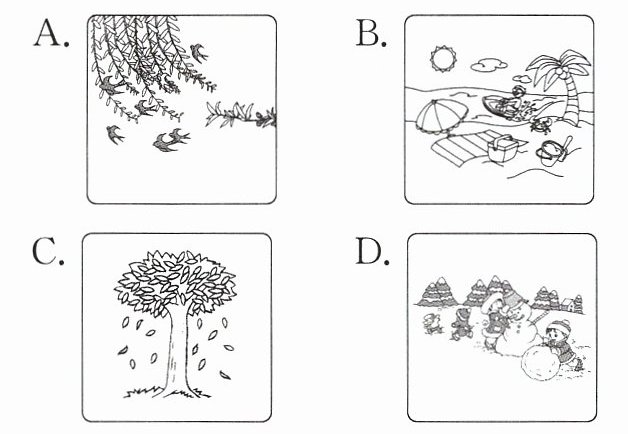
()4. What can we learn from the last paragraph?
A. People of different cultures are quite different.
B. People can be grouped only by language and culture.
C. Listening to loud music helps to deal with people's stress.
D. Music helps people all over the world to communicate.
()5. 新考法 篇章结构 Which of the following best shows the structure of the text? (P=paragraph)
A.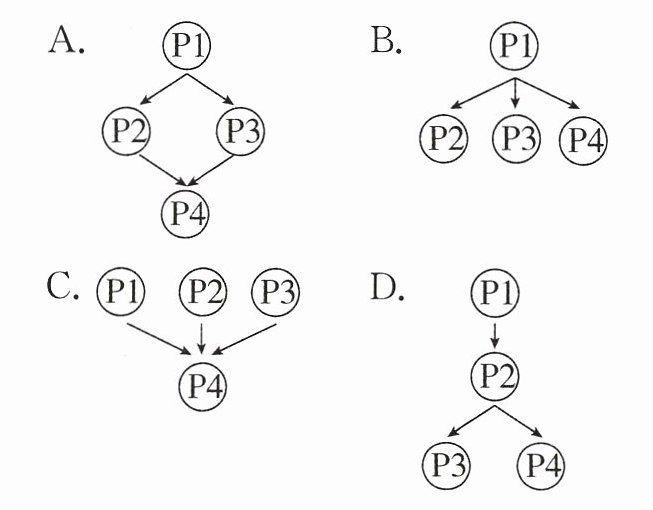
It's been five years since I came to America. The year before I arrived, every weekend I was woken up by a piece of music called “Spring River in the Flower Moon Night (《春江花月夜》)”, 1 by my mother on the guzheng.
My mum liked the beauty of Chinese 2 music very much. But she grew up in a poor family when she was young, so she never had the chance to learn a musical 3 properly. In 2019, she got a guzheng from a friend and 4 parctised playing when she had spare time. Sometimes when I miss her, I search for the songs she used to play on the internet. I expected to 5 them here in Boston.
Earlier this year, as I looked 6 a new house to live in, I met Mr Lin, the director of the Boston Musicians Community. At Lin's house, I heard the 7 of the erhu for the first time. It was beautiful and powerful—it 8 brought me back to my hometown in China.
Teaching is also part of Lin's daily life. As a teacher, he passed on his love of the erhu to his 9. I went to one of Lin's classes and met a 9-year-old boy. I asked him 10 he chose to learn the erhu. “It's much 11 to learn than the violin,” he said. “Perhaps he hasn't really started to understand the beauty of the erhu as a little kid. There are so many beautiful things in Chinese 12: the music, the language and the art. So I just try my best to let him have a place to discover it. It's my job,” Mr Lin said.
I 13 my mum for giving me a chance to immerse (使沉浸) myself in the Chinese musical world. Music makes me feel 14. If you listen to one piece, you will 15 its peace, power, and beauty.
()1. A. directed B. written C. played D. invented
()2. A. traditional B. modern C. electronic D. western
()3. A. product B. instrument C. language D. trick
()4. A. hardly B. seldom C. never D. always
()5. A. hear B. create C. check D. meet
()6. A. after B. at C. up D. for
()7. A. cry B. noise C. sound D. voice
()8. A. suddenly B. recently C. correctly D. secretly
()9. A. relatives B. friends C. parents D. students
()10. A. how B. where C. when D. why
()11. A. longer B. easier C. safer D. smarter
()12. A. culture B. paintings C. inventions D. medicine
()13. A. praise B. hate C. pay D. thank
()14. A. nervous B. worried C. relaxed D. down
()15. A. sense B. doubt C. express D. require
二、阅读理解
Do you know what music people like listening to? If you ask them, you may get many different answers. Why do different people have different musical preferences? What do these differences say about us?
Researchers from Cambridge University tried to answer these questions. They asked 350,000 people from 50 different countries. Then, they found that musical preferences depend on personality. Outgoing people prefer danceable music with strong beats such as rap. Country music fans are shown to be more serious in their jobs. One of the findings is quite interesting. The researchers thought that people with much stress should like sad music or rhythmic music. But it turned out that these people dislike these two kinds. Instead, they like loud music better. Maybe they like to listen to this kind of music to lower their stress.
The researchers also found that climate may affect people's musical preferences and personalities, too. People in hot weather prefer danceable music. They are more outgoing. This may be a result of longer daylight hours. They advised people to go outdoors to dance.
Of course, nothing is clear-cut. We may not group people simply by their musical tastes. The study just showed us that people of different cultures are more similar than we think. “People are grouped by language and culture,” said Dr David Greenberg. “But if an outgoing person in one place likes the same music as outgoing people in other places, then we can say that music is really like a bridge.”
( )1. How does the writer begin this topic?
A. By asking questions.
B. By telling stories.
C. By giving examples.
D. By listing numbers.
()2. What kind of music do people who are more serious in their jobs like better?
A. Sad music. B. Loud music.
C. Country music. D. Danceable music.
()3. 新考法 图文转换 In which season do people most probably like danceable music?
A.
()4. What can we learn from the last paragraph?
A. People of different cultures are quite different.
B. People can be grouped only by language and culture.
C. Listening to loud music helps to deal with people's stress.
D. Music helps people all over the world to communicate.
()5. 新考法 篇章结构 Which of the following best shows the structure of the text? (P=paragraph)
A.
答案
一、1-5 CABDA 6-10 DCADD 11-15 BADCA
二、1-5 ACBDA
二、1-5 ACBDA
解析
【分析】
本题分为完形填空和阅读理解两部分。完形填空需先通读全文把握主旨(作者在美国怀念母亲的古筝音乐,偶遇二胡演奏者,感受中国音乐的魅力),再结合语境、词义辨析、固定搭配逐一选择;阅读理解需先通读文章明确核心(音乐偏好与性格、气候相关,音乐是文化桥梁),再通过定位原文细节、分析题干对应选项完成答题。
【解析】
一、完形填空:
1. 考查动词辨析,音乐由母亲弹奏,play music为固定搭配,选C。
2. 考查形容词辨析,此处指中国传统音乐,选A。
3. 考查名词辨析,musical instrument意为乐器,选B。
4. 考查副词辨析,母亲有古筝后总是练习弹奏,选D。
5. 考查动词辨析,作者想在美国听到母亲常弹的歌曲,选A。
6. 考查固定搭配,look for意为寻找,此处指找新房子,选D。
7. 考查名词辨析,乐器的声音用sound,选C。
8. 考查副词辨析,二胡声突然让作者想起中国家乡,选A。
9. 考查名词辨析,林先生把对二胡的热爱传递给学生,选D。
10. 考查疑问词辨析,问男孩选择学二胡的原因,选D。
11. 考查形容词比较级,男孩称二胡比小提琴更容易学,选B。
12. 考查名词辨析,中国文化包含音乐、语言、艺术,选A。
13. 考查动词辨析,作者感谢妈妈让自己沉浸于中国音乐世界,选D。
14. 考查形容词辨析,音乐让作者感到放松,选C。
15. 考查动词辨析,听音乐能感受到它的宁静、力量与美,选A。
二、阅读理解:
1. 考查文章开头方式,作者通过提问引入话题,选A。
2. 考查细节理解,原文提到认真工作的人喜欢乡村音乐,选C。
3. 考查细节理解,热天的人偏好可跳舞的音乐,对应夏天,选B。
4. 考查推理判断,最后一段指出音乐是文化桥梁,帮助全球人交流,选D。
5. 考查篇章结构,文章为总分总结构,选A。
【答案】
一、1-5 CABDA 6-10 DCADD 11-15 BADCA
二、1-5 ACBDA
【知识点】
英语完形填空、英语阅读理解、词义辨析
【点评】
本题为初中英语综合练习题,涵盖完形与阅读,考查词汇辨析、语境理解、语篇分析能力,贴合学业要求,能有效检测学生的英语综合应用水平。
【难度系数】
0.6
本题分为完形填空和阅读理解两部分。完形填空需先通读全文把握主旨(作者在美国怀念母亲的古筝音乐,偶遇二胡演奏者,感受中国音乐的魅力),再结合语境、词义辨析、固定搭配逐一选择;阅读理解需先通读文章明确核心(音乐偏好与性格、气候相关,音乐是文化桥梁),再通过定位原文细节、分析题干对应选项完成答题。
【解析】
一、完形填空:
1. 考查动词辨析,音乐由母亲弹奏,play music为固定搭配,选C。
2. 考查形容词辨析,此处指中国传统音乐,选A。
3. 考查名词辨析,musical instrument意为乐器,选B。
4. 考查副词辨析,母亲有古筝后总是练习弹奏,选D。
5. 考查动词辨析,作者想在美国听到母亲常弹的歌曲,选A。
6. 考查固定搭配,look for意为寻找,此处指找新房子,选D。
7. 考查名词辨析,乐器的声音用sound,选C。
8. 考查副词辨析,二胡声突然让作者想起中国家乡,选A。
9. 考查名词辨析,林先生把对二胡的热爱传递给学生,选D。
10. 考查疑问词辨析,问男孩选择学二胡的原因,选D。
11. 考查形容词比较级,男孩称二胡比小提琴更容易学,选B。
12. 考查名词辨析,中国文化包含音乐、语言、艺术,选A。
13. 考查动词辨析,作者感谢妈妈让自己沉浸于中国音乐世界,选D。
14. 考查形容词辨析,音乐让作者感到放松,选C。
15. 考查动词辨析,听音乐能感受到它的宁静、力量与美,选A。
二、阅读理解:
1. 考查文章开头方式,作者通过提问引入话题,选A。
2. 考查细节理解,原文提到认真工作的人喜欢乡村音乐,选C。
3. 考查细节理解,热天的人偏好可跳舞的音乐,对应夏天,选B。
4. 考查推理判断,最后一段指出音乐是文化桥梁,帮助全球人交流,选D。
5. 考查篇章结构,文章为总分总结构,选A。
【答案】
一、1-5 CABDA 6-10 DCADD 11-15 BADCA
二、1-5 ACBDA
【知识点】
英语完形填空、英语阅读理解、词义辨析
【点评】
本题为初中英语综合练习题,涵盖完形与阅读,考查词汇辨析、语境理解、语篇分析能力,贴合学业要求,能有效检测学生的英语综合应用水平。
【难度系数】
0.6
