

 登录
登录
七、信息还原。(每小题2分,共10分)
新素材 传统文化 The 12th Huzhou Writing Brush Culture Festival announced its opening in Huzhou, Zhejiang on Friday. The writing brush produced in Huzhou, Huimo, rice paper, and the Duan inkstone are collectively known as the “Four Treasures of the Study”. 1 The production process includes over 120 steps, winning praise such as “the brush tip craftsmanship is beyond compare”.
At the national-level intangible cultural heritage productive protection base, Shanlian Huzhou Writing Brush Factory, brush maker Wang Xiaohua has deeply felt the changes over the years. She says, “2 We have trained a group of young people through mentorship(师徒制),opened different research courses, and introduced brush-making techniques into local primary and secondary school classrooms.”
3 According to the report, Huzhou writing brushes hold about 30% of the national market share, with a market share of about 60% in the high-end writing brush market.
In recent years, Huzhou has been actively improving integrated(综合的) development in areas such as “Brush+Digital”, “Brush+Cultural Tourism” and “Brush+Cultural Innovation”. The city has set up high-standard brush-themed towns, brush workshops, and other public service platforms. 4 Walking through the streets of Huzhou, one will often come across unusual brush shops. Built in 1741, Wang Yi Pin Zhai brush shop lies on Aishan Street, Wuxing District. It offers over 500 styles of Huzhou writing brushes. 5 They try to enter the view of young people through brand collaborations(合作) and cross-border partnerships, and even sell their writing brushes to many countries such as Japan, Singapore and Malaysia.
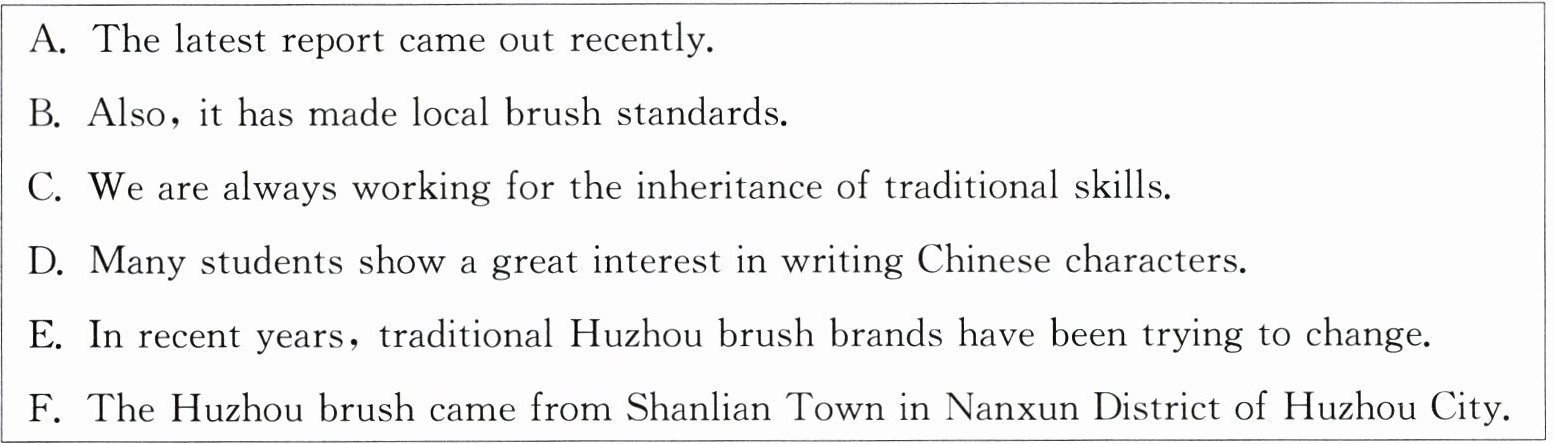
A. The latest report came out recently.
B. Also, it has made local brush standards.
C. We are always working for the inheritance of traditional skills.
D. Many students show a great interest in writing Chinese characters.
E. In recent years, traditional Huzhou brush brands have been trying to change.
F. The Huzhou brush came from Shanlian Town in Nanxun District of Huzhou City.
1.
新素材 传统文化 The 12th Huzhou Writing Brush Culture Festival announced its opening in Huzhou, Zhejiang on Friday. The writing brush produced in Huzhou, Huimo, rice paper, and the Duan inkstone are collectively known as the “Four Treasures of the Study”. 1 The production process includes over 120 steps, winning praise such as “the brush tip craftsmanship is beyond compare”.
At the national-level intangible cultural heritage productive protection base, Shanlian Huzhou Writing Brush Factory, brush maker Wang Xiaohua has deeply felt the changes over the years. She says, “2 We have trained a group of young people through mentorship(师徒制),opened different research courses, and introduced brush-making techniques into local primary and secondary school classrooms.”
3 According to the report, Huzhou writing brushes hold about 30% of the national market share, with a market share of about 60% in the high-end writing brush market.
In recent years, Huzhou has been actively improving integrated(综合的) development in areas such as “Brush+Digital”, “Brush+Cultural Tourism” and “Brush+Cultural Innovation”. The city has set up high-standard brush-themed towns, brush workshops, and other public service platforms. 4 Walking through the streets of Huzhou, one will often come across unusual brush shops. Built in 1741, Wang Yi Pin Zhai brush shop lies on Aishan Street, Wuxing District. It offers over 500 styles of Huzhou writing brushes. 5 They try to enter the view of young people through brand collaborations(合作) and cross-border partnerships, and even sell their writing brushes to many countries such as Japan, Singapore and Malaysia.
A. The latest report came out recently.
B. Also, it has made local brush standards.
C. We are always working for the inheritance of traditional skills.
D. Many students show a great interest in writing Chinese characters.
E. In recent years, traditional Huzhou brush brands have been trying to change.
F. The Huzhou brush came from Shanlian Town in Nanxun District of Huzhou City.
1.
F
2. C
3. A
4. B
5. E
答案
1.F 2.C 3.A 4.B 5.E
解析
【分析】
本题为信息还原题,需结合上下文语境分析句子间的逻辑关系,匹配对应选项。解题思路:先通读全文,明确文章围绕湖州毛笔的文化、传承、发展展开;再逐个分析每个空前后的内容,找到与选项匹配的逻辑:1空前文介绍湖笔是“文房四宝”之一,后文讲制作工艺,需补充湖笔的来源;2空后文提到培养年轻人、引入中小学课堂,对应传统技艺的传承;3空后文有“According to the report”,说明前文提及相关报告;4空前文介绍湖笔的综合发展,需补充发展成果;5空后文讲品牌的改变,对应引出品牌的变化。
【解析】
1. 前文说明湖笔是“文房四宝”之一,后文介绍湖笔的制作工艺,需补充湖笔的起源,F选项“The Huzhou brush came from Shanlian Town in Nanxun District of Huzhou City.”符合语境,故1选F。
2. 后文提到通过师徒制培训年轻人、开设课程、引入中小学课堂,体现对传统技艺的传承,C选项“We are always working for the inheritance of traditional skills.”符合语境,故2选C。
3. 后文出现“According to the report”,说明前文应提及相关报告,A选项“The latest report came out recently.”符合语境,故3选A。
4. 前文介绍湖笔在多领域的综合发展及相关平台建设,B选项“Also, it has made local brush standards.”用“Also”承接前文,补充发展成果,符合语境,故4选B。
5. 后文提到品牌通过合作、跨境等方式改变,E选项“In recent years, traditional Huzhou brush brands have been trying to change.”引出品牌的改变,符合语境,故5选E。
【答案】
1.F 2.C 3.A 4.B 5.E
【知识点】
信息还原;语境理解;逻辑衔接
【点评】
本题围绕湖州毛笔的传统文化展开,考查学生对上下文语境和逻辑关系的理解,需结合前后文内容匹配合适句子,难度适中。
【难度系数】
0.5
本题为信息还原题,需结合上下文语境分析句子间的逻辑关系,匹配对应选项。解题思路:先通读全文,明确文章围绕湖州毛笔的文化、传承、发展展开;再逐个分析每个空前后的内容,找到与选项匹配的逻辑:1空前文介绍湖笔是“文房四宝”之一,后文讲制作工艺,需补充湖笔的来源;2空后文提到培养年轻人、引入中小学课堂,对应传统技艺的传承;3空后文有“According to the report”,说明前文提及相关报告;4空前文介绍湖笔的综合发展,需补充发展成果;5空后文讲品牌的改变,对应引出品牌的变化。
【解析】
1. 前文说明湖笔是“文房四宝”之一,后文介绍湖笔的制作工艺,需补充湖笔的起源,F选项“The Huzhou brush came from Shanlian Town in Nanxun District of Huzhou City.”符合语境,故1选F。
2. 后文提到通过师徒制培训年轻人、开设课程、引入中小学课堂,体现对传统技艺的传承,C选项“We are always working for the inheritance of traditional skills.”符合语境,故2选C。
3. 后文出现“According to the report”,说明前文应提及相关报告,A选项“The latest report came out recently.”符合语境,故3选A。
4. 前文介绍湖笔在多领域的综合发展及相关平台建设,B选项“Also, it has made local brush standards.”用“Also”承接前文,补充发展成果,符合语境,故4选B。
5. 后文提到品牌通过合作、跨境等方式改变,E选项“In recent years, traditional Huzhou brush brands have been trying to change.”引出品牌的改变,符合语境,故5选E。
【答案】
1.F 2.C 3.A 4.B 5.E
【知识点】
信息还原;语境理解;逻辑衔接
【点评】
本题围绕湖州毛笔的传统文化展开,考查学生对上下文语境和逻辑关系的理解,需结合前后文内容匹配合适句子,难度适中。
【难度系数】
0.5
