

 登录
六、选词填空。
1. My mum is going to Shenzhen
2. Bob is going to
3. Don't
4. This skirt is too big for me. I'm going to buy
5. We went to the Palace Museum(故宫)
1. My mum is going to Shenzhen
in
(in/before) three months.2. Bob is going to
ask
(ask/smell) some questions in class.3. Don't
forget
(remember/forget) to bring some books for me.4. This skirt is too big for me. I'm going to buy
another
(another/small) one.5. We went to the Palace Museum(故宫)
last
(next/last) week.答案
1.in 2.ask 3.forget 4.another 5.last
解析
【分析】
本题为英语选词填空题,需结合时态、固定搭配、词义及语境分析:1. 由"is going to"判断是一般将来时,"in+一段时间"用于一般将来时表"……之后","before"不符合;2. 分析动词搭配,"ask questions"是固定短语,"smell"语义不符;3. 祈使句否定结构,结合句意"不要忘记带书"选对应动词;4. 结合裙子太大的语境,选表示"另一个"的词;5. 由过去式动词"went"判断是一般过去时,选对应时间状语。
【解析】
1. 句子为一般将来时,"in+一段时间"是一般将来时的常用时间表达,"before"不符合用法,故填in;
2. "ask questions"是固定短语,意为"问问题","smell"意为"闻",不符合语境,故填ask;
3. 祈使句否定形式为"Don't+动词原形",结合句意"不要忘记给我带书","forget"符合语义,故填forget;
4. 句意是裙子太大,需要另一条,"another"表示"另一个",符合语境,故填another;
5. 句中"went"是go的过去式,说明是一般过去时,时间状语用"last week"(上周),"next"用于将来时,故填last。
【答案】
1.in 2.ask 3.forget 4.another 5.last
【知识点】
一般将来时用法、动词词义辨析、时态判断
【点评】
本题为英语基础选词填空题,考查时态、固定搭配及词义辨析,均为英语核心基础知识点,题目难度低,适合巩固基础。
【难度系数】
0.8
七、选出与句意相符的图片。
(
(
(
(
(
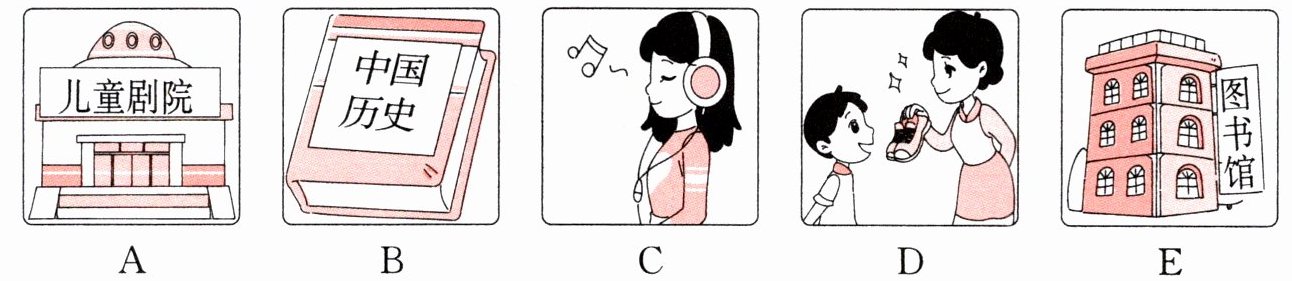 A B C D E
(
B
)1. Dad read a book about Chinese history.(
C
)2. I can listen to music in the evening.(
D
)3. Mum bought new shoes for my little brother.(
E
)4. After the show we went to a library.(
A
)5. Last week they went to a children's theatre. A B C D E答案
1.B 2.C 3.D 4.E 5.A
解析
【分析】这是一道英文句子与图片匹配题,解题思路是:先准确理解每个英文句子的含义,明确句子描述的核心内容(物品、场景等),再逐一对照图片A到E的内容,找到与句子核心内容匹配的图片,从而确定答案。
【解析】1. 句子“Dad read a book about Chinese history.”的核心是“关于中国历史的书”,对应图片B(标注“中国历史”的书籍),故选B;2. 句子“I can listen to music in the evening.”的核心是“听音乐”,对应图片C(戴耳机听音乐的女孩),故选C;3. 句子“Mum bought new shoes for my little brother.”的核心是“妈妈给弟弟买新鞋”,对应图片D(妈妈给男孩鞋子的场景),故选D;4. 句子“After the show we went to a library.”的核心是“去图书馆”,对应图片E(标注“图书馆”的建筑),故选E;5. 句子“Last week they went to a children's theatre.”的核心是“去儿童剧院”,对应图片A(标注“儿童剧院”的建筑),故选A。
【答案】1.B 2.C 3.D 4.E 5.A
【知识点】英文句子理解、图片匹配
【点评】本题考查基础英文句子含义的理解与图片的对应能力,题型简单,需要学生具备基本的英文词汇和句子理解能力,适合低年级学生练习。
【难度系数】0.8
八、连词成句。
1. men, women's, wore, clothes, The (.)
2. actors, lots, told, The, of, jokes (.)
3. in, you, We, see, three, going, weeks, are, to (.)
4. is, to, going, put, He, bed, in, room, my, another (.)
1. men, women's, wore, clothes, The (.)
The men wore women's clothes.
2. actors, lots, told, The, of, jokes (.)
The actors told lots of jokes.
3. in, you, We, see, three, going, weeks, are, to (.)
We are going to see you in three weeks.
4. is, to, going, put, He, bed, in, room, my, another (.)
He is going to put another bed in my room./He is going to put my bed in another room.
答案
1. The men wore women's clothes.
2. The actors told lots of jokes.
3. We are going to see you in three weeks.
4. He is going to put another bed in my room./He is going to put my bed in another room.
2. The actors told lots of jokes.
3. We are going to see you in three weeks.
4. He is going to put another bed in my room./He is going to put my bed in another room.
解析
【分析】做英语连词成句题时,首先根据标点判断为陈述句,先定位主语(多为定冠词The开头的名词或人称代词),再确定谓语动词,接着梳理宾语、定语、状语等成分,最后按“主语+谓语+宾语+其他”的逻辑顺序组合,同时注意时态结构和固定搭配的使用。
【解析】1. 确定主语为The men,谓语是wore,宾语是women's clothes,组合后为The men wore women's clothes.
2. 主语是The actors,谓语是told,固定搭配lots of jokes作宾语,组合为The actors told lots of jokes.
3. 主语是We,一般将来时结构are going to see作谓语,you作宾语,时间状语in three weeks放句末,组合为We are going to see you in three weeks.
4. 主语是He,一般将来时结构is going to put作谓语,可搭配another bed和in my room,或my bed和in another room,组合为He is going to put another bed in my room./He is going to put my bed in another room.
【答案】1. The men wore women's clothes.
2. The actors told lots of jokes.
3. We are going to see you in three weeks.
4. He is going to put another bed in my room./He is going to put my bed in another room.
【知识点】英语连词成句、一般将来时
【点评】本题为基础英语连词成句题,主要考察学生对陈述句结构、一般将来时用法及固定搭配的掌握,属于英语基础题型,难度较低。
【难度系数】0.8
九、选择合适的选项补全对话。
A: I've got a letter from my cousin. It's about his trip.
B: Where did he go?
A: 1.
B: Who did he go with?
A: 2.
B: What did he see?
A: 3.
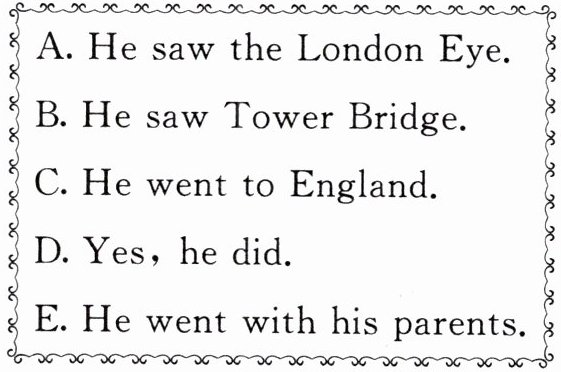
B: What did he see from the London Eye?
A: 4.
B: Did he have a good time there?
A: 5.
A: I've got a letter from my cousin. It's about his trip.
B: Where did he go?
A: 1.
C
B: Who did he go with?
A: 2.
E
B: What did he see?
A: 3.
A
He enjoyed the view(风景) from the London Eye.B: What did he see from the London Eye?
A: 4.
B
B: Did he have a good time there?
A: 5.
D
He had a good time.答案
1.C 2.E 3.A 4.B 5.D
解析
【分析】本题是旅行话题的对话补全题,需根据每个问题的疑问类型及上下文语境匹配答语:第1题疑问词Where询问地点,对应去的地方;第2题疑问词Who询问同行人物;第3题疑问词What询问看到的事物,结合后文提到的伦敦眼;第4题询问从伦敦眼看到的内容;第5题是Did开头的一般疑问句,需用对应结构回答。
【解析】1. 问句“Where did he go?”询问地点,选项C“He went to England.”符合地点类回答,故选C;2. 问句“Who did he go with?”询问同行人物,选项E“He went with his parents.”符合人物类回答,故选E;3. 问句“What did he see?”询问看到的事物,后文提到“London Eye”,选项A“He saw the London Eye.”匹配上下文,故选A;4. 问句“What did he see from the London Eye?”询问从伦敦眼看到的内容,选项B“He saw Tower Bridge.”符合,故选B;5. 问句“Did he have a good time there?”是一般疑问句,回答需用“Yes, he did.”结构,选项D符合,故选D。
【答案】1.C 2.E 3.A 4.B 5.D
【知识点】补全对话、特殊疑问句答语、一般疑问句答语
【点评】本题围绕旅行话题考查日常交际用语,需结合疑问词和上下文语境选择合适答语,属于基础对话补全题,难度适中。
【难度系数】0.4
