

 登录
登录
10.如图,BD是等边$△ ABC$的边AC上的高,以点D为圆心,DB长为半径作弧交BC的延长线于点E,则$∠ DEC=$(
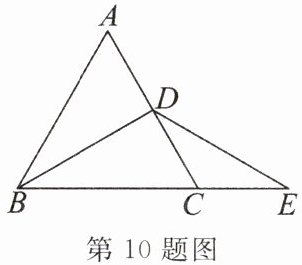
A.$20°$
B.$25°$
C.$30°$
D.$35°$
C
)A.$20°$
B.$25°$
C.$30°$
D.$35°$
答案
10.C
11.【整体思想】如图,一个等边三角形纸片,剪去一个角后得到一个四边形,则图中$∠α+∠β$的度数是(

A.$180°$
B.$220°$
C.$240°$
D.$300°$
C
)A.$180°$
B.$220°$
C.$240°$
D.$300°$
答案
11.C
12. 如图 ,在△ABC中,AB=4cm,BC=6cm,∠B=60°,将△ABC沿射线BC的方向平移2cm后得到△A'B'C',连接A'C,则△A'B'C的周长是
,在△ABC中,AB=4cm,BC=6cm,∠B=60°,将△ABC沿射线BC的方向平移2cm后得到△A'B'C',连接A'C,则△A'B'C的周长是12cm
。答案
12.12cm
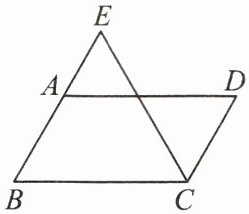
13. 如图,在四边形ABCD中,AD//BC,∠B=∠D,点E在BA的延长线上,连接CE.
(1)求证:∠E=∠ECD;
(2)若∠E=60°,CE平分∠BCD,判断△BCE的形状,并说明理由.
(1)求证:∠E=∠ECD;
(2)若∠E=60°,CE平分∠BCD,判断△BCE的形状,并说明理由.
答案
13. (1)证明:$\because AD// BC,\therefore ∠EAD=∠B,\because ∠B=∠D,\therefore ∠EAD=∠D,\therefore BE// CD,\therefore ∠E=∠ECD.$
(2)解:$△ BCE$是等边三角形,理由如下:$\because CE$平分$∠BCD,\therefore ∠BCE=∠ECD,\because EB// CD,\therefore ∠ECD=∠E=60°, \therefore ∠BCE=60°, \therefore ∠B=180°-∠E-∠BCE=60°, \therefore ∠B=∠BCE=∠E, \therefore △ BCE$是等边三角形.
(2)解:$△ BCE$是等边三角形,理由如下:$\because CE$平分$∠BCD,\therefore ∠BCE=∠ECD,\because EB// CD,\therefore ∠ECD=∠E=60°, \therefore ∠BCE=60°, \therefore ∠B=180°-∠E-∠BCE=60°, \therefore ∠B=∠BCE=∠E, \therefore △ BCE$是等边三角形.
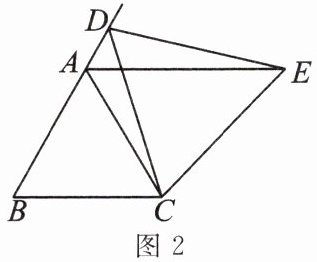
14.【核心素养·推理能力】如图1,在等边三角形ABC中,D是边AB上的动点,以CD为一边,向上作等边三角形EDC,连接AE。
(1)△DBC和△EAC全等吗?请说明理由;
(2)求证:AE//BC;
(3)如图2,动点D运动到边BA的延长线上,△EDC仍为等边三角形,请问是否仍有AE//BC?证明你的猜想。

(1)△DBC和△EAC全等吗?请说明理由;
(2)求证:AE//BC;
(3)如图2,动点D运动到边BA的延长线上,△EDC仍为等边三角形,请问是否仍有AE//BC?证明你的猜想。
答案
14. (1)解:$△ DBC≌ △ EAC$. 理由:$\because △ ABC,△ EDC$是等边三角形,$\therefore ∠ACB=∠DCE=60°,BC=AC,DC=EC. \therefore ∠ACB-∠ACD=∠DCE-∠ACD$, 即$∠BCD=∠ACE. \therefore △ DBC ≌ △ EAC$(SAS).
(2) 证明: $\because △ DBC≌ △ EAC, \therefore ∠EAC=∠B=60°.$ 又$\because ∠ACB = 60°, \therefore ∠EAC = ∠ACB. \therefore AE// BC.$
(3)解:仍有$AE// BC$. 证明: $\because △ ABC,△ EDC$为等边三角形,$\therefore BC=AC,DC=CE,∠BCA=∠DCE=60°. \therefore ∠BCA + ∠ACD = ∠DCE + ∠ACD$, 即$∠BCD = ∠ACE. \therefore △ DBC≌ △ EAC(SAS). \therefore ∠EAC=∠B=60°.$ 又$\because ∠ACB=60°, \therefore ∠EAC=∠ACB. \therefore AE// BC.$
(2) 证明: $\because △ DBC≌ △ EAC, \therefore ∠EAC=∠B=60°.$ 又$\because ∠ACB = 60°, \therefore ∠EAC = ∠ACB. \therefore AE// BC.$
(3)解:仍有$AE// BC$. 证明: $\because △ ABC,△ EDC$为等边三角形,$\therefore BC=AC,DC=CE,∠BCA=∠DCE=60°. \therefore ∠BCA + ∠ACD = ∠DCE + ∠ACD$, 即$∠BCD = ∠ACE. \therefore △ DBC≌ △ EAC(SAS). \therefore ∠EAC=∠B=60°.$ 又$\because ∠ACB=60°, \therefore ∠EAC=∠ACB. \therefore AE// BC.$
