登录
登录
1. ★★★ (2025·南京月考)已知$a,b,c$是$△ ABC$的三边长,则下列说法中不成立的一项是 (
A.若$a^2 - b^2 = c^2$,则$△ ABC$一定是直角三角形
B.若$a^2 - b^2 > c^2$,则$△ ABC$一定是钝角三角形
C.若$a^2 + b^2 = c^2$,则$△ ABC$一定是直角三角形
D.若$a^2 - b^2 ≠ c^2$,则$△ ABC$不可能是直角三角形
D
)A.若$a^2 - b^2 = c^2$,则$△ ABC$一定是直角三角形
B.若$a^2 - b^2 > c^2$,则$△ ABC$一定是钝角三角形
C.若$a^2 + b^2 = c^2$,则$△ ABC$一定是直角三角形
D.若$a^2 - b^2 ≠ c^2$,则$△ ABC$不可能是直角三角形
答案
1. D
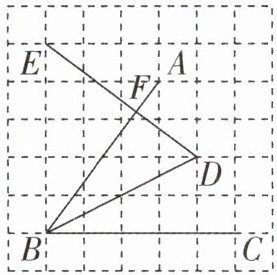
2. 如图是由边长为1的小正方形组成的网格图,线段AB,BC,BD,DE的端点均在格点上,线段AB和DE交于点F,则DF的长度为________.
答案
2. 2
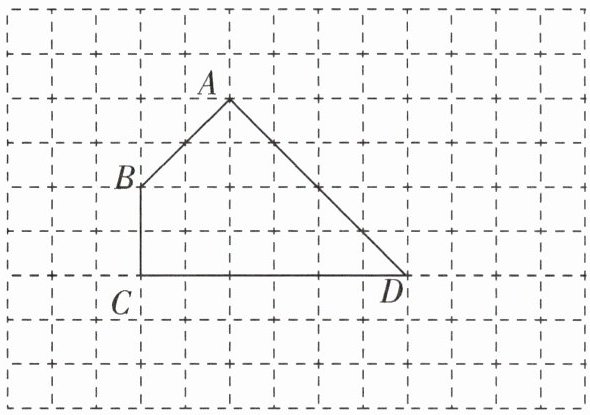
3. (2025·无锡期中)在如图的网格图中,每个网格都是边长为1的小正方形.四边形ABCD的四个顶点都在格点上,点E,F分别是AD,CD上的动点,当△BEF的周长最小时,请在图中画出△BEF,计算出它的周长,判断它的形状并说明理由.
>> 对点专练 P105,P106
>> 对点专练 P105,P106
答案
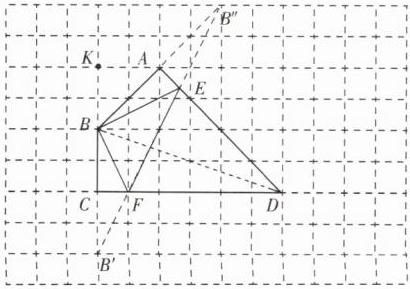
如图,连接$BD$,$\because AB^2=8$,$AD^2=32$,$BD^2=40$,$BC^2=4$,$CD^2=36$,$\therefore AB^2+AD^2=BD^2$,$BC^2+CD^2=BD^2$,$\therefore ∠ BAD=∠ BCD=90°$.
作点$B$关于$CD$的对称点$B'$,作点$B$关于$AD$的对称点$B''$,连接$B'B''$,交$AD$于点$E$,交$CD$于点$F$,连接$BE$,$BF$,此时$△ BEF$的周长最小.$△ BEF$的周长$=BE+EF+BF=B'F+EF+EB''=B'B''=\sqrt{4^2+8^2}=\sqrt{80}$.$△ BEF$是直角三角形.理由:取格点$K$,连接$KA$,$KB$.$\because ∠ BAD=∠ BCD=90°$,$∠ ADF=∠ KBA=45°$.
$\because B,B'$关于$CD$对称,$B,B''$关于$AD$对称,$\therefore ∠ CBF=∠ B'$,$∠ ABE=∠ B''$,$\because ∠ KBA=∠ B'+∠ B''=45°$,$\therefore ∠ CBF+∠ ABE=45°$.$\because ∠ CBA=180°-∠ KBA=135°$,$\therefore ∠ EBF=∠ ABC-(∠ CBF+∠ ABE)=90°$,$\therefore △ BEF$是直角三角形.
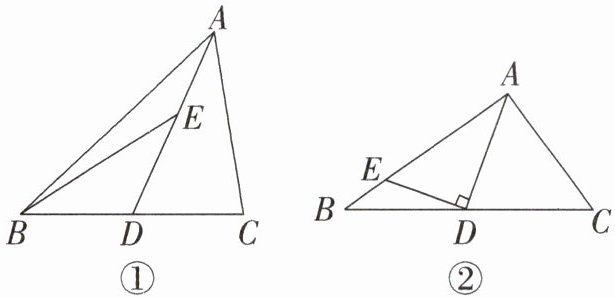
4. (1)如图①,已知 AD 是$△ ABC$的中线,E 是 AD 上的一点,$AC=BE,BD=DE,∠BCA=81°$,求$∠DAC$的度数.
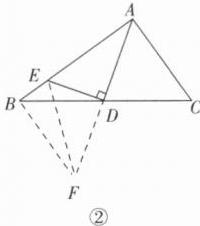
(2)如图②,已知$△ ABC,AC=3k,AB=4k,BC=5k(k>0)$,点 D 是 BC 边的中点,$AD⊥DE$,求$\frac{AE+DE}{AD}$的值.
>> 对点专练 P103
>> 根据诊断结果,请完成对应的练习
(2)如图②,已知$△ ABC,AC=3k,AB=4k,BC=5k(k>0)$,点 D 是 BC 边的中点,$AD⊥DE$,求$\frac{AE+DE}{AD}$的值.
>> 对点专练 P103
>> 根据诊断结果,请完成对应的练习
答案
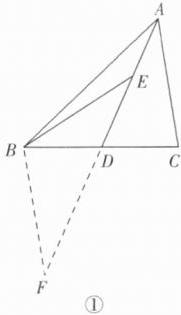
(1)延长$AD$至点$F$,使$AD=DF$,连接$BF$,如图①,设$∠ DAC=α$,$\because AD$是$BC$边上的中线,$\therefore BD=CD$,在$△ ACD$和$△ FBD$中,$\begin{cases} AD=FD, \\ ∠ ADC=∠ FDB, \\ CD=BD, \end{cases}$$\therefore △ ACD ≌ △ FBD \ (\mathrm{SAS})$,
$\therefore ∠ DAC=∠ F=α$,$AC=BF$.$\because AC=BE$,$\therefore BE=BF$,$\therefore ∠ BED=∠ F=α$.$\because BD=DE$,$\therefore ∠ DBE=∠ BED=α$,$\therefore ∠ ADC=∠ DBE+∠ BED=2α$.$\because ∠ BCA=81°$,$\therefore 2α+α+81°=180°$,$\therefore α=33°$,$\therefore ∠ DAC=33°$.
(2)延长$AD$至点$F$,使$AD=DF$,连接$BF$,$EF$,如图②,$\because AC=3k$,$AB=4k$,$BC=5k$,$\therefore AC^2+AB^2=BC^2=25k^2$,$\therefore ∠ BAC=90°$,设$BE=x$,则$AE=4k-x$.$\because AD$是$BC$边上的中线,$\therefore BD=CD$,在$△ ACD$和$△ FBD$中,$\begin{cases} AD=FD, \\ ∠ ADC=∠ FDB, \\ CD=BD, \end{cases}$$\therefore △ ACD ≌ △ FBD$
$(\mathrm{SAS})$,$\therefore ∠ DAC=∠ DFB$,$AC=BF=3k$,$\therefore AC// BF$,$\therefore ∠ FBE=180°-∠ BAC=90°$.$\because AD⊥ DE$,$AD=DF$,$\therefore ED$垂直平分$AF$,$\therefore AE=EF=4k-x$,在$\mathrm{Rt}△ BEF$中,$BF^2+BE^2=EF^2$,$\therefore (3k)^2+x^2=(4k-x)^2$,解得$x=\frac{7}{8}k$,$\therefore AE=\frac{25}{8}k$.$\because D$是$BC$的中点,
$\therefore AD=\frac{1}{2}BC=\frac{5}{2}k$,$\therefore DE=\sqrt{AE^2-AD^2}=\frac{15}{8}k$,$\therefore \frac{AE+DE}{AD}=\frac{\frac{25}{8}k+\frac{15}{8}k}{\frac{5}{2}k}=2$.