登录
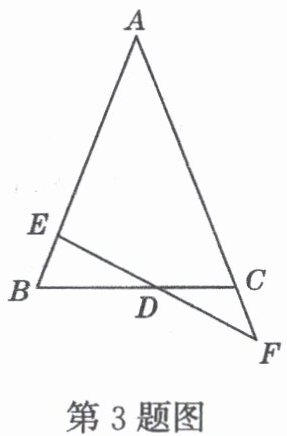
3. 如图,在△ABC中,AB=AC,点D在BC上,过点D的一条直线交AB于点E,交AC的延长线于点F,且BE=CF.
求证:DE=DF.
求证:DE=DF.
答案
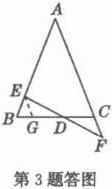
【证明】如图,过点 E 作$EG// AC$,交 BC 于点 G,
则$∠ACB=∠BGE,∠F=∠DEG.$
$\because AB=AC,\therefore ∠B=∠ACB,$
$\therefore ∠B=∠BGE,\therefore BE=GE.$
又$\because BE=CF,\therefore GE=CF.$
在$△GDE$和$△CDF$中,$\begin{cases} ∠GDE=∠CDF,\\ ∠DEG=∠F,\\ GE=CF, \end{cases}$
$\therefore △GDE≌△CDF(AAS),\therefore DE=DF.$
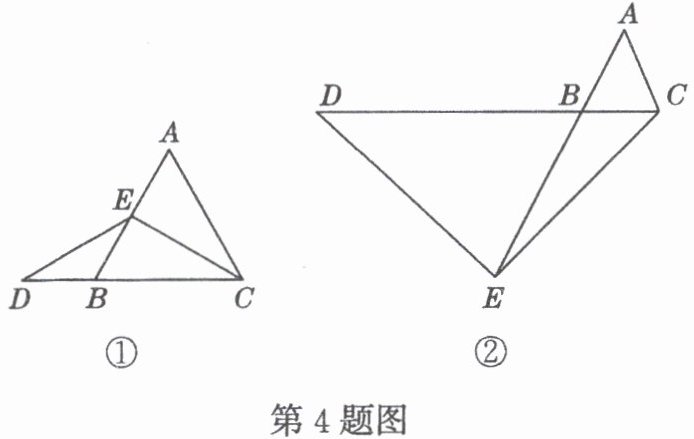
4.(期中·天津二十中)已知,在等边三角形ABC中,点D,E分别在射线CB及射线AB上,且AE=BD.
(1)如图①,当点E为线段AB的中点时,求证:DE=CE.
(2)如图②,当ED⊥CE时,求∠EDC的度数.
(1)如图①,当点E为线段AB的中点时,求证:DE=CE.
(2)如图②,当ED⊥CE时,求∠EDC的度数.
答案
(1)【证明】$\because △ABC$是等边三角形,$\therefore ∠ABC=∠ACB=60^{\circ }.$
$\because$ 点 E 为线段 AB 的中点,$\therefore AE=BE,∠BCE=\frac {1}{2}∠ACB=30^{\circ }.$
$\because AE=BD,\therefore BE=BD,\therefore ∠D=∠BED.$
$\because ∠ABC$是$△BDE$的一个外角,
$\therefore ∠ABC=∠D+∠BED=2∠D,$
$\therefore 2∠D=60^{\circ },\therefore ∠D=30^{\circ },\therefore ∠D=∠BCE=30^{\circ },$
$\therefore DE=CE.$
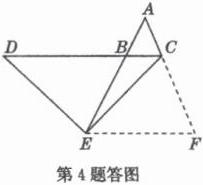
(2)【解】过点 E 作$EF// BC$交 AC 的延长线于点 F,如图,
$\therefore ∠AEF=∠ABC,$
$∠F=∠ACB.$
$\because △ABC$是等边三角形,
$\therefore ∠ABC=∠ACB=∠A=60^{\circ },$
$AB=AC,$
$\therefore ∠AEF=∠F=60^{\circ },$
$∠DBE=∠ABC=60^{\circ },$
$\therefore △AEF$是等边三角形,$∠DBE=∠F=60^{\circ },$
$\therefore AE=AF=EF,\therefore AE-AB=AF-AC,\therefore BE=FC.$
$\because AE=BD,\therefore BD=EF.$
在$△BDE$和$△FEC$中,
$BE=FC,∠DBE=∠F,BD=EF,$
$\therefore △BDE≌△FEC(SAS),\therefore ED=EC.$
$\because ED⊥CE,\therefore △EDC$是等腰直角三角形,$\therefore ∠EDC=45^{\circ }.$