

 登录
Ⅵ. Read the passage and choose the best answers.
A new study by archaeologists tells us surprising news about red stone beads(红玉髓珠)from Sanxingdui Ruins in Sichuan. The beads are 3,000 years old. For a long time, researchers believed these beautiful red beads came from foreign countries. But new tests give us a clear new answer. The stones used to make these beads come from North China, near the Yanshan Mountains and the wide Mongolian Plateau. This important discovery tells us that people of ancient Shu built long, regular trade with northern places over 1,000 kilometers away. Sichuan’s local cultural relics research center shared this new research with the public on Wednesday.
Archaeologists first found special pits(考古坑)full of these beads in the 1920s. Since 2022, workers in the field have unearthed more than 4,000 old relics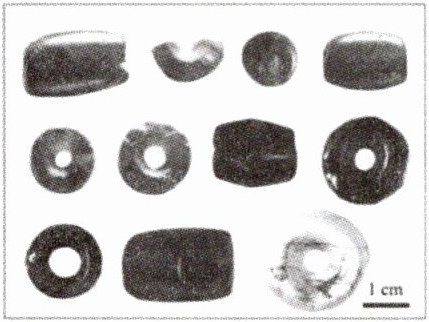
at over 400 different places. These smooth beads have tiny holes in them. They were buried together with ivory, gold and bronze old things. This means only rich and powerful people in ancient times could own them. Red stone was very hard to find in old China, and people saw it as a sign of wealth. Before this study, most scholars thought the stone for these beads came from West or South Asia. After scientists carefully checked bead samples collected from Gansu, Shaanxi and Beijing, they finally found all these beads were made of the same kind of stone from northern China.
Liu Jiancheng, one of the main researchers, said that from 1500 BC to 1000 BC, people at Sanxingdui kept close and wide connections with northern China and the Mongolian Plateau. This fully shows different parts of China often shared culture during the Bronze Age. The research team also made a complete information list to help experts study other rare old relics, such as bronze, gold, cinnabar and jade(玉). With this useful list, we can know more clearly how ancient Shu people traded and communicated with other ancient groups all over China.
(
A. Southern Sichuan.
B. Northern China.
C. Mongolian Plateau.
D. Foreign countries.
(
A. Beads were buried with daily bowls and plates.
B. Scientists checked beads from four southern places.
C. The special pits with beads were found in the 1920s.
D. The information list only records information of red stone beads.
(
A. Dug out from soil.
B. Sold in old shops.
C. Stored at home.
D. Broken into small pieces.
(
A. To introduce Sanxingdui’s famous gold masks.
B. To teach students ways to tell different old stones.
C. To ask people to protect old relics in North China.
D. To show a new finding of red stone beads and its value.
A new study by archaeologists tells us surprising news about red stone beads(红玉髓珠)from Sanxingdui Ruins in Sichuan. The beads are 3,000 years old. For a long time, researchers believed these beautiful red beads came from foreign countries. But new tests give us a clear new answer. The stones used to make these beads come from North China, near the Yanshan Mountains and the wide Mongolian Plateau. This important discovery tells us that people of ancient Shu built long, regular trade with northern places over 1,000 kilometers away. Sichuan’s local cultural relics research center shared this new research with the public on Wednesday.
Archaeologists first found special pits(考古坑)full of these beads in the 1920s. Since 2022, workers in the field have unearthed more than 4,000 old relics
at over 400 different places. These smooth beads have tiny holes in them. They were buried together with ivory, gold and bronze old things. This means only rich and powerful people in ancient times could own them. Red stone was very hard to find in old China, and people saw it as a sign of wealth. Before this study, most scholars thought the stone for these beads came from West or South Asia. After scientists carefully checked bead samples collected from Gansu, Shaanxi and Beijing, they finally found all these beads were made of the same kind of stone from northern China.
Liu Jiancheng, one of the main researchers, said that from 1500 BC to 1000 BC, people at Sanxingdui kept close and wide connections with northern China and the Mongolian Plateau. This fully shows different parts of China often shared culture during the Bronze Age. The research team also made a complete information list to help experts study other rare old relics, such as bronze, gold, cinnabar and jade(玉). With this useful list, we can know more clearly how ancient Shu people traded and communicated with other ancient groups all over China.
(
B
)1. Where are the red stone beads from according to the new study?A. Southern Sichuan.
B. Northern China.
C. Mongolian Plateau.
D. Foreign countries.
(
C
)2. Which of the following is TRUE?A. Beads were buried with daily bowls and plates.
B. Scientists checked beads from four southern places.
C. The special pits with beads were found in the 1920s.
D. The information list only records information of red stone beads.
(
A
)3. What does the underlined word “unearthed” in Paragraph 2 mean?A. Dug out from soil.
B. Sold in old shops.
C. Stored at home.
D. Broken into small pieces.
(
D
)4. What is the writer’s main purpose of writing the passage?A. To introduce Sanxingdui’s famous gold masks.
B. To teach students ways to tell different old stones.
C. To ask people to protect old relics in North China.
D. To show a new finding of red stone beads and its value.
答案
1. B 2. C 3. A 4. D
解析
【分析】
本题为英语阅读理解题,需根据题干问题定位原文对应信息解答。第1题询问红玉髓珠的来源,需回到原文第一段找相关内容;第2题判断正误,需逐一核对选项与原文细节;第3题猜测生词含义,结合上下文考古场景分析;第4题考查主旨,需梳理文章核心内容。
【解析】
1. 细节理解题:根据第一段“The stones used to make these beads come from North China”可知,红玉髓珠来自中国北方,故选B。
2. 细节理解题:A项原文提到珠子与象牙、金、青铜等陪葬,非日常碗盘,错误;B项科学家检查的是甘肃、陕西、北京(北方地区),非南部,错误;C项第二段第一句明确“Archaeologists first found special pits full of these beads in the 1920s”,正确;D项信息列表用于研究其他稀有文物,非仅红玉髓珠,错误,故选C。
3. 词义猜测题:结合“workers in the field(考古工作者)”和“old relics(古文物)”,可知“unearthed”意为“从土壤中挖出”,对应A。
4. 主旨大意题:文章主要介绍三星堆红玉髓珠的新发现及该发现的价值(反映古代贸易与文化交流),故选D。
【答案】
1. B 2. C 3. A 4. D
【知识点】
英语阅读理解、细节理解题、词义猜测题、主旨大意题
【点评】
本题围绕三星堆考古新发现展开,涵盖多种阅读题型,需学生具备快速定位原文、分析细节及理解主旨的能力,是典型的初中英语阅读理解题。
【难度系数】
0.6
