

 登录
登录
五、根据短文内容,完成表格,每空限填一词。
“What a pretty jasmine flower! What a pretty Jasmine flower! Nice to see and nice to smell! Praiseworthy scent, and white as well!”
Have you ever heard of this famous song, Mo Li Hua (Jasmine Flower)? Mo Li Hua is a Chinese folk song from Jiangsu Province. The song is so well-known that the jasmine flower became the Province Flower of Jiangsu in 2007. It was one of the first Chinese folk songs to be liked by people outside China. The song describes a custom of giving jasmine flowers, popular in the south of Yangtze River delta region.
As time goes by, Mo Li Hua is popular both in China and abroad. The song made its first appearance in the 18th century. It was created during the Qianlong period (1735-1796) of the Qing Dynasty. In 1896, the song was used as a national anthem by the Qing Chinese officials in Europe. In 1982, the song found a place on a UNESCO list of recommended songs and was put into the musical textbooks in Asia. When Hong Kong and Macau came back to China in 1997 and 1999, this music was played in the ceremonies(典礼). An adaptation(改编) by Tan Dun and Wang Hesheng was played during the medal ceremonies at the Beijing 2008 Olympic Games. In 2018, with Second Farewell to Cambridge by the famous Chinese poet Xu Zhimo, Mo Li Hua was sung in Chinese by the King’s College Choir(合唱团) in Cambridge University. In its 500-year history, no other Chinese songs have ever been recorded. On the evening of February 15, 2022, Wang Yaping played part of the popular music Mo Li Hua on Shenzhou-13 to celebrate the Lantern Festival.
The song expresses sincere and simple feelings of Chinese people. People describe the music as “heart-touching”. It is such a beautiful song that it almost stands for China abroad. This melody is a cultural gift from the Chinese people to the world. With music, friendship is our message around the world, trying to achieve worldwide understanding.
A Chinese folk song—Mo Li Hua
(1)
The song is so well-known that the jasmine flower became the Province Flower of Jiangsu in 2007.
The song describes a custom of giving jasmine flowers, popular in the (2)
(3)
The song first (4)
In 1896, the Qing officials once used the song as a national anthem in Europe.
In 1982, UNESCO (5)
In 1997 and 1999, when Hong K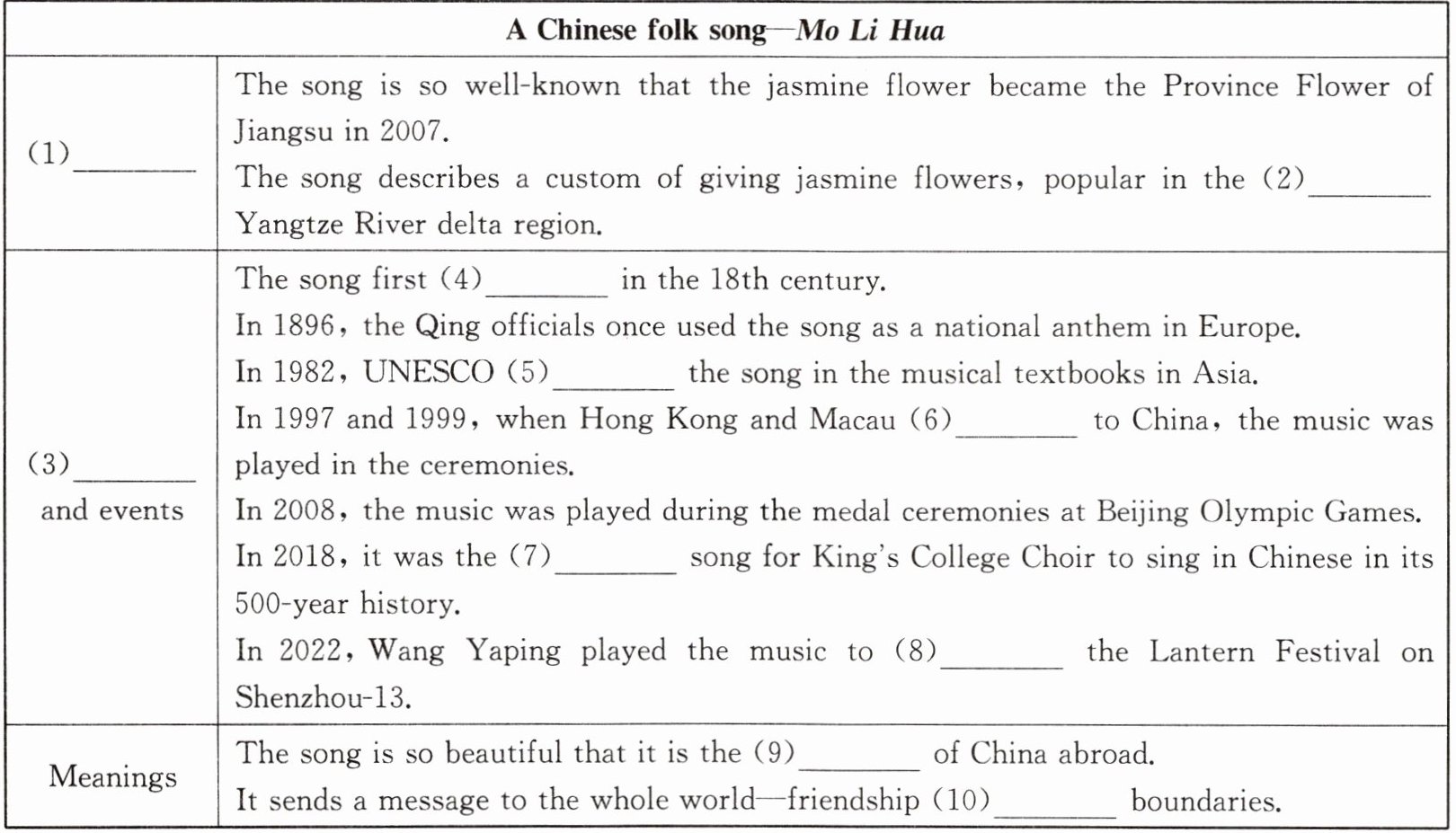 and Macau (6)
In 2008, the music was played during the medal ceremonies at Beijing Olympic Games.
In 2018, it was the (7)
In 2022, Wang Yaping played the music to (8)
Meanings
The song is so beautiful that it is the (9)
It sends a message to the whole world—friendship (10)
“What a pretty jasmine flower! What a pretty Jasmine flower! Nice to see and nice to smell! Praiseworthy scent, and white as well!”
Have you ever heard of this famous song, Mo Li Hua (Jasmine Flower)? Mo Li Hua is a Chinese folk song from Jiangsu Province. The song is so well-known that the jasmine flower became the Province Flower of Jiangsu in 2007. It was one of the first Chinese folk songs to be liked by people outside China. The song describes a custom of giving jasmine flowers, popular in the south of Yangtze River delta region.
As time goes by, Mo Li Hua is popular both in China and abroad. The song made its first appearance in the 18th century. It was created during the Qianlong period (1735-1796) of the Qing Dynasty. In 1896, the song was used as a national anthem by the Qing Chinese officials in Europe. In 1982, the song found a place on a UNESCO list of recommended songs and was put into the musical textbooks in Asia. When Hong Kong and Macau came back to China in 1997 and 1999, this music was played in the ceremonies(典礼). An adaptation(改编) by Tan Dun and Wang Hesheng was played during the medal ceremonies at the Beijing 2008 Olympic Games. In 2018, with Second Farewell to Cambridge by the famous Chinese poet Xu Zhimo, Mo Li Hua was sung in Chinese by the King’s College Choir(合唱团) in Cambridge University. In its 500-year history, no other Chinese songs have ever been recorded. On the evening of February 15, 2022, Wang Yaping played part of the popular music Mo Li Hua on Shenzhou-13 to celebrate the Lantern Festival.
The song expresses sincere and simple feelings of Chinese people. People describe the music as “heart-touching”. It is such a beautiful song that it almost stands for China abroad. This melody is a cultural gift from the Chinese people to the world. With music, friendship is our message around the world, trying to achieve worldwide understanding.
A Chinese folk song—Mo Li Hua
(1)
Introduction
The song is so well-known that the jasmine flower became the Province Flower of Jiangsu in 2007.
The song describes a custom of giving jasmine flowers, popular in the (2)
southern
Yangtze River delta region.(3)
Time
and eventsThe song first (4)
appeared
in the 18th century.In 1896, the Qing officials once used the song as a national anthem in Europe.
In 1982, UNESCO (5)
put
the song in the musical textbooks in Asia.In 1997 and 1999, when Hong K
and Macau (6) returned
to China, the music was played in the ceremonies.In 2008, the music was played during the medal ceremonies at Beijing Olympic Games.
In 2018, it was the (7)
only
song for King’s College Choir to sing in Chinese in its 500-year history.In 2022, Wang Yaping played the music to (8)
celebrate
the Lantern Festival on Shenzhou-13.Meanings
The song is so beautiful that it is the (9)
symbol
of China abroad.It sends a message to the whole world—friendship (10)
without
boundaries.答案
1. Introduction 2. southern 3. Time 4. appeared 5. put 6. returned 7. only 8. celebrate 9. symbol 10. without
解析
【分析】
解题思路:先通读短文和表格,明确每个空所在部分的主题;再根据表格中每个空的上下文提示,定位到原文对应内容,结合每空限填一词的要求,提取或转换合适词汇,确保语义和语法正确。
【解析】
1. 表格第一部分是对《茉莉花》的基本介绍,对应原文开头内容,故填Introduction;
2. 原文提到“popular in the south of Yangtze River delta region”,此处需形容词修饰region,转换为southern;
3. 表格第二部分列举不同时间的事件,主题为时间和事件,故填Time;
4. 原文提到“The song made its first appearance in the 18th century”,此处需动词作谓语,故填appeared;
5. 原文提到“was put into the musical textbooks in Asia”,对应主语UNESCO,故填put;
6. 原文提到“when Hong Kong and Macau came back to China”,此处需动词,故填returned;
7. 原文提到“no other Chinese songs have ever been recorded”,即这是唯一的中文歌,故填only;
8. 原文提到“played the music to celebrate the Lantern Festival”,故填celebrate;
9. 原文提到“it almost stands for China abroad”,此处需名词,故填symbol;
10. 原文对应“friendship without boundaries”,故填without。
【答案】
1. Introduction 2. southern 3. Time 4. appeared 5. put 6. returned 7. only 8. celebrate 9. symbol 10. without
【知识点】
阅读理解、词汇转换、固定搭配
【点评】
本题为信息匹配类题目,考查学生快速定位原文信息并准确提取词汇的能力,需注意词性转换和固定表达的运用,难度适中。
【难度系数】
0.6
解题思路:先通读短文和表格,明确每个空所在部分的主题;再根据表格中每个空的上下文提示,定位到原文对应内容,结合每空限填一词的要求,提取或转换合适词汇,确保语义和语法正确。
【解析】
1. 表格第一部分是对《茉莉花》的基本介绍,对应原文开头内容,故填Introduction;
2. 原文提到“popular in the south of Yangtze River delta region”,此处需形容词修饰region,转换为southern;
3. 表格第二部分列举不同时间的事件,主题为时间和事件,故填Time;
4. 原文提到“The song made its first appearance in the 18th century”,此处需动词作谓语,故填appeared;
5. 原文提到“was put into the musical textbooks in Asia”,对应主语UNESCO,故填put;
6. 原文提到“when Hong Kong and Macau came back to China”,此处需动词,故填returned;
7. 原文提到“no other Chinese songs have ever been recorded”,即这是唯一的中文歌,故填only;
8. 原文提到“played the music to celebrate the Lantern Festival”,故填celebrate;
9. 原文提到“it almost stands for China abroad”,此处需名词,故填symbol;
10. 原文对应“friendship without boundaries”,故填without。
【答案】
1. Introduction 2. southern 3. Time 4. appeared 5. put 6. returned 7. only 8. celebrate 9. symbol 10. without
【知识点】
阅读理解、词汇转换、固定搭配
【点评】
本题为信息匹配类题目,考查学生快速定位原文信息并准确提取词汇的能力,需注意词性转换和固定表达的运用,难度适中。
【难度系数】
0.6
