

 登录
登录
10. 如图14.3-21,在四边形ABDC中,$∠ D=∠ ABD=90°$,O为BD的中点,且AO平分$∠ BAC$。
求证:(1) CO平分$∠ ACD$;(2) $OA⊥ OC$;(3) $AB+CD=AC$。
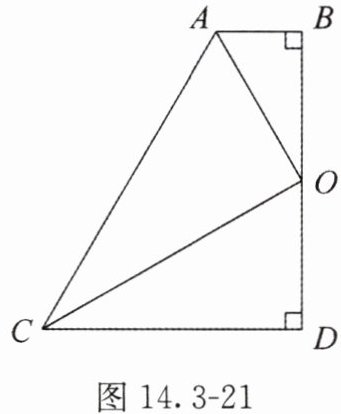
求证:(1) CO平分$∠ ACD$;(2) $OA⊥ OC$;(3) $AB+CD=AC$。
答案
10. 证明:(1) 如图,过点O作$OE⊥ AC$,垂足为E。
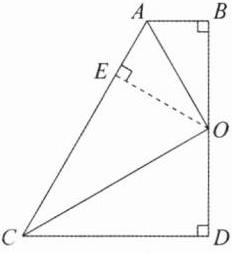
$\because ∠ ABD=90°$,AO平分$∠ BAC$,
$\therefore OB=OE$.
$\because O$为BD的中点,$\therefore OB=OD$.
$\therefore OE=OD$.
$\because ∠ D=90°$,$OE⊥ AC$,
$\therefore CO$平分$∠ ACD$.
(2) 在$\mathrm{Rt}△ ABO$和$\mathrm{Rt}△ AEO$中,
$\begin{cases} AO=AO,\\ OB=OE, \end{cases}$
$\therefore \mathrm{Rt}△ ABO≌\mathrm{Rt}△ AEO\ (\mathrm{HL})$.
$\therefore ∠ AOB=∠ AOE$.
同理可得$∠ COD=∠ COE$.
$\therefore ∠ AOC=∠ AOE+∠ COE=\frac{1}{2}×180°=90°$.
$\therefore OA⊥ OC$.
(3) $\because \mathrm{Rt}△ ABO≌\mathrm{Rt}△ AEO$,$\therefore AB=AE$.
同理可得$CD=CE$.
$\because AC=AE+CE$,$\therefore AB+CD=AC$.
解析
【分析】
本题可结合角平分线的性质、判定以及全等三角形的知识逐步推导:(1)要证CO平分∠ACD,根据角平分线的判定定理,需证明点O到AC、CD两边的距离相等,因此先过O作OE⊥AC于E,利用AO平分∠BAC的性质得OB=OE,再结合O是BD中点得OB=OD,推出OE=OD即可证得结论;(2)要证OA⊥OC,只需证明∠AOC=90°,通过证明两组直角三角形全等,得到对应角相等,可推出∠AOC为平角∠BOD的一半,即可得证;(3)要证线段和的关系,利用全等三角形对应边相等,将AB、CD分别转化为AC上的两段线段AE、CE,相加即可得到结论。
【解析】
(1) 过点O作$OE⊥ AC$,垂足为E。
$\because ∠ ABD=90°$,AO平分$∠ BAC$,
$\therefore OB=OE$(角平分线上的点到角两边的距离相等)。
$\because O$为BD的中点,$\therefore OB=OD$。
$\therefore OE=OD$。
$\because ∠ D=90°$,$OE⊥ AC$,
$\therefore CO$平分$∠ ACD$(到角两边距离相等的点在角的平分线上)。
(2) 在$\mathrm{Rt}△ ABO$和$\mathrm{Rt}△ AEO$中,
$\begin{cases} AO=AO,\\ OB=OE, \end{cases}$
$\therefore \mathrm{Rt}△ ABO≌\mathrm{Rt}△ AEO\ (\mathrm{HL})$。
$\therefore ∠ AOB=∠ AOE$。
同理可得$∠ COD=∠ COE$。
$\therefore ∠ AOC=∠ AOE+∠ COE=\frac{1}{2}×(∠AOE+∠AOB+∠COE+∠COD)=\frac{1}{2}×180°=90°$。
$\therefore OA⊥ OC$。
(3) $\because \mathrm{Rt}△ ABO≌\mathrm{Rt}△ AEO$,$\therefore AB=AE$。
同理可得$CD=CE$。
$\because AC=AE+CE$,$\therefore AB+CD=AC$。
【答案】
证明:(1) 如图,过点O作$OE⊥ AC$,垂足为E。
$\because ∠ ABD=90°$,AO平分$∠ BAC$,
$\therefore OB=OE$.
$\because O$为BD的中点,$\therefore OB=OD$.
$\therefore OE=OD$.
$\because ∠ D=90°$,$OE⊥ AC$,
$\therefore CO$平分$∠ ACD$.
(2) 在$\mathrm{Rt}△ ABO$和$\mathrm{Rt}△ AEO$中,
$\begin{cases} AO=AO,\\ OB=OE, \end{cases}$
$\therefore \mathrm{Rt}△ ABO≌\mathrm{Rt}△ AEO\ (\mathrm{HL})$.
$\therefore ∠ AOB=∠ AOE$.
同理可得$∠ COD=∠ COE$.
$\therefore ∠ AOC=∠ AOE+∠ COE=\frac{1}{2}×180°=90°$.
$\therefore OA⊥ OC$.
(3) $\because \mathrm{Rt}△ ABO≌\mathrm{Rt}△ AEO$,$\therefore AB=AE$.
同理可得$CD=CE$.
$\because AC=AE+CE$,$\therefore AB+CD=AC$.
【知识点】
角平分线的性质与判定,直角三角形全等判定,全等三角形的性质
【点评】
本题属于角平分线与全等三角形的综合基础题,作辅助线构造点到角的垂线段是解题的关键,解题过程中需灵活运用角平分线的性质、判定以及全等三角形的对应边、对应角相等的性质推导结论,能有效锻炼几何逻辑推理能力。
【难度系数】
0.7
本题可结合角平分线的性质、判定以及全等三角形的知识逐步推导:(1)要证CO平分∠ACD,根据角平分线的判定定理,需证明点O到AC、CD两边的距离相等,因此先过O作OE⊥AC于E,利用AO平分∠BAC的性质得OB=OE,再结合O是BD中点得OB=OD,推出OE=OD即可证得结论;(2)要证OA⊥OC,只需证明∠AOC=90°,通过证明两组直角三角形全等,得到对应角相等,可推出∠AOC为平角∠BOD的一半,即可得证;(3)要证线段和的关系,利用全等三角形对应边相等,将AB、CD分别转化为AC上的两段线段AE、CE,相加即可得到结论。
【解析】
(1) 过点O作$OE⊥ AC$,垂足为E。
$\because ∠ ABD=90°$,AO平分$∠ BAC$,
$\therefore OB=OE$(角平分线上的点到角两边的距离相等)。
$\because O$为BD的中点,$\therefore OB=OD$。
$\therefore OE=OD$。
$\because ∠ D=90°$,$OE⊥ AC$,
$\therefore CO$平分$∠ ACD$(到角两边距离相等的点在角的平分线上)。
(2) 在$\mathrm{Rt}△ ABO$和$\mathrm{Rt}△ AEO$中,
$\begin{cases} AO=AO,\\ OB=OE, \end{cases}$
$\therefore \mathrm{Rt}△ ABO≌\mathrm{Rt}△ AEO\ (\mathrm{HL})$。
$\therefore ∠ AOB=∠ AOE$。
同理可得$∠ COD=∠ COE$。
$\therefore ∠ AOC=∠ AOE+∠ COE=\frac{1}{2}×(∠AOE+∠AOB+∠COE+∠COD)=\frac{1}{2}×180°=90°$。
$\therefore OA⊥ OC$。
(3) $\because \mathrm{Rt}△ ABO≌\mathrm{Rt}△ AEO$,$\therefore AB=AE$。
同理可得$CD=CE$。
$\because AC=AE+CE$,$\therefore AB+CD=AC$。
【答案】
证明:(1) 如图,过点O作$OE⊥ AC$,垂足为E。
$\because ∠ ABD=90°$,AO平分$∠ BAC$,
$\therefore OB=OE$.
$\because O$为BD的中点,$\therefore OB=OD$.
$\therefore OE=OD$.
$\because ∠ D=90°$,$OE⊥ AC$,
$\therefore CO$平分$∠ ACD$.
(2) 在$\mathrm{Rt}△ ABO$和$\mathrm{Rt}△ AEO$中,
$\begin{cases} AO=AO,\\ OB=OE, \end{cases}$
$\therefore \mathrm{Rt}△ ABO≌\mathrm{Rt}△ AEO\ (\mathrm{HL})$.
$\therefore ∠ AOB=∠ AOE$.
同理可得$∠ COD=∠ COE$.
$\therefore ∠ AOC=∠ AOE+∠ COE=\frac{1}{2}×180°=90°$.
$\therefore OA⊥ OC$.
(3) $\because \mathrm{Rt}△ ABO≌\mathrm{Rt}△ AEO$,$\therefore AB=AE$.
同理可得$CD=CE$.
$\because AC=AE+CE$,$\therefore AB+CD=AC$.
【知识点】
角平分线的性质与判定,直角三角形全等判定,全等三角形的性质
【点评】
本题属于角平分线与全等三角形的综合基础题,作辅助线构造点到角的垂线段是解题的关键,解题过程中需灵活运用角平分线的性质、判定以及全等三角形的对应边、对应角相等的性质推导结论,能有效锻炼几何逻辑推理能力。
【难度系数】
0.7
11. 如图14.3-22,在四边形ADBC中,AB=AC,∠ACD=∠ABD,点P在BD的延长线上. 求证∠ADP=∠ADC. 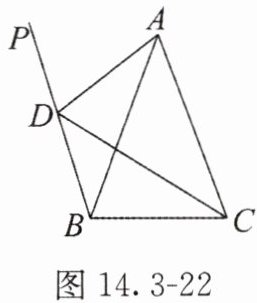 图14.3-22
图14.3-22答案
11. 证明:如图,过点A作$AE⊥ DP$,$AF⊥ DC$,垂足分别为E,F。
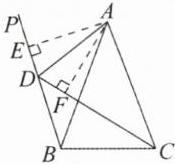
在$△ AEB$和$△ AFC$中,$\begin{cases} ∠ AEB=∠ AFC,\\ ∠ ABE=∠ ACF,\\ AB=AC, \end{cases}$
$\therefore △ AEB≌△ AFC\ (\mathrm{AAS}). \therefore AE=AF$.
$\therefore DA$平分$∠ PDC$,即$∠ ADP=∠ ADC$.
解析
【分析】
要证明∠ADP=∠ADC,本质是证明AD平分∠PDC,根据角平分线的判定定理,只需证明点A到∠PDC两边DP、DC的距离相等即可。因此我们可以过点A分别作DP、DC的垂线构造直角三角形,结合已知AB=AC、∠ABD=∠ACD的条件,证明两个直角三角形全等,得到两条垂线段相等,进而利用角平分线判定推出结论。
【解析】
证明:过点A作$AE⊥ DP$,$AF⊥ DC$,垂足分别为E、F。
在$△ AEB$和$△ AFC$中:
$\begin{cases} ∠ AEB=∠ AFC=90°\\ ∠ ABE=∠ ACF\\ AB=AC \end{cases}$
$\therefore △ AEB≌△ AFC\ (\mathrm{AAS})$
由全等三角形的性质可得$AE=AF$。
因为$AE⊥ DP$,$AF⊥ DC$,即点A到∠PDC两边的距离相等,根据角平分线的判定定理,可知DA平分$∠ PDC$,因此$∠ ADP=∠ ADC$。
【答案】
证明:如图,过点A作$AE⊥ DP$,$AF⊥ DC$,垂足分别为E,F。
在$△ AEB$和$△ AFC$中,$\begin{cases} ∠ AEB=∠ AFC,\\ ∠ ABE=∠ ACF,\\ AB=AC, \end{cases}$
$\therefore △ AEB≌△ AFC\ (\mathrm{AAS}). \therefore AE=AF$.
$\therefore DA$平分$∠ PDC$,即$∠ ADP=∠ ADC$.
【知识点】
全等三角形判定,全等三角形性质,角平分线的判定
【点评】
本题属于角相等证明的基础题型,解题核心是通过构造垂线将证角相等转化为证点到角两边的距离相等,再结合全等三角形的判定和性质得到距离相等,最终用角平分线判定得出结论,需要掌握这类构造辅助线的思路和相关定理的灵活应用。
【难度系数】
0.7
要证明∠ADP=∠ADC,本质是证明AD平分∠PDC,根据角平分线的判定定理,只需证明点A到∠PDC两边DP、DC的距离相等即可。因此我们可以过点A分别作DP、DC的垂线构造直角三角形,结合已知AB=AC、∠ABD=∠ACD的条件,证明两个直角三角形全等,得到两条垂线段相等,进而利用角平分线判定推出结论。
【解析】
证明:过点A作$AE⊥ DP$,$AF⊥ DC$,垂足分别为E、F。
在$△ AEB$和$△ AFC$中:
$\begin{cases} ∠ AEB=∠ AFC=90°\\ ∠ ABE=∠ ACF\\ AB=AC \end{cases}$
$\therefore △ AEB≌△ AFC\ (\mathrm{AAS})$
由全等三角形的性质可得$AE=AF$。
因为$AE⊥ DP$,$AF⊥ DC$,即点A到∠PDC两边的距离相等,根据角平分线的判定定理,可知DA平分$∠ PDC$,因此$∠ ADP=∠ ADC$。
【答案】
证明:如图,过点A作$AE⊥ DP$,$AF⊥ DC$,垂足分别为E,F。
在$△ AEB$和$△ AFC$中,$\begin{cases} ∠ AEB=∠ AFC,\\ ∠ ABE=∠ ACF,\\ AB=AC, \end{cases}$
$\therefore △ AEB≌△ AFC\ (\mathrm{AAS}). \therefore AE=AF$.
$\therefore DA$平分$∠ PDC$,即$∠ ADP=∠ ADC$.
【知识点】
全等三角形判定,全等三角形性质,角平分线的判定
【点评】
本题属于角相等证明的基础题型,解题核心是通过构造垂线将证角相等转化为证点到角两边的距离相等,再结合全等三角形的判定和性质得到距离相等,最终用角平分线判定得出结论,需要掌握这类构造辅助线的思路和相关定理的灵活应用。
【难度系数】
0.7
