

 登录
阅读理解 古代夏季常用服装面料
素养:文化意识 难度:中 用时:9分钟
When the heat rises in summer, we modern people choose to wear the cool clothing. But what clothing did the ancient Chinese have? Did they wear elaborate (复杂的) and heavy clothing like what we see in some TV series? Now, let us find it out together!
One of the most famous examples is a silk dress, which is also called sushadanyi. It was found from Han Tomb No.1 at Mawangdui in 1972. After centuries, we can still see the bright colors on it. The dress is also known as the earliest and thinnest dress in the world. Can you imagine its weight? It’s only 48 grams! So, many people use four Chinese characters to describe it, which mean it is as thin as a cicada wing.
Later, in Tang and Song dynasties, a clothing called luo robes (罗衫) got more and more popular. However, these clothes could only be worn among the nobility (贵族) and officials. There were some small holes on this thin material, which made it light. So luo robes were especially right for those people in hot and wet areas.
But both sha and luo were too expensive for common people to buy. So the smart ancient people found another way to make clothes. That is ge. From then on, the cost of summer clothing dropped greatly. Therefore, a lot of people could afford cool and comfortable clothes.
Although sometimes the lives of ancient times were difficult, ancient Chinese people kept coming up with new ways to make their summers more enjoyable.
1. What do sha and luo have in common?
A. Light and thin. B. Heavy and cheap.
C. Warm and colorful. D. Warm and expensive.
2. 新考法·图文转换题 What does the underlined word “cicada” in Paragraph 2 mean?
A. B. C. D.
3. What can we learn from the passage?
A. Ge clothing is at a very high price.
B. Ancient people lived a happier life than us.
C. Common people couldn’t afford luo robes.
D. People wore elaborate clothing in summer.
4. According to the passage, which word can describe ancient Chinese people best?
A. Friendly. B. Creative. C. Brave. D. Confident.
素养:文化意识 难度:中 用时:9分钟
When the heat rises in summer, we modern people choose to wear the cool clothing. But what clothing did the ancient Chinese have? Did they wear elaborate (复杂的) and heavy clothing like what we see in some TV series? Now, let us find it out together!
One of the most famous examples is a silk dress, which is also called sushadanyi. It was found from Han Tomb No.1 at Mawangdui in 1972. After centuries, we can still see the bright colors on it. The dress is also known as the earliest and thinnest dress in the world. Can you imagine its weight? It’s only 48 grams! So, many people use four Chinese characters to describe it, which mean it is as thin as a cicada wing.
Later, in Tang and Song dynasties, a clothing called luo robes (罗衫) got more and more popular. However, these clothes could only be worn among the nobility (贵族) and officials. There were some small holes on this thin material, which made it light. So luo robes were especially right for those people in hot and wet areas.
But both sha and luo were too expensive for common people to buy. So the smart ancient people found another way to make clothes. That is ge. From then on, the cost of summer clothing dropped greatly. Therefore, a lot of people could afford cool and comfortable clothes.
Although sometimes the lives of ancient times were difficult, ancient Chinese people kept coming up with new ways to make their summers more enjoyable.
1. What do sha and luo have in common?
A. Light and thin. B. Heavy and cheap.
C. Warm and colorful. D. Warm and expensive.
2. 新考法·图文转换题 What does the underlined word “cicada” in Paragraph 2 mean?
A.
B. C. D.3. What can we learn from the passage?
A. Ge clothing is at a very high price.
B. Ancient people lived a happier life than us.
C. Common people couldn’t afford luo robes.
D. People wore elaborate clothing in summer.
4. According to the passage, which word can describe ancient Chinese people best?
A. Friendly. B. Creative. C. Brave. D. Confident.
答案
语篇研读
主题和内容 本文主要介绍了中国古人的夏季衣物,从轻薄珍贵的纱、罗,到平民能穿的葛布,展现了古人的生活智慧。
意义和价值 本文以古代服饰为切入点,通过具体文物和历史实例(如马王堆汉墓的素纱单衣)让读者了解中国服饰文化的丰富性与独特性。
方式和方法 语篇类型:本文是历史文化类说明文,兼具科普性与趣味性,既普及了历史知识,又引导读者深入理解古代智慧与社会背景。
行文脉络:本文以提问开篇,引发读者对古代夏季服饰的好奇,接着通过汉代素纱单衣、唐宋罗衫和平民使用的葛布逐层分析,描述其材质及适用人群,展现古人应对炎热的智慧与阶层差异。最后总结古代在困境中创新的精神,升华主题。
亮点词句:文中的“48 grams”“as thin as a cicada wing”,通过数字与比喻展现素纱单衣的轻薄特点;“small holes”突出罗衫的精巧工艺;“ge”体现古代平民的智慧;结尾处“kept coming up with new ways”展现古人的创造力与适应精神。
1. A 细节理解题。根据第二段中的“The dress is also known as the earliest and thinnest dress in the world...only 48 grams!”和第三段中的“There were some small holes on this thin material, which made it light”可知,纱衣和罗衫的共同点是轻薄。
2. D 图文转换题。根据画线词前的“many people use four Chinese characters to describe it”并结合常识可知,“as thin as a cicada wing”的意思是“薄如蝉翼”。cicada 指的是“蝉”,故选 D。
解题通法 双向解锁图文转换
图文转换题是近两年出现的一种比较新颖的题型,旨在考查学生的词意分析和实物认知能力。此类题目考查学生的综合能力,需要学生既能认识单词,或根据上下文语境推断词意,又要匹配到对应的图片。
3. C 细节理解题。根据第四段中的“But both sha and luo were too expensive for common people to buy”可知,纱衣和罗衫对普通人来说都太贵。故 C 项符合题意。
4. B 推理判断题。通读全文并根据最后一段中的“ancient Chinese people kept coming up with new ways to make their summers more enjoyable”可知,古人根据不同需求制作出纱衣、罗衫,又为了让普通人穿得起轻薄夏装而发明葛衣。这体现出古代中国人是富有创造力的。故 B 项符合题意。
解析
【分析】
本题是历史文化类阅读理解题,包含细节理解、图文转换、推理判断三类题型。解题时需先通读全文把握主旨(介绍中国古代夏季服装面料的发展,体现古人智慧);针对不同题型采用对应方法:细节题定位原文关键信息,图文转换题结合上下文和常识推断词义,推理题结合全文合理推导。
【解析】
1. 第1题:细节理解题。根据第二段“...the earliest and thinnest dress in the world...only 48 grams!”和第三段“There were some small holes on this thin material, which made it light”,可知纱(sha)和罗(luo)的共同点是轻薄,故选A。
2. 第2题:图文转换题。画线词所在句“as thin as a cicada wing”意为“薄如蝉翼”,结合常识可知cicada指“蝉”,对应选项D,故选D。
3. 第3题:细节理解题。根据第四段“But both sha and luo were too expensive for common people to buy”,可知普通人买不起罗衫,故选C。
4. 第4题:推理判断题。全文介绍古人发明纱、罗,又发明葛布让普通人能穿得起,最后一段“kept coming up with new ways”体现古人富有创造力,故选B。
【答案】
1.A 2.D 3.C 4.B
【知识点】
阅读理解(细节理解)、阅读理解(图文转换)、阅读理解(推理判断)
【点评】
本题围绕古代夏季服装展开,考查学生的阅读理解能力,涵盖细节查找、词义推断、推理判断等题型,既涉及文化知识,又考查语言应用能力,难度适中,符合文化意识素养的考查要求。
【难度系数】
0.5
【语篇解构】 阅读文章,补充下面的结构图(每空一词)
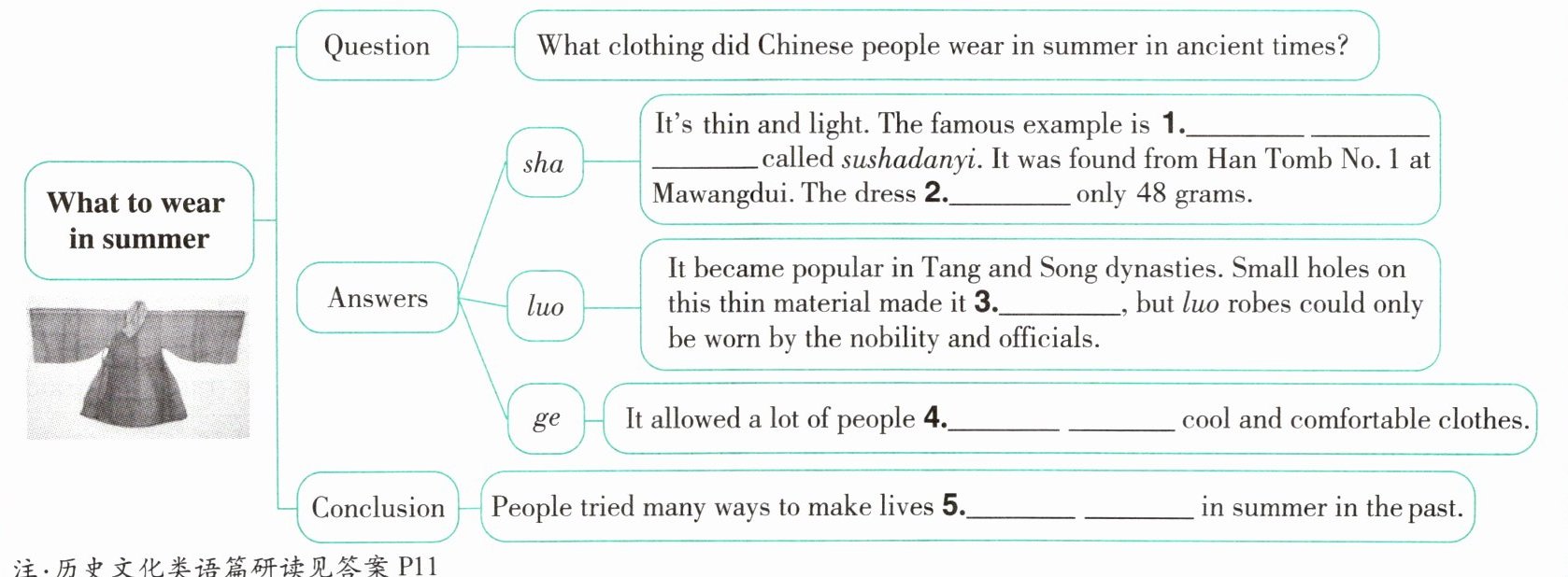
What to wear in summer
Question: What clothing did Chinese people wear in summer in ancient times?
Answers
sha: It’s thin and light. The famous example is 1.
luo: It became popular in Tang and Song dynasties. Small holes on this thin material made it 3.
ge: It allowed a lot of people 4.
Conclusion: People tried many ways to make lives 5.
注:历史文化类语篇研读见答案 P11
What to wear in summer
Question: What clothing did Chinese people wear in summer in ancient times?
Answers
sha: It’s thin and light. The famous example is 1.
a
silk
dress
called sushadanyi. It was found from Han Tomb No.1 at Mawangdui. The dress 2.weighs
only 48 grams.luo: It became popular in Tang and Song dynasties. Small holes on this thin material made it 3.
light
, but luo robes could only be worn by the nobility and officials.ge: It allowed a lot of people 4.
to
afford
cool and comfortable clothes.Conclusion: People tried many ways to make lives 5.
more
enjoyable
in summer in the past.注:历史文化类语篇研读见答案 P11
答案
1. a silk dress
2. weighs
3. light
4. to afford
5. more enjoyable
2. weighs
3. light
4. to afford
5. more enjoyable
解析
【分析】
解题时需结合语境、语法规则和固定搭配逐个填空:第1空根据提到的素纱单衣是丝绸制品,确定填对应表达;第2空主语是单数名词,需用weigh的第三人称单数形式表重量;第3空结合前文描述的衣物轻薄,确定填对应形容词;第4空依据固定搭配allow sb to do sth确定结构;第5空依据make sth +形容词的结构和语境确定答案。
【解析】
1. 素纱单衣是丝绸制成的衣物,故填a silk dress;
2. 主语the dress是第三人称单数,表重量用动词weigh的第三人称单数形式weighs;
3. 前文提到衣物薄且轻,纱罗的小孔使其更轻,故填light;
4. 固定搭配allow sb to do sth,意为“允许某人做某事”,故填to afford;
5. 结构make +宾语+形容词,结合语境是让过去夏天的生活更愉快,故填more enjoyable。
【答案】
1. a silk dress 2. weighs 3. light 4. to afford 5. more enjoyable
【知识点】
英语词汇运用、固定搭配、主谓一致
【点评】
本题结合中国古代服饰文化的英语语篇填空,既考查英语基础知识,又涉及历史文化常识,需学生综合运用知识解题。
【难度系数】
0.6
