

 登录
登录
Ⅰ.根据句意及汉语或首字母提示写出单词,或用括号中所给单词的正确形式填空
1. The (有雾的)park looked magical,so we played hide-and-seek while the mist slowly disappeared.
2. On a (下雪的)morning,we built a funny snowman with a carrot nose and coal eyes in the backyard.
3. The p music from next door softened the u noise of construction(施工) outside.
4. The (change)seasons turn our schoolyard from green to gold,making every month a new adventure.
5. New school years bring exciting ______ (begin):fresh notebooks,different classmates,and fun challenges ahead.
6. When summer comes,we go (swim),splashing and racing under the warm sun.
1. The (有雾的)park looked magical,so we played hide-and-seek while the mist slowly disappeared.
2. On a (下雪的)morning,we built a funny snowman with a carrot nose and coal eyes in the backyard.
3. The p music from next door softened the u noise of construction(施工) outside.
4. The (change)seasons turn our schoolyard from green to gold,making every month a new adventure.
5. New school years bring exciting ______ (begin):fresh notebooks,different classmates,and fun challenges ahead.
6. When summer comes,we go (swim),splashing and racing under the warm sun.
答案
1. foggy 2. snowy 3. pleasant; unpleasant
4. changing 5. beginnings 6. swimming
4. changing 5. beginnings 6. swimming
解析
【分析】本题考查词汇的正确形式运用,需结合句意、词性要求及固定搭配解题:1. 修饰名词park需用形容词,对应“有雾的”英文;2. 修饰名词morning需用形容词,对应“下雪的”英文;3. 结合语境,隔壁的音乐是悦耳的,施工噪音是不愉快的,填对应形容词;4. 修饰名词seasons需用形容词,将动词change转换为形容词;5. 形容词exciting后需接名词,将动词begin转换为名词且用复数;6. 考查固定搭配go swimming,需用动名词形式。
【解析】1. 空格修饰名词park,需用形容词,“有雾的”对应形容词foggy,故填foggy;2. 空格修饰名词morning,需用形容词,“下雪的”对应形容词snowy,故填snowy;3. 结合语境,隔壁的音乐是悦耳的(pleasant),外面施工的噪音是不愉快的(unpleasant),故分别填pleasant、unpleasant;4. 空格修饰名词seasons,需用形容词,动词change的形容词形式为changing,故填changing;5. 形容词exciting后需接名词,动词begin的名词形式为beginning,此处表泛指用复数beginnings,故填beginnings;6. 考查固定搭配go swimming,需用swim的动名词形式swimming,故填swimming。
【答案】1. foggy 2. snowy 3. pleasant; unpleasant 4. changing 5. beginnings 6. swimming
【知识点】形容词的用法、词形转换、固定搭配
【点评】本题为基础词汇运用题,涵盖形容词修饰名词、词形转换、固定搭配等考点,侧重考查学生对核心词汇的掌握及语境运用能力,难度适中。
【难度系数】0.8
【解析】1. 空格修饰名词park,需用形容词,“有雾的”对应形容词foggy,故填foggy;2. 空格修饰名词morning,需用形容词,“下雪的”对应形容词snowy,故填snowy;3. 结合语境,隔壁的音乐是悦耳的(pleasant),外面施工的噪音是不愉快的(unpleasant),故分别填pleasant、unpleasant;4. 空格修饰名词seasons,需用形容词,动词change的形容词形式为changing,故填changing;5. 形容词exciting后需接名词,动词begin的名词形式为beginning,此处表泛指用复数beginnings,故填beginnings;6. 考查固定搭配go swimming,需用swim的动名词形式swimming,故填swimming。
【答案】1. foggy 2. snowy 3. pleasant; unpleasant 4. changing 5. beginnings 6. swimming
【知识点】形容词的用法、词形转换、固定搭配
【点评】本题为基础词汇运用题,涵盖形容词修饰名词、词形转换、固定搭配等考点,侧重考查学生对核心词汇的掌握及语境运用能力,难度适中。
【难度系数】0.8
1. Visitors can see amazing ice sculptures in Harbin
A.to
B.on
C.in
D.at
C
winter.A.to
B.on
C.in
D.at
答案
1. C 解析:根据“空后winter”可知,季节前用介词in,为固定搭配。
解析
【分析】这道题考查时间介词的用法,解题思路是先明确不同时间介词的使用规则,再结合题干中的时间名词(winter,季节)匹配正确的介词。需牢记:表示季节、月份、年份等较长时间用介词in;具体某一天用on;具体时刻用at;to一般不用于此类时间表达。
【解析】题干中winter(冬天)是季节,英语中“在某个季节”的固定搭配是“in + 季节”。选项A.to不用于此类时间表达;B.on用于具体某一天;D.at用于具体时刻,均不符合要求,因此选C。
【答案】C
【知识点】时间介词
【点评】本题是基础的时间介词搭配题,考查季节前的介词用法,属于英语核心基础知识点,难度较低,适合巩固基础。
【难度系数】0.8
【解析】题干中winter(冬天)是季节,英语中“在某个季节”的固定搭配是“in + 季节”。选项A.to不用于此类时间表达;B.on用于具体某一天;D.at用于具体时刻,均不符合要求,因此选C。
【答案】C
【知识点】时间介词
【点评】本题是基础的时间介词搭配题,考查季节前的介词用法,属于英语核心基础知识点,难度较低,适合巩固基础。
【难度系数】0.8
2. Look!
A.Here your teacher comes
B.Comes here your teacher
C.Your teacher come here
D.Here comes your teacher
D
.A.Here your teacher comes
B.Comes here your teacher
C.Your teacher come here
D.Here comes your teacher
答案
2. D 解析:根据“以Here开头的倒装句”可知,倒装结构为Here+谓语+主语,主语your teacher为单数,谓语用comes。
解析
【分析】
本题考查here引导的完全倒装结构及一般现在时的主谓一致。解题思路:首先,当here置于句首且主语为名词时,句子需使用完全倒装,结构为“Here + 谓语动词 + 主语(名词)”;若主语是代词则无需倒装(如Here you are)。其次,主语your teacher是第三人称单数,一般现在时中谓语动词需用第三人称单数形式comes。最后逐一分析选项,排除不符合规则的选项,得出正确答案。
【解析】
1. 语法规则:here置于句首,主语为名词时,句子用完全倒装,结构为“Here + 谓语 + 主语”;主语your teacher是第三人称单数,一般现在时谓语动词用comes。
2. 选项分析:A选项为正常语序,不符合倒装要求,错误;B选项倒装语序错误,应为“Here comes...”,错误;C选项谓语动词未用第三人称单数,且语序不符合规则,错误;D选项符合倒装结构和主谓一致要求,正确。
【答案】
D
【知识点】
英语倒装句;一般现在时主谓一致
【点评】
本题考查初中英语基础语法点,here引导的完全倒装是常考考点,需牢记倒装规则和主谓一致要求,难度较低,掌握相关知识即可轻松作答。
【难度系数】
0.6
本题考查here引导的完全倒装结构及一般现在时的主谓一致。解题思路:首先,当here置于句首且主语为名词时,句子需使用完全倒装,结构为“Here + 谓语动词 + 主语(名词)”;若主语是代词则无需倒装(如Here you are)。其次,主语your teacher是第三人称单数,一般现在时中谓语动词需用第三人称单数形式comes。最后逐一分析选项,排除不符合规则的选项,得出正确答案。
【解析】
1. 语法规则:here置于句首,主语为名词时,句子用完全倒装,结构为“Here + 谓语 + 主语”;主语your teacher是第三人称单数,一般现在时谓语动词用comes。
2. 选项分析:A选项为正常语序,不符合倒装要求,错误;B选项倒装语序错误,应为“Here comes...”,错误;C选项谓语动词未用第三人称单数,且语序不符合规则,错误;D选项符合倒装结构和主谓一致要求,正确。
【答案】
D
【知识点】
英语倒装句;一般现在时主谓一致
【点评】
本题考查初中英语基础语法点,here引导的完全倒装是常考考点,需牢记倒装规则和主谓一致要求,难度较低,掌握相关知识即可轻松作答。
【难度系数】
0.6
3. 新语篇 天气预报 —Dad, what's the weather like on Wednesday?
—
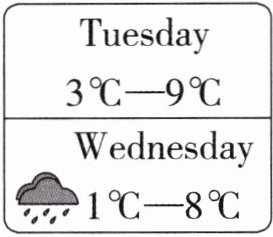
A.It's sunny and the temperature is between $1°\mathrm{C}$ and $8°\mathrm{C}$
B.It's cloudy with the temperature between $3°\mathrm{C}$ and $9°\mathrm{C}$
C.It's rainy and the temperature is between $1°\mathrm{C}$ and $8°\mathrm{C}$
D.It's sunny with the temperature between $3°\mathrm{C}$ and $9°\mathrm{C}$
—
C
.A.It's sunny and the temperature is between $1°\mathrm{C}$ and $8°\mathrm{C}$
B.It's cloudy with the temperature between $3°\mathrm{C}$ and $9°\mathrm{C}$
C.It's rainy and the temperature is between $1°\mathrm{C}$ and $8°\mathrm{C}$
D.It's sunny with the temperature between $3°\mathrm{C}$ and $9°\mathrm{C}$
答案
3. C 解析:根据图片中Wednesday的气温是1℃至8℃,且旁边有下雨的图标可知C选项正确。
解析
【分析】这是一道英语情景选择题,问题询问周三的天气,解题思路是先观察图片中周三的相关信息:周三的天气图标是下雨,气温范围是1℃到8℃,再对应选项找出匹配的答案。
【解析】根据图片内容,周三的天气是下雨,气温在1℃到8℃之间。A选项描述天气晴朗,不符合;B选项天气为多云、温度范围也不匹配;C选项描述天气下雨,温度范围是1℃到8℃,与图片信息一致;D选项天气晴朗、温度范围错误,因此选C。
【答案】C
【知识点】天气表达、温度表达
【点评】本题结合图片信息考查英语天气相关的情景对话,需要准确识别图片中的天气图标和气温数值,难度较低,属于基础看图答题类题目。
【难度系数】0.2
【解析】根据图片内容,周三的天气是下雨,气温在1℃到8℃之间。A选项描述天气晴朗,不符合;B选项天气为多云、温度范围也不匹配;C选项描述天气下雨,温度范围是1℃到8℃,与图片信息一致;D选项天气晴朗、温度范围错误,因此选C。
【答案】C
【知识点】天气表达、温度表达
【点评】本题结合图片信息考查英语天气相关的情景对话,需要准确识别图片中的天气图标和气温数值,难度较低,属于基础看图答题类题目。
【难度系数】0.2
Ⅲ. 句子翻译
1. 随着季节的更替,新的开始也随之而来。
2. 你最喜欢哪个季节?
3. 春天是一年中最美的时光。
4. 这是读书的最佳时间。
5. 我们应当在温暖的春光中读书,同时享受大自然的宁静。
1. 随着季节的更替,新的开始也随之而来。
2. 你最喜欢哪个季节?
3. 春天是一年中最美的时光。
4. 这是读书的最佳时间。
5. 我们应当在温暖的春光中读书,同时享受大自然的宁静。
答案
1. With the changing seasons come new beginnings.
2. Which season do you like best?
3. Spring is the most beautiful time of the year.
4. It's the best time to read books.
5. We should enjoy the peace of nature while reading books in the warm spring sunshine.
2. Which season do you like best?
3. Spring is the most beautiful time of the year.
4. It's the best time to read books.
5. We should enjoy the peace of nature while reading books in the warm spring sunshine.
解析
【分析】
本题为汉译英基础题型,需结合每个中文句子的核心语义,运用英语常用的介词结构、固定句式、特殊疑问句结构等进行转换,确保译文符合英语表达习惯,无语法错误。
【解析】
1. “随着季节的更替”对应介词短语With the changing seasons,“新的开始也随之而来”采用英语常用倒装结构,译为come new beginnings,故整句为With the changing seasons come new beginnings;
2. 特殊疑问句中,“哪个季节”对应which season,“最喜欢”对应like best,助动词do提前构成疑问语序,译为Which season do you like best?;
3. “春天”为Spring,“最美的时光”是the most beautiful time,“一年中”用of the year表范围,组合为Spring is the most beautiful time of the year;
4. 运用固定句式“It's the best time to do sth”(做某事的最佳时间),“读书”译为read books,故为It's the best time to read books;
5. “应当”对应should,“享受大自然的宁静”译为enjoy the peace of nature,“在温暖的春光中”译为in the warm spring sunshine,“同时”用while引导现在分词短语作状语,故整句为We should enjoy the peace of nature while reading books in the warm spring sunshine。
【答案】
1. With the changing seasons come new beginnings.
2. Which season do you like best?
3. Spring is the most beautiful time of the year.
4. It's the best time to read books.
5. We should enjoy the peace of nature while reading books in the warm spring sunshine.
【知识点】
汉译英、固定句式、特殊疑问句
【点评】
本题考查基础的汉译英能力,涉及英语常用的介词短语、固定搭配和特殊疑问句结构,是英语学习中必备的基础翻译练习,难度较低,适合巩固基础。
【难度系数】
0.8
本题为汉译英基础题型,需结合每个中文句子的核心语义,运用英语常用的介词结构、固定句式、特殊疑问句结构等进行转换,确保译文符合英语表达习惯,无语法错误。
【解析】
1. “随着季节的更替”对应介词短语With the changing seasons,“新的开始也随之而来”采用英语常用倒装结构,译为come new beginnings,故整句为With the changing seasons come new beginnings;
2. 特殊疑问句中,“哪个季节”对应which season,“最喜欢”对应like best,助动词do提前构成疑问语序,译为Which season do you like best?;
3. “春天”为Spring,“最美的时光”是the most beautiful time,“一年中”用of the year表范围,组合为Spring is the most beautiful time of the year;
4. 运用固定句式“It's the best time to do sth”(做某事的最佳时间),“读书”译为read books,故为It's the best time to read books;
5. “应当”对应should,“享受大自然的宁静”译为enjoy the peace of nature,“在温暖的春光中”译为in the warm spring sunshine,“同时”用while引导现在分词短语作状语,故整句为We should enjoy the peace of nature while reading books in the warm spring sunshine。
【答案】
1. With the changing seasons come new beginnings.
2. Which season do you like best?
3. Spring is the most beautiful time of the year.
4. It's the best time to read books.
5. We should enjoy the peace of nature while reading books in the warm spring sunshine.
【知识点】
汉译英、固定句式、特殊疑问句
【点评】
本题考查基础的汉译英能力,涉及英语常用的介词短语、固定搭配和特殊疑问句结构,是英语学习中必备的基础翻译练习,难度较低,适合巩固基础。
【难度系数】
0.8
Ⅳ. 完形填空
Charla sat on her Aunt Monica's front porch swing and looked at the birds that stayed in the big tree.
“Lucky birds, you can fly to the beach. I have to stay here all day and
Aunt Monica was going to have a baby next month. She asked Charla to help around the house
“What are you doing out here?” Aunt Monica asked, stepping on the porch.
“Getting some fresh
Aunt Monica took a deep breath. “It
Charla looked at Aunt Monica. “Are you sure you're
They headed down the road and to the end of the development. Charla wanted to turn right like they usually did,
Aunt Monica shook her head. “To the beach.”
It took longer than usual, but they made it to the beach.
“I really
Charla forced a smile. She wanted to be
“You know, I'm going to need even more help after the baby
Charla's eyes widened as she thought about changing dirty diapers(尿布).
“You're the
“Really? That would be great,” Charla said
1. A. wait B. relax C. study D. work
2. A. during B. before C. after D. with
3. A. control B. miss C. share D. wish
4. A. air B. water C. fruit D. fish
5. A. looks B. smells C. sounds D. feels
6. A. swim B. drive C. ride D. walk
7. A. willing B. powerful C. interesting D. free
8. A. and B. so C. but D. or
9. A. enjoy B. understand C. doubt D. thank
10. A. proud B. happy C. patient D. afraid
11. A. arrives B. stops C. sleeps D. returns
12. A. funniest B. smartest C. kindest D. laziest
13. A. brother B. sister C. cousin D. friend
14. A. plan B. name C. song D. story
15. A. carefully B. sadly C. politely D. excitedly
Ⅴ. 阅读与回答问题
根据短文内容,回答下列问题。(每题答案不超过10个词)
Can a cricket really tell you the temperature outside? Do fish know if it's going to be a cold winter? You've probably heard stories about animals that can predict the weather. Some of the sayings, like “if a cat sits with its back to the fire, hard weather can be expected” may sound silly or unbelievable, but some are based on animals that seem to sense more about our environment than we do.
Do animals tell us when a storm is coming? Birds react to the drop in air pressure(气压) before a storm by flying low, and not flying at all an hour or so before the storm hits. Other animals behave strangely before a storm too. Insects stay close to the ground and wolves howl(嚎叫) because their ears can sense the pressure change.
Before a hurricane(飓风), sharks will run away from the path of the storm, although they hardly ever leave their home waters. Seabirds also know they should fly inland.
While not really “weather”, earthquakes are also something that animals can predict. You may have heard stories about animals and earthquakes: Many are far more sensitive to earthquakes than humans. Unusual animal behaviour can sometimes tell us what is about to happen. After the 2005 tsunami(海啸) in Sri Lanka, it was reported that very few animals were killed. Many of them were also acting strangely the day before the tsunami hit. It seems that they knew something was coming and ran to safety. A good rule is, if the animals are running away, you probably should too.
The sound of crickets chirping(鸣叫) can tell you summer is near, but do you know that it can also tell you how hot it is? Crickets are cold-blooded so when the temperature in the air changes, the cricket's body temperature changes with it. As the temperature rises, the cricket's metabolism(新陈代谢) increases. When the heat rises, crickets chirp. To get the exact temperature in degrees Fahrenheit (℉), count the number of chirps in 14 seconds, and add 40.
Do you have a tried-and-true weather animal that predicts the weather?
1. Why do wolves howl before a storm?
2. What will sharks do before a hurricane?
3. Besides weather, what can animals also predict?
4. Why does the cricket's body temperature change with the temperature in the air?
5. 新考法 开放性试题 Can you think of any other animal behaviours that might predict weather changes? Give one example.
Charla sat on her Aunt Monica's front porch swing and looked at the birds that stayed in the big tree.
“Lucky birds, you can fly to the beach. I have to stay here all day and
D
1 to spend my summer vacation.”Aunt Monica was going to have a baby next month. She asked Charla to help around the house
A
2 the summer vacation. Charla was unhappy about it, though. Monica is her favourite aunt, and now she'd have to C
3 her with a new baby.“What are you doing out here?” Aunt Monica asked, stepping on the porch.
“Getting some fresh
A
4,” answered Charla. She had been helping paint the baby's room all morning.Aunt Monica took a deep breath. “It
B
5 like spring. Hey, how about going for a D
6?”Charla looked at Aunt Monica. “Are you sure you're
A
7?” “Yeah, I can make it. It's good for me. Come on.”They headed down the road and to the end of the development. Charla wanted to turn right like they usually did,
C
8 she stopped. “We can turn back if you want.”Aunt Monica shook her head. “To the beach.”
It took longer than usual, but they made it to the beach.
“I really
D
9 you for getting ready for the baby.”Charla forced a smile. She wanted to be
B
10 but she felt like she was losing her favourite aunt.“You know, I'm going to need even more help after the baby
A
11.”Charla's eyes widened as she thought about changing dirty diapers(尿布).
“You're the
C
12 kid I know, and I'd love it if you taught your new C
13 all about birds and the beach. In fact, I'd like you to help me think of a B
14 for her too.”“Really? That would be great,” Charla said
D
15, already making a mental list of her favourite names.1. A. wait B. relax C. study D. work
2. A. during B. before C. after D. with
3. A. control B. miss C. share D. wish
4. A. air B. water C. fruit D. fish
5. A. looks B. smells C. sounds D. feels
6. A. swim B. drive C. ride D. walk
7. A. willing B. powerful C. interesting D. free
8. A. and B. so C. but D. or
9. A. enjoy B. understand C. doubt D. thank
10. A. proud B. happy C. patient D. afraid
11. A. arrives B. stops C. sleeps D. returns
12. A. funniest B. smartest C. kindest D. laziest
13. A. brother B. sister C. cousin D. friend
14. A. plan B. name C. song D. story
15. A. carefully B. sadly C. politely D. excitedly
Ⅴ. 阅读与回答问题
根据短文内容,回答下列问题。(每题答案不超过10个词)
Can a cricket really tell you the temperature outside? Do fish know if it's going to be a cold winter? You've probably heard stories about animals that can predict the weather. Some of the sayings, like “if a cat sits with its back to the fire, hard weather can be expected” may sound silly or unbelievable, but some are based on animals that seem to sense more about our environment than we do.
Do animals tell us when a storm is coming? Birds react to the drop in air pressure(气压) before a storm by flying low, and not flying at all an hour or so before the storm hits. Other animals behave strangely before a storm too. Insects stay close to the ground and wolves howl(嚎叫) because their ears can sense the pressure change.
Before a hurricane(飓风), sharks will run away from the path of the storm, although they hardly ever leave their home waters. Seabirds also know they should fly inland.
While not really “weather”, earthquakes are also something that animals can predict. You may have heard stories about animals and earthquakes: Many are far more sensitive to earthquakes than humans. Unusual animal behaviour can sometimes tell us what is about to happen. After the 2005 tsunami(海啸) in Sri Lanka, it was reported that very few animals were killed. Many of them were also acting strangely the day before the tsunami hit. It seems that they knew something was coming and ran to safety. A good rule is, if the animals are running away, you probably should too.
The sound of crickets chirping(鸣叫) can tell you summer is near, but do you know that it can also tell you how hot it is? Crickets are cold-blooded so when the temperature in the air changes, the cricket's body temperature changes with it. As the temperature rises, the cricket's metabolism(新陈代谢) increases. When the heat rises, crickets chirp. To get the exact temperature in degrees Fahrenheit (℉), count the number of chirps in 14 seconds, and add 40.
Do you have a tried-and-true weather animal that predicts the weather?
1. Why do wolves howl before a storm?
Because their ears can sense the pressure change.
2. What will sharks do before a hurricane?
They will run away from the path of the storm.
3. Besides weather, what can animals also predict?
Earthquakes.
4. Why does the cricket's body temperature change with the temperature in the air?
Because crickets are cold-blooded.
5. 新考法 开放性试题 Can you think of any other animal behaviours that might predict weather changes? Give one example.
Ants building hills./Cows lying down before rain.(给出一个合理的答案即可)
答案
Ⅳ. 1.D 2.A 3.C 4.A 5.B 6.D 7.A 8.C 9.D 10.B 11.A 12.C 13.C 14.B 15.D
【语篇解读】本文是一篇记叙文。文章主要讲述了Charla最喜欢的Monica阿姨即将生宝宝,所以她因为暑假被阿姨叫来做家务和有人要跟她分享Monica阿姨而感到不开心,Monica用自己的方式开解了Charla之后,Charla又开心了起来。
1. D 解析:根据“She asked Charla to help around the house”可知,让她来帮忙做家务。故选D。
2. A 解析:根据“the summer vacation”可知,此处指在暑假期间。故选A。
3. C 解析:根据“her with a new baby”可知,要跟一个新出生的婴儿分享自己最喜欢的阿姨。故选C。
4. A 解析:根据“She had been helping paint the baby's room all morning.”可推测,忙了一上午的Charla需要出来透透气。故选A。
5. B 解析:根据“Aunt Monica took a deep breath.”可知,深呼吸时闻到了像春天的味道。故选B。
6. D 解析:根据下文“They headed down the road”可知,提议出去散步。故选D。
7. A 解析:根据“Yeah, I can make it. It's good for me. Come on.”可知,Charla担心Monica阿姨在勉强自己出去,所以问她是否真的乐意。故选A。
8. C 解析:根据“We can turn back if you want.”可推测,Charla为了照顾Monica阿姨选择了停下。“Charla wanted to turn right like they usually did”与“she stopped”是转折关系。故选C。
9. D 解析:根据“you for getting ready for the baby”可知,感谢为孩子的出生做的准备。故选D。
10. B 解析:根据“but she felt like she was losing her favourite aunt”可知,后半句进行转折,讲述现在难过的心情,前半句应是与之相反的心情,也就是想开心。故选B。
11. A 解析:根据上文“Aunt Monica was going to have a baby next month.”可知,此处是指孩子出生后。故选A。
12. C 解析:根据“You're the ... kid I know”以及前文提到Charla帮助阿姨做家务的事情可知,阿姨夸奖Charla是最善良的。故选C。
13. C 解析:此处指阿姨即将要出生的宝宝和Charla是表亲关系。故选C。
14. B 解析:根据下文“her favourite names”可知,阿姨让Charla给即将出生的婴儿取个名字。故选B。
15. D 解析:根据“Really? That would be great”可知,Charla感到很兴奋。故选D。
Ⅴ.【语篇解读】本文是一篇说明文。文章主要介绍了动物能预测天气和地质灾害的现象及原因。
1. Because their ears can sense the pressure change. 解析:根据“Other animals behave strangely before a storm too ... wolves howl because their ears can sense the pressure change.”可知,狼在暴风雨前嚎叫是因为耳朵能感知气压变化。
2. They will run away from the path of the storm. 解析:根据“Before a hurricane, sharks will run away from the path of the storm”可知,飓风来临前鲨鱼会逃离风暴路径。
3. Earthquakes. 解析:根据“While not really 'weather', earthquakes are also something that animals can predict.”可知,动物还能预测地震。
4. Because crickets are cold-blooded. 解析:根据“Crickets are cold-blooded so when the temperature in the air changes, the cricket's body temperature changes with it.”可知,蟋蟀是冷血动物,所以体温随气温变化。
5. Ants building hills./Cows lying down before rain.(给出一个合理的答案即可)
【语篇解读】本文是一篇记叙文。文章主要讲述了Charla最喜欢的Monica阿姨即将生宝宝,所以她因为暑假被阿姨叫来做家务和有人要跟她分享Monica阿姨而感到不开心,Monica用自己的方式开解了Charla之后,Charla又开心了起来。
1. D 解析:根据“She asked Charla to help around the house”可知,让她来帮忙做家务。故选D。
2. A 解析:根据“the summer vacation”可知,此处指在暑假期间。故选A。
3. C 解析:根据“her with a new baby”可知,要跟一个新出生的婴儿分享自己最喜欢的阿姨。故选C。
4. A 解析:根据“She had been helping paint the baby's room all morning.”可推测,忙了一上午的Charla需要出来透透气。故选A。
5. B 解析:根据“Aunt Monica took a deep breath.”可知,深呼吸时闻到了像春天的味道。故选B。
6. D 解析:根据下文“They headed down the road”可知,提议出去散步。故选D。
7. A 解析:根据“Yeah, I can make it. It's good for me. Come on.”可知,Charla担心Monica阿姨在勉强自己出去,所以问她是否真的乐意。故选A。
8. C 解析:根据“We can turn back if you want.”可推测,Charla为了照顾Monica阿姨选择了停下。“Charla wanted to turn right like they usually did”与“she stopped”是转折关系。故选C。
9. D 解析:根据“you for getting ready for the baby”可知,感谢为孩子的出生做的准备。故选D。
10. B 解析:根据“but she felt like she was losing her favourite aunt”可知,后半句进行转折,讲述现在难过的心情,前半句应是与之相反的心情,也就是想开心。故选B。
11. A 解析:根据上文“Aunt Monica was going to have a baby next month.”可知,此处是指孩子出生后。故选A。
12. C 解析:根据“You're the ... kid I know”以及前文提到Charla帮助阿姨做家务的事情可知,阿姨夸奖Charla是最善良的。故选C。
13. C 解析:此处指阿姨即将要出生的宝宝和Charla是表亲关系。故选C。
14. B 解析:根据下文“her favourite names”可知,阿姨让Charla给即将出生的婴儿取个名字。故选B。
15. D 解析:根据“Really? That would be great”可知,Charla感到很兴奋。故选D。
Ⅴ.【语篇解读】本文是一篇说明文。文章主要介绍了动物能预测天气和地质灾害的现象及原因。
1. Because their ears can sense the pressure change. 解析:根据“Other animals behave strangely before a storm too ... wolves howl because their ears can sense the pressure change.”可知,狼在暴风雨前嚎叫是因为耳朵能感知气压变化。
2. They will run away from the path of the storm. 解析:根据“Before a hurricane, sharks will run away from the path of the storm”可知,飓风来临前鲨鱼会逃离风暴路径。
3. Earthquakes. 解析:根据“While not really 'weather', earthquakes are also something that animals can predict.”可知,动物还能预测地震。
4. Because crickets are cold-blooded. 解析:根据“Crickets are cold-blooded so when the temperature in the air changes, the cricket's body temperature changes with it.”可知,蟋蟀是冷血动物,所以体温随气温变化。
5. Ants building hills./Cows lying down before rain.(给出一个合理的答案即可)
