

 登录
Ⅵ. Task-based reading.
On 4th March, after 10 years of difficult talks, nearly 200 countries agreed on a new UN agreement—the High Seas Treaty(《公海条约》). It is the first of its kind in 40 years. 1.
Oceans cover about 71% of the earth's surface, and are home to all kinds of animals and plants. Healthy oceans play a very important role in a healthy planet. 2.
Overfishing has had a terrible influence on many kinds of fish and other animals. Pollution has caused serious damage in many areas.
In 1982, one UN sea agreement described the "high seas"—the parts of the oceans that aren't in the control of any country. 3.
During the past 10 years, governments had the talks time and time again. 5.
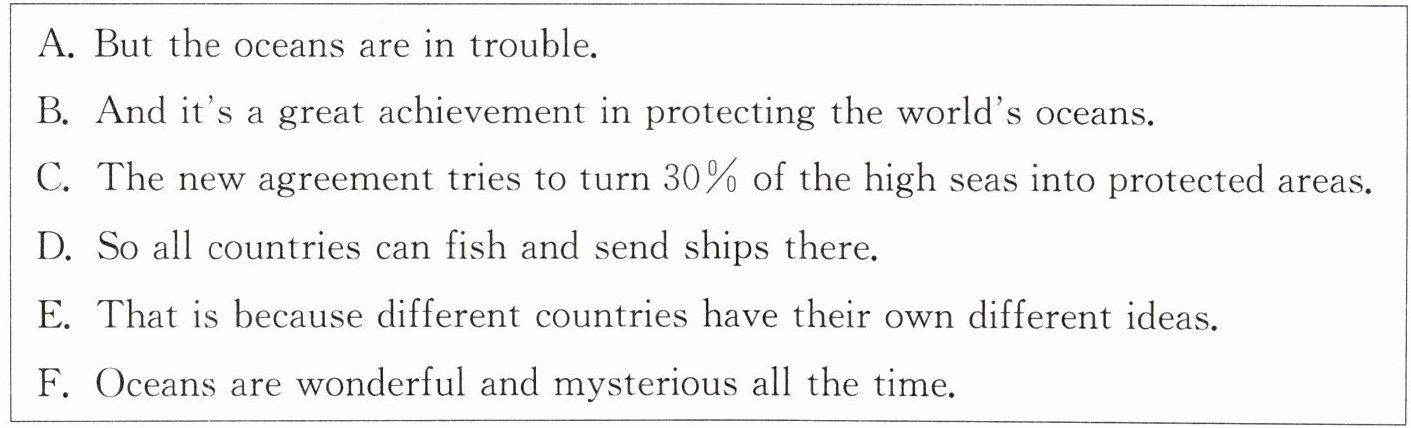
A. But the oceans are in trouble.
B. And it's a great achievement in protecting the world's oceans.
C. The new agreement tries to turn 30% of the high seas into protected areas.
D. So all countries can fish and send ships there.
E. That is because different countries have their own different ideas.
F. Oceans are wonderful and mysterious all the time.
On 4th March, after 10 years of difficult talks, nearly 200 countries agreed on a new UN agreement—the High Seas Treaty(《公海条约》). It is the first of its kind in 40 years. 1.
B
Oceans cover about 71% of the earth's surface, and are home to all kinds of animals and plants. Healthy oceans play a very important role in a healthy planet. 2.
A
Overfishing has had a terrible influence on many kinds of fish and other animals. Pollution has caused serious damage in many areas.
In 1982, one UN sea agreement described the "high seas"—the parts of the oceans that aren't in the control of any country. 3.
D
The high seas cover about $\frac{2}{3}$ of the ocean. But now only about 1% of these areas are under protection. 4. C
It also needs scientists to do some research first to see what influence human activities might have on the ocean environment.During the past 10 years, governments had the talks time and time again. 5.
E
For example, there are disagreements about how much to control fishing or pollution. Some countries even pour dirty water into the ocean for their own benefit without thinking about others. Now the agreement has a long way to go.A. But the oceans are in trouble.
B. And it's a great achievement in protecting the world's oceans.
C. The new agreement tries to turn 30% of the high seas into protected areas.
D. So all countries can fish and send ships there.
E. That is because different countries have their own different ideas.
F. Oceans are wonderful and mysterious all the time.
答案
1.B 2.A 3.D 4.C 5.E
解析
【分析】本题为任务型阅读的七选五题型,需通过分析上下文的逻辑关系(如转折、因果、指代、话题衔接),结合段落主旨选择合适的句子填空。解题时先通读全文把握语篇主题,再逐一分析每个空前后的语句,找到逻辑衔接点,匹配对应选项。
【解析】1. 第1空:前文提到《公海条约》是40年来首个同类协议,属于积极成果,选项B“这是保护世界海洋的一项伟大成就”承接上文的积极意义,符合逻辑,故选B。2. 第2空:前文阐述海洋的重要性,后文转折说明海洋面临的危害,选项A“但是海洋陷入了困境”承上启下,实现从海洋重要性到问题的过渡,故选A。3. 第3空:前文说明公海是无国家控制的区域,选项D“所以所有国家都可以在那里捕鱼和派船”解释了公海属性带来的结果,衔接上下文,故选D。4. 第4空:前文指出仅1%的公海受保护,后文说明协议还需科研支撑,选项C“新协议试图将30%的公海变成保护区”承接上文的保护不足,说明协议的核心措施,故选C。5. 第5空:前文提到谈判耗时10年,后文举例说明各国存在分歧,选项E“那是因为不同国家有各自不同的想法”解释了谈判困难的原因,衔接上下文,故选E。
【答案】1.B 2.A 3.D 4.C 5.E
【知识点】任务型阅读、语篇逻辑衔接
【点评】本题考查学生对语篇逻辑的理解与运用能力,要求结合上下文的话题、转折、因果等关系完成填空,是初中阶段常见的阅读题型,难度适中。
【难度系数】0.5
