

 登录
Ⅴ. Read and answer the questions.
The Qingming Festival is around the corner. Is your family planning to visit your ancestors’ tombs and take a spring trip? The festival is also a good time to enjoy many festive foods. Here are some of them.
It is an old tradition to eat sanzi, or fried dough twists(面团扭结), during the festival. The preparations are different in different areas. Northern people prefer larger ones made from wheat. People in the south, however, enjoy smaller ones made from rice. After being fried, the snack can be kept for a long time.
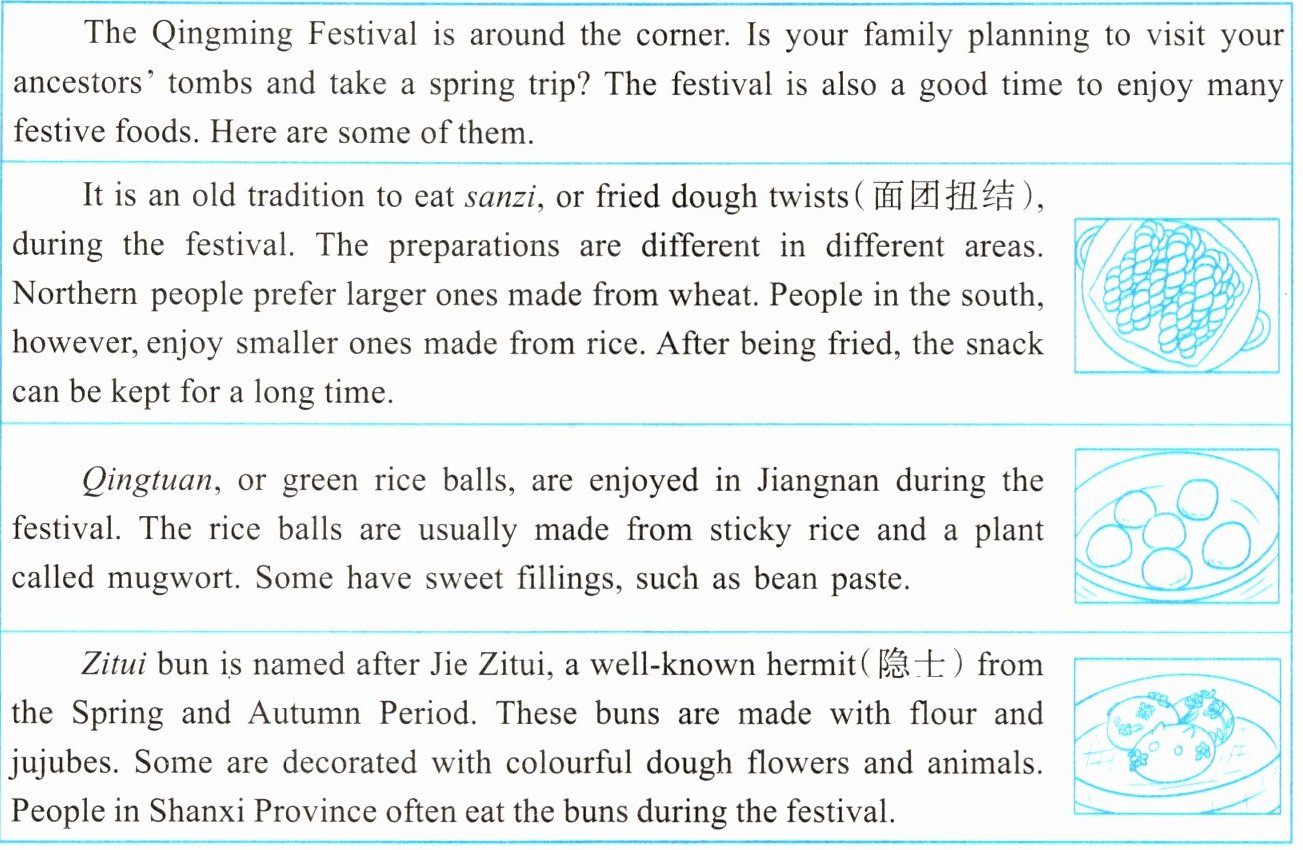
Qingtuan, or green rice balls, are enjoyed in Jiangnan during the festival. The rice balls are usually made from sticky rice and a plant called mugwort. Some have sweet fillings, such as bean paste.
Zitui bun is named after Jie Zitui, a well-known hermit(隐士) from the Spring and Autumn Period. These buns are made with flour and jujubes. Some are decorated with colourful dough flowers and animals. People in Shanxi Province often eat the buns during the festival.
(
A. Sanzi. B. Qingtuan. C. Zitui bun. D. Bean paste.
(
A. Because they are baked with jujubes.
B. Because they are put among leaves.
C. Because they are made from sticky rice.
D. Because they are fried during preparation.
(
A. How to Make Chinese Desserts
B. The History of the Qingming Festival
C. Spring Trips During Chinese Holidays
D. Traditional Qingming Festival Foods
4. If you could create a new flavour(口味) for qingtuan, what ingredients would you add?
The Qingming Festival is around the corner. Is your family planning to visit your ancestors’ tombs and take a spring trip? The festival is also a good time to enjoy many festive foods. Here are some of them.
It is an old tradition to eat sanzi, or fried dough twists(面团扭结), during the festival. The preparations are different in different areas. Northern people prefer larger ones made from wheat. People in the south, however, enjoy smaller ones made from rice. After being fried, the snack can be kept for a long time.
Qingtuan, or green rice balls, are enjoyed in Jiangnan during the festival. The rice balls are usually made from sticky rice and a plant called mugwort. Some have sweet fillings, such as bean paste.
Zitui bun is named after Jie Zitui, a well-known hermit(隐士) from the Spring and Autumn Period. These buns are made with flour and jujubes. Some are decorated with colourful dough flowers and animals. People in Shanxi Province often eat the buns during the festival.
(
C
)1. Which food is named after a famous historical person?A. Sanzi. B. Qingtuan. C. Zitui bun. D. Bean paste.
(
D
)2. Why can sanzi be stored for a long time?A. Because they are baked with jujubes.
B. Because they are put among leaves.
C. Because they are made from sticky rice.
D. Because they are fried during preparation.
(
D
)3. Which of the following might be the best title?A. How to Make Chinese Desserts
B. The History of the Qingming Festival
C. Spring Trips During Chinese Holidays
D. Traditional Qingming Festival Foods
4. If you could create a new flavour(口味) for qingtuan, what ingredients would you add?
If I could create a new flavour for qingtuan, I would add ingredients like red bean paste. Red bean paste adds sweetness.
答案
1. C 2. D 3. D
4. One possible version: If I could create a new flavour for qingtuan, I would add ingredients like red bean paste. Red bean paste adds sweetness.
4. One possible version: If I could create a new flavour for qingtuan, I would add ingredients like red bean paste. Red bean paste adds sweetness.
解析
【分析】
本题是关于清明节传统食物的阅读理解题,解题思路如下:1. 第1题是细节理解题,需定位原文中“以历史人物命名的食物”相关内容,匹配对应选项;2. 第2题是细节理解题,定位原文中关于sanzi可长期保存原因的句子,筛选正确选项;3. 第3题是主旨大意题,梳理全文核心内容,确定文章主题;4. 第4题是开放表达题,结合青团的现有原料,合理添加食材即可。
【解析】
1. 细节理解题:根据原文第三段第一句“Zitui bun is named after Jie Zitui, a well-known hermit from the Spring and Autumn Period.”可知,Zitui bun得名于历史人物介子推,对应选项C,故选C。
2. 细节理解题:根据原文第二段最后一句“After being fried, the snack can be kept for a long time.”可知,sanzi经过油炸后可长期保存,对应选项D,故选D。
3. 主旨大意题:全文主要介绍了清明节的三种传统食物(sanzi、青团、Zitui bun),核心主题是清明节传统食物,对应选项D,故选D。
4. 开放表达题:结合青团的现有原料(糯米、艾草),可添加常见食材,如红豆沙,增加甜味,符合要求即可,示例答案:If I could create a new flavour for qingtuan, I would add ingredients like red bean paste. Red bean paste adds sweetness.
【答案】
1. C 2. D 3. D
4. If I could create a new flavour for qingtuan, I would add ingredients like red bean paste. Red bean paste adds sweetness.
【知识点】
英语阅读理解、细节理解题、主旨大意题
【点评】
本题围绕清明节传统食物展开,涵盖细节理解、主旨大意和开放表达题型,贴近生活实际,既考查学生的信息定位与归纳能力,又能激发学生的思维,符合初中英语阅读理解的考查要求。
【难度系数】
0.6
Ⅵ. Think and say.
What dish can you make by yourself? Please introduce how to cook it to your classmate.
What dish can you make by yourself? Please introduce how to cook it to your classmate.
答案
One possible version:
One dish I can make by myself is scrambled eggs with tomatoes. Here’s how to cook it:
First, prepare some eggs and tomatoes. Beat the eggs in a bowl. Cut the tomatoes into small pieces. Next, heat some oil in a pan, pour in the beaten eggs and stir-fry until they are half-cooked. Then add the tomatoes and continue stir-frying. Add some salt and sugar to taste. Finally, serve the dish on a plate.
解析
【分析】
本题要求学生介绍自己会做的一道菜的烹饪方法,解题思路为:1. 选择一道熟悉、步骤简单的菜品(如番茄炒蛋);2. 用first、next、then、finally等顺序词串联“准备食材→处理食材→烹饪→调味→装盘”的逻辑;3. 用简单英语清晰说明每一步操作,符合日常表达习惯。
【解析】
本题为日常话题类表达题,需围绕“介绍菜品烹饪”展开:先点明菜品,再分步骤说明:第一步准备鸡蛋、番茄并处理食材(打蛋、切番茄);第二步炒至半熟的鸡蛋;第三步加番茄翻炒后调味;第四步装盘。用顺序词梳理逻辑,语言简洁易懂。
【答案】
One possible version: One dish I can make by myself is scrambled eggs with tomatoes. Here’s how to cook it: First, prepare some eggs and tomatoes. Beat the eggs in a bowl. Cut the tomatoes into small pieces. Next, heat some oil in a pan, pour in the beaten eggs and stir-fry until they are half-cooked. Then add the tomatoes and continue stir-frying. Add some salt and sugar to taste. Finally, serve the dish on a plate.
【知识点】
英语日常表达、步骤说明写作
【点评】
本题结合生活实际,考查学生用英语介绍日常操作的能力,贴近生活,易于学生发挥,能锻炼口语表达与逻辑组织能力。
【难度系数】
0.5
