

 登录
登录
一、[新趋势·多模态语篇]阅读图文,判断正(T)误(F)。
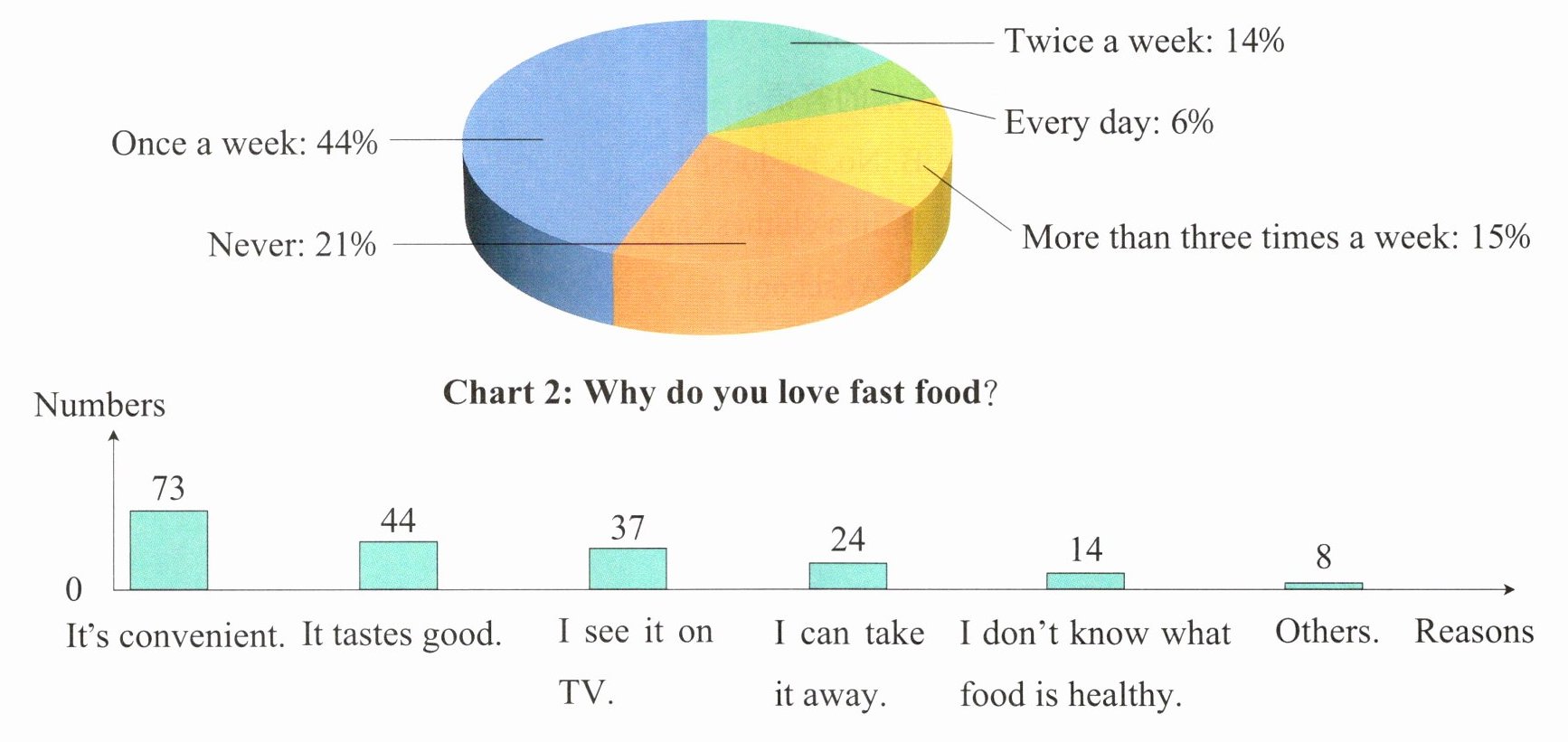
In the past, people always cooked at home. Now the life is different. People’s lifestyle changes too. Do you love fast food(快餐)? Why? How often do you eat it? Students in Class 2, Grade 6 did a survey. And here is the result.
Chart 1: How often do you eat fast food?
词汇积累 lifestyle /ˈlaɪfstaɪl/ 生活方式 taste /teɪst/ 尝起来
(
(
(
(
(
In the past, people always cooked at home. Now the life is different. People’s lifestyle changes too. Do you love fast food(快餐)? Why? How often do you eat it? Students in Class 2, Grade 6 did a survey. And here is the result.
Chart 1: How often do you eat fast food?
词汇积累 lifestyle /ˈlaɪfstaɪl/ 生活方式 taste /teɪst/ 尝起来
(
T
) 1. This is a survey of fast food.(
F
) 2. In the survey, 15 people eat fast food every day.(
F
) 3. In the survey, 42 people eat fast food.(
F
) 4. Many people know the fast food on the radio.(
F
) 5. There are 100 people in the survey in all(总共).答案
1—5 TFFFF
解析
【分析】
需结合图表信息和题目描述,逐一验证5个判断句的正误:先明确各图表的含义,Chart1是吃快餐的频率占比,Chart2是喜欢快餐的原因及对应人数,再对应每个小题的描述核对信息。
【解析】
1. 题目明确说明六年级二班学生做了关于快餐的调查,该句表述正确,填T;
2. Chart1显示每天吃快餐的占比为6%,15%是“More than three times a week”的占比,该句错误,填F;
3. Chart2中各原因人数总和为73+44+37+24+14+8=200,即总人数为200,吃快餐的人数远多于42,该句错误,填F;
4. Chart2中提到看到快餐的渠道是TV,不是radio,该句错误,填F;
5. Chart2总人数为200,不是100,该句错误,填F。
【答案】
TFFFF
【知识点】
图表信息解读;英语阅读理解
【点评】
本题为多模态语篇的判断正误题,需准确提取图表数据和信息,结合题目描述逐一验证,需细心核对细节。
【难度系数】
0.6
需结合图表信息和题目描述,逐一验证5个判断句的正误:先明确各图表的含义,Chart1是吃快餐的频率占比,Chart2是喜欢快餐的原因及对应人数,再对应每个小题的描述核对信息。
【解析】
1. 题目明确说明六年级二班学生做了关于快餐的调查,该句表述正确,填T;
2. Chart1显示每天吃快餐的占比为6%,15%是“More than three times a week”的占比,该句错误,填F;
3. Chart2中各原因人数总和为73+44+37+24+14+8=200,即总人数为200,吃快餐的人数远多于42,该句错误,填F;
4. Chart2中提到看到快餐的渠道是TV,不是radio,该句错误,填F;
5. Chart2总人数为200,不是100,该句错误,填F。
【答案】
TFFFF
【知识点】
图表信息解读;英语阅读理解
【点评】
本题为多模态语篇的判断正误题,需准确提取图表数据和信息,结合题目描述逐一验证,需细心核对细节。
【难度系数】
0.6
二、阅读短文,选择正确的答案。
My name is Amy. My hometown(家乡) changes a lot. Many years ago, it was a very poor vil- lage. There were no cars. People didn't have much money. There were no tall buildings. People lived in small houses. Some children had to work in the field. They couldn't go to school because their fami- lies were poor.
But now my village is very beautiful. There are some tall buildings and two squares. In the even- ing, some people go to the squares to dance or go for a walk after dinner. Square dancing is good for people's health. There is a big supermarket in my village too. I don't need to take my money while shopping. It's convenient to pay on our smartphones. I think life will be better and better(越来越好的).
(
A. town B. city C. village
(
A. Because there was no school.
B. Because they didn't want to go to school.
C. Because their family didn't have much money.
(
A. 可能的 B. 快速的 C. 方便的
(
A. mobile phones B. money C. telephones
(
A. There is no supermarket in Amy's village now.
B. Amy's hometown changes a lot.
C. Amy thinks people's life will be better and better.
My name is Amy. My hometown(家乡) changes a lot. Many years ago, it was a very poor vil- lage. There were no cars. People didn't have much money. There were no tall buildings. People lived in small houses. Some children had to work in the field. They couldn't go to school because their fami- lies were poor.
But now my village is very beautiful. There are some tall buildings and two squares. In the even- ing, some people go to the squares to dance or go for a walk after dinner. Square dancing is good for people's health. There is a big supermarket in my village too. I don't need to take my money while shopping. It's convenient to pay on our smartphones. I think life will be better and better(越来越好的).
(
C
) 1. When Amy was young, she lived in a .A. town B. city C. village
(
C
) 2. Why couldn't some children go to school?A. Because there was no school.
B. Because they didn't want to go to school.
C. Because their family didn't have much money.
(
C
) 3. The underlined word "convenient" means "" in Chinese.A. 可能的 B. 快速的 C. 方便的
(
B
) 4. People paid with in the village many years ago.A. mobile phones B. money C. telephones
(
A
) 5. Which one is NOT true?A. There is no supermarket in Amy's village now.
B. Amy's hometown changes a lot.
C. Amy thinks people's life will be better and better.
答案
1.C 2.C 3.C 4.B 5.A
解析
【分析】
解题时需先通读短文,理解Amy家乡今昔变化的内容,再针对每个题目定位短文中的对应语句,逐一比对选项,排除错误答案选出正确选项:第1题找Amy过去的居住地点,第2题找不能上学的原因,第3题结合语境猜测词义,第4题对比过去和现在的支付方式,第5题判断不符合短文内容的选项。
【解析】
1. 定位短文第一段关键句“Many years ago, it was a very poor village.”,可知Amy小时候居住在村庄,对应选项C。
2. 定位短文第一段末尾关键句“They couldn't go to school because their families were poor.”,可知不能上学的原因是家庭贫困,对应选项C。
3. 结合语境“don't need to take my money while shopping... pay on our smartphones”,可知“convenient”意为“方便的”,对应选项C。
4. 短文提到现在用智能手机支付,反推很多年前人们用钱支付,对应选项B。
5. 逐一核对选项:A选项称现在Amy的村庄没有超市,但短文第二段提到“There is a big supermarket in my village too.”,故A错误;B选项“家乡变化大”、C选项“生活越来越好”均符合短文内容,因此选A。
【答案】
1.C 2.C 3.C 4.B 5.A
【知识点】
英语阅读理解、细节信息提取、词义猜测
【点评】
本题围绕Amy家乡的今昔变化展开,重点考查学生从文本中定位细节、理解词义及判断正误的能力,题目设置基础,只要仔细阅读短文即可完成作答。
【难度系数】
0.7
解题时需先通读短文,理解Amy家乡今昔变化的内容,再针对每个题目定位短文中的对应语句,逐一比对选项,排除错误答案选出正确选项:第1题找Amy过去的居住地点,第2题找不能上学的原因,第3题结合语境猜测词义,第4题对比过去和现在的支付方式,第5题判断不符合短文内容的选项。
【解析】
1. 定位短文第一段关键句“Many years ago, it was a very poor village.”,可知Amy小时候居住在村庄,对应选项C。
2. 定位短文第一段末尾关键句“They couldn't go to school because their families were poor.”,可知不能上学的原因是家庭贫困,对应选项C。
3. 结合语境“don't need to take my money while shopping... pay on our smartphones”,可知“convenient”意为“方便的”,对应选项C。
4. 短文提到现在用智能手机支付,反推很多年前人们用钱支付,对应选项B。
5. 逐一核对选项:A选项称现在Amy的村庄没有超市,但短文第二段提到“There is a big supermarket in my village too.”,故A错误;B选项“家乡变化大”、C选项“生活越来越好”均符合短文内容,因此选A。
【答案】
1.C 2.C 3.C 4.B 5.A
【知识点】
英语阅读理解、细节信息提取、词义猜测
【点评】
本题围绕Amy家乡的今昔变化展开,重点考查学生从文本中定位细节、理解词义及判断正误的能力,题目设置基础,只要仔细阅读短文即可完成作答。
【难度系数】
0.7
