

 登录
Ⅶ.短文填空

Students in Shenzhen discover what life was like in ancient China.
In traditional history classes, students might find 1.
through the small, daily things in the past,” said Huang Ying, the 5.
The class is a mix of short 6.
“After taking this class, I realized that people in ancient times were 10.
Students in Shenzhen discover what life was like in ancient China.
In traditional history classes, students might find 1.
it
hard to remember the dry, hard-to-remember facts. However, to make history 2. easier
to understand, Shenzhen Foreign Languages School, Bao’an, has started a special course 3. called
Casual Talks on Ancient People’s Daily Life. In this course, students look at how people 4. lived
in ancient times, including their clothes, food, games and even pets. “We hope students can feel the warmth of historythrough the small, daily things in the past,” said Huang Ying, the 5.
course's
teacher.The class is a mix of short 6.
talks
, videos and hands-on activities. Students learn interesting stories that help them 7. see
historical people in a new way. For example, many might know that Lu You was a patriotic poet(爱国诗人), but fewer know that he also loved 8. raising
cats and even wrote poems about them. Students learn how ancient people spent their free time in the class. During a lesson on ancient sports, students played traditional games such as touhu and cuju. “I 9. was
surprised to see students start following traditional rules of manners after the lesson,” Huang said, “They used to boo(发墟声) one another during games, but now they show more respect.”“After taking this class, I realized that people in ancient times were 10.
hard-working
and showed a lot of wisdom in their daily lives, even without modern technology. I really admire(羡慕) them,” said 13-year-old Zhang Huajie.答案
1. it 2. easier 3. called 4. lived
5. course's 6. talks 7. see 8. raising
9. was 10. hard-working
5. course's 6. talks 7. see 8. raising
9. was 10. hard-working
解析
【分析】
本题为短文填空题型,需结合语境、固定搭配、语法规则,从给定词汇中选择合适词汇并变形填空。解题时先通读全文理解大意,再逐个分析空格的句子结构、所需词性及形式:1. 考查固定句型的形式宾语;2. 结合转折逻辑判断形容词比较级;3. 分析动词与名词的被动关系;4. 根据时态确定动词过去式;5. 用名词所有格表示所属关系;6. 并列名词的复数形式;7. 考查固定搭配的动词原形;8. 动名词作宾语;9. 一般过去时的be动词;10. 形容词作表语描述人物品质。
【解析】
1. 固定句型“find it + adj + to do sth”中,it作形式宾语,真正宾语是后面的不定式,故填it;
2. 由however转折可知,此处表示“让历史更容易理解”,用easy的比较级easier,故填easier;
3. “special course”与“call”是被动关系,用过去分词called作定语修饰course,故填called;
4. 描述古代人的生活,时态为一般过去时,live的过去式是lived,故填lived;
5. 表示“课程的老师”,用名词所有格course's,故填course's;
6. 与short、videos、activities并列,talk表示“谈话”,需用复数形式talks,故填talks;
7. 考查固定搭配help sb do sth,用动词原形see,故填see;
8. 考查固定搭配love doing sth,raise的动名词是raising,故填raising;
9. 主语是I,时态为一般过去时,be动词用was,故填was;
10. 描述古代人的品质,用给定的形容词hard-working,故填hard-working。
【答案】
1. it 2. easier 3. called 4. lived
5. course's 6. talks 7. see 8. raising
9. was 10. hard-working
【知识点】
固定句型;动词形式变化;名词所有格;形容词比较级
【点评】
本题考查词汇在语境中的综合运用,需结合语法规则和上下文逻辑变形词汇,难度适中,能有效考查学生的词汇掌握与语境分析能力。
【难度系数】
0.6
Ⅰ.听选答案
第一节:听下面10段对话,每段对话后有一个问题,读两遍。请根据每段对话的内容和后面的问题,从所给的三个选项中选出问题的正确答案。
1. A.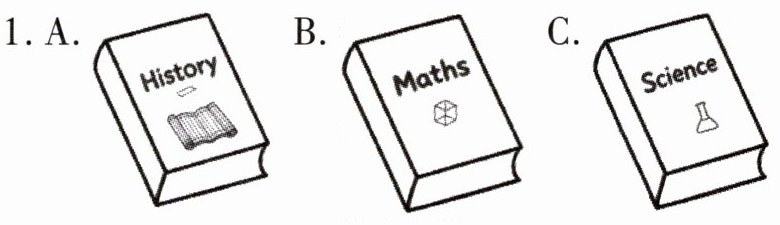 B. C.
2. A.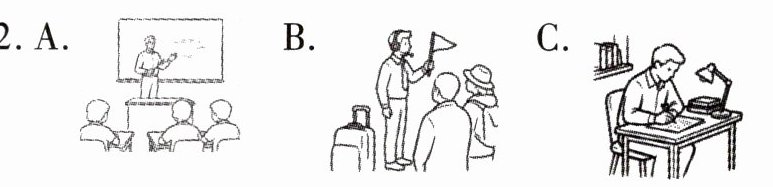 B. C.
3. A. In a library. B. In a museum. C. In a classroom.
4. A. Because it’s difficult. B. Because it’s easy. C. Because it’s interesting.
5. A. Read history books. B. Visit the history museum. C. Watch a history movie.
6. A. Boring. B. Great. C. Tiring.
7. A. A map. B. A book. C. A picture.
8. A. Learn from mistakes. B. Learn from the future. C. Learn from the past.
9. A. Writing skills. B. Speaking skills. C. Research skills.
10. A. The Giant Wild Goose Pagoda. B. The Terracotta Warriors and Horses. C. The City Wall of Xi’an.
第一节:听下面10段对话,每段对话后有一个问题,读两遍。请根据每段对话的内容和后面的问题,从所给的三个选项中选出问题的正确答案。
1. A.
B. C.2. A.
B. C.3. A. In a library. B. In a museum. C. In a classroom.
4. A. Because it’s difficult. B. Because it’s easy. C. Because it’s interesting.
5. A. Read history books. B. Visit the history museum. C. Watch a history movie.
6. A. Boring. B. Great. C. Tiring.
7. A. A map. B. A book. C. A picture.
8. A. Learn from mistakes. B. Learn from the future. C. Learn from the past.
9. A. Writing skills. B. Speaking skills. C. Research skills.
10. A. The Giant Wild Goose Pagoda. B. The Terracotta Warriors and Horses. C. The City Wall of Xi’an.
答案
1. A 2. B 3. B 4. C 5. B 6. B 7. A 8. C 9. C 10. A
