

 登录
登录
听第一段对话,回答第11至12小题。
(
A. The living room. B. The garden. C. The study.
(
A. To read interesting books. B. To enjoy the sunshine. C. To have fun with her catt.
(
C
)11. What's Nora's favourite place at her home?A. The living room. B. The garden. C. The study.
(
A
)12. What does Nora like to do there?A. To read interesting books. B. To enjoy the sunshine. C. To have fun with her catt.
答案
11.C 12.A
解析
【分析】做这类听力选择题时,先快速浏览题目与选项,预判听力材料围绕“Nora家最喜欢的地方及对应活动”展开;听第一段对话时,重点捕捉与“Nora favourite home place”相关的场所关键词,以及该场所的活动描述,匹配选项即可得出答案。
【解析】本题为听力理解细节题,根据听力原文内容:第11小题中Nora明确表示最喜欢的家的地方是书房,对应选项C;第12小题中Nora说明在该场所喜欢做的事是读有趣的书,对应选项A。
【答案】11.C 12.A
【知识点】听力理解、日常话题
【点评】本题属于基础听力细节题,要求学生抓取听力关键信息,提前预判选项可提升答题准确率,适合日常听力练习巩固。
【难度系数】0.7
【解析】本题为听力理解细节题,根据听力原文内容:第11小题中Nora明确表示最喜欢的家的地方是书房,对应选项C;第12小题中Nora说明在该场所喜欢做的事是读有趣的书,对应选项A。
【答案】11.C 12.A
【知识点】听力理解、日常话题
【点评】本题属于基础听力细节题,要求学生抓取听力关键信息,提前预判选项可提升答题准确率,适合日常听力练习巩固。
【难度系数】0.7
听第一篇短文,完成第13至15小题。

(
(
(
(
C
)13. A. culture B. history C. art(
B
)14. A. Wool B. Silk C. Cotton(
A
)15. A. smooth B. soft C. warm答案
13.C 14.B 15.A
解析
【分析】本题为听力理解题,需结合听力原文内容,分析每个小题的语境与选项的匹配关系:13题需明确国画对应的中国领域,国画属于艺术范畴;14题需选择符合“文化象征”的围巾类型;15题需匹配丝绸围巾的触感形容词。
【解析】13题:国画是中国传统艺术形式,因此从国画中可了解中国艺术,对应选项C;14题:丝绸围巾是中国文化的典型象征,契合题目中“great culture”的描述,对应选项B;15题:丝绸围巾的触感为光滑,与“comfortable(舒适的)”语义匹配,对应选项A。
【答案】13.C 14.B 15.A
【知识点】听力理解、文化类词汇、形容词辨析
【点评】本题围绕中国特色礼物展开,考查听力信息抓取与词汇搭配,难度适中,需准确捕捉听力中的关键描述。
【难度系数】0.6
【解析】13题:国画是中国传统艺术形式,因此从国画中可了解中国艺术,对应选项C;14题:丝绸围巾是中国文化的典型象征,契合题目中“great culture”的描述,对应选项B;15题:丝绸围巾的触感为光滑,与“comfortable(舒适的)”语义匹配,对应选项A。
【答案】13.C 14.B 15.A
【知识点】听力理解、文化类词汇、形容词辨析
【点评】本题围绕中国特色礼物展开,考查听力信息抓取与词汇搭配,难度适中,需准确捕捉听力中的关键描述。
【难度系数】0.6
听第二篇短文,完成第16至20小题。
(
A. Because being too heavy is popular.
B. Because being too heavy causes health problems.
C. Because people want to look thin.
(
A. Western medicine.
B. Traditional Chinese medicine.
C. Sports equipment.
(
A. Sports parks.
B. Weight clinics.
C. New hospitals.
(
A. Food with more sugar and oil.
B. Food with less sugar and oil.
C. Food with only chicken and fish.
(
A. Only losing weight.
B. Eating well, moving more and feeling happy.
C. Just eating healthy snacks.
(
B
)16. Why does China make a plan to solve the weight problem?A. Because being too heavy is popular.
B. Because being too heavy causes health problems.
C. Because people want to look thin.
(
B
)17. What do doctors use to help people lose weight safely in the clinics?A. Western medicine.
B. Traditional Chinese medicine.
C. Sports equipment.
(
A
)18. What do many cities build for people to do exercise?A. Sports parks.
B. Weight clinics.
C. New hospitals.
(
B
)19. What kind of food are people choosing now?A. Food with more sugar and oil.
B. Food with less sugar and oil.
C. Food with only chicken and fish.
(
B
)20. What does keeping healthy mean according to the passage?A. Only losing weight.
B. Eating well, moving more and feeling happy.
C. Just eating healthy snacks.
答案
16.B 17.B 18.A 19.B 20.B
解析
【分析】
本题为英语听力短文理解题,解题思路如下:1. 提前浏览16-20题的题干与选项,预判短文主题围绕中国解决体重问题的相关措施及健康理念;2. 听短文时,针对各小题的问题抓取对应细节信息:16题关注中国制定减重计划的原因,17题关注诊所安全减重的手段,18题关注城市为锻炼建的设施,19题关注人们现在选择的食物类型,20题关注健康的含义;3. 听完后核对选项与听到的细节,选出匹配的答案。
【解析】
16题:短文提到超重会引发健康问题,因此中国制定减重计划,对应选项B;
17题:文中说明诊所帮助安全减重使用的是传统中药,对应选项B;
18题:许多城市修建运动公园供人们锻炼,对应选项A;
19题:现在人们选择少糖少油的食物,对应选项B;
20题:短文指出健康意味着吃好、多运动且心情愉悦,对应选项B。
【答案】
16.B 17.B 18.A 19.B 20.B
【知识点】
英语听力理解、短文细节抓取
【点评】
本题考查英语听力短文的细节信息捕捉,题目均为基础细节题,只要认真听辨短文内容即可正确作答,难度适中。
【难度系数】
0.8
本题为英语听力短文理解题,解题思路如下:1. 提前浏览16-20题的题干与选项,预判短文主题围绕中国解决体重问题的相关措施及健康理念;2. 听短文时,针对各小题的问题抓取对应细节信息:16题关注中国制定减重计划的原因,17题关注诊所安全减重的手段,18题关注城市为锻炼建的设施,19题关注人们现在选择的食物类型,20题关注健康的含义;3. 听完后核对选项与听到的细节,选出匹配的答案。
【解析】
16题:短文提到超重会引发健康问题,因此中国制定减重计划,对应选项B;
17题:文中说明诊所帮助安全减重使用的是传统中药,对应选项B;
18题:许多城市修建运动公园供人们锻炼,对应选项A;
19题:现在人们选择少糖少油的食物,对应选项B;
20题:短文指出健康意味着吃好、多运动且心情愉悦,对应选项B。
【答案】
16.B 17.B 18.A 19.B 20.B
【知识点】
英语听力理解、短文细节抓取
【点评】
本题考查英语听力短文的细节信息捕捉,题目均为基础细节题,只要认真听辨短文内容即可正确作答,难度适中。
【难度系数】
0.8
Ⅱ. 完形填空。(共10小题,计10分)
阅读下面短文,掌握其大意,然后从各题所给的四个选项中选出一个最佳答案。
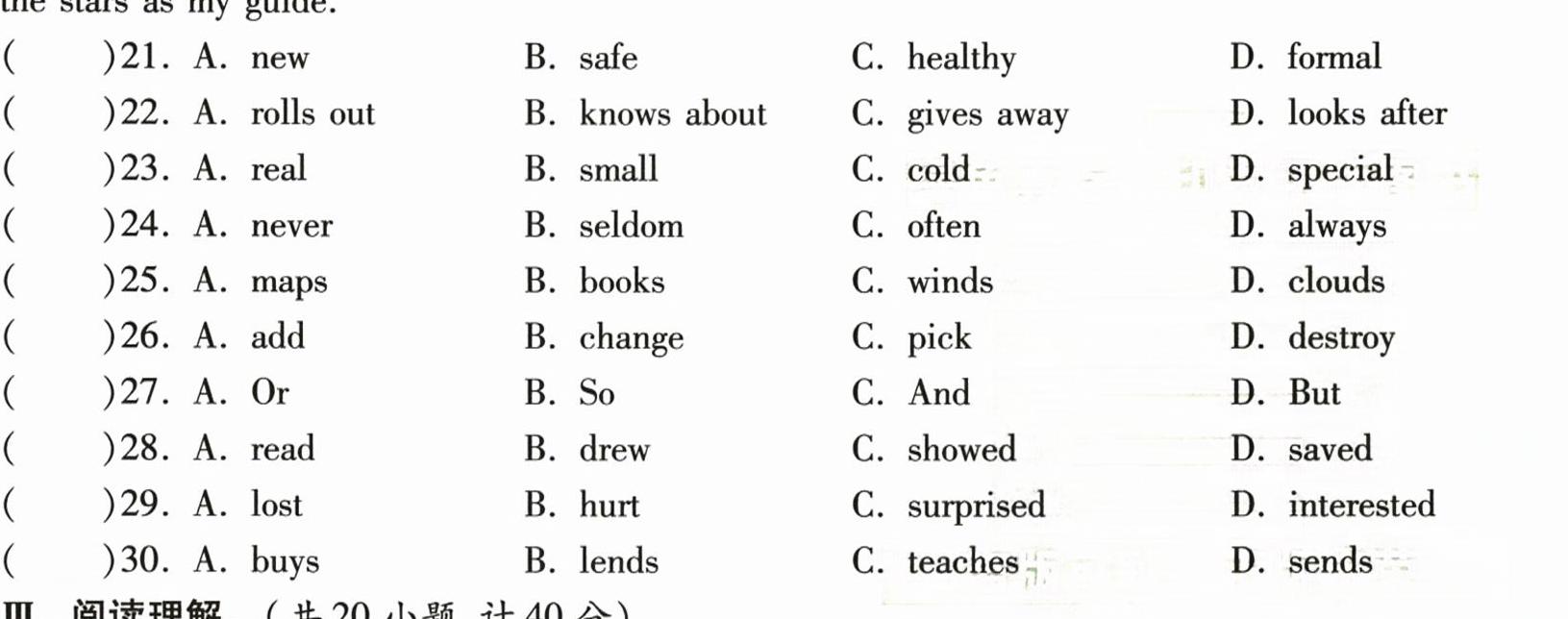
$Every summer, I visit my grandfather for two weeks. I always learn something \underline{21} and I always have fun.$
$My grandfather almost \underline{22} everything on the farm. One summer, he showed me how to make a fire without using matches. Another summer, he told me the names of the flowers along the path. And this summer, he showed me how to find one \underline{23} star. My grandfather said I could \underline{24} know my way around with its help.$
$“What a great idea!” I thought. I could find my way without using \underline{25} or smartphones. I was so excited about it. Grandfather told me how all the stars in the sky \underline{26} places through the night. They even move in different seasons of the year. \underline{27} there is one unusual star that always sits in the sky in the same place.$
After reading about the Milky Way(银河$) and the night sky, Grandfather said it was time to go out and take a look. The night on the farm was dark. There were millions of stars in the sky. Grandfather \underline{28} me one group of stars called the Big Dipper. “See it there,” he said. “It looks like a dipper for drinking water. Follow a line from the edge($边缘$) of the dipper. It leads to the North Star. It always points to the north. If you can find it, you will never be \underline{29} in your life.” It took me some time to find it. But there it was—the North Star!$
$My grandfather \underline{30} me the most wonderful things in the world. Now I know how to find my way using the stars as my guide.$
阅读下面短文,掌握其大意,然后从各题所给的四个选项中选出一个最佳答案。
$Every summer, I visit my grandfather for two weeks. I always learn something \underline{21} and I always have fun.$
$My grandfather almost \underline{22} everything on the farm. One summer, he showed me how to make a fire without using matches. Another summer, he told me the names of the flowers along the path. And this summer, he showed me how to find one \underline{23} star. My grandfather said I could \underline{24} know my way around with its help.$
$“What a great idea!” I thought. I could find my way without using \underline{25} or smartphones. I was so excited about it. Grandfather told me how all the stars in the sky \underline{26} places through the night. They even move in different seasons of the year. \underline{27} there is one unusual star that always sits in the sky in the same place.$
After reading about the Milky Way(银河$) and the night sky, Grandfather said it was time to go out and take a look. The night on the farm was dark. There were millions of stars in the sky. Grandfather \underline{28} me one group of stars called the Big Dipper. “See it there,” he said. “It looks like a dipper for drinking water. Follow a line from the edge($边缘$) of the dipper. It leads to the North Star. It always points to the north. If you can find it, you will never be \underline{29} in your life.” It took me some time to find it. But there it was—the North Star!$
$My grandfather \underline{30} me the most wonderful things in the world. Now I know how to find my way using the stars as my guide.$
答案
21 A 【解析】考查形容词。根据“Every summer, I visit my grandfather for two weeks. I always learn something...and I always have fun.”并结合后文爷爷教“我”生火、认花、找星星等新技能可知,是学到“新的”知识,故选A。
22 B 【解析】考查动词短语。根据“One summer, he showed me how to make a fire without using matches...the names of the flowers along the path.”可知,爷爷对农场的事情了解很多,故选B。
23 D 【解析】考查形容词。根据“I could...know my way around with its help”可知,这颗星星可以给作者指路,所以它是特殊的,故选D。
24 D 【解析】考查副词。根据“know my way around with its help”及下文“It leads to...to the north.”可知,北极星总是指向北方,这会让作者“总是”能找到自己的路,故选D。
25 A 【解析】考查名词。根据“I could find my way without using...or smartphones.”以及结合生活常识可知,找路常用“地图”,这里是说借助星星的指引,不用“地图”也能找到路,故选A。
26 B 【解析】考查动词。根据“They even move in different seasons of the year.”可知,它们甚至在一年的不同季节移动。由此可知,星星的位置会发生改变,故选B。
27 D 【解析】考查连词。前文“They even move in different seasons of the year.”与后文“there is one unusual star that always sits in the sky in the same place”是转折关系,“But(但是)”表转折,符合逻辑,故选D。
28 C 【解析】考查动词。根据“it was time to go out and take a look”可知,此时爷爷和作者在室外观星,所以是将星星指给作者看,show sb. sth.“向某人展示某物”,故选C。
29 A 【解析】考查形容词。根据“It always points to the north.”可知,北极星永远指向北方,所以找到它就不会迷路,故选A。
30 C 【解析】考查动词。根据“Every summer, I visit my grandfather for two weeks. I always learn something...”和从全文来看,爷爷教“我”生火、认花、找星星等很多知识,此处指爷爷总是教给作者很多知识,故选C。
22 B 【解析】考查动词短语。根据“One summer, he showed me how to make a fire without using matches...the names of the flowers along the path.”可知,爷爷对农场的事情了解很多,故选B。
23 D 【解析】考查形容词。根据“I could...know my way around with its help”可知,这颗星星可以给作者指路,所以它是特殊的,故选D。
24 D 【解析】考查副词。根据“know my way around with its help”及下文“It leads to...to the north.”可知,北极星总是指向北方,这会让作者“总是”能找到自己的路,故选D。
25 A 【解析】考查名词。根据“I could find my way without using...or smartphones.”以及结合生活常识可知,找路常用“地图”,这里是说借助星星的指引,不用“地图”也能找到路,故选A。
26 B 【解析】考查动词。根据“They even move in different seasons of the year.”可知,它们甚至在一年的不同季节移动。由此可知,星星的位置会发生改变,故选B。
27 D 【解析】考查连词。前文“They even move in different seasons of the year.”与后文“there is one unusual star that always sits in the sky in the same place”是转折关系,“But(但是)”表转折,符合逻辑,故选D。
28 C 【解析】考查动词。根据“it was time to go out and take a look”可知,此时爷爷和作者在室外观星,所以是将星星指给作者看,show sb. sth.“向某人展示某物”,故选C。
29 A 【解析】考查形容词。根据“It always points to the north.”可知,北极星永远指向北方,所以找到它就不会迷路,故选A。
30 C 【解析】考查动词。根据“Every summer, I visit my grandfather for two weeks. I always learn something...”和从全文来看,爷爷教“我”生火、认花、找星星等很多知识,此处指爷爷总是教给作者很多知识,故选C。
解析
【分析】
这是一篇记叙文类完形填空,解题思路如下:1. 先通读全文,把握文章主旨:作者每年夏天与祖父相处,学习用星星指路的技能,收获知识与乐趣;2. 逐题分析时,结合上下文语境、词汇的词义辨析、固定搭配等知识,逐一筛选最佳选项;3. 完成所有题目后,再次通读全文,验证答案是否符合文意与逻辑。
【解析】
21. 考查形容词词义辨析。根据后文祖父教“我”生火、认花、找星星等新内容,可知此处指学到“新的”知识,故选A。
22. 考查动词短语辨析。根据后文祖父教“我”农场相关的多种技能,可知祖父了解农场的一切,knows about(了解)符合语境,故选B。
23. 考查形容词词义辨析。根据后文“我能借助它找到路”,可知这颗星星是“特殊的”,故选D。
24. 考查副词词义辨析。根据北极星总是指向北方的常识,可知它能让“我”“总是”找到路,故选D。
25. 考查名词词义辨析。结合找路的常识,不用地图或智能手机也能借助星星指路,maps(地图)符合语境,故选A。
26. 考查动词词义辨析。根据后文“它们在一年不同季节移动”,可知星星的位置会“改变”,故选B。
27. 考查连词用法。前文说星星会移动,后文说有一颗星星位置不变,是转折关系,But(但是)符合逻辑,故选D。
28. 考查动词词义辨析。祖父带“我”观星,将星星指给“我”看,show sb. sth.(向某人展示某物)符合语境,故选C。
29. 考查形容词词义辨析。北极星指向北方,找到它就不会“迷路”,lost(迷路的)符合语境,故选A。
30. 考查动词词义辨析。祖父教“我”生火、认花、找星星等知识,teaches(教)符合语境,故选C。
【答案】
21.A 22.B 23.D 24.D 25.A 26.B 27.D 28.C 29.A 30.C
【知识点】
形容词词义辨析、动词短语辨析、连词用法
【点评】
本文是一篇贴近学生生活的记叙文,讲述作者与祖父相处时学习用星星指路的经历,既考查学生对词汇的掌握,又考查学生对上下文语境的理解能力,是典型的初中完形填空题目。
【难度系数】
0.6
这是一篇记叙文类完形填空,解题思路如下:1. 先通读全文,把握文章主旨:作者每年夏天与祖父相处,学习用星星指路的技能,收获知识与乐趣;2. 逐题分析时,结合上下文语境、词汇的词义辨析、固定搭配等知识,逐一筛选最佳选项;3. 完成所有题目后,再次通读全文,验证答案是否符合文意与逻辑。
【解析】
21. 考查形容词词义辨析。根据后文祖父教“我”生火、认花、找星星等新内容,可知此处指学到“新的”知识,故选A。
22. 考查动词短语辨析。根据后文祖父教“我”农场相关的多种技能,可知祖父了解农场的一切,knows about(了解)符合语境,故选B。
23. 考查形容词词义辨析。根据后文“我能借助它找到路”,可知这颗星星是“特殊的”,故选D。
24. 考查副词词义辨析。根据北极星总是指向北方的常识,可知它能让“我”“总是”找到路,故选D。
25. 考查名词词义辨析。结合找路的常识,不用地图或智能手机也能借助星星指路,maps(地图)符合语境,故选A。
26. 考查动词词义辨析。根据后文“它们在一年不同季节移动”,可知星星的位置会“改变”,故选B。
27. 考查连词用法。前文说星星会移动,后文说有一颗星星位置不变,是转折关系,But(但是)符合逻辑,故选D。
28. 考查动词词义辨析。祖父带“我”观星,将星星指给“我”看,show sb. sth.(向某人展示某物)符合语境,故选C。
29. 考查形容词词义辨析。北极星指向北方,找到它就不会“迷路”,lost(迷路的)符合语境,故选A。
30. 考查动词词义辨析。祖父教“我”生火、认花、找星星等知识,teaches(教)符合语境,故选C。
【答案】
21.A 22.B 23.D 24.D 25.A 26.B 27.D 28.C 29.A 30.C
【知识点】
形容词词义辨析、动词短语辨析、连词用法
【点评】
本文是一篇贴近学生生活的记叙文,讲述作者与祖父相处时学习用星星指路的经历,既考查学生对词汇的掌握,又考查学生对上下文语境的理解能力,是典型的初中完形填空题目。
【难度系数】
0.6
