

 登录
登录
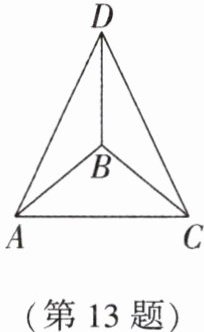
13. 如图,在$△ ABC$中,$AB=BC$,$∠ ABC=100°$,边$BA$绕点$B$顺时针旋转$m°(0<m<180)$得到线段$BD$,连接$AD,DC$,若$△ ADC$为等腰三角形,则$m$所有可能的取值是
130 或 100 或 160
.答案
13. 130 或 100 或 160 解析:由旋转可得$BD=AB=BC$.$\because △ ADC$为等腰三角形,$\therefore$ 分三种情况讨论.①当$DA=DC$时,$∠ ABD=∠ CBD=\dfrac{1}{2}(360°-∠ ABC)=130°$,$\therefore m=130$.②当$AD=AC$时,$∠ ABD=∠ ABC=100°$,$\therefore m=100$.③当$CA=CD$时,$∠ CBD=∠ ABC=100°$,$\therefore ∠ ABD=360°-100°-100°=160°$,$\therefore m=160$.综上所述,$m$所有可能的取值为 130 或 100 或 160.
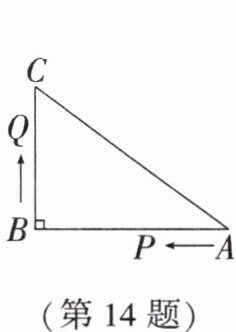
14. (2026·营口校级月考) 如图, 在 $△ ABC$ 中,
$∠ B=90°, AB=16\ \mathrm{cm}, BC=12\ \mathrm{cm}, AC=20\ \mathrm{cm}$,
$P, Q$ 是 $△ ABC$ 边上的两个动点, 其中点 $P$ 从点 $A$ 开始沿 $A\to B$ 方向运动, 且速度为每秒$1\ \mathrm{cm}$, 点 $Q$ 从点 $B$ 开始沿 $BC\to CA$ 方向运动,且速度为每秒 $2\ \mathrm{cm}$, $P, Q$ 两点同时出发, 当点 $P$ 运动到点 $B$ 时两点停止运动, 设运动时间为 $t$ 秒. 当点 $Q$ 在边 $CA$ 上运动, $△ BCQ$ 是以 $BC$ 或 $BQ$ 为底边的等腰三角形时,
$t=$
$∠ B=90°, AB=16\ \mathrm{cm}, BC=12\ \mathrm{cm}, AC=20\ \mathrm{cm}$,
$P, Q$ 是 $△ ABC$ 边上的两个动点, 其中点 $P$ 从点 $A$ 开始沿 $A\to B$ 方向运动, 且速度为每秒$1\ \mathrm{cm}$, 点 $Q$ 从点 $B$ 开始沿 $BC\to CA$ 方向运动,且速度为每秒 $2\ \mathrm{cm}$, $P, Q$ 两点同时出发, 当点 $P$ 运动到点 $B$ 时两点停止运动, 设运动时间为 $t$ 秒. 当点 $Q$ 在边 $CA$ 上运动, $△ BCQ$ 是以 $BC$ 或 $BQ$ 为底边的等腰三角形时,
$t=$
11 或 12
.答案
14. 11 或 12 解析:设运动时间为$t$秒.由题意可知,当点$P$运动到点$B$时两点停止运动,则$0≤ t≤ 16$,当点$Q$在边$CA$上运动时,此时$6≤ t≤ 16$,①当$△ BCQ$是以$BC$为底边的等腰三角形时,$BQ=CQ$,如图①所示,则$∠ C=∠ CBQ$,$\because ∠ ABC=90°$,$\therefore ∠ CBQ+∠ ABQ=90°$,$∠ A+∠ C=90°$.$\therefore ∠ A=∠ ABQ$,$\therefore BQ=AQ$,$\therefore CQ=AQ=\dfrac{1}{2}AC=10\ \mathrm{cm}$,$\therefore BC+CQ=22\ \mathrm{cm}$,$\therefore t=22÷2=11$(秒);②当$△ BCQ$是以$BQ$为底边的等腰三角形时,$CQ=BC$,如图②所示,则$BC+CQ=24\ \mathrm{cm}$,$\therefore t=24÷2=12$(秒).故答案为 11 或 12.
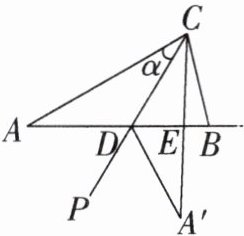
15. (泰州中考) 如图, $△ A B C$ 中, $A B=A C, ∠ A=30°$, 射线 $C P$ 从射线 $C A$ 开始绕点 $C$ 逆时针旋转 $α(0°<α<75°)$, 与射线 $A B$ 相交于点 $D$, 将 $△ A C D$ 沿射线 $C P$ 翻折至 $△ A' C D$ 处, 射线 $C A'$ 与射线 $A B$ 相交于点 $E$. 若 $△ A' D E$ 是等腰三角形, 则 $α$ 的度数为
$45°$或$22.5°$或$67.5°$
.答案
15. $45°$或$22.5°$或$67.5°$ 解析:由翻折得$∠ CA'D=∠ A=30°$,$∠ ACD=∠ A'CD=α$,$\therefore ∠ ACE=2α$.$\because AB=AC$,$∠ A=30°$,$\therefore ∠ ACB=∠ ABC=\dfrac{180°-∠ A}{2}=75°$.当$DE=A'E$时,如图①,$\therefore ∠ A'DE=∠ A'=30°$,$\therefore ∠ AEC=∠ A'DE+∠ A'=60°$.在$△ ACE$中,$\because ∠ A+∠ ACE+∠ AEC=180°$,$\therefore 30°+2α+60°=180°$,$\therefore α=45°$.当$DE=DA'$时,则$∠ DEA'=∠ A'=30°$.$\because ∠ A=30°$,$\therefore ∠ DEA'=∠ A$,$\therefore AC// A'E$,这与$AC$与$A'E$交于点$C$矛盾,这种情形不存在,舍去.当$A'E=A'D$时,有两种情形:一是点$E$在线段$AB$上时,如图②,$\therefore ∠ A'DE=∠ A'ED=\dfrac{180°-∠ A'}{2}=75°$,$\therefore ∠ AEC=180°-∠ A'ED=105°$. 在$△ ACE$中,$\because ∠ A+∠ ACE+∠ AEC=180°$,$\therefore 30°+2α+105°=180°$,$\therefore α=22.5°$.二是点$E$在线段$AB$的延长线上时,如图③,$\therefore ∠ A'DE=∠ A'ED$.又$\because ∠ A'DE+∠ A'ED=∠ CA'D=30°$,$\therefore ∠ A'ED=15°$.在$△ ACE$中,$\because ∠ A+∠ ACE+∠ AEC=180°$,$\therefore 30°+2α+15°=180°$,$\therefore α=67.5°$.综上所述,$∠ α$的度数为$45°$或$22.5°$或$67.5°$.
16. (苏州中考)定义:一个三角形的一边长是另一边长的2倍,这样的三角形叫作“倍长三角形”.若等腰$△ ABC$是“倍长三角形”,底边$BC$的长为3,则腰$AB$的长为
6
.答案
16. 6 解析:$\because △ ABC$是等腰三角形,底边$BC=3$,$\therefore AB=AC$.当$AB=AC=2BC$时,$△ ABC$是“倍长三角形”;当$BC=2AB=2AC$时,$AB+AC=BC$,根据三角形三边关系,此时构不成三角形,不符合题意,$\therefore$ 当等腰$△ ABC$是“倍长三角形”,底边$BC$的长为 3 时,腰$AB$的长为 6.
17. 新趋势 新定义 【定义】数学课上,陈老师对我们说,如果1条线段将一个三角形分成2个等腰三角形,那么这1条线段就称为这个三角形的“好线”,如果2条线段将一个三角形分成3个等腰三角形,那么这2条线段就称为这个三角形的“好好线”.
【理解】(1) 如图①,在$△ ABC$中,$∠ A=27°$,$∠ C=72°$,请你在这个三角形中画出它的“好线”,并标出等腰三角形顶角的度数.
(2) 如图②,已知$△ ABC$是一个顶角为$45°$的等腰三角形,请你在这个三角形中画出它的“好好线”,并标出所分得的等腰三角形底角的度数.
【应用】(3) 在$△ ABC$中,已知一个内角为$42°$,若它只有“好线”,请你写出这个三角形最大内角的所有可能值:
(4) 在$△ ABC$中,$∠ C=27°$,$AD$和$DE$分别是$△ ABC$的“好好线”,点$D$在$BC$边上,点$E$在$AB$边上,且$AD=DC$,$BE=DE$,请你根据题意画出示意图,并求$∠ B$的度数.
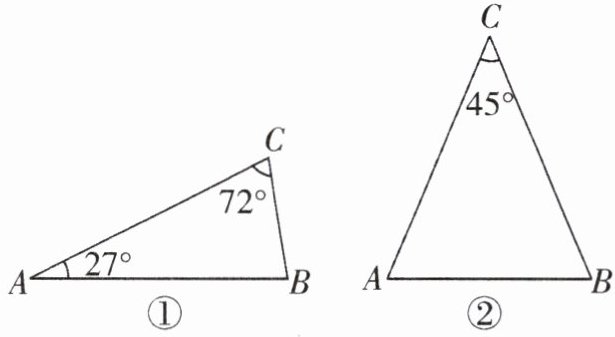
【理解】(1) 如图①,在$△ ABC$中,$∠ A=27°$,$∠ C=72°$,请你在这个三角形中画出它的“好线”,并标出等腰三角形顶角的度数.
(2) 如图②,已知$△ ABC$是一个顶角为$45°$的等腰三角形,请你在这个三角形中画出它的“好好线”,并标出所分得的等腰三角形底角的度数.
【应用】(3) 在$△ ABC$中,已知一个内角为$42°$,若它只有“好线”,请你写出这个三角形最大内角的所有可能值:
$84°$,$117°$,$124°$,$103.5°$,$126°$
.(4) 在$△ ABC$中,$∠ C=27°$,$AD$和$DE$分别是$△ ABC$的“好好线”,点$D$在$BC$边上,点$E$在$AB$边上,且$AD=DC$,$BE=DE$,请你根据题意画出示意图,并求$∠ B$的度数.
答案
17. (1)如图所示.
(2)如图所示(任选一种即可).
(3)$84°$,$117°$,$124°$,$103.5°$,$126°$ 解析:如图①,$AD=CD$,$CD=BC$,$∠ A=42°$,则$△ ACD$和$△ BCD$都是等腰三角形,$\therefore ∠ B=84°$,$∠ ACB=54°$,$\therefore$ 最大内角为$84°$.如图②,$AD=BD$,$BD=CD$,$∠ A=42°$,则$△ ABD$和$△ BCD$都是等腰三角形,$\therefore ∠ ABC=90°$,$∠ C=48°$,$\therefore$ 最大内角为$90°$,但此时$△ ABC$既有“好线”又有“好好线”,应舍去.如图③,$AB=AD$,$BD=CD$,$∠ A=42°$,则$△ ABD$和$△ BCD$都是等腰三角形,$\therefore ∠ ABC=103.5°$,$∠ C=34.5°$,$\therefore$ 最大内角为$103.5°$.如图④,$AB=BD$,$BD=CD$,$∠ A=42°$,则$△ ABD$和$△ BCD$都是等腰三角形,$\therefore ∠ ABC=117°$,$∠ C=21°$,$\therefore$ 最大内角为$117°$.如图⑤,$AB=BD$,$AD=CD$,$∠ BAC=42°$,则$△ ABD$和$△ ADC$都是等腰三角形,$\therefore ∠ B=124°$,最大内角为$124°$.如图⑥,$AD=BD$,$BC=CD$,$∠ A=42°$,则$△ ABD$和$△ BCD$都是等腰三角形,$\therefore ∠ ABC=126°$,$∠ C=12°$,$\therefore$ 最大内角为$126°$.综上,$△ ABC$中最大内角的所有可能值为$84°$,$117°$,$124°$,$103.5°$,$126°$.
(4) 如图 ⑦, 当$DA=DE$时, 又$AD=DC$,$BE=DE$,$\therefore ∠ CAD=∠ C=27°$. 设$∠ B=x$, 则$∠ BDE=x$,$∠ BAD=∠ AED=2x$.$\because ∠ B+∠ C+∠ BAC=180°$,$\therefore x+27°+2x+27°=180°$, 解得$x=42°$,$\therefore ∠ B=42°$. 如图 ⑧, 当$AD=AE$时,$\because AD=CD$,$BE=DE$,$\therefore ∠ CAD=∠ C=27°$. 设$∠ B=x$, 则$∠ BDE=x$,$∠ ADE=∠ AED=2x$. 又$∠ ADB=∠ DAC+∠ C=54°$,$∠ ADB=∠ ADE+∠ BDE=3x$,$\therefore 3x=54°$, 解得$x=18°$,$\therefore ∠ B=18°$. 如图 ⑨, 当$AE=DE$时, 又$BE=DE$,$\therefore ∠ ADB=90°$. 又$AD=CD$,$\therefore ∠ C=∠ CAD=\dfrac{1}{2}∠ ADB=45°≠27°$. 故$∠ B$的度数为$18°$或$42°$.
(2)如图所示(任选一种即可).
(3)$84°$,$117°$,$124°$,$103.5°$,$126°$ 解析:如图①,$AD=CD$,$CD=BC$,$∠ A=42°$,则$△ ACD$和$△ BCD$都是等腰三角形,$\therefore ∠ B=84°$,$∠ ACB=54°$,$\therefore$ 最大内角为$84°$.如图②,$AD=BD$,$BD=CD$,$∠ A=42°$,则$△ ABD$和$△ BCD$都是等腰三角形,$\therefore ∠ ABC=90°$,$∠ C=48°$,$\therefore$ 最大内角为$90°$,但此时$△ ABC$既有“好线”又有“好好线”,应舍去.如图③,$AB=AD$,$BD=CD$,$∠ A=42°$,则$△ ABD$和$△ BCD$都是等腰三角形,$\therefore ∠ ABC=103.5°$,$∠ C=34.5°$,$\therefore$ 最大内角为$103.5°$.如图④,$AB=BD$,$BD=CD$,$∠ A=42°$,则$△ ABD$和$△ BCD$都是等腰三角形,$\therefore ∠ ABC=117°$,$∠ C=21°$,$\therefore$ 最大内角为$117°$.如图⑤,$AB=BD$,$AD=CD$,$∠ BAC=42°$,则$△ ABD$和$△ ADC$都是等腰三角形,$\therefore ∠ B=124°$,最大内角为$124°$.如图⑥,$AD=BD$,$BC=CD$,$∠ A=42°$,则$△ ABD$和$△ BCD$都是等腰三角形,$\therefore ∠ ABC=126°$,$∠ C=12°$,$\therefore$ 最大内角为$126°$.综上,$△ ABC$中最大内角的所有可能值为$84°$,$117°$,$124°$,$103.5°$,$126°$.
(4) 如图 ⑦, 当$DA=DE$时, 又$AD=DC$,$BE=DE$,$\therefore ∠ CAD=∠ C=27°$. 设$∠ B=x$, 则$∠ BDE=x$,$∠ BAD=∠ AED=2x$.$\because ∠ B+∠ C+∠ BAC=180°$,$\therefore x+27°+2x+27°=180°$, 解得$x=42°$,$\therefore ∠ B=42°$. 如图 ⑧, 当$AD=AE$时,$\because AD=CD$,$BE=DE$,$\therefore ∠ CAD=∠ C=27°$. 设$∠ B=x$, 则$∠ BDE=x$,$∠ ADE=∠ AED=2x$. 又$∠ ADB=∠ DAC+∠ C=54°$,$∠ ADB=∠ ADE+∠ BDE=3x$,$\therefore 3x=54°$, 解得$x=18°$,$\therefore ∠ B=18°$. 如图 ⑨, 当$AE=DE$时, 又$BE=DE$,$\therefore ∠ ADB=90°$. 又$AD=CD$,$\therefore ∠ C=∠ CAD=\dfrac{1}{2}∠ ADB=45°≠27°$. 故$∠ B$的度数为$18°$或$42°$.
