

 登录
登录
Ⅰ. Write the words according to the phonetic symbols.根据音标写单词。
1. /'nəʊtɪs/
2. /ɪm'pɔːtnt/
3. /smɑːt/
4. /'waɪtbɔːd/
5. /'kɔːnə(r)/
6. /drɔː(r)/
1. /'nəʊtɪs/
notice
2. /ɪm'pɔːtnt/
important
3. /smɑːt/
smart
4. /'waɪtbɔːd/
whiteboard
5. /'kɔːnə(r)/
corner
6. /drɔː(r)/
drawer
答案
1. notice 2. important 3. smart 4. whiteboard 5. corner 6. drawer
解析
【分析】
本题为根据英语音标写出对应单词的题型,解题思路是:逐个分析每个音标,回忆常见英语单词的音标与拼写对应关系,匹配出正确的单词,确保音标发音与单词的字母组合完全对应。
【解析】
1. 音标/'nəʊtɪs/对应单词notice;
2. 音标/ɪm'pɔːtnt/对应单词important;
3. 音标/smɑːt/对应单词smart;
4. 音标/'waɪtbɔːd/对应单词whiteboard;
5. 音标/'kɔːnə(r)/对应单词corner;
6. 音标/drɔː(r)/对应单词drawer。
【答案】
1. notice 2. important 3. smart 4. whiteboard 5. corner 6. drawer
【知识点】
英语音标、单词拼写
【点评】
本题属于英语基础题型,考察常见单词的音标与拼写的对应关系,需要学生平时积累基础单词的正确发音和拼写,难度较低。
【难度系数】
0.9
本题为根据英语音标写出对应单词的题型,解题思路是:逐个分析每个音标,回忆常见英语单词的音标与拼写对应关系,匹配出正确的单词,确保音标发音与单词的字母组合完全对应。
【解析】
1. 音标/'nəʊtɪs/对应单词notice;
2. 音标/ɪm'pɔːtnt/对应单词important;
3. 音标/smɑːt/对应单词smart;
4. 音标/'waɪtbɔːd/对应单词whiteboard;
5. 音标/'kɔːnə(r)/对应单词corner;
6. 音标/drɔː(r)/对应单词drawer。
【答案】
1. notice 2. important 3. smart 4. whiteboard 5. corner 6. drawer
【知识点】
英语音标、单词拼写
【点评】
本题属于英语基础题型,考察常见单词的音标与拼写的对应关系,需要学生平时积累基础单词的正确发音和拼写,难度较低。
【难度系数】
0.9
Ⅱ. Write the words according to the picture. 根据图片写单词。
A: What’s your new classroom like?
B: It’s
A: Oh, good. What’s special?
B: There are three
A: That’s great. Then you don’t have to take everything home. And where’s your seat?
B: I sit at the
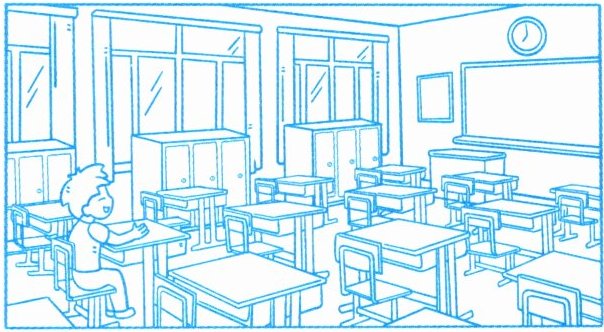
A: What’s your new classroom like?
B: It’s
large / big / ...
. There is something special
in it.A: Oh, good. What’s special?
B: There are three
lockers
in my classroom and we can put something in them.A: That’s great. Then you don’t have to take everything home. And where’s your seat?
B: I sit at the
back
of the classroom.答案
1. large / big / ... 2. special 3. lockers 4. back
解析
【分析】
首先结合对话语境和图片内容分析每个空:第一空描述新教室的特征,图片里教室空间大,可填合适的形容词;第二空由下文询问“special”可知,此处应填对应词汇;第三空结合“放东西”和图片里的储物柜,确定对应名词;第四空询问座位位置,根据图片男孩的位置确定词汇。
【解析】
1. 第一空:问句问新教室什么样,结合图片教室的大小,可填large(大的)或big等合适形容词;
2. 第二空:根据下文“Oh, good. What’s special?”,此处应填special(特别的),引出下文关于教室特别之处的讨论;
3. 第三空:由“we can put something in them”及图片中的三个储物柜,可知填lockers(储物柜,复数形式);
4. 第四空:问句问座位位置,图片中男孩坐在教室后部,故填back(后部)。
【答案】
large / big / ...; special; lockers; back
【知识点】
词汇运用;根据图片填空
【点评】
本题结合图片和对话语境,考查学生对形容词、名词的理解与运用,需观察图片细节并结合对话逻辑填写单词,难度适中。
【难度系数】
0.3
首先结合对话语境和图片内容分析每个空:第一空描述新教室的特征,图片里教室空间大,可填合适的形容词;第二空由下文询问“special”可知,此处应填对应词汇;第三空结合“放东西”和图片里的储物柜,确定对应名词;第四空询问座位位置,根据图片男孩的位置确定词汇。
【解析】
1. 第一空:问句问新教室什么样,结合图片教室的大小,可填large(大的)或big等合适形容词;
2. 第二空:根据下文“Oh, good. What’s special?”,此处应填special(特别的),引出下文关于教室特别之处的讨论;
3. 第三空:由“we can put something in them”及图片中的三个储物柜,可知填lockers(储物柜,复数形式);
4. 第四空:问句问座位位置,图片中男孩坐在教室后部,故填back(后部)。
【答案】
large / big / ...; special; lockers; back
【知识点】
词汇运用;根据图片填空
【点评】
本题结合图片和对话语境,考查学生对形容词、名词的理解与运用,需观察图片细节并结合对话逻辑填写单词,难度适中。
【难度系数】
0.3
Ⅲ. Complete the situational conversation. 完成情境对话。
来自加拿大的Paul和Betty正在谈论梦想教室。
Paul: What’s your dream classroom like?
Betty: It’s smart. There is a
Paul: What can the robot do?
Betty: It can help the teachers
Paul: That’s
Betty: Yes,
Paul: Where do you
Betty: We
Paul:
Betty: We put our things in two big lockers.
Paul:
来自加拿大的Paul和Betty正在谈论梦想教室。
Paul: What’s your dream classroom like?
Betty: It’s smart. There is a
robot
in my classroom.Paul: What can the robot do?
Betty: It can help the teachers
do some work
.Paul: That’s
special
. Is there a blackboard
in your classroom?Betty: Yes,
there is
one blackboard. And there is a smart whiteboard, too
.Paul: Where do you
put up
notices?Betty: We
put them up on the blackboard
on the blackboard.Paul:
Where do you put your things
?Betty: We put our things in two big lockers.
Paul:
Great!
答案
One possible version:
Paul: What's your dream classroom like?
Betty: It's smart. There is a robot in my classroom.
Paul: What can the robot do?
Betty: It can help the teachers do some work.
Paul: That's special. Is there a blackboard in your classroom?
Betty: Yes, there is one blackboard. And there is a smart whiteboard, too.
Paul: Where do you put up notices?
Betty: We put them up on the blackboard.
Paul: Where do you put your things?
Betty: We put our things in two big lockers.
Paul: Great!
Paul: What's your dream classroom like?
Betty: It's smart. There is a robot in my classroom.
Paul: What can the robot do?
Betty: It can help the teachers do some work.
Paul: That's special. Is there a blackboard in your classroom?
Betty: Yes, there is one blackboard. And there is a smart whiteboard, too.
Paul: Where do you put up notices?
Betty: We put them up on the blackboard.
Paul: Where do you put your things?
Betty: We put our things in two big lockers.
Paul: Great!
解析
【分析】首先通读对话,明确话题为谈论梦想教室,需结合上下文的问答逻辑补全内容:1. 由后文Paul询问机器人的功能,可知第一空填对应物品;2. 结合机器人的作用填其功能;3. 填Paul对机器人的评价;4. 由后文提到黑板,可知此处询问是否有黑板;5. 用there be句型作肯定回答;6. 补充教室的其他物品;7. 结合答语“贴在黑板上”,可知询问通知的张贴处;8. 指代前文的notices,填对应动词短语;9. 由答语“放东西在储物柜”,可知询问物品放置处;10. 填Paul的回应语。
【解析】根据对话上下文逻辑及日常交际用语:
1. 由下句“What can the robot do?”可知,第一空填robot;
2. 机器人的功能是帮老师做一些工作,故填do some work;
3. Paul对机器人的评价,填special;
4. 后文Betty回答有黑板,故此处问“有黑板吗”,填blackboard;
5. there be句型的肯定回答,填there is;
6. 补充教室的智能白板,填a smart whiteboard, too;
7. 由答语“put them up on the blackboard”可知,问“张贴通知在哪里”,填put up;
8. 指代notices,用them,故填put them up;
9. 由答语“put our things in two big lockers”可知,问“放东西在哪里”,填Where do you put your things?;
10. Paul的回应,填Great!
【答案】One possible version:
Paul: What's your dream classroom like?
Betty: It's smart. There is a robot in my classroom.
Paul: What can the robot do?
Betty: It can help the teachers do some work.
Paul: That's special. Is there a blackboard in your classroom?
Betty: Yes, there is one blackboard. And there is a smart whiteboard, too.
Paul: Where do you put up notices?
Betty: We put them up on the blackboard.
Paul: Where do you put your things?
Betty: We put our things in two big lockers.
Paul: Great!
【知识点】日常交际用语;there be句型;动词短语
【点评】本题为情境对话补全题,围绕“梦想教室”话题展开,考查学生对日常交际表达、上下文逻辑的理解及运用能力,需结合问答呼应关系填写内容,难度适中。
【难度系数】0.5
【解析】根据对话上下文逻辑及日常交际用语:
1. 由下句“What can the robot do?”可知,第一空填robot;
2. 机器人的功能是帮老师做一些工作,故填do some work;
3. Paul对机器人的评价,填special;
4. 后文Betty回答有黑板,故此处问“有黑板吗”,填blackboard;
5. there be句型的肯定回答,填there is;
6. 补充教室的智能白板,填a smart whiteboard, too;
7. 由答语“put them up on the blackboard”可知,问“张贴通知在哪里”,填put up;
8. 指代notices,用them,故填put them up;
9. 由答语“put our things in two big lockers”可知,问“放东西在哪里”,填Where do you put your things?;
10. Paul的回应,填Great!
【答案】One possible version:
Paul: What's your dream classroom like?
Betty: It's smart. There is a robot in my classroom.
Paul: What can the robot do?
Betty: It can help the teachers do some work.
Paul: That's special. Is there a blackboard in your classroom?
Betty: Yes, there is one blackboard. And there is a smart whiteboard, too.
Paul: Where do you put up notices?
Betty: We put them up on the blackboard.
Paul: Where do you put your things?
Betty: We put our things in two big lockers.
Paul: Great!
【知识点】日常交际用语;there be句型;动词短语
【点评】本题为情境对话补全题,围绕“梦想教室”话题展开,考查学生对日常交际表达、上下文逻辑的理解及运用能力,需结合问答呼应关系填写内容,难度适中。
【难度系数】0.5
Ⅳ. Read and answer the questions. 阅读并回答问题。
Sicheng is at school now. He is in the classroom, but he can't find his
school things(学习用品). Where are they? Are they in his schoolbag? Oh, no! They are in his room. He doesn't take them to school. He calls his mother and asks her to take his school things to school. Here are his school things.
His ruler is on the chair. Under the chair is his pencil box. There is a notebook on the desk. There is a dictionary on the bed. His pencils aren't in the pencil box. They're on the sofa.
Sicheng asks his mother not to forget(忘记) to take his basketball. Sicheng often plays basketball after school. But where is his basketball? Oh, it's under the table.
(
A. In his room. B. In the library. C. In the classroom.
(
A. On the bed. B. On the desk. C. Under the chair.
(
A. Sicheng's ruler.
B. Sicheng's pencils.
C. Sicheng's notebook.
4. What does Sicheng often do after school?
5. What do you want to say to Sicheng?
Sicheng is at school now. He is in the classroom, but he can't find his
school things(学习用品). Where are they? Are they in his schoolbag? Oh, no! They are in his room. He doesn't take them to school. He calls his mother and asks her to take his school things to school. Here are his school things.
His ruler is on the chair. Under the chair is his pencil box. There is a notebook on the desk. There is a dictionary on the bed. His pencils aren't in the pencil box. They're on the sofa.
Sicheng asks his mother not to forget(忘记) to take his basketball. Sicheng often plays basketball after school. But where is his basketball? Oh, it's under the table.
(
A
)1. Where are Sicheng's school things?A. In his room. B. In the library. C. In the classroom.
(
C
)2. Where is Sicheng's pencil box?A. On the bed. B. On the desk. C. Under the chair.
(
B
)3. What is on the sofa?A. Sicheng's ruler.
B. Sicheng's pencils.
C. Sicheng's notebook.
4. What does Sicheng often do after school?
He often plays basketball.
5. What do you want to say to Sicheng?
Please be careful next time.
答案
1. A 2. C 3. B 4. He often plays basketball.
5. One possible version: Please be careful next time.
5. One possible version: Please be careful next time.
解析
【分析】
这是一道英语阅读理解题,解题思路为:先通读全文把握文章大意,再针对每个问题回到原文定位相关信息,逐一匹配答案。细节类题目需精准找到对应句子,开放类题目结合文章内容合理作答即可。
【解析】
1. 问题询问Sicheng的学习用品位置,根据原文第一段“They are in his room.”,可确定答案为A。
2. 问题询问Sicheng的铅笔盒位置,根据原文第二段“Under the chair is his pencil box.”,可确定答案为C。
3. 问题询问沙发上的物品,根据原文第二段“His pencils aren't in the pencil box. They're on the sofa.”,可确定答案为B。
4. 问题询问Sicheng课后常做的事,根据原文第三段“Sicheng often plays basketball after school.”,直接提取对应内容即可。
5. 问题为开放题,结合Sicheng忘带物品的情况,给出合理建议即可,如“Please be careful next time.”。
【答案】
1. A 2. C 3. B 4. He often plays basketball. 5. Please be careful next time.
【知识点】
英语阅读理解、细节理解题、开放型问题
【点评】
本题是基础英语阅读理解题,侧重考查学生定位文章细节信息的能力,最后一题开放型问题难度较低,学生结合文章内容即可作答,整体难度不大。
【难度系数】
0.8
这是一道英语阅读理解题,解题思路为:先通读全文把握文章大意,再针对每个问题回到原文定位相关信息,逐一匹配答案。细节类题目需精准找到对应句子,开放类题目结合文章内容合理作答即可。
【解析】
1. 问题询问Sicheng的学习用品位置,根据原文第一段“They are in his room.”,可确定答案为A。
2. 问题询问Sicheng的铅笔盒位置,根据原文第二段“Under the chair is his pencil box.”,可确定答案为C。
3. 问题询问沙发上的物品,根据原文第二段“His pencils aren't in the pencil box. They're on the sofa.”,可确定答案为B。
4. 问题询问Sicheng课后常做的事,根据原文第三段“Sicheng often plays basketball after school.”,直接提取对应内容即可。
5. 问题为开放题,结合Sicheng忘带物品的情况,给出合理建议即可,如“Please be careful next time.”。
【答案】
1. A 2. C 3. B 4. He often plays basketball. 5. Please be careful next time.
【知识点】
英语阅读理解、细节理解题、开放型问题
【点评】
本题是基础英语阅读理解题,侧重考查学生定位文章细节信息的能力,最后一题开放型问题难度较低,学生结合文章内容即可作答,整体难度不大。
【难度系数】
0.8
