

 登录
二、阅读理解(每小题 2 分,满分 30 分)
A
(

(
A. noon
B. afternoon
C. morning
D. night
(
A. colourful and happy
B. sweet and colourful
C. happy and hard - working
D. noisy and busy
A
(
A
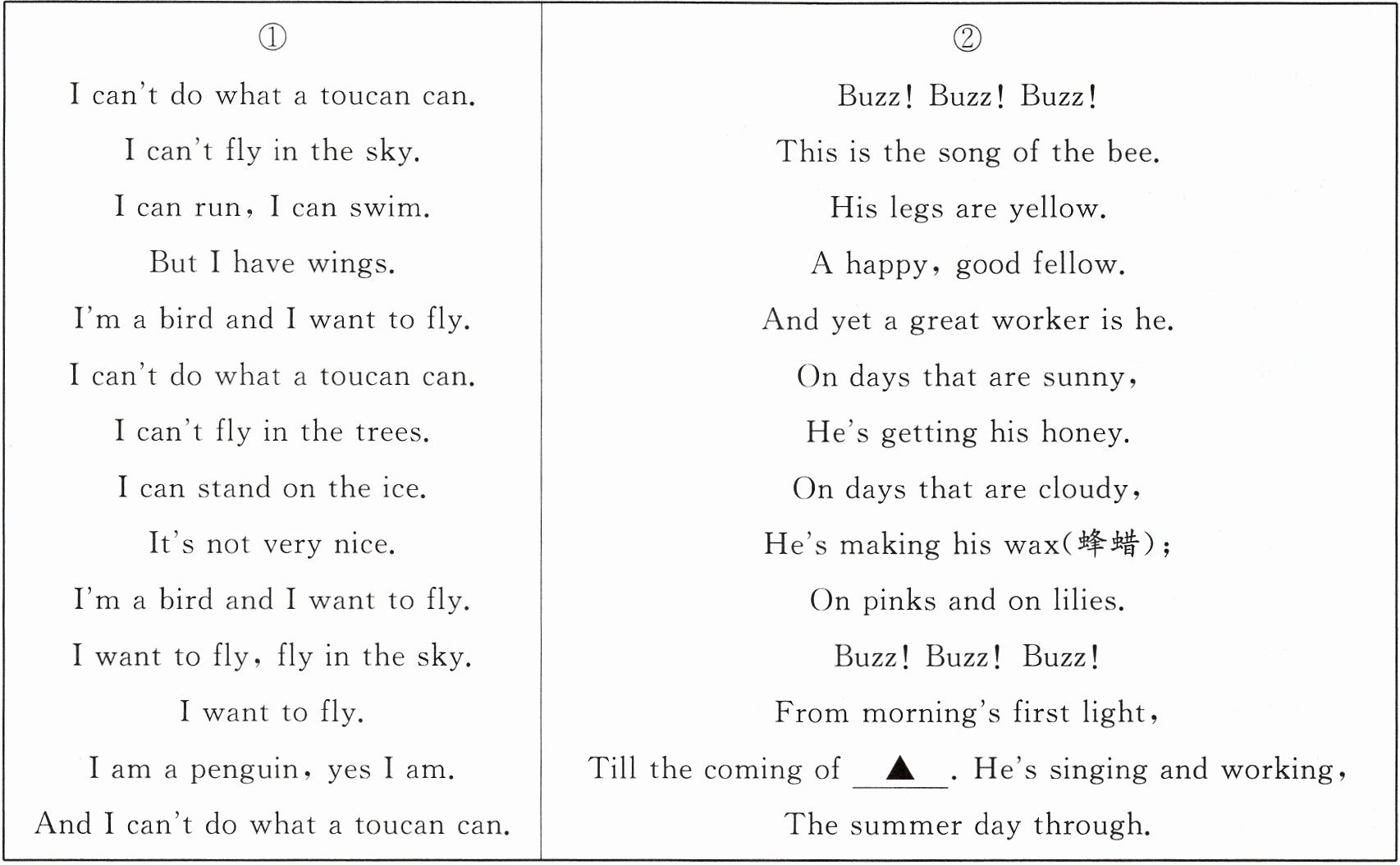
)11. Which of the following is a penguin?(
D
)12. Which word is the best to put in " ▲ "?A. noon
B. afternoon
C. morning
D. night
(
C
)13. Poem ② mainly tells us that bees are C
.A. colourful and happy
B. sweet and colourful
C. happy and hard - working
D. noisy and busy
答案
11. A 细节理解题。根据第一首诗的内容可知,penguin 指企鹅,A 选项中的图片是企鹅。故选 A。
12. D 补全文章题。根据“From morning's first light, Till the coming of...”并结合蜜蜂是勤劳的可知,它是从早到晚都在忙碌。故选 D。
13. C 推理判断题。根据“A happy, good fellow... From morning's first light, Till the coming of... He's singing and working,”可知,蜜蜂是快乐、勤劳的。故选 C。
12. D 补全文章题。根据“From morning's first light, Till the coming of...”并结合蜜蜂是勤劳的可知,它是从早到晚都在忙碌。故选 D。
13. C 推理判断题。根据“A happy, good fellow... From morning's first light, Till the coming of... He's singing and working,”可知,蜜蜂是快乐、勤劳的。故选 C。
解析
【分析】
这是英语阅读理解的三道基础题型,解题思路如下:1. 第11题是细节理解题,需定位第一首诗中与企鹅相关的内容,匹配对应图片选出答案;2. 第12题是补全文章题,要结合时间线索及蜜蜂的习性,分析选项选出合适的词;3. 第13题是推理判断题,需找到原文中描述蜜蜂的关键词,推理其特点后选出答案。
【解析】
11. 细节理解题:根据第一首诗的内容,A选项对应的图片是企鹅,符合题意,故选A。
12. 补全文章题:根据时间线索“From morning's first light, Till the coming of...”,结合蜜蜂勤劳的特性,可知其忙碌从清晨持续到夜晚,因此选D。
13. 推理判断题:原文描述蜜蜂“happy, good fellow”以及“singing and working”,可推断出蜜蜂是快乐且勤劳的,故选C。
【答案】
11.A 12.D 13.C
【知识点】
细节理解题、补全文章题、推理判断题
【点评】
本题考查英语阅读理解的基础题型,侧重考查学生对文本细节的查找、上下文逻辑的理解以及事物特点的推理能力,题目难度较低,只要仔细阅读原文即可正确作答。
【难度系数】
0.8
B
A long time ago, there were no elephants in China. One day, Cao Cao got an elephant as a gift from another country. People were very happy to see this big animal.
Everyone was excited about it and had a question: How much does it weigh? But there was a problem: How to weigh it? At that time, no scales (秤) in China were big enough to weigh such a large animal. Cao Cao had a six - year - old son named Cao Chong. He said, "Father, I know how to weigh it." At first, nobody believed the boy. But after he told them his idea, they all thought it was a good one.
"Here's what you do; follow me," the boy said to the ministers (大臣们). "Let the elephant stand in a big boat on the water. Draw a line on the side of the boat at the water level (水平面). Then let the elephant off the boat. Collect a lot of big stones. Put the stones on the boat until the boat falls to the same water level. Then take the stones out of the boat and weigh them one by one. In this way, we can know the weight of the stones. Finally, we can know how much the elephant weighs."
"Wonderful! Wonderful!" shouted the people. Soon everyone in the country knew that Cao Cao had a clever son.
(
A. the scales were not big enough
B. people were not strong enough
C. people were afraid of the elephant
D. the ministers didn't follow Cao Chong
(
A. Cao Cao.
B. The elephant.
C. Cao Chong's idea.
D. The ministers' words.
(
A. Cao Cao gave an elephant to another country as a gift.
B. Cao Chong was Cao Cao's son.
C. Everyone was worried about the elephant.
D. The ministers found a way to weigh the elephant.
(
A. Clever.
B. Kind.
C. Excited.
D. Popular.
A long time ago, there were no elephants in China. One day, Cao Cao got an elephant as a gift from another country. People were very happy to see this big animal.
Everyone was excited about it and had a question: How much does it weigh? But there was a problem: How to weigh it? At that time, no scales (秤) in China were big enough to weigh such a large animal. Cao Cao had a six - year - old son named Cao Chong. He said, "Father, I know how to weigh it." At first, nobody believed the boy. But after he told them his idea, they all thought it was a good one.
"Here's what you do; follow me," the boy said to the ministers (大臣们). "Let the elephant stand in a big boat on the water. Draw a line on the side of the boat at the water level (水平面). Then let the elephant off the boat. Collect a lot of big stones. Put the stones on the boat until the boat falls to the same water level. Then take the stones out of the boat and weigh them one by one. In this way, we can know the weight of the stones. Finally, we can know how much the elephant weighs."
"Wonderful! Wonderful!" shouted the people. Soon everyone in the country knew that Cao Cao had a clever son.
(
A
)14. People couldn't weigh the elephant because A
.A. the scales were not big enough
B. people were not strong enough
C. people were afraid of the elephant
D. the ministers didn't follow Cao Chong
(
C
)15. What does the underlined word "it" refer to in Paragraph 2?A. Cao Cao.
B. The elephant.
C. Cao Chong's idea.
D. The ministers' words.
(
B
)16. Which of the following is TRUE?A. Cao Cao gave an elephant to another country as a gift.
B. Cao Chong was Cao Cao's son.
C. Everyone was worried about the elephant.
D. The ministers found a way to weigh the elephant.
(
A
)17. What do you think of Cao Chong?A. Clever.
B. Kind.
C. Excited.
D. Popular.
答案
14. A 细节理解题。根据“At that time, no scales in China were big enough to weigh such a large animal.”可知,当时的秤不够大,所以不能称象。故选 A。
15. C 代词指代题。根据“At first, nobody believed the boy. But after he told them his idea, they all thought it was a good one.”可知,曹冲想到一个主意,讲出来之后大家都觉得他的主意不错。因此“it”指的是“Cao Chong's idea”。故选 C。
16. B 判断正误题。根据“Cao Cao had a six-year-old son named Cao Chong.”可知,曹冲是曹操的儿子。故选 B。
17. A 细节理解题。根据“Soon everyone in the country knew that Cao Cao had a clever son.”可知,很快大家都知道曹操有个聪明的儿子,由此可知,曹冲是聪明的。故选 A。
解析
【分析】
本题为英语阅读理解题,包含细节理解题、代词指代题、判断正误题三类题型。解题思路为:先通读原文理解大意,再针对每个题目,根据题干关键词定位原文对应内容,逐一核对选项与原文信息,选出正确答案。
【解析】
14. 细节理解题:根据题干关键词“couldn't weigh the elephant”定位到原文第二段“At that time, no scales (秤) in China were big enough to weigh such a large animal.”,可知当时没有足够大的秤称大象,对应选项A。
15. 代词指代题:定位到原文第二段“At first, nobody believed the boy. But after he told them his idea, they all thought it was a good one.”,句中“it”指代前文提到的曹冲的主意(his idea),对应选项C。
16. 判断正误题:逐一核对选项:A选项“曹操给别国大象当礼物”与原文“Cao Cao got an elephant as a gift from another country”不符;B选项“曹冲是曹操的儿子”与原文“Cao Cao had a six-year-old son named Cao Chong”一致;C选项“大家担心大象”与原文“Everyone was excited about it and had a question: How much does it weigh?”不符;D选项“大臣找到称象方法”与原文曹冲提出方法不符,故正确选项为B。
17. 细节理解题:根据题干“what do you think of Cao Chong”定位到原文最后“Soon everyone in the country knew that Cao Cao had a clever son.”,可知曹冲很聪明,对应选项A。
【答案】
14. A 15. C 16. B 17. A
【知识点】
英语阅读理解、细节理解题、代词指代题
【点评】
本题围绕经典故事“曹冲称象”展开,题型为基础的英语阅读题型,主要考察学生对原文细节信息的查找、代词指代的理解以及正误判断能力,整体难度适中。
【难度系数】
0.8
