

 登录
登录
A
KEY→P21
范畴:人与自我 主题:学习方法 体裁:应用文 难度:★★★ 建议用时:5分钟 评价:/3
新模态 复合型文本 Listening to music while studying
Do you like listening to music when you're studying? A lot of students think that listening to their favorite songs helps them study better, especially when they are revising. But does it really make them learn more? And will it be different if they choose different kinds of music?
How to research
To answer these questions, teachers from Cardiff Metropolitan University recently ran a study. They divided students into different groups:
• Group A: revised in silence;
• Group B: revised with music without words;
• Group C: revised with music with words they liked;
• Group D: revised with music with words they disliked.
The students then took a test on the passages they had been revising.
Main findings
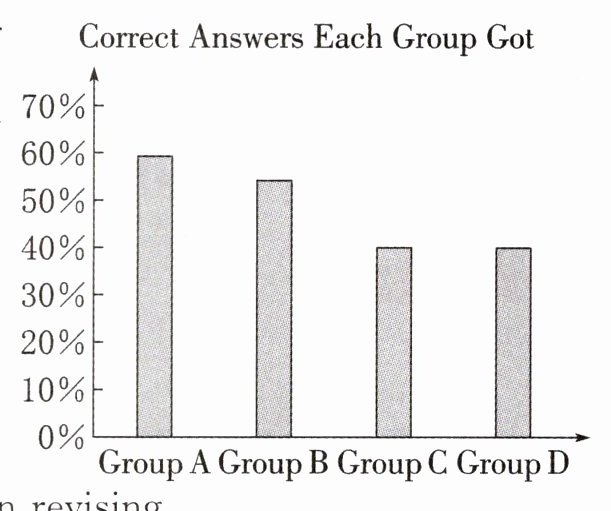
☆ Group A did better in the exam than the other three groups.
☆ Group B got higher scores than Group C and Group D.
☆ There's no difference between Group C and Group D. Both groups got lower scores than usual.
(
A. Group A. B. Group B. C. Group C. D. Group D.
(
A. Music with words makes students study better.
B. There's no difference in studying with music or not.
C. Students who learn without music get the best result.
D. Music with liked words is helpful for students' study.
(
A. Learning habits. B. After-school activities.
C. Music clubs. D. Sports events.
KEY→P21
范畴:人与自我 主题:学习方法 体裁:应用文 难度:★★★ 建议用时:5分钟 评价:/3
新模态 复合型文本 Listening to music while studying
Do you like listening to music when you're studying? A lot of students think that listening to their favorite songs helps them study better, especially when they are revising. But does it really make them learn more? And will it be different if they choose different kinds of music?
How to research
To answer these questions, teachers from Cardiff Metropolitan University recently ran a study. They divided students into different groups:
• Group A: revised in silence;
• Group B: revised with music without words;
• Group C: revised with music with words they liked;
• Group D: revised with music with words they disliked.
The students then took a test on the passages they had been revising.
Main findings
☆ Group A did better in the exam than the other three groups.
☆ Group B got higher scores than Group C and Group D.
☆ There's no difference between Group C and Group D. Both groups got lower scores than usual.
(
A
)1. Which group got the most correct answers in the test?A. Group A. B. Group B. C. Group C. D. Group D.
(
C
)2. What do the teachers find out from the study?A. Music with words makes students study better.
B. There's no difference in studying with music or not.
C. Students who learn without music get the best result.
D. Music with liked words is helpful for students' study.
(
A
)3. Which section of a magazine is this article most likely taken from?A. Learning habits. B. After-school activities.
C. Music clubs. D. Sports events.
答案
A
本文主要讲述了在学习时听音乐的影响。
1. A 细节理解题。观察图表可知A组获得的正确答案最多。
2. C 细节理解题。根据文中“Group A: revised in silence”以及“Group A did better in the exam than the other three groups.”可知,不听音乐的学生得到最好的结果。
3. A 文章出处题。本文围绕“学习时听音乐是否影响学习效果”展开研究,核心是探讨不同学习环境对学习效率的影响,属于学习习惯相关话题,因此最可能出自杂志的学习习惯版块。
本文主要讲述了在学习时听音乐的影响。
1. A 细节理解题。观察图表可知A组获得的正确答案最多。
2. C 细节理解题。根据文中“Group A: revised in silence”以及“Group A did better in the exam than the other three groups.”可知,不听音乐的学生得到最好的结果。
3. A 文章出处题。本文围绕“学习时听音乐是否影响学习效果”展开研究,核心是探讨不同学习环境对学习效率的影响,属于学习习惯相关话题,因此最可能出自杂志的学习习惯版块。
