

 登录
Ⅰ. Listen and complete the tasks.
A. Listen and complete the table.
Problem Emma left the shopping list at home.
Technique 1 Create a 1.
Technique 2 Group things, like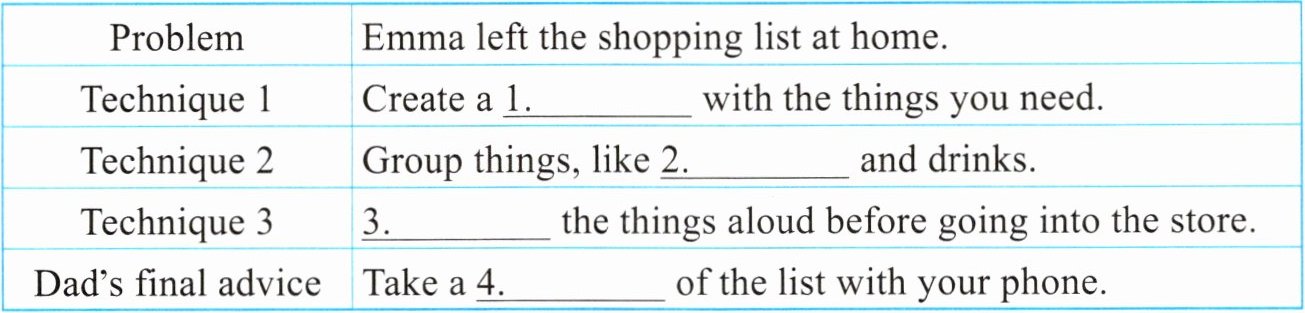
Technique 3 3.
Dad’s final advice Take a 4.
B. Listen again and answer the questions.
(
A. It is getting better. B. It is too full. C. It works perfectly.
(
A. Order milk online.
B. Go to a memory workshop.
C. Write a new list and take a photo.
A. Listen and complete the table.
Problem Emma left the shopping list at home.
Technique 1 Create a 1.
story
with the things you need.Technique 2 Group things, like
vegetables
and drinks.Technique 3 3.
Repeat
the things aloud before going into the store.Dad’s final advice Take a 4.
photo
of the list with your phone.B. Listen again and answer the questions.
(
B
)1. How does Emma feel about her memory?A. It is getting better. B. It is too full. C. It works perfectly.
(
C
)2. What will Emma and her dad do next?A. Order milk online.
B. Go to a memory workshop.
C. Write a new list and take a photo.
答案
Ⅰ. A. 1. story 2. vegetables 3. Repeat 4. photo
B. 1. B 2. C
B. 1. B 2. C
Ⅱ. Complete the passage with the correct forms of the words in the box. Then answer the question.
run out happen to recognize increase wild wear oneself out touch
Birdwatching is my favourite hobby. Last Saturday, I went into a 1.
After walking in circles for another hour, we both began to 6.
8. How did the writer’s feeling change from the beginning to the end of the trip?
run out happen to recognize increase wild wear oneself out touch
Birdwatching is my favourite hobby. Last Saturday, I went into a 1.
wild
forest with my cousin Emma. We were both excited because spring is the best time to see rare birds. I had read about them before, so I 2. recognized
a rare bird at once. Just as I was reaching for my camera, I accidentally 3. touched
the buttons and the bird flew away. An hour later, Emma said, “My phone battery is about to 4. run out
. We should head back.” I agreed, but then something terrible 5. happened to
us—we took a wrong turn and got lost.After walking in circles for another hour, we both began to 6.
wear ourselves out
. My legs were shaking, and Emma was worried. We sat down to rest, and a few nuts 7. increased
our energy a little. Luckily, a group of hikers led us back to the parking lot. We were tired but safe.8. How did the writer’s feeling change from the beginning to the end of the trip?
At first he / she was excited, but later he / she became tired and worried. In the end, he / she was tired but safe.
答案
Ⅱ. 1. wild 2. recognized 3. touched 4. run out 5. happened to
6. wear ourselves out 7. increased
8. At first he / she was excited, but later he / she became tired and worried. In the end, he / she was tired but safe.
6. wear ourselves out 7. increased
8. At first he / she was excited, but later he / she became tired and worried. In the end, he / she was tired but safe.
解析
【分析】
做本题需分两步:一是选词填空,先明确方框内单词/短语的含义及用法,再通读全文,结合每个空格的语境、语法(词性、时态、搭配等)选择合适的词并进行形式变形;二是回答第8题,需通读全文,抓取体现作者情绪变化的关键词,整理成答案。
【解析】
1. 第1空:空格修饰名词forest,需形容词,方框中wild(野生的)符合“野生森林”的语境,故填wild。
2. 第2空:句子缺谓语,时态为一般过去时,结合“之前读过相关内容所以认出稀有鸟类”,recognize的过去式为recognized,故填recognized。
3. 第3空:句子缺谓语,时态为一般过去时,结合“伸手拿相机时不小心碰到按钮”,touch的过去式为touched,故填touched。
4. 第4空:be about to后接动词原形,run out表示“(某物)用完”,主语为battery,符合“手机电池要用完”的语境,故填run out。
5. 第5空:固定搭配sth happen to sb(某事发生在某人身上),时态为一般过去时,故填happened to。
6. 第6空:begin to后接动词原形,主语为we,wear oneself out需对应主语用ourselves,结合“走了很久筋疲力尽”的语境,故填wear ourselves out。
7. 第7空:句子缺谓语,时态为一般过去时,结合“坚果补充了一点能量”,increase的过去式为increased,故填increased。
8. 第8题:从原文抓取情绪变化:开头作者和表妹“excited”,后来迷路后“worried”“tired”,最后被帮助后“tired but safe”,整理为答案。
【答案】
Ⅱ. 1. wild 2. recognized 3. touched 4. run out 5. happened to 6. wear ourselves out 7. increased 8. At first he / she was excited, but later he / she became tired and worried. In the end, he / she was tired but safe.
【知识点】
动词短语运用、词汇时态变形、阅读理解(情感梳理)
【点评】
本题考查词汇在语境中的正确运用及对文章情感脉络的梳理,需学生结合上下文分析词义、语法及情绪变化,是基础综合题型,难度适中。
【难度系数】
0.5
