

 登录
Ⅳ. Read and complete the tasks.
All creatures, from the tiny fruit fly to the great blue whale, have some form of memory. Elephants remember the locations of distant watering holes. Mice remember how to find their way through laboratory mazes(迷宫) to food. Squirrels, who bury up to 10,000 nuts every year, remember—most of the time—where they put them. Crows remember human faces. So be careful: If you’re ever mean to a crow, it’ll likely remember you.
Of all the memories in the animal kingdom, though, yours is especially impressive. Each human brain contains about 90 billion neurons(神经元)—and each of these can form more than a thousand connections with other neurons. Memories are stored in these connections, called synapses(突触). This all adds up, scientists estimate, to more than 60 trillion connections—about 2.5 million GB of memory. That’s right, your memory is huge. If it worked like a computer’s hard drive, it would be large enough to store the information from five billion books.
A. Match the animals with what they remember.
(
(
(
(
B. Complete the mind map about the human brain.
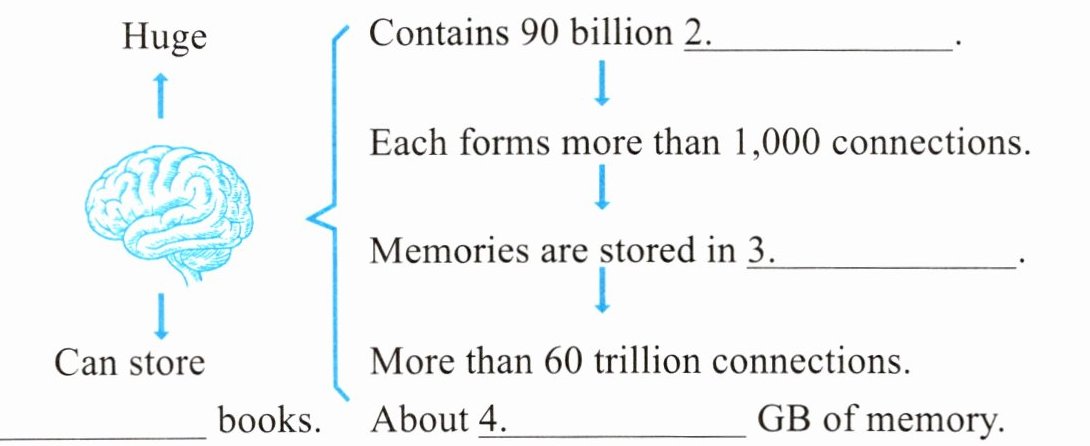
1.
Contains 90 billion 2.
Each forms more than 1,000 connections.
Memories are stored in 3.
More than 60 trillion connections.
Huge
Can store
About 4.
C. Answer the question.
What is the main purpose of the passage?
All creatures, from the tiny fruit fly to the great blue whale, have some form of memory. Elephants remember the locations of distant watering holes. Mice remember how to find their way through laboratory mazes(迷宫) to food. Squirrels, who bury up to 10,000 nuts every year, remember—most of the time—where they put them. Crows remember human faces. So be careful: If you’re ever mean to a crow, it’ll likely remember you.
Of all the memories in the animal kingdom, though, yours is especially impressive. Each human brain contains about 90 billion neurons(神经元)—and each of these can form more than a thousand connections with other neurons. Memories are stored in these connections, called synapses(突触). This all adds up, scientists estimate, to more than 60 trillion connections—about 2.5 million GB of memory. That’s right, your memory is huge. If it worked like a computer’s hard drive, it would be large enough to store the information from five billion books.
A. Match the animals with what they remember.
(
D
)1. Elephants A. Find their way to food.(
A
)2. Mice B. Remember human faces.(
C
)3. Squirrels C. Remember where they put their nuts.(
B
)4. Crows D. Remember the locations of watering holes.B. Complete the mind map about the human brain.
1.
five billion
books.Contains 90 billion 2.
neurons
.Each forms more than 1,000 connections.
Memories are stored in 3.
synapses / connections
.More than 60 trillion connections.
Huge
Can store
About 4.
2.5 million
GB of memory.C. Answer the question.
What is the main purpose of the passage?
To describe how memory works in animals and humans.
答案
Ⅳ. A. 1. D 2. A 3. C 4. B
B. 1. five billion 2. neurons 3. synapses / connections 4. 2.5 million
C. To describe how memory works in animals and humans.
B. 1. five billion 2. neurons 3. synapses / connections 4. 2.5 million
C. To describe how memory works in animals and humans.
解析
【分析】
本题为英语阅读理解题,包含信息匹配、思维导图填空和主旨大意三类题型。解题思路:A部分需定位原文中不同动物对应的记忆内容,完成匹配;B部分需从原文提取人类大脑的相关数据和概念,填入思维导图空缺;C部分需通读全文,梳理内容,总结文章主要目的。
【解析】
A部分:1. 原文第一段明确“Elephants remember the locations of distant watering holes”,对应D;2. “Mice remember how to find their way through mazes to food”对应A;3. “Squirrels remember where they put their nuts”对应C;4. “Crows remember human faces”对应B。B部分:1. 原文第二段末句提到大脑可存储“five billion books”,故填five billion;2. “Each human brain contains about 90 billion neurons”,填neurons;3. “Memories are stored in these connections, called synapses”,填synapses/connections;4. “about 2.5 million GB of memory”,填2.5 million。C部分:全文先介绍动物的记忆特点,再阐述人类记忆的相关情况,核心目的是描述动物和人类的记忆。
【答案】
A.1.D 2.A 3.C 4.B;B.1. five billion 2. neurons 3. synapses/connections 4. 2.5 million;C. To describe how memory works in animals and humans.
【知识点】
英语阅读理解、信息匹配、主旨大意
【点评】
本题考查学生英语阅读的信息定位、匹配及主旨总结能力,需仔细研读原文,提取关键信息,难度适中。
【难度系数】
0.6
