

 登录
登录
一、用所给单词的适当形式填空
1. It takes time to get used to
2. The phone
3.
4. When the teacher
5. I have not seen my best friend
1. It takes time to get used to
getting
(get) up early in the morning.2. The phone
rang
(ring) while I was doing my homework last night.3.
Hurry
(hurry) up, or we will miss the early bus to school.4. When the teacher
enters
(enter) the classroom, we should keep quiet.5. I have not seen my best friend
recently
(recent).答案
1. getting 2. rang 3. Hurry 4. enters 5. recently
解析
【分析】本题为英语用所给单词适当形式填空题型,需结合固定搭配、动词时态、祈使句结构、词性转换等语法知识解题。第1题考查固定搭配中介词后接动名词的用法;第2题考查过去进行时对应的主句时态;第3题考查祈使句的动词原形开头规则;第4题考查时间状语从句的时态呼应;第5题考查形容词转换为副词修饰动词的用法。
【解析】1. 固定搭配get used to意为“习惯于”,其中to为介词,后接动词的动名词形式,故填getting;2. while引导过去进行时的时间状语时,主句需用一般过去时,ring的过去式为rang,故填rang;3. 祈使句以动词原形开头,用于表达命令或建议,故填Hurry;4. when引导的时间状语从句,主句为一般现在时范畴(should+动词原形),从句需用一般现在时,主语the teacher是第三人称单数,动词用第三人称单数形式,故填enters;5. 此处需用副词修饰动词seen,recent的副词形式为recently,故填recently。
【答案】1. getting 2. rang 3. Hurry 4. enters 5. recently
【知识点】固定搭配、动词时态、词性转换
【点评】本题考查初中英语核心基础语法,涵盖固定搭配、时态、祈使句及词性转换,题型常规,需熟练掌握相关规则即可正确解答。
【难度系数】0.3
【解析】1. 固定搭配get used to意为“习惯于”,其中to为介词,后接动词的动名词形式,故填getting;2. while引导过去进行时的时间状语时,主句需用一般过去时,ring的过去式为rang,故填rang;3. 祈使句以动词原形开头,用于表达命令或建议,故填Hurry;4. when引导的时间状语从句,主句为一般现在时范畴(should+动词原形),从句需用一般现在时,主语the teacher是第三人称单数,动词用第三人称单数形式,故填enters;5. 此处需用副词修饰动词seen,recent的副词形式为recently,故填recently。
【答案】1. getting 2. rang 3. Hurry 4. enters 5. recently
【知识点】固定搭配、动词时态、词性转换
【点评】本题考查初中英语核心基础语法,涵盖固定搭配、时态、祈使句及词性转换,题型常规,需熟练掌握相关规则即可正确解答。
【难度系数】0.3
1. (2026·扬州江都区期末)—When shall we go to watch the basketball match in the sports center?
—Not until the work
A.has finished
B.will finish
C.will be finished
D.is finished
—Not until the work
D
tomorrow.A.has finished
B.will finish
C.will be finished
D.is finished
答案
1. D [解析]考查时态和语态。句意:——我们什么时候去体育中心看篮球赛?——直到明天工作被完成。句中主语是“the work”(工作),工作应该“被完成”,故用被动语态,not until 句型中从句通常用一般现在时。故选 D。
知识拓展 not until 引导时间状语从句时,若主句表将来含义,从句需用一般现在时表将来,即“主将从现”原则;当从句主语和谓语动词为被动关系时,要使用一般现在时的被动语态,结构为“am/is/are+动词过去分词”。
知识拓展 not until 引导时间状语从句时,若主句表将来含义,从句需用一般现在时表将来,即“主将从现”原则;当从句主语和谓语动词为被动关系时,要使用一般现在时的被动语态,结构为“am/is/are+动词过去分词”。
解析
【分析】
这道题考查not until引导的时间状语从句的时态和语态。解题思路:第一步,判断not until从句的时态:主句表达将来的动作(去看篮球赛),根据“主将从现”原则,从句需用一般现在时表将来;第二步,判断语态:主语the work(工作)和谓语动词finish之间是被动关系(工作被完成),需使用被动语态;第三步,结合时态和语态,一般现在时的被动结构为“am/is/are + 过去分词”,主语the work是单数,因此用is finished,对应选项D。
【解析】
not until引导时间状语从句时,若主句表将来含义,从句遵循“主将从现”原则,用一般现在时表将来;主语the work与动词finish是被动关系,需用一般现在时的被动语态,结构为“is + 过去分词”,finish的过去分词是finished,故空格处填is finished,答案选D。
【答案】
D
【知识点】
一般现在时的被动语态;not until的时态用法
【点评】
本题结合not until句型考查时态与语态的基础知识点,需掌握“主将从现”原则及被动语态的判断,是英语学习中时态语态的常考题型。
【难度系数】
0.5
这道题考查not until引导的时间状语从句的时态和语态。解题思路:第一步,判断not until从句的时态:主句表达将来的动作(去看篮球赛),根据“主将从现”原则,从句需用一般现在时表将来;第二步,判断语态:主语the work(工作)和谓语动词finish之间是被动关系(工作被完成),需使用被动语态;第三步,结合时态和语态,一般现在时的被动结构为“am/is/are + 过去分词”,主语the work是单数,因此用is finished,对应选项D。
【解析】
not until引导时间状语从句时,若主句表将来含义,从句遵循“主将从现”原则,用一般现在时表将来;主语the work与动词finish是被动关系,需用一般现在时的被动语态,结构为“is + 过去分词”,finish的过去分词是finished,故空格处填is finished,答案选D。
【答案】
D
【知识点】
一般现在时的被动语态;not until的时态用法
【点评】
本题结合not until句型考查时态与语态的基础知识点,需掌握“主将从现”原则及被动语态的判断,是英语学习中时态语态的常考题型。
【难度系数】
0.5
2. Many ancient Chinese traditions still
A.remain
B.become
C.seem
D.leave
A
alive in rural villages, even as modern life continues to develop rapidly.A.remain
B.become
C.seem
D.leave
答案
2. A [解析]考查动词辨析。句意:即使现代生活不断迅速发展,许多中国古老传统在乡村里依然留存。remain 保持,仍然是;become 成为,变得;seem 似乎,好像;leave 离开,留下。这里指“古老的中国传统仍然存在”,remain 有“留下,保持不变”的意思。故选 A。
解析
【分析】首先通读句子理解句意:即使现代生活快速发展,许多中国古老传统在乡村依然留存。接着辨析四个选项的动词含义:A.remain意为“保持,仍然处于某种状态”;B.become意为“变得,成为”;C.seem意为“似乎,好像”;D.leave意为“离开,留下”。结合语境,此处需要表达“传统仍存在、保持存活状态”的意思,据此选择符合语境的动词。
【解析】本题考查动词辨析。句意:即使现代生活不断迅速发展,许多中国古老传统在乡村里依然留存。remain有“保持,仍然是”的含义,符合“传统留存”的语境;become(成为)、seem(似乎)、leave(离开)均不符合句意,故选A。
【答案】A
【知识点】动词辨析
【点评】本题为基础动词词义辨析题,需结合语境理解句意,准确辨析各动词含义即可选出答案,属于英语基础题型。
【难度系数】0.5
【解析】本题考查动词辨析。句意:即使现代生活不断迅速发展,许多中国古老传统在乡村里依然留存。remain有“保持,仍然是”的含义,符合“传统留存”的语境;become(成为)、seem(似乎)、leave(离开)均不符合句意,故选A。
【答案】A
【知识点】动词辨析
【点评】本题为基础动词词义辨析题,需结合语境理解句意,准确辨析各动词含义即可选出答案,属于英语基础题型。
【难度系数】0.5
3. —Excuse me, could you please tell me
—Of course. It's about ten minutes' walk straight down this road, on your left.
A.where is the nearest gift shop
B.how we can get to the nearest gift shop
C.how far is the nearest gift shop from here
D.what time the nearest gift shop closes today
B
? We want to buy some souvenirs before leaving.—Of course. It's about ten minutes' walk straight down this road, on your left.
A.where is the nearest gift shop
B.how we can get to the nearest gift shop
C.how far is the nearest gift shop from here
D.what time the nearest gift shop closes today
答案
3. B [解析]考查宾语从句。句意:——打扰一下,你能告诉我怎么去最近的礼品店吗?在离开之前我们想买一点纪念品。——当然。沿着这条路直走大约 10 分钟就到,在你的左边。A 选项是疑问语序,错误;B 选项意思、语序和时态都正确;C 选项是疑问语序,错误;D 选项回答与问题不符。故选 B。
解析
【分析】本题考查宾语从句的用法,解题思路分两步:1. 明确宾语从句需用陈述语序,据此排除疑问语序的选项;2. 根据答语内容判断问句的语义,选出匹配的选项。
【解析】首先,宾语从句的语序必须是陈述语序(连接词+主语+谓语),A选项“where is the nearest gift shop”和C选项“how far is the nearest gift shop from here”均为疑问语序,不符合宾语从句的语序要求,排除A、C;其次,答语“沿着这条路直走大约10分钟就到,在你的左边”是在说明去礼品店的路线,说明问句是询问到达礼品店的方式,B选项“how we can get to the nearest gift shop”意为“我们怎么去最近的礼品店”,符合语境;D选项“what time the nearest gift shop closes today”意为“今天最近的礼品店什么时候关门”,答语未涉及时间,不符合,因此选B。
【答案】B
【知识点】宾语从句、陈述语序
【点评】本题结合日常交际场景考查宾语从句的核心考点,既要求掌握宾语从句的陈述语序规则,又需具备语境理解能力,是初中英语的典型基础题型。
【难度系数】0.6
【解析】首先,宾语从句的语序必须是陈述语序(连接词+主语+谓语),A选项“where is the nearest gift shop”和C选项“how far is the nearest gift shop from here”均为疑问语序,不符合宾语从句的语序要求,排除A、C;其次,答语“沿着这条路直走大约10分钟就到,在你的左边”是在说明去礼品店的路线,说明问句是询问到达礼品店的方式,B选项“how we can get to the nearest gift shop”意为“我们怎么去最近的礼品店”,符合语境;D选项“what time the nearest gift shop closes today”意为“今天最近的礼品店什么时候关门”,答语未涉及时间,不符合,因此选B。
【答案】B
【知识点】宾语从句、陈述语序
【点评】本题结合日常交际场景考查宾语从句的核心考点,既要求掌握宾语从句的陈述语序规则,又需具备语境理解能力,是初中英语的典型基础题型。
【难度系数】0.6
4. Our teacher didn't tell us the student's name, but we all know
A.which
B.what
C.whose
D.whom
D
she was talking about.A.which
B.what
C.whose
D.whom
答案
4. D [解析]考查宾语从句连接词。句意:老师没告诉我们那个学生的名字,但我们都知道她在谈论谁。which 哪一个;what 什么;whose 谁的;whom 谁(作宾语)。前面提到 the student(学生),指人。从句中 talk about 后面缺宾语。指人并作宾语应用 whom。故选 D。
解析
【分析】
本题考查宾语从句连接词的选择,解题思路如下:1. 先判断空格所在句子为宾语从句,作动词know的宾语;2. 分析从句的句子成分,从句主语是she,谓语是was talking about,缺少宾语;3. 结合前文提到的the student(指人),确定需要选指人且在从句中作宾语的连接词,再逐一分析选项排除错误答案。
【解析】
空格处引导宾语从句,在从句中作talk about的宾语,且指代前文的the student(指人)。A项which意为“哪一个”,多指代物或特定范围内的人/物,不符合语境;B项what意为“什么”,指代事物,不符合指人的要求;C项whose意为“谁的”,在从句中作定语,需修饰名词,此处不缺定语,排除;D项whom是who的宾格形式,在从句中作宾语,指代人,符合语境,故选D。
【答案】
D
【知识点】
宾语从句连接词;代词辨析
【点评】
本题结合具体语境考查宾语从句连接词的用法,需掌握不同连接词的含义及在从句中所作的成分,属于英语基础题型,难度适中。
【难度系数】
0.6
本题考查宾语从句连接词的选择,解题思路如下:1. 先判断空格所在句子为宾语从句,作动词know的宾语;2. 分析从句的句子成分,从句主语是she,谓语是was talking about,缺少宾语;3. 结合前文提到的the student(指人),确定需要选指人且在从句中作宾语的连接词,再逐一分析选项排除错误答案。
【解析】
空格处引导宾语从句,在从句中作talk about的宾语,且指代前文的the student(指人)。A项which意为“哪一个”,多指代物或特定范围内的人/物,不符合语境;B项what意为“什么”,指代事物,不符合指人的要求;C项whose意为“谁的”,在从句中作定语,需修饰名词,此处不缺定语,排除;D项whom是who的宾格形式,在从句中作宾语,指代人,符合语境,故选D。
【答案】
D
【知识点】
宾语从句连接词;代词辨析
【点评】
本题结合具体语境考查宾语从句连接词的用法,需掌握不同连接词的含义及在从句中所作的成分,属于英语基础题型,难度适中。
【难度系数】
0.6
5. —Does the woman writer make up this story?
—No, in fact the book is based on a(n)
A.intellectual
B.traditional
C.natural
D.personal
—No, in fact the book is based on a(n)
D
experience.A.intellectual
B.traditional
C.natural
D.personal
答案
5. D [解析]考查形容词辨析。句意:——这位女作家编造了这个故事吗?——不,事实上这本书是基于个人经历(创作的)。intellectual 智力的,理性的;traditional 传统的;natural 自然的;personal 个人的,私人的。make up 编造,be based on a personal experience 基于个人经历(真实发生),与“编造”形成对比。故选 D。
解析
【分析】首先理解对话语境:问句询问女作家是否编造故事,答句否定“编造”,说明书籍创作依据的是真实经历,需辨析四个形容词的含义,结合语境选出合适的选项。
【解析】对话翻译:——这位女作家编造了这个故事吗?——不,事实上这本书是基于______经历创作的。各选项词义:A. intellectual(智力的);B. traditional(传统的);C. natural(自然的);D. personal(个人的)。根据语境,“基于个人经历”与“编造”形成对比,符合答句逻辑,故选D。
【答案】D
【知识点】形容词辨析;语境理解
【点评】本题考查形容词词义辨析,需结合对话语境分析选项含义,难度不大,掌握基础词汇即可作答。
【难度系数】0.6
【解析】对话翻译:——这位女作家编造了这个故事吗?——不,事实上这本书是基于______经历创作的。各选项词义:A. intellectual(智力的);B. traditional(传统的);C. natural(自然的);D. personal(个人的)。根据语境,“基于个人经历”与“编造”形成对比,符合答句逻辑,故选D。
【答案】D
【知识点】形容词辨析;语境理解
【点评】本题考查形容词词义辨析,需结合对话语境分析选项含义,难度不大,掌握基础词汇即可作答。
【难度系数】0.6
三、翻译句子
1. 适应新的学校生活是需要时间的。
It takes time to
2. 我们等了他两个小时,但他没有出现。
We waited for him for two hours, but he didn't
3. 真正的阅读不是消磨时间,而是丰富我们的思想。
Real reading is
4. 阅读和思考对你的个人成长有好处。
Reading and thinking are good for
5. 友谊对我们来说是非常重要的。
Friendship is
1. 适应新的学校生活是需要时间的。
It takes time to
get used to
a new school life.2. 我们等了他两个小时,但他没有出现。
We waited for him for two hours, but he didn't
show up
.3. 真正的阅读不是消磨时间,而是丰富我们的思想。
Real reading is
not killing
time, but
enriching our minds.4. 阅读和思考对你的个人成长有好处。
Reading and thinking are good for
your personal growth
.5. 友谊对我们来说是非常重要的。
Friendship is
very important to
us.答案
1. get used to 2. show up 3. not killing;but 4. your personal growth 5. very important to
解析
【分析】
本题为英语翻译填空题,需结合固定搭配、常用短语及句子结构补全空格。第1题考查“适应”的固定表达;第2题考查“出现”的常用短语;第3题考查“不是...而是...”的结构,需保持前后形式一致;第4题考查“个人成长”的名词短语;第5题考查“对某人重要”的固定结构。
【解析】
1. “适应”的固定搭配为get used to,故空格处填get used to;
2. “出现”的常用短语为show up,didn't后接动词原形,故空格处填show up;
3. “不是...而是...”结构为not...but...,对应“消磨时间”用动名词形式killing,故空格处依次填not killing、but;
4. “你的个人成长”的英文表达为your personal growth,故空格处填your personal growth;
5. “对某人非常重要”的固定结构为very important to sb,故空格处填very important to。
【答案】
1. get used to 2. show up 3. not killing;but 4. your personal growth 5. very important to
【知识点】
固定搭配、常用短语、连词用法
【点评】
本题考查英语基础短语、固定结构的运用,属于常见的翻译填空题型,侧重基础知识点的掌握,难度适中。
【难度系数】
0.6
本题为英语翻译填空题,需结合固定搭配、常用短语及句子结构补全空格。第1题考查“适应”的固定表达;第2题考查“出现”的常用短语;第3题考查“不是...而是...”的结构,需保持前后形式一致;第4题考查“个人成长”的名词短语;第5题考查“对某人重要”的固定结构。
【解析】
1. “适应”的固定搭配为get used to,故空格处填get used to;
2. “出现”的常用短语为show up,didn't后接动词原形,故空格处填show up;
3. “不是...而是...”结构为not...but...,对应“消磨时间”用动名词形式killing,故空格处依次填not killing、but;
4. “你的个人成长”的英文表达为your personal growth,故空格处填your personal growth;
5. “对某人非常重要”的固定结构为very important to sb,故空格处填very important to。
【答案】
1. get used to 2. show up 3. not killing;but 4. your personal growth 5. very important to
【知识点】
固定搭配、常用短语、连词用法
【点评】
本题考查英语基础短语、固定结构的运用,属于常见的翻译填空题型,侧重基础知识点的掌握,难度适中。
【难度系数】
0.6
四、(2025·遂宁中考)阅读填表
词数:310 体裁:议论文 核心素养:思维品质
话题:图书 难度:中 建议用时:6分钟
根据短文内容,完成图表中所缺信息。
Should books always have a happy ending?
The purpose of World Book Day is to encourage people to enjoy reading and there's no
doubt that a book's ending is usually a big part of that joy. Even so, there are plenty of stories that don't finish on a happy note. What do you think? Should books always have a happy ending?
Part of the reason we read in the first place is that reading makes us happy. We read to get away from troubles and worries in real life. If your reading experiences are full of sadness or other negative feelings, you may give up reading. If your experiences of reading are connected to positive feelings, you could be encouraged to carry on reading. It doesn't mean stories with happy endings cannot make you enjoy reading. They can also include surprises, which make the stories quite dramatic and exciting, even if you know everything's going to end well. Exploring love into the characters' lives is equally as satisfying.
In real life, the story doesn't stop at the "happy ending". It doesn't end. It keeps going past that happy moment to a lifetime of more moments both good and bad. Books with unhappy endings are useful because they show you the true feelings such as sadness but in a controlled way. They can help you deal with these feelings in your life. The stories explore the painful side of love and the topic of heartbreak. Reading about these kinds of things in stories can help make us feel like we're not alone in our personal experiences. Some experts say that experiencing negative feelings can make you better at understanding how other people are feeling. This ability, known as empathy, helps you to connect with people and support them through hard times. It's the "unhappy" endings that have the greatest influence.
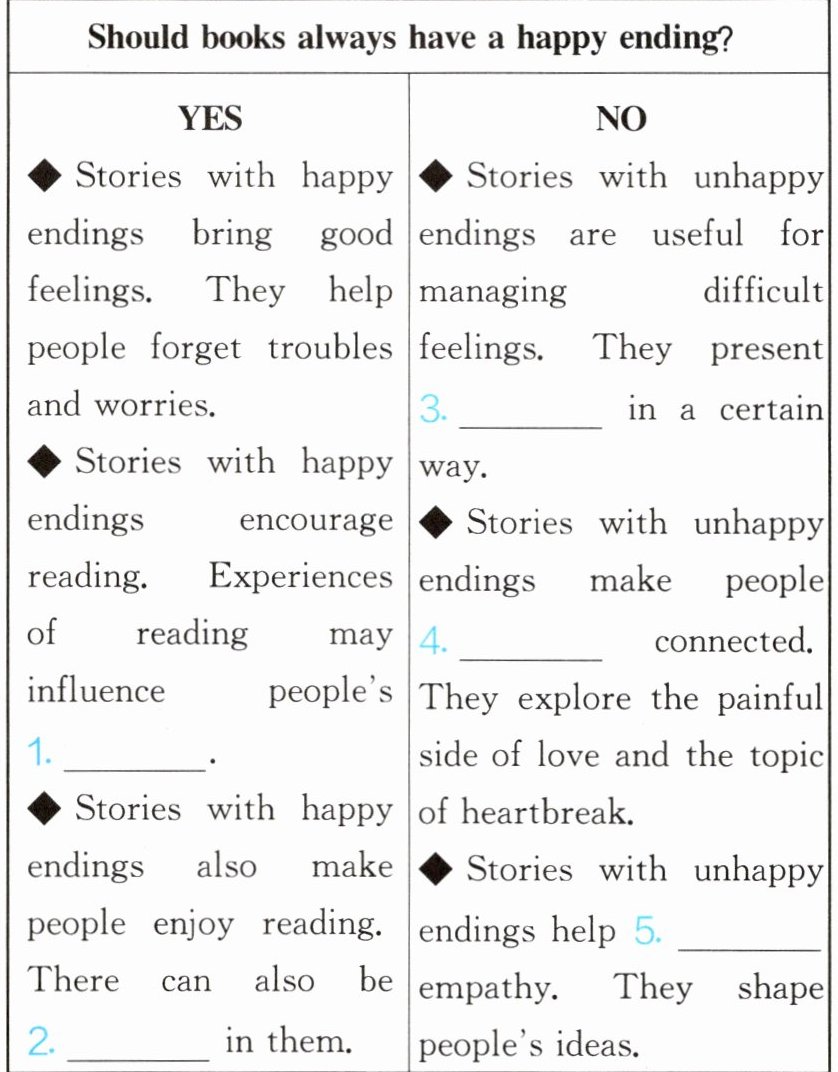
词数:310 体裁:议论文 核心素养:思维品质
话题:图书 难度:中 建议用时:6分钟
根据短文内容,完成图表中所缺信息。
Should books always have a happy ending?
The purpose of World Book Day is to encourage people to enjoy reading and there's no
doubt that a book's ending is usually a big part of that joy. Even so, there are plenty of stories that don't finish on a happy note. What do you think? Should books always have a happy ending?
Part of the reason we read in the first place is that reading makes us happy. We read to get away from troubles and worries in real life. If your reading experiences are full of sadness or other negative feelings, you may give up reading. If your experiences of reading are connected to positive feelings, you could be encouraged to carry on reading. It doesn't mean stories with happy endings cannot make you enjoy reading. They can also include surprises, which make the stories quite dramatic and exciting, even if you know everything's going to end well. Exploring love into the characters' lives is equally as satisfying.
In real life, the story doesn't stop at the "happy ending". It doesn't end. It keeps going past that happy moment to a lifetime of more moments both good and bad. Books with unhappy endings are useful because they show you the true feelings such as sadness but in a controlled way. They can help you deal with these feelings in your life. The stories explore the painful side of love and the topic of heartbreak. Reading about these kinds of things in stories can help make us feel like we're not alone in our personal experiences. Some experts say that experiencing negative feelings can make you better at understanding how other people are feeling. This ability, known as empathy, helps you to connect with people and support them through hard times. It's the "unhappy" endings that have the greatest influence.
答案
四、[文章大意]本文探讨了书籍是否应该总是有一个“快乐结局”的问题。
1. reading behaviors/reading habits
2. surprises
3. the true feelings
4. feel
5. develop
1. reading behaviors/reading habits
2. surprises
3. the true feelings
4. feel
5. develop
解析
【分析】本题为信息匹配类阅读填表题,需结合图表中“YES”和“NO”的观点,定位原文对应内容,明确每个空缺处的语义,再从原文中匹配对应的词汇或短语,确保填写内容符合原文意思和句子逻辑。解题时,先分析每个空所在句子的含义,再回到原文查找相关表述,逐一对应答案。
【解析】1. 定位原文第二段:“If your experiences of reading are connected to positive feelings, you could be encouraged to carry on reading...” 可知快乐结局的故事对阅读行为/习惯有影响,故填reading behaviors/reading habits;2. 原文第二段提到“They can also include surprises, which make the stories quite dramatic and exciting...” 对应2空,填surprises;3. 原文第三段:“Books with unhappy endings are useful because they show you the true feelings such as sadness but in a controlled way.” 对应3空,填the true feelings;4. 原文第三段:“Reading about these kinds of things in stories can help make us feel like we're not alone in our personal experiences.” 对应4空,填feel;5. 原文第三段:“Some experts say that experiencing negative feelings can make you better at understanding how other people are feeling. This ability, known as empathy...” 可知不快乐结局的故事有助于培养同理心,故填develop。
【答案】1. reading behaviors/reading habits 2. surprises 3. the true feelings 4. feel 5. develop
【知识点】阅读理解(信息匹配)、英语词汇运用
【点评】本题考查学生的细节定位能力和语义理解能力,要求学生能快速从原文中找到对应信息并准确填写,属于中等难度的阅读题型,需学生仔细分析原文与图表的对应关系。
【难度系数】0.6
【解析】1. 定位原文第二段:“If your experiences of reading are connected to positive feelings, you could be encouraged to carry on reading...” 可知快乐结局的故事对阅读行为/习惯有影响,故填reading behaviors/reading habits;2. 原文第二段提到“They can also include surprises, which make the stories quite dramatic and exciting...” 对应2空,填surprises;3. 原文第三段:“Books with unhappy endings are useful because they show you the true feelings such as sadness but in a controlled way.” 对应3空,填the true feelings;4. 原文第三段:“Reading about these kinds of things in stories can help make us feel like we're not alone in our personal experiences.” 对应4空,填feel;5. 原文第三段:“Some experts say that experiencing negative feelings can make you better at understanding how other people are feeling. This ability, known as empathy...” 可知不快乐结局的故事有助于培养同理心,故填develop。
【答案】1. reading behaviors/reading habits 2. surprises 3. the true feelings 4. feel 5. develop
【知识点】阅读理解(信息匹配)、英语词汇运用
【点评】本题考查学生的细节定位能力和语义理解能力,要求学生能快速从原文中找到对应信息并准确填写,属于中等难度的阅读题型,需学生仔细分析原文与图表的对应关系。
【难度系数】0.6
