

 登录
登录
二、阅读短文,在下面的表格中填入与文意最符合的内容,每空一词。
新情境·传统文化
建议用时:10 分钟
难度:★★★★★
When you sit with your family for a meal, have you ever wondered where and when the tradition of using chopsticks began?
· A symbol
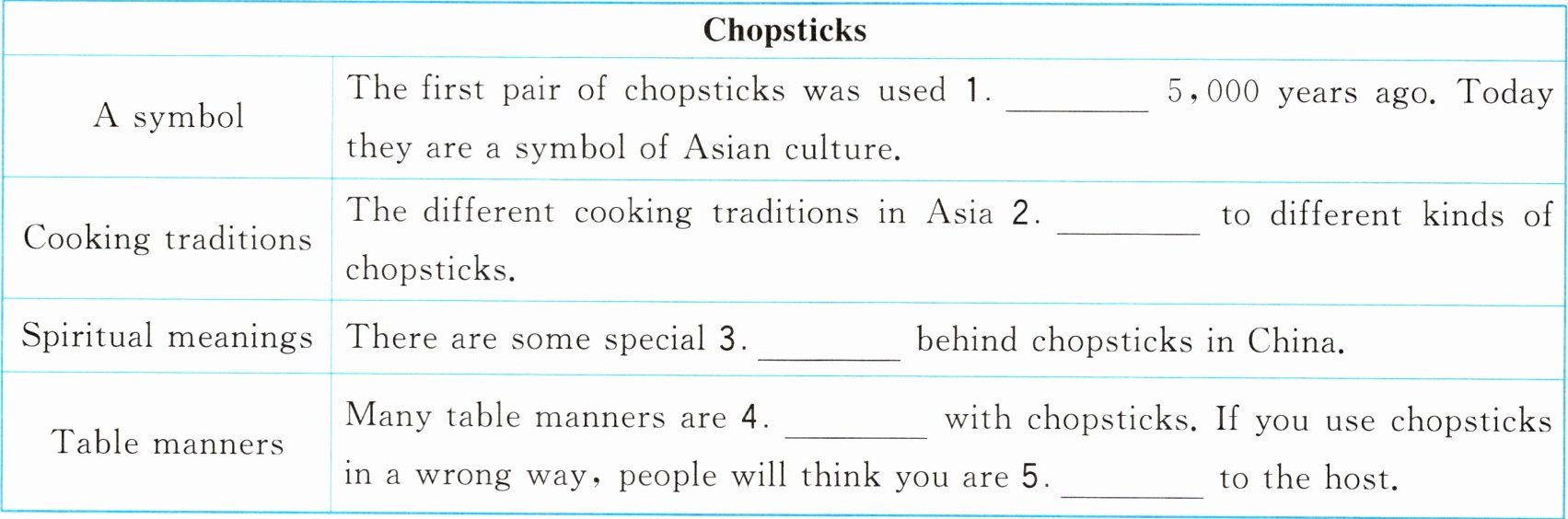
People say that the first pair of chopsticks was used in China more than 5,000 years ago. The practice became popular in Korea, Vietnam and Japan. Today they are a symbol of Asian culture.
· Cooking traditions
The different cooking traditions in Asia lead to different kinds of chopsticks. For example, Korean people often use flat chopsticks. They find it easier to pick up small side dishes because of the shape.
· Spiritual(精神的) meanings
Chopsticks mean something special in China. For example, “weak things, when united, become strong”, which is always used by parents to teach their children to get on well with others, is a saying(谚语) that includes “chopsticks”.
· Table manners
There are also many table manners about chopsticks. For example, never stick your chopsticks upright(直立地) in your rice bowl or tap on your bowl with your chopsticks. People believe it is not polite to the host(主人).
新情境·传统文化
建议用时:10 分钟
难度:★★★★★
When you sit with your family for a meal, have you ever wondered where and when the tradition of using chopsticks began?
· A symbol
People say that the first pair of chopsticks was used in China more than 5,000 years ago. The practice became popular in Korea, Vietnam and Japan. Today they are a symbol of Asian culture.
· Cooking traditions
The different cooking traditions in Asia lead to different kinds of chopsticks. For example, Korean people often use flat chopsticks. They find it easier to pick up small side dishes because of the shape.
· Spiritual(精神的) meanings
Chopsticks mean something special in China. For example, “weak things, when united, become strong”, which is always used by parents to teach their children to get on well with others, is a saying(谚语) that includes “chopsticks”.
· Table manners
There are also many table manners about chopsticks. For example, never stick your chopsticks upright(直立地) in your rice bowl or tap on your bowl with your chopsticks. People believe it is not polite to the host(主人).
答案
二、1. over 2. lead 3. meanings 4. connected 5. impolite
解析
【分析】
这是短文细节匹配类的阅读填空题,要求每空仅填一词,解题思路如下:首先对照表格的每个小标题,回到原文对应板块定位相关语句;之后比对表格句子和原文的语义,优先匹配原文直接出现的、符合语法规则的词汇,遇到需要同义转换的空,结合固定搭配、语义逻辑推导正确词汇;最后检查每空的词性、单复数形式是否符合句子语法要求。
【解析】
1. 定位原文"A symbol"板块的"People say that the first pair of chopsticks was used in China more than 5,000 years ago",more than表示“超过”,对应同义单词over,符合句子语义,故填over。
2. 定位原文"Cooking traditions"板块的"The different cooking traditions in Asia lead to different kinds of chopsticks",lead to是固定短语意为“带来、导致”,完全匹配表格句子语义,故填lead。
3. 定位原文"Spiritual meanings"板块的内容,表格中空前有some修饰,需要填可数名词复数,指代筷子背后特殊的含义,故填meanings。
4. 该句语义为“很多餐桌礼仪和筷子相关”,对应原文“many table manners about chopsticks”的语义,结合空前的are和空后的with,固定搭配be connected with表示“与……有关”,完全符合语法和语义要求,故填connected。
5. 定位原文最后一段"People believe it is not polite to the host",错误使用筷子的行为对主人是不礼貌的,not polite同义替换为impolite,故填impolite。
【答案】
1. over 2. lead 3. meanings 4. connected 5. impolite
【知识点】
阅读细节定位,固定短语搭配,词义转换
【点评】
本题以中国传统筷子文化为命题情境,既考察学生快速抓取文本关键信息的阅读能力,也兼顾了词汇、固定搭配的基础知识点考察,部分空需要做简单的同义转换,能很好区分学生的综合语言运用能力,同时渗透了传统文化相关的常识科普。
【难度系数】
0.6
这是短文细节匹配类的阅读填空题,要求每空仅填一词,解题思路如下:首先对照表格的每个小标题,回到原文对应板块定位相关语句;之后比对表格句子和原文的语义,优先匹配原文直接出现的、符合语法规则的词汇,遇到需要同义转换的空,结合固定搭配、语义逻辑推导正确词汇;最后检查每空的词性、单复数形式是否符合句子语法要求。
【解析】
1. 定位原文"A symbol"板块的"People say that the first pair of chopsticks was used in China more than 5,000 years ago",more than表示“超过”,对应同义单词over,符合句子语义,故填over。
2. 定位原文"Cooking traditions"板块的"The different cooking traditions in Asia lead to different kinds of chopsticks",lead to是固定短语意为“带来、导致”,完全匹配表格句子语义,故填lead。
3. 定位原文"Spiritual meanings"板块的内容,表格中空前有some修饰,需要填可数名词复数,指代筷子背后特殊的含义,故填meanings。
4. 该句语义为“很多餐桌礼仪和筷子相关”,对应原文“many table manners about chopsticks”的语义,结合空前的are和空后的with,固定搭配be connected with表示“与……有关”,完全符合语法和语义要求,故填connected。
5. 定位原文最后一段"People believe it is not polite to the host",错误使用筷子的行为对主人是不礼貌的,not polite同义替换为impolite,故填impolite。
【答案】
1. over 2. lead 3. meanings 4. connected 5. impolite
【知识点】
阅读细节定位,固定短语搭配,词义转换
【点评】
本题以中国传统筷子文化为命题情境,既考察学生快速抓取文本关键信息的阅读能力,也兼顾了词汇、固定搭配的基础知识点考察,部分空需要做简单的同义转换,能很好区分学生的综合语言运用能力,同时渗透了传统文化相关的常识科普。
【难度系数】
0.6
