

 登录
登录
9. (2026·郑州月考)如图,菱形ABCD的对角线AC,BD相交于点O,过点D作DE//AC且DE = $\frac{1}{2}$AC,连接AE交OD于点F,连接CE,OE.
(1)求证:四边形OCED为矩形;
(2)若菱形ABCD的边长为4,∠ABC=60°,则AE的长为

(1)求证:四边形OCED为矩形;
(2)若菱形ABCD的边长为4,∠ABC=60°,则AE的长为
$2\sqrt{7}$
.答案
(1)$\because$ 四边形ABCD是菱形,$\therefore OA=OC=\frac{1}{2} AC,OB=OD$,$AC ⊥ BD$,$\therefore ∠ COD=90°$.$\because DE=\frac{1}{2} AC$,$\therefore DE=OC$.$\because DE // AC$,$\therefore$ 四边形OCED为平行四边形.又$\because ∠ COD=90°$,$\therefore$ 平行四边形OCED为矩形.
(2)$2\sqrt{7}$ 解析:$\because$ 菱形ABCD的边长为4,$\therefore AB=BC=CD=DA=4$.$\because ∠ ABC=60°$,$\therefore △ ABC$是等边三角形,$\therefore AC=BC=AB=4$,$\therefore OA=OC=\frac{1}{2} AC=2$.$\because AC ⊥ BD$,$\therefore OB=OD=\sqrt{BC^2-OC^2}=\sqrt{4^2-2^2}=2\sqrt{3}$.$\because$ 四边形CODE是矩形,$\therefore ∠ ACE=90°$,$CE=OD=2\sqrt{3}$,在$\mathrm{Rt}△ ACE$中,由勾股定理得$AE=\sqrt{AC^2+CE^2}=\sqrt{4^2+(2\sqrt{3})^2}=2\sqrt{7}$.故答案为$2\sqrt{7}$.
(2)$2\sqrt{7}$ 解析:$\because$ 菱形ABCD的边长为4,$\therefore AB=BC=CD=DA=4$.$\because ∠ ABC=60°$,$\therefore △ ABC$是等边三角形,$\therefore AC=BC=AB=4$,$\therefore OA=OC=\frac{1}{2} AC=2$.$\because AC ⊥ BD$,$\therefore OB=OD=\sqrt{BC^2-OC^2}=\sqrt{4^2-2^2}=2\sqrt{3}$.$\because$ 四边形CODE是矩形,$\therefore ∠ ACE=90°$,$CE=OD=2\sqrt{3}$,在$\mathrm{Rt}△ ACE$中,由勾股定理得$AE=\sqrt{AC^2+CE^2}=\sqrt{4^2+(2\sqrt{3})^2}=2\sqrt{7}$.故答案为$2\sqrt{7}$.
10. (达州中考)如图,在$△ ABC$中,点O是边AC上一个动点,过点O作直线$EF// BC$分别交$∠ ACB$的平分线、外角$∠ ACD$的平分线于点E,F.
(1)若$CE=8,CF=6$,求OC的长.
(2)连接AE,AF.问:当点O在边AC上运动到什么位置时,四边形AECF是矩形?并说明理由.
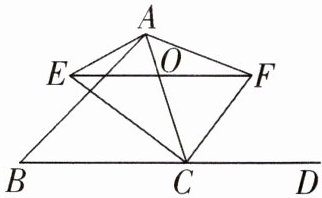
(1)若$CE=8,CF=6$,求OC的长.
(2)连接AE,AF.问:当点O在边AC上运动到什么位置时,四边形AECF是矩形?并说明理由.
答案
(1)$\because EF$交$∠ ACB$的平分线于点E,交$∠ ACD$的平分线于点F,$\therefore ∠ OCE = ∠ BCE, ∠ OCF = ∠ DCF$.$\because EF // BC$,$\therefore ∠ OEC = ∠ BCE, ∠ OFC = ∠ DCF$,$\therefore ∠ OEC = ∠ OCE$,$∠ OFC = ∠ OCF, \therefore OE = OC, OF = OC, \therefore OE = OF$.$\because ∠ OCE+∠ BCE+∠ OCF+∠ DCF = 180°$,$\therefore ∠ ECF = 90°$.在$\mathrm{Rt}△ CEF$中,由勾股定理得 $EF = \sqrt{CE^2+CF^2} = 10$,$\therefore OC=OE=\frac{1}{2} EF=5$.
(2)当点O在边AC上运动到AC的中点时,四边形AECF是矩形.理由如下:由(1)得$OE=OF$,$∠ ECF=90°$,当点O为AC的中点时,$AO=CO$.$\because EO=FO$,$\therefore$ 四边形AECF是平行四边形.$\because ∠ ECF=90°$,$\therefore$ 平行四边形AECF是矩形.
(2)当点O在边AC上运动到AC的中点时,四边形AECF是矩形.理由如下:由(1)得$OE=OF$,$∠ ECF=90°$,当点O为AC的中点时,$AO=CO$.$\because EO=FO$,$\therefore$ 四边形AECF是平行四边形.$\because ∠ ECF=90°$,$\therefore$ 平行四边形AECF是矩形.
11. (2026·山西期末)综合与探究
问题情境:如图,菱形ABCD中,∠ABC=60°,AB=6,点E为边AB的中点,点F为边CD上的动点,连接EF,将四边形EBCF沿EF折叠,BC对应边为GH,直线GH分别交AB,CD于点M,N.
猜想证明:(1)如图①,当GH与AD在同一直线上时,猜想并说明DF与CF之间的数量关系.
拓展延伸:(2)如图②,在点F运动过程中,当GH⊥AB于点M时,连接CE,则四边形ECNM为矩形,请证明.
(3)在(2)的条件下,直接写出NH的长度.
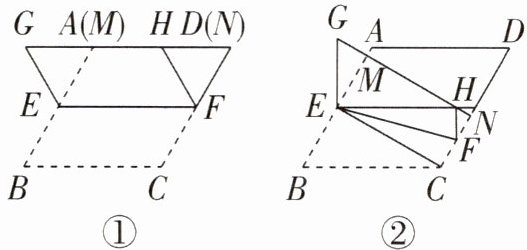

问题情境:如图,菱形ABCD中,∠ABC=60°,AB=6,点E为边AB的中点,点F为边CD上的动点,连接EF,将四边形EBCF沿EF折叠,BC对应边为GH,直线GH分别交AB,CD于点M,N.
猜想证明:(1)如图①,当GH与AD在同一直线上时,猜想并说明DF与CF之间的数量关系.
拓展延伸:(2)如图②,在点F运动过程中,当GH⊥AB于点M时,连接CE,则四边形ECNM为矩形,请证明.
(3)在(2)的条件下,直接写出NH的长度.
答案
(1)$DF=CF$.说明如下: $\because$ 四边形ABCD 是菱形,$\therefore ∠ B=∠ D=60°$,$AB// CD$,$\therefore ∠ C+∠ B=180°$,$\therefore ∠ C=180°-∠ B=180°-60°=120°$.由折叠得:$FH=CF$,$∠ C=∠ FHG=120°$.$\because ∠ FHG+∠ DHF=180°$,$\therefore ∠ DHF=180°-∠ FHG=180°-120°=60°$.$\therefore ∠ D=∠ DHF=60°$.$\therefore FH=DF$.$\therefore DF=CF$.
(2)如图
 ,连接AC,$\because$ 四边形ABCD是菱形,$\therefore AB// CD$,$BA=BC$.$\because ∠ B=60°$,$\therefore △ ABC$是等边三角形.$\therefore CA=CB$.$\because E$为AB的中点,$\therefore CE⊥ AB$.$\therefore ∠ CEA=90°$.$\because GH⊥ AB$于点M,$\therefore ∠ EMN=90°$.$\because AB// CD$,$\therefore ∠ EMN + ∠ MNC = 180°$.$\therefore ∠ MNC = 180°- ∠ EMN = 90°$.$\therefore ∠ CEM = ∠ EMN = ∠ MNC=90°$.$\therefore$ 四边形ECNM是矩形.
(3)$NH=\frac{6\sqrt{3}-9}{2}$. 解析 $\because E$为AB的中点,$AB=6$,$\therefore GE=BE=\frac{1}{2} AB=3$.$\because$ 折叠,$\therefore ∠ G=∠ B=60°$.又$\because GH⊥ AB$,$\therefore ∠ GME=90°$,则$∠ GEM=30°$.$\therefore GM=\frac{1}{2} GE$.$\therefore ME=\sqrt{3} GM=\frac{\sqrt{3}}{2} GE= \frac{3}{2}\sqrt{3}$.$\because$ 四边形ECNM为矩形,$\therefore CN=ME= \frac{3}{2}\sqrt{3}$,$∠ HNF=90°$.$\because FH// GE$,$\therefore ∠ FHN=∠ G=∠ B=60°$,$\therefore ∠ HFN=30°$,则 $HN=\frac{1}{2} HF$.在$\mathrm{Rt}△ HNF$中,$NF=\sqrt{HF^2-HN^2}=\sqrt{3} HN$.设 $NH=x$,则 $NF=\sqrt{3} x$, $HF=2x$.又$\because HF=CF=CN-FN= \frac{3}{2}\sqrt{3} -\sqrt{3} x$, $\therefore \frac{3}{2}\sqrt{3} -\sqrt{3} x=2x$,解得$x=\frac{6\sqrt{3}-9}{2}$.$\therefore NH=\frac{6\sqrt{3}-9}{2}$.
