

 登录
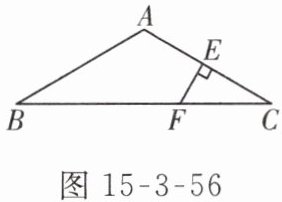
5. 如图15-3-56,在$△ ABC$中,$AB=AC,∠ BAC=120°,AC$的垂直平分线$EF$交$AC$于点$E$,交$BC$于点$F$. 求证$BF=2CF$.
答案
5. 证明:连接 AF. $\because AB=AC$,$∠BAC=120°$,
$\therefore ∠B=∠C=\dfrac{180°-120°}{2}=30°$.
又$\because EF$ 是 $AC$ 的垂直平分线,
$\therefore AF=CF$,$\therefore ∠C=∠FAC=30°$,
$\therefore ∠BAF=∠BAC-∠FAC=120°-30°=90°$.
在 $\mathrm{Rt}△BAF$ 中,$∠BAF=90°$,$∠B=30°$,
$\therefore AF=\dfrac{1}{2}BF$,$\therefore CF=\dfrac{1}{2}BF$,
即 $BF=2CF$.
$\therefore ∠B=∠C=\dfrac{180°-120°}{2}=30°$.
又$\because EF$ 是 $AC$ 的垂直平分线,
$\therefore AF=CF$,$\therefore ∠C=∠FAC=30°$,
$\therefore ∠BAF=∠BAC-∠FAC=120°-30°=90°$.
在 $\mathrm{Rt}△BAF$ 中,$∠BAF=90°$,$∠B=30°$,
$\therefore AF=\dfrac{1}{2}BF$,$\therefore CF=\dfrac{1}{2}BF$,
即 $BF=2CF$.
如图15-3-57,在△ABC中,∠A=90°,∠B=30°,AC=3cm,点D以1cm/s的速度从点A向点C运动,同时点E以2cm/s的速度从点C向点B运动,运动时间为ts.
(1)当t=
(2)当t为何值时,△DEC为直角三角形?
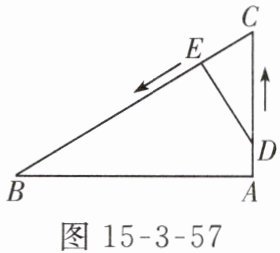
图15-3-57
(1)当t=
1
时,△DEC为等边三角形.(2)当t为何值时,△DEC为直角三角形?
图15-3-57
答案
(1)1
(2)解:在$△ABC$中,$\because ∠A=90°$,$∠B=30°$,
$\therefore ∠C=90°-30°=60°$.
由题意,得 $AD=t\mathrm{cm}$,$CE=2t\mathrm{cm}$,
$\therefore CD=(3-t)\mathrm{cm}$.
①当$∠DEC$为直角时,$∠EDC=30°$.
$\therefore CE=\dfrac{1}{2}CD$,即 $2t=\dfrac{1}{2}(3-t)$,解得 $t=\dfrac{3}{5}$;
②当$∠EDC$为直角时,$∠DEC=30°$.
$\therefore CD=\dfrac{1}{2}CE$,即 $3-t=\dfrac{1}{2}×2t$,解得 $t=\dfrac{3}{2}$.
综上所述,当 $t=\dfrac{3}{5}$ 或 $t=\dfrac{3}{2}$ 时,$△DEC$ 为直角三角形.
