

 登录
17.(本小题满分12分)如图,在$△ ABC$中,$∠ B=2∠ C$,AE平分$∠ BAC$交BC于点E.
(1)若$AD⊥ BC$于点D,$∠ C=40°$,求$∠ DAE$的度数;
(2)若$EF⊥ AE$交AC于点F,求证$∠ C=2∠ FEC$.
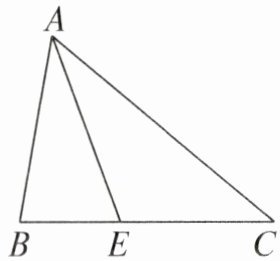
(1)若$AD⊥ BC$于点D,$∠ C=40°$,求$∠ DAE$的度数;
(2)若$EF⊥ AE$交AC于点F,求证$∠ C=2∠ FEC$.
答案
17. (1)解 如图,作$AD⊥ BC$ 于点D.
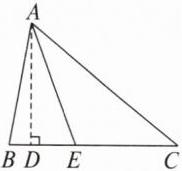
$\because∠ C=40°$,$∠ B=2∠ C$,
$\therefore∠ B=80°$,$\therefore∠ BAC=60°$.
$\because AE$ 平分$∠ BAC$,
$\therefore∠ EAC=30°$.
$\because AD⊥ BC$,$\therefore∠ ADC=90°$,
$\therefore∠ DAC=50°$,
$\therefore∠ DAE=50°-30°=20°$.
(2)证明 如图,作$EF⊥ AE$,交$AC$ 于点F.
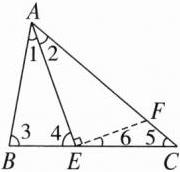
$\because EF⊥ AE$,$\therefore∠ AEF=90°$.
$\because∠ B=2∠ C$,即$∠ 3=2∠ 5$.
$\therefore$设$∠ C=∠ 5=x$,
则$∠ B=∠ 3=2x$.
$\because AE$ 平分$∠ BAC$,
$\therefore∠ 1=∠ 2$.
设$∠ 1=∠ 2=y$,
则$∠ 2+∠ 5=∠ 4=x+y$,
$\therefore∠ 3+∠ 1+∠ 4=2x+y+y+x+y=180°$,
$\therefore 3x+2y=180°$,
即$\frac{3}{2}x + y=90°$.
$\because∠ 4+∠ 6=x+y+∠ 6=90°$,
$\therefore∠ 6=\frac{1}{2}x$,即$∠ 5=2∠ 6$,
$\therefore∠ C=2∠ FEC$.
解析
【分析】
(1) 求解∠DAE可先逐步求出相关角的度数:首先根据已知∠C的度数和∠B=2∠C的关系算出∠B,再用三角形内角和定理求出∠BAC的度数;结合AE是角平分线的性质得到∠EAC的度数;再由AD⊥BC,在直角△ADC中求出∠DAC的度数,最后用∠DAC减去∠EAC即可得到∠DAE的大小。
(2) 要证明∠C=2∠FEC,可采用设参数表示角度的方法简化推导:先设∠C为x,则∠B为2x,设AE平分∠BAC得到的两个等角为y,利用三角形内角和得到x与y的关系式;再结合EF⊥AE得到∠AEF=90°,推导∠FEC和x的数量关系,即可得出待证结论。
【解析】
(1) 解:如图,作$AD⊥ BC$ 于点D。
$\because∠ C=40°$,$∠ B=2∠ C$,
$\therefore∠ B=2×40°=80°$,
由三角形内角和为$180°$可得:$∠ BAC=180°-∠ B-∠ C=180°-80°-40°=60°$。
$\because AE$ 平分$∠ BAC$,
$\therefore∠ EAC=\frac{1}{2}∠ BAC=\frac{1}{2}×60°=30°$。
$\because AD⊥ BC$,$\therefore∠ ADC=90°$,
在$Rt△ ADC$中,$∠ DAC=90°-∠ C=90°-40°=50°$,
$\therefore∠ DAE=∠ DAC-∠ EAC=50°-30°=20°$。
(2) 证明:如图,作$EF⊥ AE$,交$AC$ 于点F。
$\because EF⊥ AE$,$\therefore∠ AEF=90°$,即$∠ AEB+∠ FEC=90°$。
已知$∠ B=2∠ C$,设$∠ C=x$,则$∠ B=2x$。
$\because AE$ 平分$∠ BAC$,$\therefore∠ BAE=∠ CAE$,设$∠ BAE=∠ CAE=y$。
在$△ ABC$中,由内角和定理得:$∠ B+∠ C+∠ BAC=2x+x+2y=180°$,整理得$3x+2y=180°$,即$\frac{3}{2}x+y=90°$。
又$\because ∠ AEB$是$△ AEC$的外角,$\therefore ∠ AEB=∠ C+∠ CAE=x+y$。
结合$∠ AEB+∠ FEC=90°$,可得$x+y+∠ FEC=90°$。
将$\frac{3}{2}x+y=90°$变形为$y=90°-\frac{3}{2}x$,代入上式得:
$x+90°-\frac{3}{2}x+∠ FEC=90°$,
解得$∠ FEC=\frac{1}{2}x$,即$∠ FEC=\frac{1}{2}∠ C$,
$\therefore∠ C=2∠ FEC$。
【答案】
(1) 解 如图,作$AD⊥ BC$ 于点D.
$\because∠ C=40°$,$∠ B=2∠ C$,
$\therefore∠ B=80°$,$\therefore∠ BAC=60°$.
$\because AE$ 平分$∠ BAC$,
$\therefore∠ EAC=30°$.
$\because AD⊥ BC$,$\therefore∠ ADC=90°$,
$\therefore∠ DAC=50°$,
$\therefore∠ DAE=50°-30°=20°$.
(2)证明 如图,作$EF⊥ AE$,交$AC$ 于点F.
$\because EF⊥ AE$,$\therefore∠ AEF=90°$.
$\because∠ B=2∠ C$,即$∠ 3=2∠ 5$.
$\therefore$设$∠ C=∠ 5=x$,
则$∠ B=∠ 3=2x$.
$\because AE$ 平分$∠ BAC$,
$\therefore∠ 1=∠ 2$.
设$∠ 1=∠ 2=y$,
则$∠ 2+∠ 5=∠ 4=x+y$,
$\therefore∠ 3+∠ 1+∠ 4=2x+y+y+x+y=180°$,
$\therefore 3x+2y=180°$,
即$\frac{3}{2}x + y=90°$.
$\because∠ 4+∠ 6=x+y+∠ 6=90°$,
$\therefore∠ 6=\frac{1}{2}x$,即$∠ 5=2∠ 6$,
$\therefore∠ C=2∠ FEC$.
【知识点】
三角形内角和定理,角平分线的定义,直角三角形的性质
【点评】
本题是三角形角度运算的典型题型,既考查了基础的角度计算能力,也考查了逻辑推导能力。解题时通过设参数表示未知角度,能让角之间的数量关系更清晰,降低推导难度,熟练掌握三角形相关性质是解决这类问题的关键。
【难度系数】
0.7
18.(本小题满分13分)在$△ ABC$中,AE平分$∠ BAC$,$AD⊥ BC$于点D,$∠ B=70°$,$∠ C=34°$.
(1)如图①,试求$∠ DAE$的度数.请把$∠ B$,$∠ C$,$∠ DAE$的关系规律化(不需要证明).
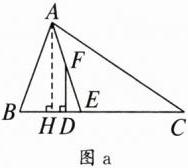
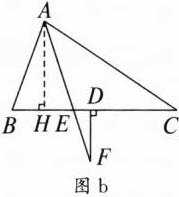
(2)设F为AE上任一点,当它在AE上滑动时,AD变成FD,如图②,结论还成立吗?当它滑动到AE的延长线上时,AD变成FD,如图③,结论还成立吗?证明你的结论.
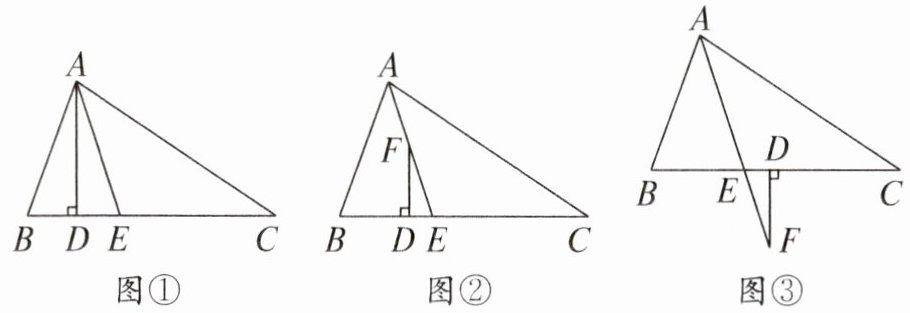
(1)如图①,试求$∠ DAE$的度数.请把$∠ B$,$∠ C$,$∠ DAE$的关系规律化(不需要证明).
(2)设F为AE上任一点,当它在AE上滑动时,AD变成FD,如图②,结论还成立吗?当它滑动到AE的延长线上时,AD变成FD,如图③,结论还成立吗?证明你的结论.
答案
解 (1)如题图①,
$\because AD⊥ BC$,$\therefore∠ ADB=90°$,
$\therefore∠ BAD=90°-∠ B=90°-70°=20°$.
$\because∠ BAC=180°-∠ B-∠ C=180°-70°-34°=76°$,$AE$ 平分$∠ BAC$,
$\therefore∠ BAE=\frac{1}{2}∠ BAC=\frac{1}{2}×76°=38°$,
$\therefore∠ DAE=∠ BAE-∠ BAD=38°-20°=18°$,
$\therefore∠ B$,$∠ C$,$∠ DAE$ 的关系为$∠ DAE=\frac{1}{2}(∠ B-∠ C)$.
(2)成立.
如图 a,作$AH⊥ BC$ 于点 H,由(1)得$∠ HAE=\frac{1}{2}(∠ B-∠ C)$.
$\because AH// FD$,
$\therefore∠ DFE=∠ HAE$,
$\therefore∠ DFE=\frac{1}{2}(∠ B-∠ C)$成立.
如图 b,作$AH⊥ BC$ 于点 H,由(1)得$∠ HAE=\frac{1}{2}(∠ B-∠ C)$,
$\because AH// FD$,$\therefore∠ F=∠ HAE$,
$\therefore∠ DFE=\frac{1}{2}(∠ B-∠ C)$成立.
解析
【分析】
(1) 求∠DAE的度数可分三步:首先利用三角形内角和定理算出∠BAC的度数,再结合角平分线的定义得到∠BAE的度数;之后根据AD⊥BC,利用直角三角形两锐角互余求出∠BAD的度数;最后通过角度差∠DAE=∠BAE-∠BAD算出结果,再对式子变形即可推导∠B、∠C、∠DAE的关系。
(2) 点F滑动的两种情况都可以通过作辅助线验证结论:过A作AH⊥BC于H,先由(1)的结论得到∠HAE与∠B、∠C的关系,再根据AH、FD都垂直于BC得到两直线平行,利用平行线内错角相等的性质,将∠DFE转化为∠HAE,即可验证结论是否成立。
【解析】
(1) 如图①,
$\because AD⊥ BC$,$\therefore∠ ADB=90°$,
在$Rt△ ABD$中,$∠ BAD=90°-∠ B=90°-70°=20°$。
在$△ ABC$中,$∠ BAC=180°-∠ B-∠ C=180°-70°-34°=76°$,
$\because AE$ 平分$∠ BAC$,
$\therefore∠ BAE=\frac{1}{2}∠ BAC=\frac{1}{2}×76°=38°$,
$\therefore∠ DAE=∠ BAE-∠ BAD=38°-20°=18°$,
整理可得$∠ B$、$∠ C$、$∠ DAE$的关系为$∠ DAE=\frac{1}{2}(∠ B-∠ C)$。
(2) 两种情况结论都成立,证明如下:
① 如图②,作$AH⊥ BC$ 于点 H,由(1)得$∠ HAE=\frac{1}{2}(∠ B-∠ C)$。
$\because AH⊥BC,FD⊥BC$,$\therefore AH// FD$,
$\therefore∠ DFE=∠ HAE$,即$∠ DFE=\frac{1}{2}(∠ B-∠ C)$,结论成立。
② 如图③,作$AH⊥ BC$ 于点 H,由(1)得$∠ HAE=\frac{1}{2}(∠ B-∠ C)$,
$\because AH⊥BC,FD⊥BC$,$\therefore AH// FD$,
$\therefore∠ F=∠ HAE$,即$∠ DFE=\frac{1}{2}(∠ B-∠ C)$,结论成立。
【答案】
(1) $∠DAE=18°$,关系为$\boldsymbol{∠DAE=\frac{1}{2}(∠B-∠C)}$;
(2) 两种情况结论均成立,$\boldsymbol{∠DFE=\frac{1}{2}(∠B-∠C)}$。
【知识点】
三角形内角和定理,角平分线的定义,平行线的性质
【点评】
本题是三角形角度计算的探究类题型,在点的动态变化中探究不变的角度规律,既考查基础的角度运算能力,也要求掌握作辅助线转化角度的方法,有助于锻炼从特殊到一般的几何探究思维。
【难度系数】
0.6
