

 登录
阅读短文,用英文填空或回答问题。(注意每小题的词数要求)
When the first person looked up to the sky, people's imagination of space began. There are many stories about Chinese exploration(探索) of space.
Thousands of years ago, there was a lady named Chang'e that flew to the moon and lived there with a rabbit. It's just a story in myths(神话).
In the Ming Dynasty, a man named Wan Hu used a machine as a rocket to fly to space but failed. He was thought of as the first human that tried to explore space.
Our exploration of space never stopped until it became a reality in modern times. Chinese space technology has made great progress.
In 2003, Shenzhou V set off successfully. Yang Liwei's words “I am proud(自豪的) of our country” brought tears to our eyes. Carrying the flying dream of the Chinese nation for thousands of years, as the first space visitor of China, he started the Space Age for the Chinese. In 2008, Zhai Zhigang had the first Chinese spacewalk. “I am out of the capsule, and I feel good,” he told the world.
In the near future, China plans to send astronauts to the moon by 2030. From 2003 to 2030, Chinese people go farther and farther in space. ▲
46−49. Complete the mind map according to the passage.(每空不超过6词)
China’s Exploration of Space
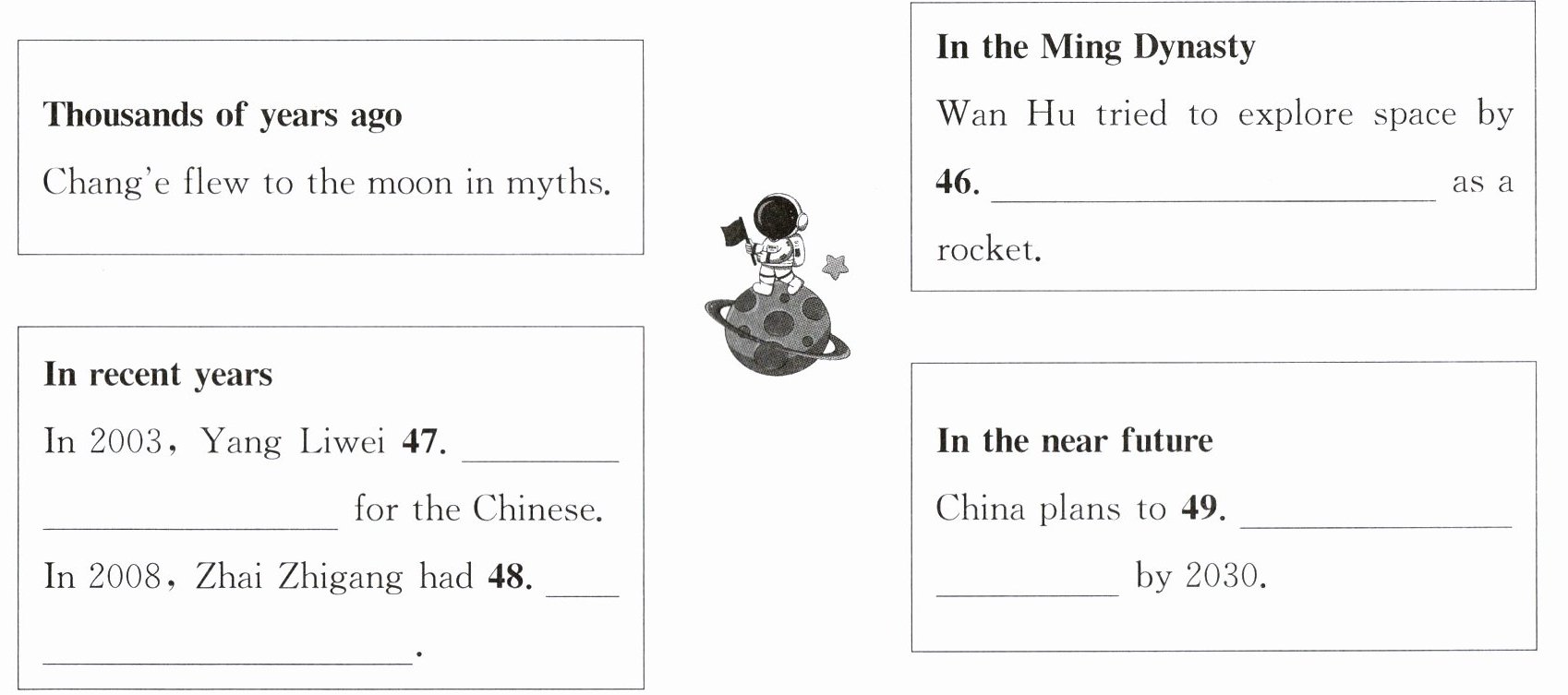
Thousands of years ago
Chang'e flew to the moon in myths.
In recent years
In 2003, Yang Liwei 47.
In 2008, Zhai Zhigang had 48.
In the Ming Dynasty
Wan Hu tried to explore space by 46.
In the near future
China plans to 49.
50. Please write a sentence to fill in ▲ to end the passage.
(不超过25词)
第二节 书面表达(共1题,满分15分)
When the first person looked up to the sky, people's imagination of space began. There are many stories about Chinese exploration(探索) of space.
Thousands of years ago, there was a lady named Chang'e that flew to the moon and lived there with a rabbit. It's just a story in myths(神话).
In the Ming Dynasty, a man named Wan Hu used a machine as a rocket to fly to space but failed. He was thought of as the first human that tried to explore space.
Our exploration of space never stopped until it became a reality in modern times. Chinese space technology has made great progress.
In 2003, Shenzhou V set off successfully. Yang Liwei's words “I am proud(自豪的) of our country” brought tears to our eyes. Carrying the flying dream of the Chinese nation for thousands of years, as the first space visitor of China, he started the Space Age for the Chinese. In 2008, Zhai Zhigang had the first Chinese spacewalk. “I am out of the capsule, and I feel good,” he told the world.
In the near future, China plans to send astronauts to the moon by 2030. From 2003 to 2030, Chinese people go farther and farther in space. ▲
46−49. Complete the mind map according to the passage.(每空不超过6词)
China’s Exploration of Space
Thousands of years ago
Chang'e flew to the moon in myths.
In recent years
In 2003, Yang Liwei 47.
started the Space Age
for the Chinese.In 2008, Zhai Zhigang had 48.
the first Chinese spacewalk
.In the Ming Dynasty
Wan Hu tried to explore space by 46.
using a machine
as a rocket.In the near future
China plans to 49.
send astronauts to the moon
by 2030.50. Please write a sentence to fill in ▲ to end the passage.
China's exploration of space will keep going further.(答案不唯一)
(不超过25词)
第二节 书面表达(共1题,满分15分)
答案
46. using a machine
47. started the Space Age
48. the first Chinese spacewalk
49. send astronauts to the moon
50. China's exploration of space will keep going further.(答案不唯一)
47. started the Space Age
48. the first Chinese spacewalk
49. send astronauts to the moon
50. China's exploration of space will keep going further.(答案不唯一)
解析
【分析】
本题为阅读理解填空题,需根据短文内容提取关键信息完成思维导图和结尾句。解题思路:1. 针对46-49题,定位每个时间节点对应的原文内容,提取匹配的短语;2. 针对50题,结合前文中国太空探索的发展历程,总结合理的结尾句,注意词数限制。
【解析】
46. 定位原文“In the Ming Dynasty, a man named Wan Hu used a machine as a rocket...”,by后接动名词短语,故填using a machine;
47. 定位原文“In 2003... he started the Space Age for the Chinese.”,直接提取短语;
48. 定位原文“In 2008, Zhai Zhigang had the first Chinese spacewalk.”,直接提取;
49. 定位原文“In the near future, China plans to send astronauts to the moon by 2030.”,直接提取;
50. 结合前文“Chinese people go farther and farther in space”,总结符合语境的结尾句,如“China's exploration of space will keep going further.”
【答案】
46. using a machine
47. started the Space Age
48. the first Chinese spacewalk
49. send astronauts to the moon
50. China's exploration of space will keep going further.
【知识点】
阅读理解信息提取、词汇运用、句子总结
【点评】
本题考查学生对短文细节的提取能力和总结能力,题型贴合实际,难度适中,需准确对应原文内容完成填空。
【难度系数】
0.6
