

 登录
登录
Ⅰ. 用括号内所给单词的适当形式填空。
1. Albert Einstein and Marie Curie are two of the greatest
2. This year's party
3. They
4. Teaching is my
5. We should
6. The
7. Patience is a
8. The scientist made a great
1. Albert Einstein and Marie Curie are two of the greatest
geniuses
(genius) in science.2. This year's party
outdid
(outdo) last year's.3. They
proudly
(proud) stood on the stage.4. Teaching is my
profession
(professional).5. We should
widen
(wide) our range of interests.6. The
pianist
(piano) practises the piano every day.7. Patience is a
characteristic
(character) of a good teacher.8. The scientist made a great
contribution
(contribute) to the world.答案
1. geniuses 2. outdid 3. proudly 4. profession
5. widen 6. pianist 7. characteristic
8. contribution
5. widen 6. pianist 7. characteristic
8. contribution
解析
【分析】
本题为英语词汇适当形式填空题,需结合句子语法结构、词性要求及语境确定单词正确形式:1. 数词two后接可数名词复数,需转换genius的复数形式;2. 句子描述过去动作,动词需用过去式;3. 修饰动词stood需用副词,需转换形容词proud为副词;4. 形容词性物主代词my后接名词,需转换形容词professional为名词;5. 情态动词should后接动词原形,需转换形容词wide为动词;6. 表示“练习钢琴的人”需用职业名词;7. 不定冠词a后接可数名词单数,需转换名词character为对应名词;8. 形容词great后接名词,需转换动词contribute为名词。
【解析】
1. 考查可数名词复数:“two of + 可数名词复数”表示“……中的两个”,genius的复数形式为geniuses,故填geniuses;
2. 考查动词时态:此处表示今年派对胜过去年的,是过去发生的动作,outdo的过去式为outdid,故填outdid;
3. 考查副词用法:副词修饰动词,stood为动词,需用proud的副词形式proudly修饰,故填proudly;
4. 考查词性转换(形容词转名词):形容词性物主代词my后需接名词,professional的名词形式为profession,意为“职业”,故填profession;
5. 考查词性转换(形容词转动词):情态动词should后接动词原形,wide的动词形式为widen,意为“拓宽”,故填widen;
6. 考查名词:表示“练习钢琴的人”需用名词pianist(钢琴家),符合语境,故填pianist;
7. 考查词性转换(名词转名词):不定冠词a后接可数名词单数,character此处转换为characteristic,意为“特征”,符合句意“耐心是好老师的一个特征”,故填characteristic;
8. 考查词性转换(动词转名词):形容词great后接名词,contribute的名词形式为contribution,构成固定搭配make a contribution to,故填contribution。
【答案】
1. geniuses 2. outdid 3. proudly 4. profession 5. widen 6. pianist 7. characteristic 8. contribution
【知识点】
词性转换、可数名词复数、动词时态
【点评】
本题为英语基础词汇运用题,考查词性转换、名词复数变化及动词时态等核心基础知识点,题型常规,难度较低,适合巩固初中英语词汇变形规则,学生需掌握常见词的不同词性形式及语法搭配要求。
【难度系数】
0.7
本题为英语词汇适当形式填空题,需结合句子语法结构、词性要求及语境确定单词正确形式:1. 数词two后接可数名词复数,需转换genius的复数形式;2. 句子描述过去动作,动词需用过去式;3. 修饰动词stood需用副词,需转换形容词proud为副词;4. 形容词性物主代词my后接名词,需转换形容词professional为名词;5. 情态动词should后接动词原形,需转换形容词wide为动词;6. 表示“练习钢琴的人”需用职业名词;7. 不定冠词a后接可数名词单数,需转换名词character为对应名词;8. 形容词great后接名词,需转换动词contribute为名词。
【解析】
1. 考查可数名词复数:“two of + 可数名词复数”表示“……中的两个”,genius的复数形式为geniuses,故填geniuses;
2. 考查动词时态:此处表示今年派对胜过去年的,是过去发生的动作,outdo的过去式为outdid,故填outdid;
3. 考查副词用法:副词修饰动词,stood为动词,需用proud的副词形式proudly修饰,故填proudly;
4. 考查词性转换(形容词转名词):形容词性物主代词my后需接名词,professional的名词形式为profession,意为“职业”,故填profession;
5. 考查词性转换(形容词转动词):情态动词should后接动词原形,wide的动词形式为widen,意为“拓宽”,故填widen;
6. 考查名词:表示“练习钢琴的人”需用名词pianist(钢琴家),符合语境,故填pianist;
7. 考查词性转换(名词转名词):不定冠词a后接可数名词单数,character此处转换为characteristic,意为“特征”,符合句意“耐心是好老师的一个特征”,故填characteristic;
8. 考查词性转换(动词转名词):形容词great后接名词,contribute的名词形式为contribution,构成固定搭配make a contribution to,故填contribution。
【答案】
1. geniuses 2. outdid 3. proudly 4. profession 5. widen 6. pianist 7. characteristic 8. contribution
【知识点】
词性转换、可数名词复数、动词时态
【点评】
本题为英语基础词汇运用题,考查词性转换、名词复数变化及动词时态等核心基础知识点,题型常规,难度较低,适合巩固初中英语词汇变形规则,学生需掌握常见词的不同词性形式及语法搭配要求。
【难度系数】
0.7
Ⅱ. 根据中文意思完成英语句子。
1. 她不仅是科学领域的天才,还是位有天赋的画家。
She is
2. 向所有老师致敬。
3. 有些人曾经看不起波兰民间音乐。
Some people
4. 无论老少,我们都应该互相帮助。
能力提升
1. 她不仅是科学领域的天才,还是位有天赋的画家。
She is
not
only
a genius in science but
also
a talented painter.2. 向所有老师致敬。
Hats
off
to all the teachers.3. 有些人曾经看不起波兰民间音乐。
Some people
looked
down
on
Polish folk music.4. 无论老少,我们都应该互相帮助。
Young
and
old
, we should help each other.能力提升
答案
1. not only; but also 2. Hats off 3. looked down on
4. Young and old
4. Young and old
解析
【分析】
本题考查英语常用固定短语与句型的运用,需结合中文语义匹配对应的英语固定表达。第1题对应“不仅…而且…”的并列结构,用固定搭配连接;第2题“向…致敬”对应特定固定短语;第3题“看不起”的固定短语结合时态变化;第4题“老少”对应固定表达。
【解析】
1. 表示“不仅…而且…”的固定搭配为not only…but also,用于连接两个并列成分,符合句子结构,故填not only; but also。
2. “向…致敬”的固定短语为Hats off to,句首单词首字母大写,故填Hats off。
3. “看不起”的固定短语为look down on,由“曾经”可知用一般过去式,故填looked down on。
4. “老少”的固定表达为Young and old,句首单词首字母大写,故填Young and old。
【答案】
1. not only; but also 2. Hats off 3. looked down on 4. Young and old
【知识点】
固定搭配;固定短语;常用句型
【点评】
本题侧重考查英语基础固定短语和句型的运用,是日常学习的重点内容,需牢记常见固定表达以准确完成句子。
【难度系数】
0.3
本题考查英语常用固定短语与句型的运用,需结合中文语义匹配对应的英语固定表达。第1题对应“不仅…而且…”的并列结构,用固定搭配连接;第2题“向…致敬”对应特定固定短语;第3题“看不起”的固定短语结合时态变化;第4题“老少”对应固定表达。
【解析】
1. 表示“不仅…而且…”的固定搭配为not only…but also,用于连接两个并列成分,符合句子结构,故填not only; but also。
2. “向…致敬”的固定短语为Hats off to,句首单词首字母大写,故填Hats off。
3. “看不起”的固定短语为look down on,由“曾经”可知用一般过去式,故填looked down on。
4. “老少”的固定表达为Young and old,句首单词首字母大写,故填Young and old。
【答案】
1. not only; but also 2. Hats off 3. looked down on 4. Young and old
【知识点】
固定搭配;固定短语;常用句型
【点评】
本题侧重考查英语基础固定短语和句型的运用,是日常学习的重点内容,需牢记常见固定表达以准确完成句子。
【难度系数】
0.3
Ⅲ. 根据上下文意思,从方框中选出恰当的单词并用其适当形式补全短文。
gift characteristic value follow young piano inspiration proud funeral Polish
Chopin was one of the greatest musicians in history. He was born in 1.
Chopin often told his students, “Put all your soul into it! Play the way you feel!” This advice is still 4.
Polish folk music became an important 5.
When Chopin died at 39, thousands of people came to his 7.
gift characteristic value follow young piano inspiration proud funeral Polish
Chopin was one of the greatest musicians in history. He was born in 1.
Poland
in 1810. Although he only gave about 30 public concerts, he was celebrated as one of the world's greatest 2. pianists
. He was also a 3. gifted
composer.Chopin often told his students, “Put all your soul into it! Play the way you feel!” This advice is still 4.
followed
by musicians today.Polish folk music became an important 5.
characteristic
of Chopin's music. His use of this music made people see it as a 6. valuable
art form. His music also helped build a nation that was divided by other countries.When Chopin died at 39, thousands of people came to his 7.
funeral
. Today, people around the world still listen to his moving music. It is studied in music schools, played by pianists, and loved by listeners, 8. young
and old. Chopin's music continues to 9. inspire
people everywhere. The Polish people 10. proudly
think of Poland as the country of Chopin.答案
1. Poland 2. pianists 3. gifted 4. followed
5. characteristic 6. valuable 7. funeral 8. young
9. inspire 10. proudly
5. characteristic 6. valuable 7. funeral 8. young
9. inspire 10. proudly
解析
【分析】
本题为短文选词填空题,解题思路如下:1. 通读全文,明确短文围绕音乐家肖邦的生平与成就展开;2. 分析每个空格的句子语境、所需词性,结合方框给出的单词,筛选合适词汇;3. 根据语法规则(如名词单复数、形容词/副词变形、被动语态等)对所选词汇进行适当形式转换;4. 代入验证,确保符合上下文逻辑。
【解析】
1. 句意:他1810年出生在波兰,需填表示国家的名词,故填Poland;
2. 句意:他被称为世界最伟大的钢琴家之一,“one of + 形容词最高级 + 名词复数”结构,故填pianists;
3. 句意:他是一位有天赋的作曲家,需用gift的形容词形式修饰名词composer,故填gifted;
4. 句意:这个建议至今被音乐家遵循,为一般现在时的被动语态,需用follow的过去分词,故填followed;
5. 句意:波兰民间音乐是他音乐的重要特征,需填名词“特征”,故填characteristic;
6. 句意:他的创作让波兰民间音乐成为有价值的艺术形式,需用value的形容词形式修饰名词art form,故填valuable;
7. 句意:他去世时,很多人参加他的葬礼,需填名词“葬礼”,故填funeral;
8. 句意:固定搭配“young and old”表示“老少”,故填young;
9. 句意:他的音乐继续激励各地的人,需用inspiration的动词形式作谓语,故填inspire;
10. 句意:波兰人自豪地认为波兰是肖邦的祖国,需用proud的副词形式修饰动词think,故填proudly。
【答案】
1. Poland 2. pianists 3. gifted 4. followed 5. characteristic 6. valuable 7. funeral 8. young 9. inspire 10. proudly
【知识点】
英语词汇运用、词性转换、短文填空
【点评】
本题围绕肖邦的相关内容设题,考查学生对词汇的语境理解及词性变形能力,题型基础,需结合上下文逻辑和语法规则解题,适合初中阶段学生练习。
【难度系数】
0.7
本题为短文选词填空题,解题思路如下:1. 通读全文,明确短文围绕音乐家肖邦的生平与成就展开;2. 分析每个空格的句子语境、所需词性,结合方框给出的单词,筛选合适词汇;3. 根据语法规则(如名词单复数、形容词/副词变形、被动语态等)对所选词汇进行适当形式转换;4. 代入验证,确保符合上下文逻辑。
【解析】
1. 句意:他1810年出生在波兰,需填表示国家的名词,故填Poland;
2. 句意:他被称为世界最伟大的钢琴家之一,“one of + 形容词最高级 + 名词复数”结构,故填pianists;
3. 句意:他是一位有天赋的作曲家,需用gift的形容词形式修饰名词composer,故填gifted;
4. 句意:这个建议至今被音乐家遵循,为一般现在时的被动语态,需用follow的过去分词,故填followed;
5. 句意:波兰民间音乐是他音乐的重要特征,需填名词“特征”,故填characteristic;
6. 句意:他的创作让波兰民间音乐成为有价值的艺术形式,需用value的形容词形式修饰名词art form,故填valuable;
7. 句意:他去世时,很多人参加他的葬礼,需填名词“葬礼”,故填funeral;
8. 句意:固定搭配“young and old”表示“老少”,故填young;
9. 句意:他的音乐继续激励各地的人,需用inspiration的动词形式作谓语,故填inspire;
10. 句意:波兰人自豪地认为波兰是肖邦的祖国,需用proud的副词形式修饰动词think,故填proudly。
【答案】
1. Poland 2. pianists 3. gifted 4. followed 5. characteristic 6. valuable 7. funeral 8. young 9. inspire 10. proudly
【知识点】
英语词汇运用、词性转换、短文填空
【点评】
本题围绕肖邦的相关内容设题,考查学生对词汇的语境理解及词性变形能力,题型基础,需结合上下文逻辑和语法规则解题,适合初中阶段学生练习。
【难度系数】
0.7
Ⅳ. 阅读短文,选择最佳选项。
When I was a teenager, my parents were never interested in the music I preferred. They said to me, “David, the
music you like listening to is a lot of noise.” At the same time, my father described the music that he liked as beautiful. As it turns out, they are not alone. As I grow older, I've often heard people of my age say, “Today’s music is terrible.” Many older people just don’t like new music. But why is that?
The mere exposure effect(纯粹接触效应) may explain this. It means the more familiar we are with something, the more likely we are to prefer it. When we are in our early teens, we usually spend a lot of time listening to popular music and discussing it with our friends. The new songs and singers during this time become familiar to us. After we turn 30, we are busy working and raising our family. We don't have so much time to look for new music. Instead, we prefer to listen to our old favourites. According to studies, by the time we turn 33 years old, most of us will completely stop exploring new music.
But I think there is another reason for older people's dislike of new music. Most new music, after all, is not written for them. It is made for young people. Some types of music began as a rebellion by young people against out-of-date ways of doing things. These types include punk, rap, hip-hop, heavy metal and more. They naturally interest younger listeners.
Do your parents dislike the music you like too? Now, after reading this text, you know there is nothing wrong with that.
1. Why do many older people dislike new music? (
①Because the new music sounds terrible.
②Because they are afraid of noise.
③Because most new music is not written for them.
④Because they are not familiar with the new music.
A. ①②
B. ②③
C. ③④
D. ②④
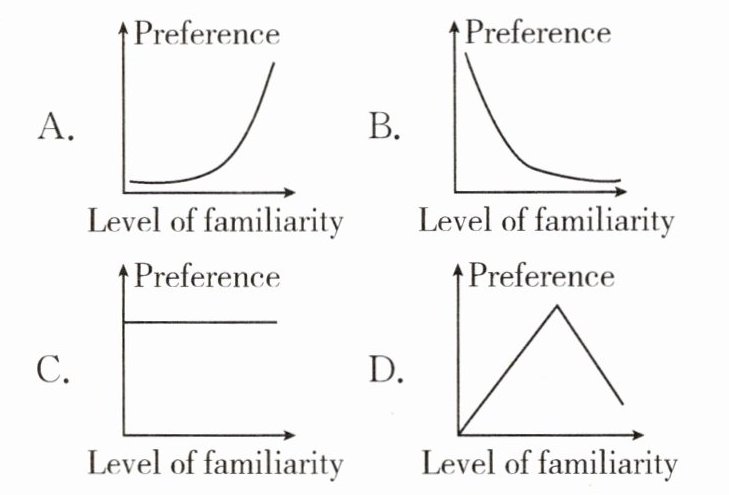
2. Which of the following charts correctly shows “the mere exposure effect”?(Preference:偏爱,Level of familiarity:熟悉度)
(
3. Which of the following words is closest in meaning to the underlined word “rebellion” in paragraph 3? (
A. Purpose.
B. Sense.
C. Praise.
D. Disagreement.
4. Which of the following is TRUE according to the text? (
A. All new music is written for young people.
B. Most people no longer explore new music at the age of 33.
C. Teenagers usually spend a lot of time watching popular TV series.
D. Today’s music is terrible in all people’s eyes.
5. What is the best title for the text? (
A. Why Don’t Your Parents Like the Music You Like?
B. What’s the Real Meaning of the Mere Exposure Effect?
C. When Do Most Young People Stop Exploring New Music?
D. How Do Young People Like Different Types of New Music?
When I was a teenager, my parents were never interested in the music I preferred. They said to me, “David, the
music you like listening to is a lot of noise.” At the same time, my father described the music that he liked as beautiful. As it turns out, they are not alone. As I grow older, I've often heard people of my age say, “Today’s music is terrible.” Many older people just don’t like new music. But why is that?
The mere exposure effect(纯粹接触效应) may explain this. It means the more familiar we are with something, the more likely we are to prefer it. When we are in our early teens, we usually spend a lot of time listening to popular music and discussing it with our friends. The new songs and singers during this time become familiar to us. After we turn 30, we are busy working and raising our family. We don't have so much time to look for new music. Instead, we prefer to listen to our old favourites. According to studies, by the time we turn 33 years old, most of us will completely stop exploring new music.
But I think there is another reason for older people's dislike of new music. Most new music, after all, is not written for them. It is made for young people. Some types of music began as a rebellion by young people against out-of-date ways of doing things. These types include punk, rap, hip-hop, heavy metal and more. They naturally interest younger listeners.
Do your parents dislike the music you like too? Now, after reading this text, you know there is nothing wrong with that.
1. Why do many older people dislike new music? (
C
)①Because the new music sounds terrible.
②Because they are afraid of noise.
③Because most new music is not written for them.
④Because they are not familiar with the new music.
A. ①②
B. ②③
C. ③④
D. ②④
2. Which of the following charts correctly shows “the mere exposure effect”?(Preference:偏爱,Level of familiarity:熟悉度)
(
A
)3. Which of the following words is closest in meaning to the underlined word “rebellion” in paragraph 3? (
D
)A. Purpose.
B. Sense.
C. Praise.
D. Disagreement.
4. Which of the following is TRUE according to the text? (
B
)A. All new music is written for young people.
B. Most people no longer explore new music at the age of 33.
C. Teenagers usually spend a lot of time watching popular TV series.
D. Today’s music is terrible in all people’s eyes.
5. What is the best title for the text? (
A
)A. Why Don’t Your Parents Like the Music You Like?
B. What’s the Real Meaning of the Mere Exposure Effect?
C. When Do Most Young People Stop Exploring New Music?
D. How Do Young People Like Different Types of New Music?
答案
1-5 CADBA
解析
【分析】
本题为英语阅读理解题,需先通读短文把握主旨,再针对每个小题结合原文信息逐一分析选项:
1. 第1题需定位老人不喜欢新音乐的原因,从原文找对应表述;
2. 第2题需理解“纯粹接触效应”的含义,对应熟悉度与偏爱的关系;
3. 第3题需结合上下文猜测划线词的词义;
4. 第4题需判断选项与原文细节是否一致,逐一排除错误选项;
5. 第5题需概括文章主旨,选择最贴合的标题。
【解析】
1. 第1题:根据原文第二段“纯粹接触效应(越熟悉越喜欢)”可知老人对新音乐不熟悉,对应④;第三段“Most new music, after all, is not written for them”对应③,故③④正确,选C。
2. 第2题:“纯粹接触效应”指越熟悉某事物越偏爱,即熟悉度越高,偏爱程度越高,对应图A(曲线随熟悉度上升而上升),故选A。
3. 第3题:划线词所在句意为“一些音乐类型最初是年轻人反对过时方式的______”,against表反对,故rebellion意为“反抗、不同意”,对应选项D。
4. 第4题:A项“所有新音乐为年轻人写”与原文“Most new music”不符;B项“多数人33岁不再探索新音乐”与原文“by the time we turn 33 years old, most of us will completely stop exploring new music”一致;C项“青少年花时间看电视剧”与原文“listening to popular music”不符;D项“所有人觉得今天的音乐糟糕”与原文“people of my age say... Many older people”不符,故选B。
5. 第5题:文章围绕“父母为何不喜欢孩子喜欢的音乐”展开,A项贴合主旨;B项仅为文中一个理论,C项仅为细节,D项与主旨无关,故选A。
【答案】
1.C 2.A 3.D 4.B 5.A
【知识点】
阅读理解,细节理解,词义猜测
【点评】
本文是一篇关于音乐偏好与年龄关系的说明文,题型涵盖细节理解、词义猜测和主旨大意,需学生精准定位原文信息,仔细辨析选项与原文的匹配度,整体难度适中。
【难度系数】
0.6
本题为英语阅读理解题,需先通读短文把握主旨,再针对每个小题结合原文信息逐一分析选项:
1. 第1题需定位老人不喜欢新音乐的原因,从原文找对应表述;
2. 第2题需理解“纯粹接触效应”的含义,对应熟悉度与偏爱的关系;
3. 第3题需结合上下文猜测划线词的词义;
4. 第4题需判断选项与原文细节是否一致,逐一排除错误选项;
5. 第5题需概括文章主旨,选择最贴合的标题。
【解析】
1. 第1题:根据原文第二段“纯粹接触效应(越熟悉越喜欢)”可知老人对新音乐不熟悉,对应④;第三段“Most new music, after all, is not written for them”对应③,故③④正确,选C。
2. 第2题:“纯粹接触效应”指越熟悉某事物越偏爱,即熟悉度越高,偏爱程度越高,对应图A(曲线随熟悉度上升而上升),故选A。
3. 第3题:划线词所在句意为“一些音乐类型最初是年轻人反对过时方式的______”,against表反对,故rebellion意为“反抗、不同意”,对应选项D。
4. 第4题:A项“所有新音乐为年轻人写”与原文“Most new music”不符;B项“多数人33岁不再探索新音乐”与原文“by the time we turn 33 years old, most of us will completely stop exploring new music”一致;C项“青少年花时间看电视剧”与原文“listening to popular music”不符;D项“所有人觉得今天的音乐糟糕”与原文“people of my age say... Many older people”不符,故选B。
5. 第5题:文章围绕“父母为何不喜欢孩子喜欢的音乐”展开,A项贴合主旨;B项仅为文中一个理论,C项仅为细节,D项与主旨无关,故选A。
【答案】
1.C 2.A 3.D 4.B 5.A
【知识点】
阅读理解,细节理解,词义猜测
【点评】
本文是一篇关于音乐偏好与年龄关系的说明文,题型涵盖细节理解、词义猜测和主旨大意,需学生精准定位原文信息,仔细辨析选项与原文的匹配度,整体难度适中。
【难度系数】
0.6
