

 登录
Ⅰ. Listen and circle the unstressed word in each sentence.
1. Carry a reusable shopping bag always.
2. Protect the environment every single day.
3. Separate paper, plastic, and glass every day.
4. Remember to recycle all office paper products.
1. Carry a reusable shopping bag always.
2. Protect the environment every single day.
3. Separate paper, plastic, and glass every day.
4. Remember to recycle all office paper products.
答案
1. a
2. the
3. and
4. to
2. the
3. and
4. to
Ⅱ. Listen and answer the questions.
(
A. Throwing away old things and buying new ones.
B. Breaking down old things to make new materials.
C. Changing old things into new, creative products.
(
A. Turning used paper into notebooks.
B. Turning old T-shirts into shopping bags.
C. Making a plant pot from a plastic bottle.
(
A. Two.
B. Three.
C. Four.
(
C
)1. What is upcycling?A. Throwing away old things and buying new ones.
B. Breaking down old things to make new materials.
C. Changing old things into new, creative products.
(
A
)2. What example of upcycling does Mia give for school?A. Turning used paper into notebooks.
B. Turning old T-shirts into shopping bags.
C. Making a plant pot from a plastic bottle.
(
B
)3. How many good points about upcycling does Mia talk about?A. Two.
B. Three.
C. Four.
答案
1. C
2. A
3. B
2. A
3. B
Ⅲ. Read and complete the tasks.
🌱 Two friends talk about 3Rs
Amy: Hi Leo! Do you know the "3Rs" rule to protect our earth?
Leo: Not really. Can you tell me?
Amy: Sure! Reduce means using less to make less waste. Reuse is using things again instead of throwing them away. Recycle is turning waste into new materials.
Leo: Wow, that's easy to follow!
♻️ Creative examples around us
Amy: And people are already doing creative things with them! In China, the upcycling trend is growing. A designer Xenia turns old jeans into special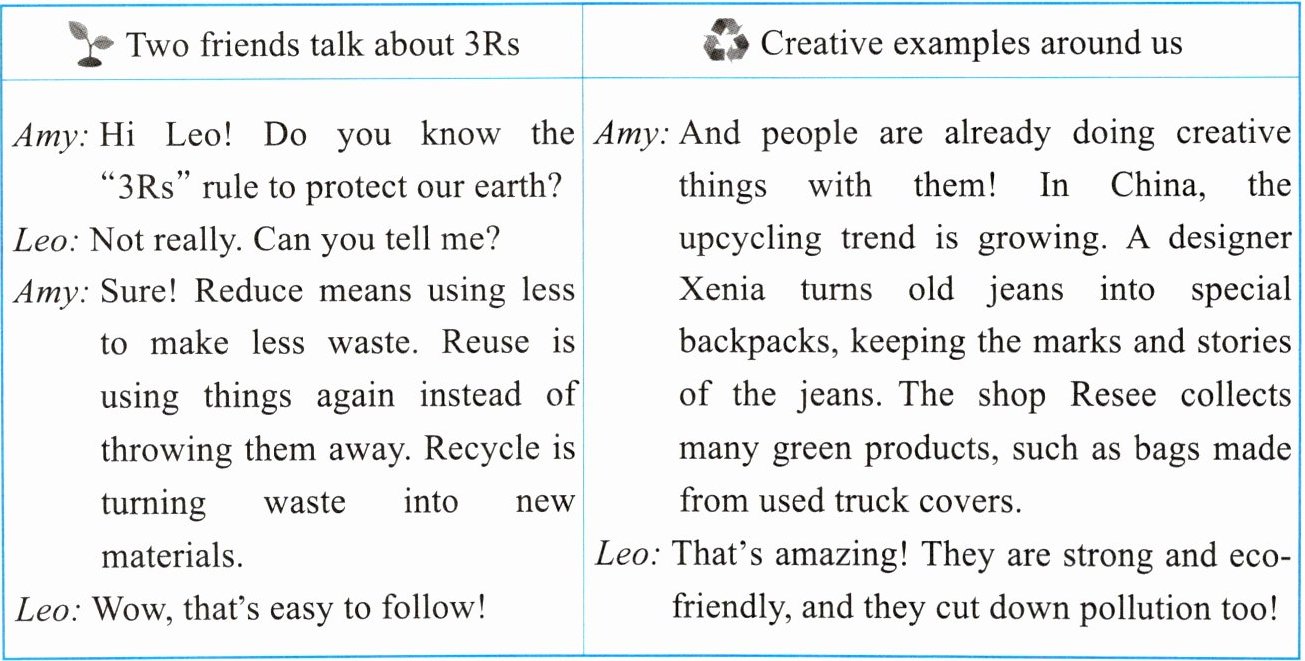 backpacks, keeping the marks and stories of the jeans. The shop Resee collects many green products, such as bags made from used truck covers.
Leo: That's amazing! They are strong and eco-friendly, and they cut down pollution too!
A. Let’s classify! Write REDUCE, REUSE or RECYCLE in each blank.
1. Taking a shorter shower to save water.
2. Giving your used clothes to your younger cousin.
3. Collecting plastic waste and turning it into new chairs.
B. Answer the questions.
(
A. She throws them away. B. She gives them to poor people.
C. She sells them to friends. D. She makes them into backpacks.
(
A. It fails to protect our environment.
B. It is becoming more and more popular.
C. It is not accepted by most Chinese people.
D. It only uses old jeans to make new things.
3. Do you like upcycling? Why or why not?
🌱 Two friends talk about 3Rs
Amy: Hi Leo! Do you know the "3Rs" rule to protect our earth?
Leo: Not really. Can you tell me?
Amy: Sure! Reduce means using less to make less waste. Reuse is using things again instead of throwing them away. Recycle is turning waste into new materials.
Leo: Wow, that's easy to follow!
♻️ Creative examples around us
Amy: And people are already doing creative things with them! In China, the upcycling trend is growing. A designer Xenia turns old jeans into special
backpacks, keeping the marks and stories of the jeans. The shop Resee collects many green products, such as bags made from used truck covers.Leo: That's amazing! They are strong and eco-friendly, and they cut down pollution too!
A. Let’s classify! Write REDUCE, REUSE or RECYCLE in each blank.
1. Taking a shorter shower to save water.
REDUCE
2. Giving your used clothes to your younger cousin.
REUSE
3. Collecting plastic waste and turning it into new chairs.
RECYCLE
B. Answer the questions.
(
D
)1. What does Xenia do with old jeans?A. She throws them away. B. She gives them to poor people.
C. She sells them to friends. D. She makes them into backpacks.
(
B
)2. What can we know about the upcycling trend?A. It fails to protect our environment.
B. It is becoming more and more popular.
C. It is not accepted by most Chinese people.
D. It only uses old jeans to make new things.
3. Do you like upcycling? Why or why not?
Yes. It cuts down pollution.
答案
A. 1. REDUCE
2. REUSE
3. RECYCLE
B. 1. D
2. B
3. One possible version: Yes. It cuts down pollution.
2. REUSE
3. RECYCLE
B. 1. D
2. B
3. One possible version: Yes. It cuts down pollution.
解析
【分析】
首先明确“3Rs”的核心定义:Reduce是减少使用以降低浪费,Reuse是重复使用物品而非丢弃,Recycle是将废物转化为新材料。A部分需根据每个行为匹配对应概念;B部分1题定位Xenia处理旧牛仔裤的做法,2题定位升级改造趋势的描述,3题结合其环保意义作答。
【解析】
A. 1. 短时间淋浴节水属于减少水资源使用,对应Reduce,故填REDUCE。
2. 将旧衣服给表妹是重复使用物品,对应Reuse,故填REUSE。
3. 收集塑料废物制成新椅子是将废物转化为新材料,对应Recycle,故填RECYCLE。
B. 1. 原文明确提到“A designer Xenia turns old jeans into special backpacks”,对应选项D,故选D。
2. 原文提到“In China, the upcycling trend is growing”,说明升级改造趋势越来越流行,对应选项B,故选B。
3. 结合升级改造“环保、减少污染”的优点,可回答Yes. It cuts down pollution.(符合逻辑即可)
【答案】
A. 1. REDUCE 2. REUSE 3. RECYCLE
B. 1. D 2. B 3. Yes. It cuts down pollution.
【知识点】
英语阅读理解、环保概念理解、细节信息查找
【点评】
本题围绕环保主题展开,既考察对“3Rs”核心概念的理解,又锻炼原文细节定位能力,题目难度适中,贴近生活实际,适合学生巩固环保相关的英语阅读知识。
【难度系数】
0.6
