

 登录
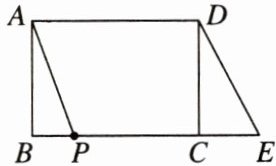
3. 如图,在长方形ABCD中,AB=4,AD=6.延长BC到点E,使CE=2,连接DE,动点P从点B出发,以每秒2个单位的速度沿BC-CD-DA向终点A运动,设点P的运动时间为t s,当t的值为多少时,△ABP和△DCE全等?
答案
【解】由题意得,当点$P$在线段$BC$上时,$BP=2t$,
$\because$ 四边形$ABCD$为长方形,
$\therefore CD=AB=4,BC=AD=6,∠B=∠DCB=90°,$
$\therefore ∠DCE=90°=∠B$.此时有$△ ABP≌△ DCE$,
$\therefore BP=CE,\therefore 2t=2$,解得$t=1$;
当点$P$在线段$AD$上时,$∠BAP=∠DCE=90°$,
$AP=16-2t$,此时有$△ ABP≌△ CDE$,
$\therefore AP=CE,\therefore 16-2t=2$,解得$t=7.$
综上,当$t$的值为$1$或$7$时,$△ ABP$和$△ DCE$全等.
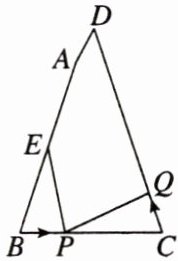
4. 新考法 逆向思维法 如图,已知四边形ABCD中,AB=10 cm,BC=8 cm,CD=12 cm,∠B=∠C,点E为AB的中点.如果点P在线段BC上以3 cm/s的速度由B点向C点运动,同时,点Q在线段CD上由C点向D点运动.
(1)若点Q的运动速度与点P的运动速度相等,经过1 s后,△BPE与△CQP是否全等?请说明理由.
(2)当点Q的运动速度为多少时,能够使△BPE与△CQP全等?
(1)若点Q的运动速度与点P的运动速度相等,经过1 s后,△BPE与△CQP是否全等?请说明理由.
(2)当点Q的运动速度为多少时,能够使△BPE与△CQP全等?
答案
【解】(1)$△ BPE$与$△ CQP$全等.理由如下:
运动$1\ \mathrm{s}$后,$BP=CQ=3\ \mathrm{cm}$,
$\therefore PC=BC-BP=8-3=5(\mathrm{cm}).$
$\because E$为$AB$的中点,且$AB=10\ \mathrm{cm}$,
$\therefore BE=5\ \mathrm{cm},\therefore BE=PC.$
在$△ BPE$和$△ CQP$中,$\begin{cases}BE=CP,\\∠B=∠C,\\BP=CQ,\end{cases}$
$\therefore △ BPE≌△ CQP(\mathrm{SAS}).$
(2)$\because ∠B=∠C$,$△ BPE$与$△ CQP$全等,
$\therefore$ 分两种情况:$△ BEP≌△ CQP$或$△ BEP≌△ CPQ.$
设运动时间为$t\ \mathrm{s}$,则$BP=3t\ \mathrm{cm}$,$\therefore CP=(8-3t)\ \mathrm{cm}.$
当$△ BEP≌△ CQP$时,则$BP=CP$,$CQ=BE=5\ \mathrm{cm}$,
$\therefore 3t=8-3t$,解得$t=\dfrac{4}{3}$,
$\therefore$ 点$Q$的运动速度$=5÷\dfrac{4}{3}=\dfrac{15}{4}(\mathrm{cm/s}).$
当$△ BEP≌△ CPQ$时,由(1)可知$t=1$,
$\therefore CQ=BP=3\ \mathrm{cm}$,$\therefore$ 点$Q$的运动速度$=3÷1=3(\mathrm{cm/s}).$
综上,当点$Q$的运动速度为$\dfrac{15}{4}\ \mathrm{cm/s}$或$3\ \mathrm{cm/s}$时,$△ BPE$与$△ CQP$全等.
