

 登录
登录
25. (答案含评分细则) 核心素养 科学思维「2026四川广元期中,★★」(10分)
如图甲所示,汽车A和汽车B在马路上相向而行,汽车A向东运动,汽车B向西运动。如图乙是汽车A和汽车B的路程随时间变化的坐标图,第15 s两车车头正好相遇。
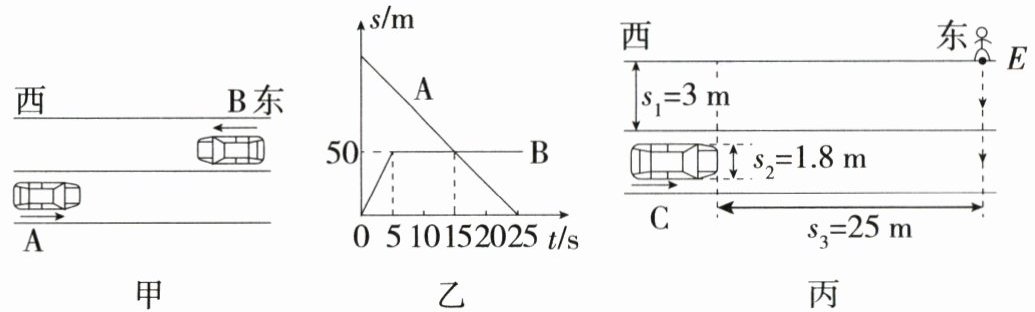
(1)求前5 s内B运动的速度。
(2)开始时,汽车A和汽车B在东西方向上相距多远?
(3)如图丙所示,马路为双向两车道,每条车道宽3 m。一辆长4 m、宽1.8 m的汽车C(汽车可看成一个长方体)以5 m/s的速度由西向东匀速行驶在右侧车道的正中间。此时,一行人突然从图中E点横穿马路,人与汽车在东西方向的距离为$s_3=25$ m,为了能够安全通过,行人的速度范围为多少?(不考虑汽车车速、方向变化以及制动情况,若结果除不尽保留两位小数)
如图甲所示,汽车A和汽车B在马路上相向而行,汽车A向东运动,汽车B向西运动。如图乙是汽车A和汽车B的路程随时间变化的坐标图,第15 s两车车头正好相遇。
(1)求前5 s内B运动的速度。
(2)开始时,汽车A和汽车B在东西方向上相距多远?
(3)如图丙所示,马路为双向两车道,每条车道宽3 m。一辆长4 m、宽1.8 m的汽车C(汽车可看成一个长方体)以5 m/s的速度由西向东匀速行驶在右侧车道的正中间。此时,一行人突然从图中E点横穿马路,人与汽车在东西方向的距离为$s_3=25$ m,为了能够安全通过,行人的速度范围为多少?(不考虑汽车车速、方向变化以及制动情况,若结果除不尽保留两位小数)
答案
25.解析 (1)前 5 s 内 B 运动的速度
$v_\mathrm{B}=\frac{s_\mathrm{B}}{t_\mathrm{B}}=\frac{50\ \mathrm{m}}{5\ \mathrm{s}}=10\ \mathrm{m/s}$。 ..................... (1 分)
(2)汽车 A 的速度 $v_\mathrm{A}=\frac{s_\mathrm{A}}{t_\mathrm{A}}=\frac{50\ \mathrm{m}}{10\ \mathrm{s}}=5\ \mathrm{m/s}$, ............ (1 分)
开始时,汽车 A 和汽车 B 在东西方向上的距离为
$s=s_\mathrm{A}'+s_\mathrm{B}=v_\mathrm{A}t=5\ \mathrm{m/s}×25\ \mathrm{s}=125\ \mathrm{m}$。 ..................... (1 分)
(3)由图丙可得,行人与汽车行驶路径近侧的距离
$s_4=3\ \mathrm{m}+\frac{1}{2}×(3\ \mathrm{m}-1.8\ \mathrm{m})=3.6\ \mathrm{m}$, ..................... (1 分)
行人与汽车行驶路径远侧的距离
$s_5=3\ \mathrm{m}+\frac{1}{2}×(3\ \mathrm{m}-1.8\ \mathrm{m})+1.8\ \mathrm{m}=5.4\ \mathrm{m}$, ..................... (1 分)
汽车通过后行人走到汽车行驶路径近侧所用最短时间
$t_1=\frac{s_3+s_\mathrm{车}}{v_\mathrm{车}}=\frac{25\ \mathrm{m}+4\ \mathrm{m}}{5\ \mathrm{m/s}}=5.8\ \mathrm{s}$, ..................... (1 分)
此时行人的最大速度
$v_1=\frac{s_4}{t_1}=\frac{3.6\ \mathrm{m}}{5.8\ \mathrm{s}}\approx0.62\ \mathrm{m/s}$, ..................... (1 分)
汽车到达前行人走到汽车行驶路径远侧所用最长时间
$t_2=\frac{s_3}{v_\mathrm{车}}=\frac{25\ \mathrm{m}}{5\ \mathrm{m/s}}=5\ \mathrm{s}$, ..................... (1 分)
此时行人的最小速度 $v_2=\frac{s_5}{t_2}=\frac{5.4\ \mathrm{m}}{5\ \mathrm{s}}=1.08\ \mathrm{m/s}$,
行人的速度范围是小于 0.62 m/s 和大于 1.08 m/s。 ..................... (2 分)
$v_\mathrm{B}=\frac{s_\mathrm{B}}{t_\mathrm{B}}=\frac{50\ \mathrm{m}}{5\ \mathrm{s}}=10\ \mathrm{m/s}$。 ..................... (1 分)
(2)汽车 A 的速度 $v_\mathrm{A}=\frac{s_\mathrm{A}}{t_\mathrm{A}}=\frac{50\ \mathrm{m}}{10\ \mathrm{s}}=5\ \mathrm{m/s}$, ............ (1 分)
开始时,汽车 A 和汽车 B 在东西方向上的距离为
$s=s_\mathrm{A}'+s_\mathrm{B}=v_\mathrm{A}t=5\ \mathrm{m/s}×25\ \mathrm{s}=125\ \mathrm{m}$。 ..................... (1 分)
(3)由图丙可得,行人与汽车行驶路径近侧的距离
$s_4=3\ \mathrm{m}+\frac{1}{2}×(3\ \mathrm{m}-1.8\ \mathrm{m})=3.6\ \mathrm{m}$, ..................... (1 分)
行人与汽车行驶路径远侧的距离
$s_5=3\ \mathrm{m}+\frac{1}{2}×(3\ \mathrm{m}-1.8\ \mathrm{m})+1.8\ \mathrm{m}=5.4\ \mathrm{m}$, ..................... (1 分)
汽车通过后行人走到汽车行驶路径近侧所用最短时间
$t_1=\frac{s_3+s_\mathrm{车}}{v_\mathrm{车}}=\frac{25\ \mathrm{m}+4\ \mathrm{m}}{5\ \mathrm{m/s}}=5.8\ \mathrm{s}$, ..................... (1 分)
此时行人的最大速度
$v_1=\frac{s_4}{t_1}=\frac{3.6\ \mathrm{m}}{5.8\ \mathrm{s}}\approx0.62\ \mathrm{m/s}$, ..................... (1 分)
汽车到达前行人走到汽车行驶路径远侧所用最长时间
$t_2=\frac{s_3}{v_\mathrm{车}}=\frac{25\ \mathrm{m}}{5\ \mathrm{m/s}}=5\ \mathrm{s}$, ..................... (1 分)
此时行人的最小速度 $v_2=\frac{s_5}{t_2}=\frac{5.4\ \mathrm{m}}{5\ \mathrm{s}}=1.08\ \mathrm{m/s}$,
行人的速度范围是小于 0.62 m/s 和大于 1.08 m/s。 ..................... (2 分)
解析
【分析】
本题需结合s-t图像分析两车的运动规律,利用速度公式解决问题,第三问需结合横穿马路的实际场景,分析行人安全通过的两种临界情况:一是汽车完全通过后行人再通过,二是汽车到达前行人已通过,进而确定行人的速度范围。
(1) 从s-t图像中读取前5s内B车的路程和时间,用速度公式计算速度;
(2) 先由s-t图像求出A车的速度,再根据相遇时间计算两车初始的距离;
(3) 确定行人需通过的近侧、远侧距离,分别计算两种安全情况对应的时间,进而求出行人的速度范围。
【解析】
(1) 由图乙可知,前5s内B车通过的路程$s_B=50\ \mathrm{m}$,运动时间$t_B=5\ \mathrm{s}$,根据速度公式$v=\frac{s}{t}$,B车的速度:
$v_B=\frac{s_B}{t_B}=\frac{50\ \mathrm{m}}{5\ \mathrm{s}}=10\ \mathrm{m/s}$。
(2) 由图乙可知,A车在0~10s内通过的路程$s_A=50\ \mathrm{m}$,则A车的速度:
$v_A=\frac{s_A}{t_A}=\frac{50\ \mathrm{m}}{10\ \mathrm{s}}=5\ \mathrm{m/s}$;
第15s时两车相遇,此时A车运动的时间$t=15\ \mathrm{s}$,A车通过的路程$s_A'=v_A t=5\ \mathrm{m/s}×15\ \mathrm{s}=75\ \mathrm{m}$;
B车0~5s运动后静止,15s内B车通过的路程为50m,因此开始时两车的距离:
$s=s_A'+s_B=75\ \mathrm{m}+50\ \mathrm{m}=125\ \mathrm{m}$。
(3) 由图丙可知,行人需通过的近侧距离:
$s_4=3\ \mathrm{m}+\frac{1}{2}×(3\ \mathrm{m}-1.8\ \mathrm{m})=3.6\ \mathrm{m}$;
远侧距离:
$s_5=3\ \mathrm{m}+\frac{1}{2}×(3\ \mathrm{m}-1.8\ \mathrm{m})+1.8\ \mathrm{m}=5.4\ \mathrm{m}$;
情况1:汽车完全通过E点时行人走到近侧,汽车行驶总路程为$s_3+s_{\mathrm{车}}=25\ \mathrm{m}+4\ \mathrm{m}=29\ \mathrm{m}$,所需时间:
$t_1=\frac{s_3+s_{\mathrm{车}}}{v_{\mathrm{车}}}=\frac{29\ \mathrm{m}}{5\ \mathrm{m/s}}=5.8\ \mathrm{s}$;
此时行人的最大速度:
$v_1=\frac{s_4}{t_1}=\frac{3.6\ \mathrm{m}}{5.8\ \mathrm{s}}\approx0.62\ \mathrm{m/s}$;
情况2:汽车到达E点时行人走到远侧,汽车行驶路程为$s_3=25\ \mathrm{m}$,所需时间:
$t_2=\frac{s_3}{v_{\mathrm{车}}}=\frac{25\ \mathrm{m}}{5\ \mathrm{m/s}}=5\ \mathrm{s}$;
此时行人的最小速度:
$v_2=\frac{s_5}{t_2}=\frac{5.4\ \mathrm{m}}{5\ \mathrm{s}}=1.08\ \mathrm{m/s}$;
因此行人的速度范围为:小于0.62 m/s或大于1.08 m/s。
【答案】
(1) $10\ \mathrm{m/s}$;(2) $125\ \mathrm{m}$;(3) 小于0.62 m/s或大于1.08 m/s
【知识点】
匀速直线运动速度、s-t图像应用、速度公式应用
【点评】
本题结合s-t图像与实际交通场景,考查学生的科学思维能力,需理解图像物理意义并将物理知识应用于实际问题,难度中等,注重知识的综合运用。
【难度系数】
0.5
本题需结合s-t图像分析两车的运动规律,利用速度公式解决问题,第三问需结合横穿马路的实际场景,分析行人安全通过的两种临界情况:一是汽车完全通过后行人再通过,二是汽车到达前行人已通过,进而确定行人的速度范围。
(1) 从s-t图像中读取前5s内B车的路程和时间,用速度公式计算速度;
(2) 先由s-t图像求出A车的速度,再根据相遇时间计算两车初始的距离;
(3) 确定行人需通过的近侧、远侧距离,分别计算两种安全情况对应的时间,进而求出行人的速度范围。
【解析】
(1) 由图乙可知,前5s内B车通过的路程$s_B=50\ \mathrm{m}$,运动时间$t_B=5\ \mathrm{s}$,根据速度公式$v=\frac{s}{t}$,B车的速度:
$v_B=\frac{s_B}{t_B}=\frac{50\ \mathrm{m}}{5\ \mathrm{s}}=10\ \mathrm{m/s}$。
(2) 由图乙可知,A车在0~10s内通过的路程$s_A=50\ \mathrm{m}$,则A车的速度:
$v_A=\frac{s_A}{t_A}=\frac{50\ \mathrm{m}}{10\ \mathrm{s}}=5\ \mathrm{m/s}$;
第15s时两车相遇,此时A车运动的时间$t=15\ \mathrm{s}$,A车通过的路程$s_A'=v_A t=5\ \mathrm{m/s}×15\ \mathrm{s}=75\ \mathrm{m}$;
B车0~5s运动后静止,15s内B车通过的路程为50m,因此开始时两车的距离:
$s=s_A'+s_B=75\ \mathrm{m}+50\ \mathrm{m}=125\ \mathrm{m}$。
(3) 由图丙可知,行人需通过的近侧距离:
$s_4=3\ \mathrm{m}+\frac{1}{2}×(3\ \mathrm{m}-1.8\ \mathrm{m})=3.6\ \mathrm{m}$;
远侧距离:
$s_5=3\ \mathrm{m}+\frac{1}{2}×(3\ \mathrm{m}-1.8\ \mathrm{m})+1.8\ \mathrm{m}=5.4\ \mathrm{m}$;
情况1:汽车完全通过E点时行人走到近侧,汽车行驶总路程为$s_3+s_{\mathrm{车}}=25\ \mathrm{m}+4\ \mathrm{m}=29\ \mathrm{m}$,所需时间:
$t_1=\frac{s_3+s_{\mathrm{车}}}{v_{\mathrm{车}}}=\frac{29\ \mathrm{m}}{5\ \mathrm{m/s}}=5.8\ \mathrm{s}$;
此时行人的最大速度:
$v_1=\frac{s_4}{t_1}=\frac{3.6\ \mathrm{m}}{5.8\ \mathrm{s}}\approx0.62\ \mathrm{m/s}$;
情况2:汽车到达E点时行人走到远侧,汽车行驶路程为$s_3=25\ \mathrm{m}$,所需时间:
$t_2=\frac{s_3}{v_{\mathrm{车}}}=\frac{25\ \mathrm{m}}{5\ \mathrm{m/s}}=5\ \mathrm{s}$;
此时行人的最小速度:
$v_2=\frac{s_5}{t_2}=\frac{5.4\ \mathrm{m}}{5\ \mathrm{s}}=1.08\ \mathrm{m/s}$;
因此行人的速度范围为:小于0.62 m/s或大于1.08 m/s。
【答案】
(1) $10\ \mathrm{m/s}$;(2) $125\ \mathrm{m}$;(3) 小于0.62 m/s或大于1.08 m/s
【知识点】
匀速直线运动速度、s-t图像应用、速度公式应用
【点评】
本题结合s-t图像与实际交通场景,考查学生的科学思维能力,需理解图像物理意义并将物理知识应用于实际问题,难度中等,注重知识的综合运用。
【难度系数】
0.5
