

 登录
登录
Ⅰ.用括号中所给单词的适当形式填空
1. A kind
2. She read the instructions
3. He is a good
4. It's
5. We should respect everyone's
1. A kind
stranger
(strange) helped the lost child find her way back home.2. She read the instructions
carefully
(care) before starting the experiment.3. He is a good
listener
(listen) and always offers helpful advice.4. It's
impolite
(polite) to cut in others when they are speaking.5. We should respect everyone's
personal
(person) space and privacy(隐私).答案
1. stranger
2. carefully
3. listener
4. impolite
5. personal
2. carefully
3. listener
4. impolite
5. personal
解析
【分析】
解题思路:先分析每个句子空格处所需的词性,再结合括号内单词的词性,进行对应词形变化,同时结合句意验证正确性。具体步骤:1. 确定空格所需词性,转换括号内单词;2. 结合句意确认词形符合语境;3. 完成填空。
【解析】
1. 空格前有不定冠词a和形容词kind,需填名词,括号内strange是形容词,其名词形式为stranger(陌生人),符合“好心的陌生人帮助迷路孩子”的句意,故填stranger;
2. 空格处修饰动词read,需用副词,括号内care是名词/动词,副词形式为carefully,符合“仔细阅读说明”的语境,故填carefully;
3. 空格前有不定冠词a和形容词good,需填名词,括号内listen是动词,其名词形式为listener(听者),符合“他是好的听者”的句意,故填listener;
4. 句型“It's + 形容词 + to do sth.”表示“做某事是……的”,根据句意“打断别人说话是不礼貌的”,需用polite的反义词impolite,故填impolite;
5. 空格后是名词space,需用形容词修饰,括号内person是名词,其形容词形式为personal(个人的),符合“尊重个人空间”的语境,故填personal。
【答案】
1. stranger;2. carefully;3. listener;4. impolite;5. personal
【知识点】
词性转换、副词用法、形容词用法
【点评】
本题考查初中英语基础词汇的词形变化,涉及名词、副词、反义词的转换,结合句子成分和句意即可完成,是巩固词汇基础的典型基础题。
【难度系数】
0.8
解题思路:先分析每个句子空格处所需的词性,再结合括号内单词的词性,进行对应词形变化,同时结合句意验证正确性。具体步骤:1. 确定空格所需词性,转换括号内单词;2. 结合句意确认词形符合语境;3. 完成填空。
【解析】
1. 空格前有不定冠词a和形容词kind,需填名词,括号内strange是形容词,其名词形式为stranger(陌生人),符合“好心的陌生人帮助迷路孩子”的句意,故填stranger;
2. 空格处修饰动词read,需用副词,括号内care是名词/动词,副词形式为carefully,符合“仔细阅读说明”的语境,故填carefully;
3. 空格前有不定冠词a和形容词good,需填名词,括号内listen是动词,其名词形式为listener(听者),符合“他是好的听者”的句意,故填listener;
4. 句型“It's + 形容词 + to do sth.”表示“做某事是……的”,根据句意“打断别人说话是不礼貌的”,需用polite的反义词impolite,故填impolite;
5. 空格后是名词space,需用形容词修饰,括号内person是名词,其形容词形式为personal(个人的),符合“尊重个人空间”的语境,故填personal。
【答案】
1. stranger;2. carefully;3. listener;4. impolite;5. personal
【知识点】
词性转换、副词用法、形容词用法
【点评】
本题考查初中英语基础词汇的词形变化,涉及名词、副词、反义词的转换,结合句子成分和句意即可完成,是巩固词汇基础的典型基础题。
【难度系数】
0.8
Ⅱ.根据汉语意思完成句子,每空一词
6.学生们对科学展览表现出了兴趣。
The students
7.我的父母经常因为一些小事互相争论。
My parents often
8.完成这次讨论之后,让我们进入下一个话题吧。
Let's
9.在课堂上请认真听老师讲课。
Please
10.不要试图模仿别人——做你自己并且保持自信就好。
Don't try to imitate others—just
6.学生们对科学展览表现出了兴趣。
The students
showed
interest
in
the science exhibition.7.我的父母经常因为一些小事互相争论。
My parents often
argue
with
each other about small things.8.完成这次讨论之后,让我们进入下一个话题吧。
Let's
move
on
to
the next topic after finishing this discussion.9.在课堂上请认真听老师讲课。
Please
pay
attention
to
the teacher during the class.10.不要试图模仿别人——做你自己并且保持自信就好。
Don't try to imitate others—just
be
yourself
and be confident.答案
6. showed interest in
7. argue with
8. move on to
9. pay attention to
10. be yourself
7. argue with
8. move on to
9. pay attention to
10. be yourself
解析
【分析】
本题为根据汉语意思完成句子,需先理解每个汉语表达对应的英语固定短语,再结合句子的时态、句式(如祈使句、一般现在时)确定短语的正确形式,最终匹配出符合要求的答案。
【解析】
6. 汉语“表现出兴趣”对应固定短语show interest in,句子描述过去发生的动作,故用一般过去式showed,因此填showed interest in;
7. 汉语“和某人争论”对应固定短语argue with,由often可知用一般现在时,主语my parents是复数,故填argue with;
8. 汉语“进入(话题)”对应固定短语move on to,let's后接动词原形,故填move on to;
9. 汉语“认真听”对应固定短语pay attention to,please后接动词原形,故填pay attention to;
10. 汉语“做你自己”对应固定短语be yourself,此处为祈使句,用动词原形,故填be yourself。
【答案】
6. showed interest in
7. argue with
8. move on to
9. pay attention to
10. be yourself
【知识点】
固定短语搭配,动词短语
【点评】
本题考查英语常用动词短语的固定搭配,侧重基础词汇积累,需结合句子时态、句式要求填写正确形式,属于常规基础题型。
【难度系数】
0.6
本题为根据汉语意思完成句子,需先理解每个汉语表达对应的英语固定短语,再结合句子的时态、句式(如祈使句、一般现在时)确定短语的正确形式,最终匹配出符合要求的答案。
【解析】
6. 汉语“表现出兴趣”对应固定短语show interest in,句子描述过去发生的动作,故用一般过去式showed,因此填showed interest in;
7. 汉语“和某人争论”对应固定短语argue with,由often可知用一般现在时,主语my parents是复数,故填argue with;
8. 汉语“进入(话题)”对应固定短语move on to,let's后接动词原形,故填move on to;
9. 汉语“认真听”对应固定短语pay attention to,please后接动词原形,故填pay attention to;
10. 汉语“做你自己”对应固定短语be yourself,此处为祈使句,用动词原形,故填be yourself。
【答案】
6. showed interest in
7. argue with
8. move on to
9. pay attention to
10. be yourself
【知识点】
固定短语搭配,动词短语
【点评】
本题考查英语常用动词短语的固定搭配,侧重基础词汇积累,需结合句子时态、句式要求填写正确形式,属于常规基础题型。
【难度系数】
0.6
Ⅲ.阅读还原(2025衡阳实验学校月考)
Talking to someone is a great help when you are worried, scared or don't know what is bothering(使烦恼) you. Here are some tips about how to talk about your problems.
Who do you talk to? Talk to someone you trust(信任). They could be your parents, friends, teachers or other people you trust.
11.
How do you talk about your feelings? First, find a quiet and private(私密的) place to talk. If it is hard to start talking, you could write your problem down and give it to them.
12.
13.
hard time. They can help by asking questions and letting you answer. In this way, they will get to know about your problems.
14.
A. What do you talk about?
B. Try to be braver so that we can help ourselves.
C. You could even draw or find pictures on a piece of paper to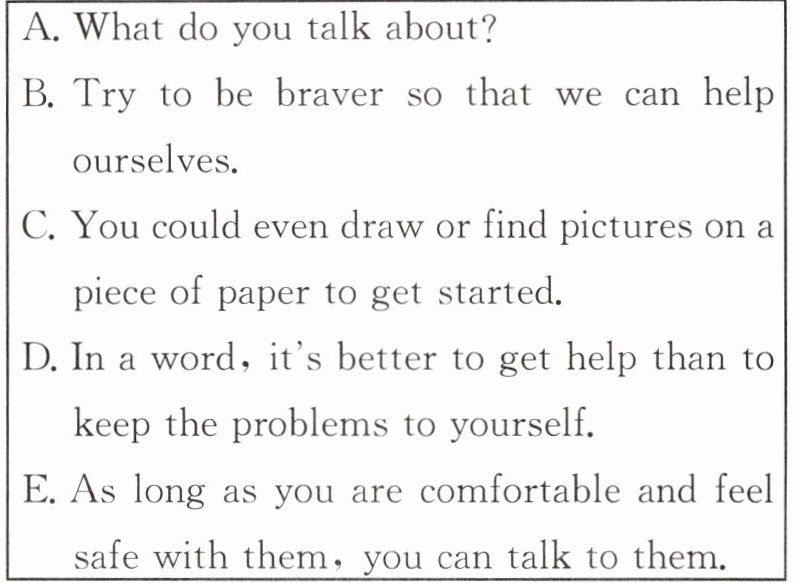 started.
D. In a word, it's better to get help than to keep the problems to yourself.
E. As long as you are comfortable and feel safe with them, you can talk to them.
Talking to someone is a great help when you are worried, scared or don't know what is bothering(使烦恼) you. Here are some tips about how to talk about your problems.
Who do you talk to? Talk to someone you trust(信任). They could be your parents, friends, teachers or other people you trust.
11.
E
Also, the person you talk to should be helpful. He or she can help you to solve your problems.How do you talk about your feelings? First, find a quiet and private(私密的) place to talk. If it is hard to start talking, you could write your problem down and give it to them.
12.
C
Try to give examples of what's bothering you so that they can really understand what you're trying to tell them. Try not to leave out anything.13.
A
You can talk about what is bothering you. If it's hard to talk about the problems, let people know that you're having ahard time. They can help by asking questions and letting you answer. In this way, they will get to know about your problems.
14.
D
There might be more parts to the problems that you can solve by yourself—it's always better to have others to help you out.A. What do you talk about?
B. Try to be braver so that we can help ourselves.
C. You could even draw or find pictures on a piece of paper to
started.D. In a word, it's better to get help than to keep the problems to yourself.
E. As long as you are comfortable and feel safe with them, you can talk to them.
答案
11. E
12. C
13. A
14. D
12. C
13. A
14. D
解析
【分析】
做阅读还原题需结合上下文语境、句子间的逻辑关系(如承接、问答、总结)判断选项:11空上文讲要找信任的人,下文说对方要有用,需选承接选人的标准的句子;12空上文提到难开口可写问题,需选补充开启谈话的方式;13空下文讲谈论烦恼,需选对应“谈论什么”的问句;14空下文说他人帮忙更好,需选总结求助重要性的句子。
【解析】
1. 11空:上文指出要和信任的人交谈,下文说明交谈对象需有帮助,E选项“只要你和他们在一起舒服安全,就可以和他们谈”承接上文选人的标准,符合语境,故选E。
2. 12空:上文提到“如果难开口可以把问题写下来”,C选项“甚至可以画或找图片开始”是补充的开启谈话的方式,与上文衔接自然,故选C。
3. 13空:下文围绕“谈论烦恼”展开,A选项“What do you talk about?”(你谈论什么?)与下文形成问答衔接,符合逻辑,故选A。
4. 14空:下文强调有他人帮忙更好,D选项“总之,求助比自己憋着好”总结本段主旨,与下文呼应,故选D。
【答案】
11.E 12.C 13.A 14.D
【知识点】
英语阅读还原、语篇衔接、句意理解
【点评】
本题为初中英语阅读还原题,侧重考查学生对语篇逻辑和上下文衔接的理解能力,需抓住句子间的承接、问答、总结等关系解题,难度适中。
【难度系数】
0.5
做阅读还原题需结合上下文语境、句子间的逻辑关系(如承接、问答、总结)判断选项:11空上文讲要找信任的人,下文说对方要有用,需选承接选人的标准的句子;12空上文提到难开口可写问题,需选补充开启谈话的方式;13空下文讲谈论烦恼,需选对应“谈论什么”的问句;14空下文说他人帮忙更好,需选总结求助重要性的句子。
【解析】
1. 11空:上文指出要和信任的人交谈,下文说明交谈对象需有帮助,E选项“只要你和他们在一起舒服安全,就可以和他们谈”承接上文选人的标准,符合语境,故选E。
2. 12空:上文提到“如果难开口可以把问题写下来”,C选项“甚至可以画或找图片开始”是补充的开启谈话的方式,与上文衔接自然,故选C。
3. 13空:下文围绕“谈论烦恼”展开,A选项“What do you talk about?”(你谈论什么?)与下文形成问答衔接,符合逻辑,故选A。
4. 14空:下文强调有他人帮忙更好,D选项“总之,求助比自己憋着好”总结本段主旨,与下文呼应,故选D。
【答案】
11.E 12.C 13.A 14.D
【知识点】
英语阅读还原、语篇衔接、句意理解
【点评】
本题为初中英语阅读还原题,侧重考查学生对语篇逻辑和上下文衔接的理解能力,需抓住句子间的承接、问答、总结等关系解题,难度适中。
【难度系数】
0.5
