

 登录
Ⅴ. Read the passage and choose the best answers.
Curiosity is part of human nature. Children are well-known for wanting answers to many questions. Books and TV shows often depend on curiosity. People keep reading or watching because they want to find out what will happen. And curiosity also brings many benefits(好处;益处).
Learning is the easiest if you have a real desire(渴望) for knowledge. Curiosity can create such a desire when you want an answer to a question. Many of history's greatest discoveries were made by curious people. People wondered how things worked and how they could do their work more effectively(有效地). Thanks to their curiosity, people now know much more about the world. Even if you don't plan to be an inventor or researcher, curiosity can still help you in the classroom. If you develop the joy of learning, classes will become more enjoyable. Even when you're no longer a student, curiosity will make you knowledgeable and thus a good worker.
What should you do if you aren't curious yet? Luckily, curiosity is a skill that can be improved. If you behave as if you're curious, you'll soon really feel curious. Often, the more you learn about a topic, the more interesting it will seem. When you learn about a topic, find information in many ways. Read books, listen to lectures(讲座) and ask questions. Don't always get information in the same way. Instead, learn to value the facts that different people know and ask a lot of questions. Remember, everyone knows something that you don't. Find out what that is and ask about it. This helps you learn and makes the other person happy by sharing their knowledge.
(
A. they are born with natural curiosity
B. they don't know about the human nature
C. they are well-known for reading and watching
D. they don't want to find the answers by themselves
(
A. make your job more difficult B. make the class interesting
C. create more stories in history D. develop a new kind of classroom
(
A. respect B. refuse C. collect D. forget
(
A. Share knowledge in the classroom.
B. Curiosity is a skill that can't be improved.
C. Curiosity can make the other person happy.
D. Be curious and try to improve your curiosity.
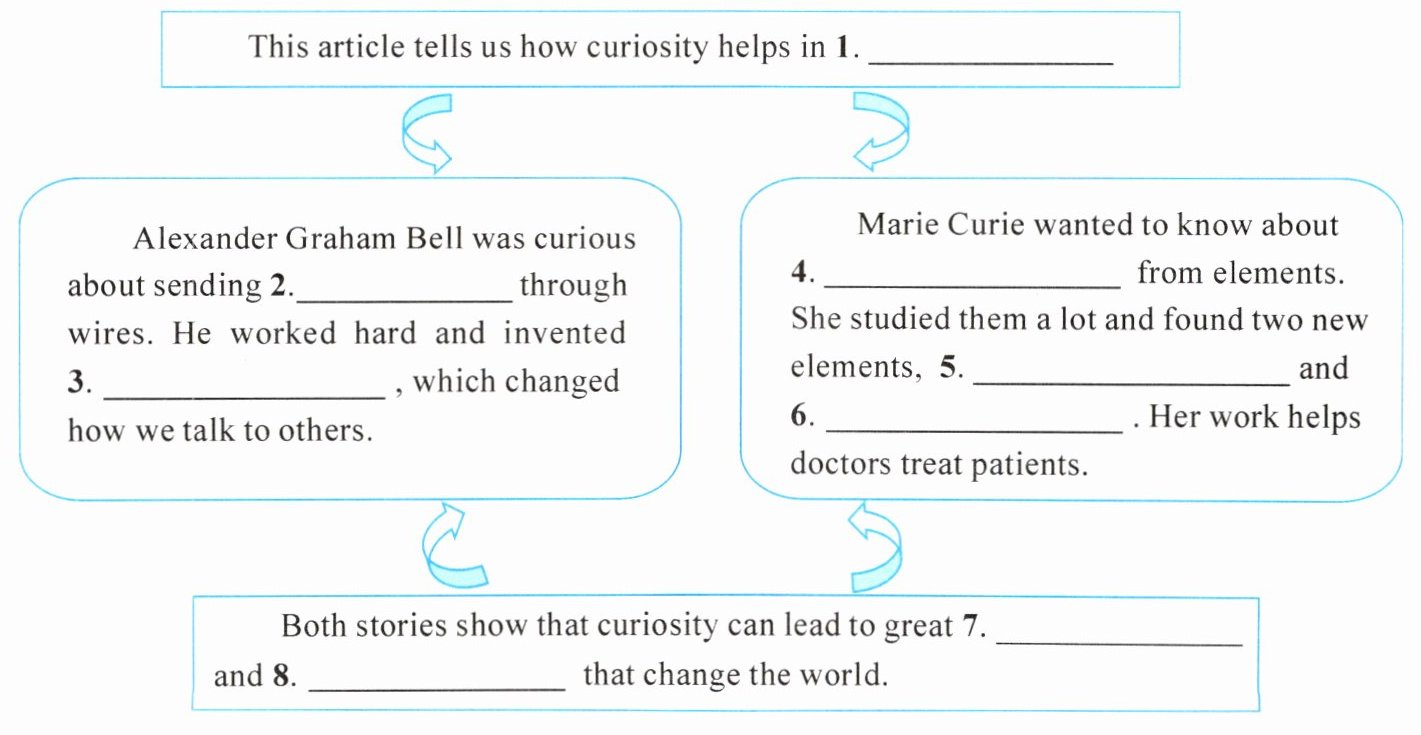
Ⅵ. Read the passage and complete the mind-map.
The power of curiosity in science
Curiosity is a magical key that unlocked the door to great inventions and discoveries. It can work wonders in science. Here are two cool stories.
First, there's Alexander Graham Bell. Back then, people talked face-to-face or sent letters. But Bell was super curious. He kept asking: "Can we make voices travel through wires(线材)?" This question made him spend lots of time in his lab. He tried different things, like various kinds of wires and small parts. He never got tired of testing new ideas. Finally, his curiosity led to a big invention: the telephone! Now we can talk to friends and family far away with just a phone call.
Then there's Marie Curie. She was really interested in some strange rays(射线) that certain elements(元素) gave off. She wanted to know everything about them. Even though her lab wasn't fancy, she didn't care. She just kept studying those rays. Her curiosity was so strong that she didn't mind working long hours. And guess what? She discovered two new elements, radium and polonium! Her work has helped doctors treat sick people in new ways.
These two stories show us how powerful curiosity can be. It can turn a simple "what if" into something that changes the world.
Curiosity is part of human nature. Children are well-known for wanting answers to many questions. Books and TV shows often depend on curiosity. People keep reading or watching because they want to find out what will happen. And curiosity also brings many benefits(好处;益处).
Learning is the easiest if you have a real desire(渴望) for knowledge. Curiosity can create such a desire when you want an answer to a question. Many of history's greatest discoveries were made by curious people. People wondered how things worked and how they could do their work more effectively(有效地). Thanks to their curiosity, people now know much more about the world. Even if you don't plan to be an inventor or researcher, curiosity can still help you in the classroom. If you develop the joy of learning, classes will become more enjoyable. Even when you're no longer a student, curiosity will make you knowledgeable and thus a good worker.
What should you do if you aren't curious yet? Luckily, curiosity is a skill that can be improved. If you behave as if you're curious, you'll soon really feel curious. Often, the more you learn about a topic, the more interesting it will seem. When you learn about a topic, find information in many ways. Read books, listen to lectures(讲座) and ask questions. Don't always get information in the same way. Instead, learn to value the facts that different people know and ask a lot of questions. Remember, everyone knows something that you don't. Find out what that is and ask about it. This helps you learn and makes the other person happy by sharing their knowledge.
(
A
)1. The children like to ask questions because .A. they are born with natural curiosity
B. they don't know about the human nature
C. they are well-known for reading and watching
D. they don't want to find the answers by themselves
(
B
)2. According to the passage, curiosity can .A. make your job more difficult B. make the class interesting
C. create more stories in history D. develop a new kind of classroom
(
A
)3. The underlined word "value" probably means .A. respect B. refuse C. collect D. forget
(
D
)4. What's the main idea of the passage?A. Share knowledge in the classroom.
B. Curiosity is a skill that can't be improved.
C. Curiosity can make the other person happy.
D. Be curious and try to improve your curiosity.
Ⅵ. Read the passage and complete the mind-map.
The power of curiosity in science
Curiosity is a magical key that unlocked the door to great inventions and discoveries. It can work wonders in science. Here are two cool stories.
First, there's Alexander Graham Bell. Back then, people talked face-to-face or sent letters. But Bell was super curious. He kept asking: "Can we make voices travel through wires(线材)?" This question made him spend lots of time in his lab. He tried different things, like various kinds of wires and small parts. He never got tired of testing new ideas. Finally, his curiosity led to a big invention: the telephone! Now we can talk to friends and family far away with just a phone call.
Then there's Marie Curie. She was really interested in some strange rays(射线) that certain elements(元素) gave off. She wanted to know everything about them. Even though her lab wasn't fancy, she didn't care. She just kept studying those rays. Her curiosity was so strong that she didn't mind working long hours. And guess what? She discovered two new elements, radium and polonium! Her work has helped doctors treat sick people in new ways.
These two stories show us how powerful curiosity can be. It can turn a simple "what if" into something that changes the world.
答案
1. A 2. B 3. A 4. D
1. science 2. voices 3. the telephone 4. strange rays 5. radium
6. polonium 7. inventions 8. discoveries
1. science 2. voices 3. the telephone 4. strange rays 5. radium
6. polonium 7. inventions 8. discoveries
解析
【分析】
本题分为两部分,第Ⅴ部分为阅读理解选择题,需通过定位原文对应内容,结合词义猜测、主旨归纳等方法选出正确答案;第Ⅵ部分为思维导图填空,需根据短文内容,定位每个空对应的关键信息,准确填写。
1. 第Ⅴ题第1题:定位原文第一段,查找孩子爱问问题的原因,选出对应选项。
2. 第Ⅴ题第2题:定位原文第二段,找到好奇心对课堂的作用,匹配选项内容。
3. 第Ⅴ题第3题:结合上下文语境,猜测划线单词含义,选出合适选项。
4. 第Ⅴ题第4题:通读全文,归纳文章主旨,选出最贴合的选项。
5. 第Ⅵ题:根据思维导图每个空,对应短文具体内容,逐一查找关键信息填写,注意专有名词拼写。
【解析】
第Ⅴ部分:
1. 第1题:原文第一段提到“Curiosity is part of human nature. Children are well-known for wanting answers to many questions.”,说明孩子爱问问题是因为天生有好奇心,对应选项A,故选A。
2. 第2题:原文第二段提到“curiosity can still help you in the classroom. If you develop the joy of learning, classes will become more enjoyable.”,“more enjoyable”与选项B的“make the class interesting”意思一致,故选B。
3. 第3题:划线词所在句意为“学会重视不同人知道的事实并多问问题”,value在此处意为“重视、尊重”,对应选项A的respect,故选A。
4. 第4题:全文讲述好奇心的益处,同时提到“curiosity is a skill that can be improved”,核心是鼓励并培养好奇心,对应选项D,故选D。
第Ⅵ部分:
1. 第1空:短文第六题标题为“The power of curiosity in science”,说明文章讲好奇心在科学中的作用,故填science。
2. 第2空:关于Bell的部分提到“Can we make voices travel through wires?”,对应他好奇的内容,故填voices。
3. 第3空:Bell最终发明了电话,故填the telephone。
4. 第4空:关于Marie Curie的部分提到“She was really interested in some strange rays that certain elements gave off.”,对应她想知道的内容,故填strange rays。
5. 第5、6空:Marie Curie发现的两种新元素是radium和polonium,故分别填radium、polonium。
6. 第7、8空:两个例子分别对应发明和发现,结合最后一段,故填inventions、discoveries。
【答案】
第Ⅴ题:1.A 2.B 3.A 4.D;第Ⅵ题:1.science 2.voices 3.the telephone 4.strange rays 5.radium 6.polonium 7.inventions 8.discoveries
【知识点】
阅读理解细节理解、词义猜测、主旨归纳
【点评】
本题是典型的英语阅读理解题,涵盖细节查找、词义猜测和主旨归纳三类题型,考查学生快速定位原文信息、理解文章主旨的能力,整体难度适中,只要仔细阅读原文即可正确解答。
【难度系数】
0.7
