

 登录
登录
(
A.went; looked
B.go; looks
C.go; look
D.went; looks
B
)5.Did Helen go
to bed late last night? She looks
tired today.A.went; looked
B.go; looks
C.go; look
D.went; looks
答案
5. B
解析
【分析】首先看第一空,句子是一般过去时的一般疑问句,结构为“Did + 主语 + 动词原形 + 其他”,助动词Did后必须接动词原形,因此排除含过去式went的A、D选项;再看第二空,主语是第三人称单数She,时间状语为today,需用一般现在时,谓语动词要使用第三人称单数形式,因此排除动词用原形的C选项,最终确定答案为B。
【解析】1. 第一空:一般过去时的一般疑问句中,助动词Did后需跟动词原形,不能用过去式,故排除A、D(went是go的过去式);2. 第二空:主语She是第三人称单数,时间状语today表明时态为一般现在时,谓语动词需用第三人称单数形式,look的第三人称单数是looks,故排除C,因此选B。
【答案】B
【知识点】一般过去时的一般疑问句;一般现在时的第三人称单数
【点评】本题考查英语时态的基础用法,需掌握一般过去时疑问句的动词形式规则和一般现在时第三人称单数的动词变化,是初中英语入门阶段的典型基础题,难度较低。
【难度系数】0.7
【解析】1. 第一空:一般过去时的一般疑问句中,助动词Did后需跟动词原形,不能用过去式,故排除A、D(went是go的过去式);2. 第二空:主语She是第三人称单数,时间状语today表明时态为一般现在时,谓语动词需用第三人称单数形式,look的第三人称单数是looks,故排除C,因此选B。
【答案】B
【知识点】一般过去时的一般疑问句;一般现在时的第三人称单数
【点评】本题考查英语时态的基础用法,需掌握一般过去时疑问句的动词形式规则和一般现在时第三人称单数的动词变化,是初中英语入门阶段的典型基础题,难度较低。
【难度系数】0.7
五、班长统计了大家的日常活动。观察表格,用always、usually、often、sometimes、never填空。
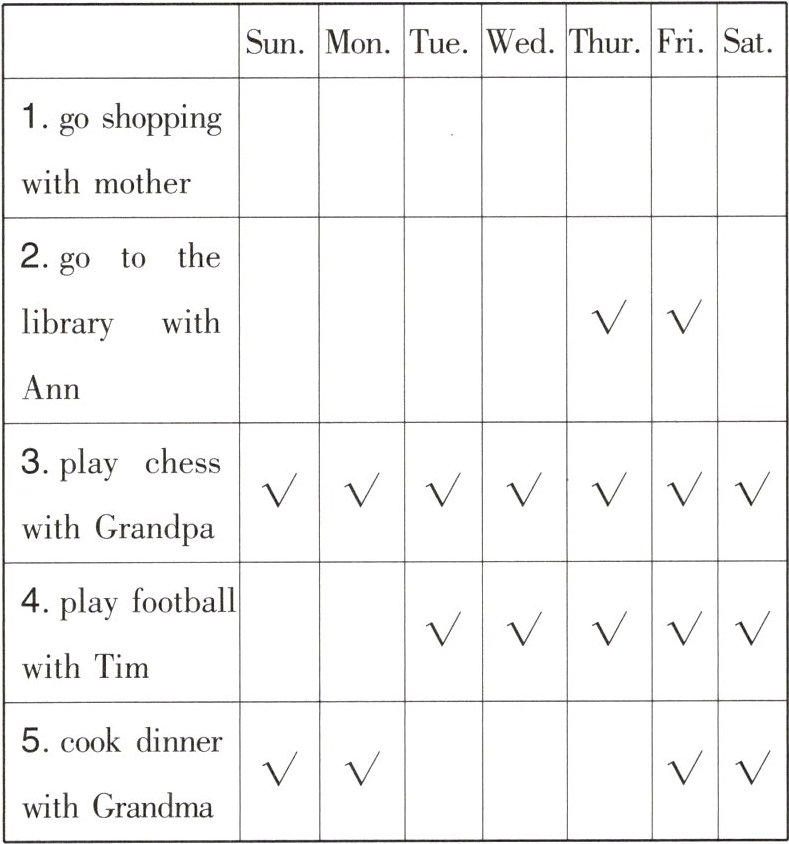
1. I don't like shopping. I
2. Sally
3. Peter likes playing chess. He
4. John
5. I
1. I don't like shopping. I
never
go shopping with my mother.2. Sally
sometimes
goes to the library with Ann.3. Peter likes playing chess. He
always
plays chess with his grandpa.4. John
usually
plays football with Tim.5. I
often
cook dinner with my grandma.答案
1. never 2. sometimes 3. always 4. usually 5. often
解析
【分析】首先明确always(总是,频率最高,每天发生)、usually(通常,频率较高,大部分时间)、often(经常,频率中等,较多发生)、sometimes(有时,频率较低,偶尔发生)、never(从不,频率为0,从未发生)的含义,再对应表格中各项活动的打勾次数,判断每个句子对应的活动频率,选择合适的副词填空。
【解析】1. 观察表格,go shopping with mother这一项无任何打勾,说明从不做该活动,填never;2. go to the library with Ann仅周四、周五有打勾,一周7天里仅2次,属于偶尔发生,填sometimes;3. play chess with Grandpa每天都有打勾,说明总是做该活动,填always;4. play football with Tim周二至周六有打勾,共5天,一周里大部分时间,属于通常情况,填usually;5. cook dinner with Grandma周日、周一、周五、周六有打勾,共4天,属于经常发生,填often。
【答案】1. never 2. sometimes 3. always 4. usually 5. often
【知识点】频率副词用法、表格信息提取
【点评】本题结合表格考查频率副词的实际运用,需准确理解副词含义并对应表格活动频率判断,难度适中。
【难度系数】0.6
【解析】1. 观察表格,go shopping with mother这一项无任何打勾,说明从不做该活动,填never;2. go to the library with Ann仅周四、周五有打勾,一周7天里仅2次,属于偶尔发生,填sometimes;3. play chess with Grandpa每天都有打勾,说明总是做该活动,填always;4. play football with Tim周二至周六有打勾,共5天,一周里大部分时间,属于通常情况,填usually;5. cook dinner with Grandma周日、周一、周五、周六有打勾,共4天,属于经常发生,填often。
【答案】1. never 2. sometimes 3. always 4. usually 5. often
【知识点】频率副词用法、表格信息提取
【点评】本题结合表格考查频率副词的实际运用,需准确理解副词含义并对应表格活动频率判断,难度适中。
【难度系数】0.6
六、给下列问句选择合适的答语。
A. My sister.
B. In the clothes shop near here.
C. At 7:00 every morning.
D. Let's take the bus.
E. I think it is Helen's.
(
(
(
(
(
A. My sister.
B. In the clothes shop near here.
C. At 7:00 every morning.
D. Let's take the bus.
E. I think it is Helen's.
(
B
)1. Where did you buy the cool cap?(
D
)2. How can we get to the Lake Park?(
E
)3. The schoolbag is red. Whose is it?(
C
)4. When does Mr Li usually go to work?(
A
)5. Who often goes home with you after school?答案
1. B 2. D 3. E 4. C 5. A
解析
【分析】
本题为日常交际用语匹配题,解题思路是先分析每个问句的疑问词,明确问句询问的内容(地点、方式、所属、时间、人物),再匹配对应答语的核心信息,选出正确选项。
【解析】
1. 问句1疑问词为Where,询问买帽子的地点,对应答语B(In the clothes shop near here.),故选B;
2. 问句2疑问词为How,询问出行方式,对应答语D(Let's take the bus.),故选D;
3. 问句3疑问词为Whose,询问物品所属,对应答语E(I think it is Helen's.),故选E;
4. 问句4疑问词为When,询问时间,对应答语C(At 7:00 every morning.),故选C;
5. 问句5疑问词为Who,询问人物,对应答语A(My sister.),故选A。
【答案】
1.B 2.D 3.E 4.C 5.A
【知识点】
特殊疑问句、日常交际用语
【点评】
本题考查基础日常交际中特殊疑问词与答语的匹配,题型简单,侧重基础交际能力的考察。
【难度系数】
0.9
本题为日常交际用语匹配题,解题思路是先分析每个问句的疑问词,明确问句询问的内容(地点、方式、所属、时间、人物),再匹配对应答语的核心信息,选出正确选项。
【解析】
1. 问句1疑问词为Where,询问买帽子的地点,对应答语B(In the clothes shop near here.),故选B;
2. 问句2疑问词为How,询问出行方式,对应答语D(Let's take the bus.),故选D;
3. 问句3疑问词为Whose,询问物品所属,对应答语E(I think it is Helen's.),故选E;
4. 问句4疑问词为When,询问时间,对应答语C(At 7:00 every morning.),故选C;
5. 问句5疑问词为Who,询问人物,对应答语A(My sister.),故选A。
【答案】
1.B 2.D 3.E 4.C 5.A
【知识点】
特殊疑问句、日常交际用语
【点评】
本题考查基础日常交际中特殊疑问词与答语的匹配,题型简单,侧重基础交际能力的考察。
【难度系数】
0.9
七、阅读短文,选择正确的答案。
Do you often help your parents do housework? Many children begin to do housework when they are very young. At the age of two, they learn to put rubbish into the bin and put toys in order. They learn to clean up the bedroom when they are five years old. When they get older, they may cook meals and change the bulbs (电灯泡). Doing housework has many benefits (益处). By doing housework, we can know what the responsibility is. And it can help us become a better person in the future.
( )1. Many children begin to do housework ______ .
A. when they go to school
B. when they are in Grade 3
C. before they go to school
()2. The underlined word "responsibility" means "" in Chinese.
A. 责任
B. 手工
C. 艺术
()3. Which one is NOT the benefit of doing housework?
A. We can get more money.
B. We can learn more about the responsibility.
C. We can become a better person.
()4. The writer writes the article to tell us .
A. how to change bulbs
B. we should learn to do housework
C. what to do when we are still babies
Do you often help your parents do housework? Many children begin to do housework when they are very young. At the age of two, they learn to put rubbish into the bin and put toys in order. They learn to clean up the bedroom when they are five years old. When they get older, they may cook meals and change the bulbs (电灯泡). Doing housework has many benefits (益处). By doing housework, we can know what the responsibility is. And it can help us become a better person in the future.
( )1. Many children begin to do housework ______ .
A. when they go to school
B. when they are in Grade 3
C. before they go to school
()2. The underlined word "responsibility" means "" in Chinese.
A. 责任
B. 手工
C. 艺术
()3. Which one is NOT the benefit of doing housework?
A. We can get more money.
B. We can learn more about the responsibility.
C. We can become a better person.
()4. The writer writes the article to tell us .
A. how to change bulbs
B. we should learn to do housework
C. what to do when we are still babies
答案
1. C 2. A 3. A 4. B
解析
【分析】
做这类阅读理解题,需先通读短文把握主旨,再针对每个小题的问题,回到原文定位对应信息:细节题直接找原文原句,词义题结合上下文语境推断,主旨题梳理全文核心观点,从而选出正确答案。
【解析】
1. 细节题:原文提到“Many children begin to do housework when they are very young. At the age of two...”,说明孩子很小(上学前)就开始做家务,对应选项C。
2. 词义题:结合上下文,做家务的益处是了解“responsibility”,结合语境可知是“责任”,选A。
3. 细节题:原文明确做家务的益处是“know what the responsibility is”和“become a better person”,未提及“get more money”,选A。
4. 主旨题:全文围绕“孩子做家务的好处”展开,目的是告诉我们应该学做家务,选B。
【答案】
1. C 2. A 3. A 4. B
【知识点】
英语阅读理解、词义猜测、主旨大意
【点评】
本题为基础英语阅读理解题,考查细节查找、词义推断和主旨理解,内容贴近学生生活,难度适中,能帮助学生理解做家务的意义。
【难度系数】
0.7
做这类阅读理解题,需先通读短文把握主旨,再针对每个小题的问题,回到原文定位对应信息:细节题直接找原文原句,词义题结合上下文语境推断,主旨题梳理全文核心观点,从而选出正确答案。
【解析】
1. 细节题:原文提到“Many children begin to do housework when they are very young. At the age of two...”,说明孩子很小(上学前)就开始做家务,对应选项C。
2. 词义题:结合上下文,做家务的益处是了解“responsibility”,结合语境可知是“责任”,选A。
3. 细节题:原文明确做家务的益处是“know what the responsibility is”和“become a better person”,未提及“get more money”,选A。
4. 主旨题:全文围绕“孩子做家务的好处”展开,目的是告诉我们应该学做家务,选B。
【答案】
1. C 2. A 3. A 4. B
【知识点】
英语阅读理解、词义猜测、主旨大意
【点评】
本题为基础英语阅读理解题,考查细节查找、词义推断和主旨理解,内容贴近学生生活,难度适中,能帮助学生理解做家务的意义。
【难度系数】
0.7
