

 登录
三、用方框中所给短语的适当形式填空。
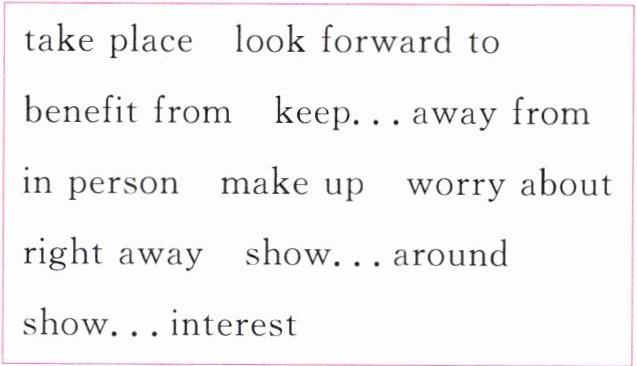
take place look forward to
benefit from keep. . . away from
in person make up worry about
right away show. . . around
show. . . interest
21. When my cousin visited Beijing for the first time, I offered to
22. The meeting will
23. My brother and I often have fights, but we always
24. Parents try to
25. If you want to watch the drama, you should book the seats
26. You can ask me
27. She
28. If you are sure about your choice, you don't have to
29. Students can
30. He
take place look forward to
benefit from keep. . . away from
in person make up worry about
right away show. . . around
show. . . interest
21. When my cousin visited Beijing for the first time, I offered to
show
her around
.22. The meeting will
take place
at 3 p. m. today.23. My brother and I often have fights, but we always
make up
soon after.24. Parents try to
keep
their kids away from
bad influences.25. If you want to watch the drama, you should book the seats
right away
.26. You can ask me
in person
if you have any questions.27. She
looks forward to
getting a new bike for her birthday.28. If you are sure about your choice, you don't have to
worry about
what other people will say.29. Students can
benefit
a lot from
reading different kinds of books.30. He
showed
great interest
in music when he was a small child.答案
21. show;around
22. take place
23. make up
24. keep;away from
25. right away
26. in person
27. looks forward to
28. worry about
29. benefit;from
30. showed;interest
22. take place
23. make up
24. keep;away from
25. right away
26. in person
27. looks forward to
28. worry about
29. benefit;from
30. showed;interest
解析
【分析】
这道题是用给定的动词短语的适当形式完成句子,解题思路分为三步:1. 先明确每个短语的含义,掌握它们的用法;2. 通读每个句子,理解句意,分析句子所需的语义和语法成分,匹配对应的短语;3. 根据句子的时态、主谓一致、固定搭配等语法规则,调整短语的形式(如动词的单三形式、过去式等),确保填入后句子通顺合理。
【解析】
21. 句意:当我的表弟第一次来北京时,我主动提出带她四处参观。短语show sb. around意为“带某人参观”,offer to do sth.是固定搭配,故填show; around。
22. 句意:会议将在今天下午3点举行。take place意为“举行,发生”,用于计划中的事件,will后接动词原形,故填take place。
23. 句意:我和弟弟经常打架,但很快就和好了。make up有“和解”的含义,主语为we,句子是一般现在时,故填make up。
24. 句意:父母尽力让孩子远离不良影响。keep sb. away from意为“让某人远离……”,try to do sth.是固定搭配,故填keep; away from。
25. 句意:如果你想看这部戏剧,应该立刻订座位。right away意为“立刻,马上”,符合语境,故填right away。
26. 句意:如果你有任何问题,可以亲自问我。in person意为“亲自”,符合语境,故填in person。
27. 句意:她期待生日得到一辆新自行车。look forward to意为“期待”,主语是第三人称单数she,句子为一般现在时,动词用第三人称单数形式,故填looks forward to。
28. 句意:如果你确定自己的选择,不必担心别人会说什么。worry about意为“担心”,have to后接动词原形,故填worry about。
29. 句意:学生能从阅读不同种类的书籍中受益很多。benefit from意为“从……中受益”,can后接动词原形,故填benefit; from。
30. 句意:他小时候对音乐表现出极大的兴趣。show...interest in意为“对……表现出兴趣”,时间状语是“when he was a small child”(过去时),动词用过去式,故填showed; interest。
【答案】
21. show; around
22. take place
23. make up
24. keep; away from
25. right away
26. in person
27. looks forward to
28. worry about
29. benefit; from
30. showed; interest
【知识点】
动词短语辨析,时态运用,固定搭配
【点评】
本题考查常用动词短语的词义及形式运用,需要学生掌握短语含义,结合句子语境和语法规则解题,是基础英语知识的综合应用,难度适中。
【难度系数】
0.4
一、补全对话,每空词数不限。
A:David, you look angry. 1. ?
B:I argued with Jack.
A:2. ?
B:He lent my model plane to his friend without telling me.
A:3. . But your argument made the thing worse.
B:Yes. I was so angry then.
A:4. . But Jack is only 6 years old. I think he just loved your model plane and wanted to share it with his friend.
B:Maybe you are right. What should I do now?
A:5. . A face-to-face talk will help a lot.
B:Thanks for your advice.
二、阅读短文,在空白处填入一个适当的单词或括号内单词的正确形式。
Small talk refers to light conversation for social occasions (社交场合). It is the 6. (start) point for friendship. You can start conversation in many different ways 7. small talk.
Asking open questions is one of the best 8. (way) to make small talk. For example, you are at 9. (someone) birthday party, but you know few people. How do you break the ice? You can start a conversation with “This is a great party. How do you know the host?” This way is also 10. (help) in many other situations, such as school clubs or picnics.
Sometimes, a simple introduction (介绍) can also work, especially to help find common 11. (point) with others.
For example, when going into a new environment, you can introduce yourself by 12. ______ (say) “I am in Class 3. My maths teacher is Mr Smith.”13. ______ other person may say, “Oh, really? He is also my maths teacher. He is very strict...” So a good conversation can begin.
The third way is to say something you're good at to others. This is useful when you want to join a group. For example, you see some kids 14. (play) football on the school playground. Just say, “Do you need more players? I am a very good goalkeeper (守门员).”
So next time, don't 15. nervous when meeting strangers. Just try small talk. A stranger may become your next friend.
答案
1. What's wrong/What happened/What's the matter with you/...
2. Why did you do that/Why
3. That's too bad
4. I understand how you were feeling/I understand you/...
5. You should have a talk with him
6. starting 7. through 8. ways 9. someone's 10. helpful 11. points 12. saying
13. The 14. playing 15. be
2. Why did you do that/Why
3. That's too bad
4. I understand how you were feeling/I understand you/...
5. You should have a talk with him
6. starting 7. through 8. ways 9. someone's 10. helpful 11. points 12. saying
13. The 14. playing 15. be
解析
【分析】
本题分为补全对话和短文填空两部分:1. 补全对话需结合上下文语境,运用日常情景交际用语,根据A、B的对话逻辑(询问状况→询问吵架原因→表达同情→共情理解→给出建议)推导空缺内容;2. 短文填空需结合语法规则(词性转换、名词所有格、介词、冠词、非谓语动词等)和语境,判断每个空的正确形式。
【解析】
1. 由A看到B生气,B回答“和Jack吵架”,可知此处是询问对方状况,常用日常交际用语,如What's wrong/What happened等;
2. B说明吵架原因,故此处询问吵架的原因,用Why did you do that/Why;
3. 听到对方遇到不好的事,需表达同情,用That's too bad;
4. 此处是A理解B当时的情绪,表达共情,如I understand how you were feeling等;
5. B询问解决办法,结合后文“面对面谈话有帮助”,给出建议You should have a talk with him;
6. 此处需用动名词作定语修饰point,故填starting;
7. 表示“通过闲聊”,用介词through;
8. one of后接名词复数,故填ways;
9. 表示“某人的生日”,用名词所有格someone's;
10. 此处需形容词作表语,help的形容词为helpful;
11. common后接名词复数,故填points;
12. by是介词,后接动名词,故填saying;
13. 特指前文提到的另一个人,用定冠词The;
14. see sb doing sth(看到某人正在做某事),故填playing;
15. don't后接动词原形,nervous是形容词,前加be,故填be。
【答案】
1. What's wrong/What happened/What's the matter with you/...
2. Why did you do that/Why
3. That's too bad
4. I understand how you were feeling/I understand you/...
5. You should have a talk with him
6. starting
7. through
8. ways
9. someone's
10. helpful
11. points
12. saying
13. The
14. playing
15. be
【知识点】
情景交际、词形变化、名词用法
【点评】
本题考查日常情景交际用语及英语基础语法,题目贴近生活,注重基础运用,适合巩固英语核心知识点,难度适中。
【难度系数】
0.7
