

 登录
登录
二、阅读理解
What happens when a newspaper is recycled? It is cut up, mixed with water and chemicals and boiled before it is pressed into new paper. So is there a simpler way to deal with solid waste? Yes. It's called upcycling.
In recycling, an object is broken down into small pieces. However, in upcycling, the whole object or parts of the object are reused in a new way. Upcycling can be less wasteful than recycling and more creative.
Unwanted e-waste is especially dangerous to throw away because it has toxic(有毒的) materials. And it takes a long time for it to break down. So it stays buried in landfills for centuries and ends up causing air and water pollution. In order to reduce e-waste, people are upcycling their old electronics to create stylish jewellery pieces.
Upcycling is catching on in Hong Kong. Many upcycled products can now be found more easily than ever. Here are two examples.
Making music
When Kevin saw plastic bottles being thrown away, he thought of a useful way they could be reused. His invention, called "boombottle", is an easy-to-carry speaker system that is as powerful as a normal speaker and lights up in the dark!
Keeping it local
Woodrite calls itself Hong Kong's first "local-to-local" furniture brand because it collects small pieces of wood around the city and uses them to create handmade furniture in the factory. The furniture is then sold locally. By doing this, the company hopes to reduce the amount of wood that ends up in our landfills and raise interest in upcycled products.
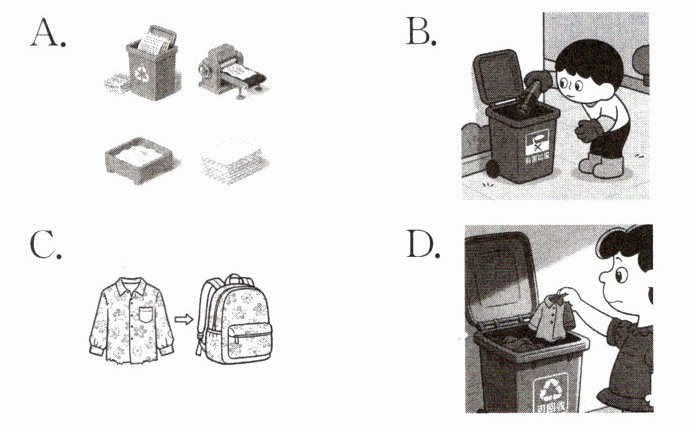
1.(创新考法·图片理解)Which picture shows upcycling?
2. What does the underlined phrase "catching on" in Paragraph 4 mean?
A. Becoming more popular.
B. Dying out quickly.
C. Getting more serious.
D. Drawing less attention.
3. What can we learn from the two examples?
A. People can buy Woodrite furniture around the world.
B. Woodrite tries to cut down more trees in the forest.
C. Boombottles are easy to carry around.
D. Normal speakers are louder than boombottles.
深度阅读·回答问题
4. What is the main difference between recycling and upcycling according to the passage?
情境三 环境污染的危害及共同防治的重要性。
What happens when a newspaper is recycled? It is cut up, mixed with water and chemicals and boiled before it is pressed into new paper. So is there a simpler way to deal with solid waste? Yes. It's called upcycling.
In recycling, an object is broken down into small pieces. However, in upcycling, the whole object or parts of the object are reused in a new way. Upcycling can be less wasteful than recycling and more creative.
Unwanted e-waste is especially dangerous to throw away because it has toxic(有毒的) materials. And it takes a long time for it to break down. So it stays buried in landfills for centuries and ends up causing air and water pollution. In order to reduce e-waste, people are upcycling their old electronics to create stylish jewellery pieces.
Upcycling is catching on in Hong Kong. Many upcycled products can now be found more easily than ever. Here are two examples.
Making music
When Kevin saw plastic bottles being thrown away, he thought of a useful way they could be reused. His invention, called "boombottle", is an easy-to-carry speaker system that is as powerful as a normal speaker and lights up in the dark!
Keeping it local
Woodrite calls itself Hong Kong's first "local-to-local" furniture brand because it collects small pieces of wood around the city and uses them to create handmade furniture in the factory. The furniture is then sold locally. By doing this, the company hopes to reduce the amount of wood that ends up in our landfills and raise interest in upcycled products.
1.(创新考法·图片理解)Which picture shows upcycling?
2. What does the underlined phrase "catching on" in Paragraph 4 mean?
A. Becoming more popular.
B. Dying out quickly.
C. Getting more serious.
D. Drawing less attention.
3. What can we learn from the two examples?
A. People can buy Woodrite furniture around the world.
B. Woodrite tries to cut down more trees in the forest.
C. Boombottles are easy to carry around.
D. Normal speakers are louder than boombottles.
深度阅读·回答问题
4. What is the main difference between recycling and upcycling according to the passage?
情境三 环境污染的危害及共同防治的重要性。
答案
1. C 图片理解题。根据"However, in upcycling, the whole object or parts of the object are reused in a new way."可知,在升级改造中,整个物体或物体的零件以新的方式被重复使用。
2. A 词义猜测题。根据"Many upcycled products can now be found more easily than ever."可知,升级改造在香港很流行,所以catching on是“变得更受欢迎”的意思。
3. C 推理判断题。根据"His invention, called 'boombottle', is an easy-to-carry speaker system that is as powerful as a normal speaker and lights up in the dark!"可知,boombottle便于携带。
4. In recycling, an object is broken down into small pieces, while in upcycling, the whole object or parts of it are reused in a new and creative way.
2. A 词义猜测题。根据"Many upcycled products can now be found more easily than ever."可知,升级改造在香港很流行,所以catching on是“变得更受欢迎”的意思。
3. C 推理判断题。根据"His invention, called 'boombottle', is an easy-to-carry speaker system that is as powerful as a normal speaker and lights up in the dark!"可知,boombottle便于携带。
4. In recycling, an object is broken down into small pieces, while in upcycling, the whole object or parts of it are reused in a new and creative way.
解析
【分析】
本题为英语阅读理解题,包含图片理解、词义猜测、细节理解和信息归纳类题目。解题思路:1. 图片理解题需先明确upcycling(升级改造)的定义,再对比图片匹配;2. 词义猜测题需结合上下文语境推断短语含义;3. 细节理解题需定位原文对应信息;4. 信息归纳题需找到原文中recycling和upcycling的区别并整理成句。
【解析】
1. 图片理解题:根据原文第二段“However, in upcycling, the whole object or parts of the object are reused in a new way.”可知,升级改造是将整个物体或其部分以新方式重复利用。对比图片:A是将纸打碎回收(属于recycling),B是丢弃有害垃圾,C是旧衬衫改造成书包(符合upcycling),D是丢弃旧衣服,因此选C。
2. 词义猜测题:定位到第四段,后文提到“Many upcycled products can now be found more easily than ever.”说明升级改造在香港很流行,因此“catching on”意为“变得更受欢迎”,对应选项A。
3. 细节理解题:定位到“Making music”部分,原文明确说明“His invention, called 'boombottle', is an easy-to-carry speaker system...”,可知boombottle便于携带,对应选项C。
4. 信息归纳题:根据原文第二段“In recycling, an object is broken down into small pieces. However, in upcycling, the whole object or parts of the object are reused in a new way.”,结合upcycling更具创造性的特点,整理出两者区别。
【答案】
1.C 2.A 3.C 4.In recycling, an object is broken down into small pieces, while in upcycling, the whole object or parts of it are reused in a new and creative way.
【知识点】
阅读理解题型、词义猜测、细节理解
【点评】
本文围绕环保主题“升级改造(upcycling)”展开,题型多样,既考查对核心概念的理解,也考查细节定位和词义猜测能力,贴近生活,易于学生理解,适合初中英语阅读练习。
【难度系数】
0.6
本题为英语阅读理解题,包含图片理解、词义猜测、细节理解和信息归纳类题目。解题思路:1. 图片理解题需先明确upcycling(升级改造)的定义,再对比图片匹配;2. 词义猜测题需结合上下文语境推断短语含义;3. 细节理解题需定位原文对应信息;4. 信息归纳题需找到原文中recycling和upcycling的区别并整理成句。
【解析】
1. 图片理解题:根据原文第二段“However, in upcycling, the whole object or parts of the object are reused in a new way.”可知,升级改造是将整个物体或其部分以新方式重复利用。对比图片:A是将纸打碎回收(属于recycling),B是丢弃有害垃圾,C是旧衬衫改造成书包(符合upcycling),D是丢弃旧衣服,因此选C。
2. 词义猜测题:定位到第四段,后文提到“Many upcycled products can now be found more easily than ever.”说明升级改造在香港很流行,因此“catching on”意为“变得更受欢迎”,对应选项A。
3. 细节理解题:定位到“Making music”部分,原文明确说明“His invention, called 'boombottle', is an easy-to-carry speaker system...”,可知boombottle便于携带,对应选项C。
4. 信息归纳题:根据原文第二段“In recycling, an object is broken down into small pieces. However, in upcycling, the whole object or parts of the object are reused in a new way.”,结合upcycling更具创造性的特点,整理出两者区别。
【答案】
1.C 2.A 3.C 4.In recycling, an object is broken down into small pieces, while in upcycling, the whole object or parts of it are reused in a new and creative way.
【知识点】
阅读理解题型、词义猜测、细节理解
【点评】
本文围绕环保主题“升级改造(upcycling)”展开,题型多样,既考查对核心概念的理解,也考查细节定位和词义猜测能力,贴近生活,易于学生理解,适合初中英语阅读练习。
【难度系数】
0.6
三、选词填空
close no longer keep harm pollute
Knowledge about pollution
Land pollution
If we don't recycle plastic and glass, they may stay in the ground for a long time.
Dangerous chemicals can also go underground, and they are 1.
Air pollution
Some power plants and factories put 2.
Water pollution
Similarly, there are lots of plastics and chemicals in our oceans, rivers and lakes. Our drinking water may 4.
Our world is a beautiful place, and we have to work hard 5.
深度阅读·选择正确的答案
6. Which of the following isn't mentioned as a cause of air pollution?
A. Power plants.
B. Factories.
C. Bikes.
D. Cars.
close no longer keep harm pollute
Knowledge about pollution
Land pollution
If we don't recycle plastic and glass, they may stay in the ground for a long time.
Dangerous chemicals can also go underground, and they are 1.
harmful
to plants and animals.Air pollution
Some power plants and factories put 2.
pollution
into the air. Cars, trucks and planes can also cause air pollution. If we allow pollution to happen, we may not see a blue sky one day. The most important thing is that air is 3. closely
related to our breath.Water pollution
Similarly, there are lots of plastics and chemicals in our oceans, rivers and lakes. Our drinking water may 4.
no longer
be safe and the lives of aquatic plants(水生植物) and fish will be endangered.Our world is a beautiful place, and we have to work hard 5.
to keep
it beautiful.深度阅读·选择正确的答案
6. Which of the following isn't mentioned as a cause of air pollution?
A. Power plants.
B. Factories.
C. Bikes.
D. Cars.
答案
1. harmful 2. pollution 3. closely 4. no longer 5. to keep 6. C
解析
【分析】
首先通读全文理解文章关于污染的主题,针对选词填空部分,需结合每个空的句子结构、语境,分析所需单词的词性及形式变化;针对第6题,属于细节理解题,需回到原文定位空气污染的原因,对比选项找出未提及的内容。
【解析】
1. 第1空:句子结构为“be + 形容词 + to”,结合语境“危险化学物质对动植物有害”,需用harm的形容词形式harmful;
2. 第2空:put后需接名词作宾语,发电厂和工厂排放的是污染物,pollute的名词形式为pollution;
3. 第3空:需修饰形容词related,故用副词,close的副词形式是closely,构成固定搭配closely related(密切相关);
4. 第4空:根据语境“饮用水不再安全”,填短语no longer;
5. 第5空:固定搭配work hard to do sth(努力做某事),此处需用动词不定式,故填to keep;
6. 第6题:细节理解题,原文提到空气污染的原因有power plants、factories、cars、trucks、planes,未提及bikes,因此选C。
【答案】
1. harmful 2. pollution 3. closely 4. no longer 5. to keep 6. C
【知识点】
词汇运用、固定搭配、细节理解
【点评】
本题结合词汇运用与阅读理解,既考查单词词性变化、固定搭配的掌握,又考查对文章细节的定位能力,难度适中,适合初中学生巩固相关知识。
【难度系数】
0.6
首先通读全文理解文章关于污染的主题,针对选词填空部分,需结合每个空的句子结构、语境,分析所需单词的词性及形式变化;针对第6题,属于细节理解题,需回到原文定位空气污染的原因,对比选项找出未提及的内容。
【解析】
1. 第1空:句子结构为“be + 形容词 + to”,结合语境“危险化学物质对动植物有害”,需用harm的形容词形式harmful;
2. 第2空:put后需接名词作宾语,发电厂和工厂排放的是污染物,pollute的名词形式为pollution;
3. 第3空:需修饰形容词related,故用副词,close的副词形式是closely,构成固定搭配closely related(密切相关);
4. 第4空:根据语境“饮用水不再安全”,填短语no longer;
5. 第5空:固定搭配work hard to do sth(努力做某事),此处需用动词不定式,故填to keep;
6. 第6题:细节理解题,原文提到空气污染的原因有power plants、factories、cars、trucks、planes,未提及bikes,因此选C。
【答案】
1. harmful 2. pollution 3. closely 4. no longer 5. to keep 6. C
【知识点】
词汇运用、固定搭配、细节理解
【点评】
本题结合词汇运用与阅读理解,既考查单词词性变化、固定搭配的掌握,又考查对文章细节的定位能力,难度适中,适合初中学生巩固相关知识。
【难度系数】
0.6
