

 登录
登录
六、阅读理解。 语篇类型 记叙文 素材内容 语文课谈母爱与惜粮 立德树人 珍惜粮食
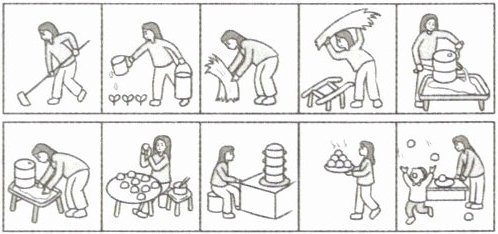
It's time for Chinese class! Miss Li brings some pictures to her students. She says, "Good morning, everyone. Look at these pictures. What can you find?"
Tony is the first to stand up. He says, "The woman in the pictures does a lot of work. After doing some farm work, she makes food for her son. These pictures tell us the mother’s love is great! She does a lot for the family."
Miss Li says, "Very good! So please say thanks to your mother when you see her. Any different ideas?"
"From the first nine pictures, we can see the woman’s hard work. I know that it is not easy to get food," Daming says. "But in the last picture, the boy plays with food. It’s not right. We can’t waste food."
Miss Li says, "Good! This morning we will learn a poem(诗)— Sympathy for Peasants."
Sympathy for Peasants
— Li Shen
At noon they hoe up weeds;
Their sweat(汗)drips on the soil.
Who knows the rice on the plate
Is the fruit of hard work!
25. (
A. The mother’s love is great.
B. Farm work is difficult to do.
C. It’s not right to play with food.
D. It’s fun to do farm work.
26. (
A. Let’s money to buy some books.
B. Mrs. Black is happy because her son likes to rice.
C. Don’t time, Bill. We have six things to do.
D. Many animals like to food for the winter.
27. (
A. Miss Li is not happy with Tony’s idea.
B. Tony doesn’t like the son in the last picture.
C. Miss Li always shows her students pictures in class.
D. The Chinese name of the poem is “《悯农》”.
积累
联系上文,完成知识积累。 (6分)得分
英汉互译。
1. It’s time for...
2. 站起来
3. say thanks to
4. at noon
拓展
5. a lot of =
6. 每天晚上按时上床睡觉很重要。(句子仿写:It’s + 形容词 + to... )
It's time for Chinese class! Miss Li brings some pictures to her students. She says, "Good morning, everyone. Look at these pictures. What can you find?"
Tony is the first to stand up. He says, "The woman in the pictures does a lot of work. After doing some farm work, she makes food for her son. These pictures tell us the mother’s love is great! She does a lot for the family."
Miss Li says, "Very good! So please say thanks to your mother when you see her. Any different ideas?"
"From the first nine pictures, we can see the woman’s hard work. I know that it is not easy to get food," Daming says. "But in the last picture, the boy plays with food. It’s not right. We can’t waste food."
Miss Li says, "Good! This morning we will learn a poem(诗)— Sympathy for Peasants."
Sympathy for Peasants
— Li Shen
At noon they hoe up weeds;
Their sweat(汗)drips on the soil.
Who knows the rice on the plate
Is the fruit of hard work!
25. (
A
) What does Tony learn from the pictures?A. The mother’s love is great.
B. Farm work is difficult to do.
C. It’s not right to play with food.
D. It’s fun to do farm work.
26. (
C
) [新考法·迁移运用] In which of the blanks(空)can we put “waste”?A. Let’s money to buy some books.
B. Mrs. Black is happy because her son likes to rice.
C. Don’t time, Bill. We have six things to do.
D. Many animals like to food for the winter.
27. (
D
) What can we know from the passage?A. Miss Li is not happy with Tony’s idea.
B. Tony doesn’t like the son in the last picture.
C. Miss Li always shows her students pictures in class.
D. The Chinese name of the poem is “《悯农》”.
积累
联系上文,完成知识积累。 (6分)得分
英汉互译。
1. It’s time for...
到(做)……的时间了
2. 站起来
stand up
3. say thanks to
对……说谢谢
4. at noon
在中午
拓展
5. a lot of =
lots of
6. 每天晚上按时上床睡觉很重要。(句子仿写:It’s + 形容词 + to... )
It's important to go to bed on time every night.
答案
25~27: ACD
积累
1.到(做)……的时间了 2. stand up
3.对……说谢谢 4.在中午
拓展
5. lots of
6. It's important to go to bed on time every night.
积累
1.到(做)……的时间了 2. stand up
3.对……说谢谢 4.在中午
拓展
5. lots of
6. It's important to go to bed on time every night.
解析
【分析】
1. 第25题:定位原文中Tony的发言,提取他从图片中得到的核心观点,对应匹配选项;
2. 第26题:先明确“waste”的词义为“浪费”,再逐一分析选项语境,判断哪个选项需要“浪费”的语义;
3. 第27题:逐一核对每个选项与原文细节的匹配度,排除错误选项后确定答案;
4. 积累部分:根据英汉短语的对应关系直接填写;
5. 拓展部分:第5题是同义短语替换,第6题套用指定句型仿写句子。
【解析】
25. 由原文Tony的表述“These pictures tell us the mother’s love is great!”可知,Tony从图片中体会到母爱伟大,对应选项A;B是Daming的观点,C是Daming对最后一幅图的看法,D未提及,故选A。
26. “waste”意为“浪费”。A选项语境为“让我们______钱买书”,不符合;B选项“儿子喜欢______米饭”,不符合;C选项“不要______时间”,符合“浪费时间”的语境;D选项“动物喜欢______食物过冬”,是“储存”的意思,不符合,故选C。
27. A选项:Miss Li对Tony的回答说“Very good!”,说明满意,错误;B选项:原文未提及Tony不喜欢儿子,错误;C选项:原文仅提到这节课带了图片,未说总是带,错误;D选项:诗的中文是《悯农》,正确,故选D。
积累:
1. It’s time for... 对应“到(做)……的时间了”;
2. “站起来”对应stand up;
3. say thanks to对应“对……说谢谢”;
4. at noon对应“在中午”;
拓展:
5. a lot of的同义短语是lots of;
6. 套用“It’s + 形容词 + to do sth.”句型,仿写为“It's important to go to bed on time every night.”
【答案】
25~27: ACD
积累
1.到(做)……的时间了 2. stand up
3.对……说谢谢 4.在中午
拓展
5. lots of
6. It's important to go to bed on time every night.
【知识点】
阅读理解、词汇运用、句子仿写
【点评】
本题结合图片、古诗与英语语篇,既考查阅读理解的细节定位与推理能力,又涵盖短语互译、同义替换和句型仿写,渗透了感恩母爱、珍惜粮食的德育理念,符合立德树人要求,题型贴合新考法的迁移运用要求。
【难度系数】
0.6
1. 第25题:定位原文中Tony的发言,提取他从图片中得到的核心观点,对应匹配选项;
2. 第26题:先明确“waste”的词义为“浪费”,再逐一分析选项语境,判断哪个选项需要“浪费”的语义;
3. 第27题:逐一核对每个选项与原文细节的匹配度,排除错误选项后确定答案;
4. 积累部分:根据英汉短语的对应关系直接填写;
5. 拓展部分:第5题是同义短语替换,第6题套用指定句型仿写句子。
【解析】
25. 由原文Tony的表述“These pictures tell us the mother’s love is great!”可知,Tony从图片中体会到母爱伟大,对应选项A;B是Daming的观点,C是Daming对最后一幅图的看法,D未提及,故选A。
26. “waste”意为“浪费”。A选项语境为“让我们______钱买书”,不符合;B选项“儿子喜欢______米饭”,不符合;C选项“不要______时间”,符合“浪费时间”的语境;D选项“动物喜欢______食物过冬”,是“储存”的意思,不符合,故选C。
27. A选项:Miss Li对Tony的回答说“Very good!”,说明满意,错误;B选项:原文未提及Tony不喜欢儿子,错误;C选项:原文仅提到这节课带了图片,未说总是带,错误;D选项:诗的中文是《悯农》,正确,故选D。
积累:
1. It’s time for... 对应“到(做)……的时间了”;
2. “站起来”对应stand up;
3. say thanks to对应“对……说谢谢”;
4. at noon对应“在中午”;
拓展:
5. a lot of的同义短语是lots of;
6. 套用“It’s + 形容词 + to do sth.”句型,仿写为“It's important to go to bed on time every night.”
【答案】
25~27: ACD
积累
1.到(做)……的时间了 2. stand up
3.对……说谢谢 4.在中午
拓展
5. lots of
6. It's important to go to bed on time every night.
【知识点】
阅读理解、词汇运用、句子仿写
【点评】
本题结合图片、古诗与英语语篇,既考查阅读理解的细节定位与推理能力,又涵盖短语互译、同义替换和句型仿写,渗透了感恩母爱、珍惜粮食的德育理念,符合立德树人要求,题型贴合新考法的迁移运用要求。
【难度系数】
0.6
七、(新题型·情境串考点)语篇填空。(10分)得分
根据短文内容或所给提示填空。
Time flies! I was a primary school student months ago. I am now in junior high. Today is my 28.
I know primary school is like 30.
32.
根据短文内容或所给提示填空。
Time flies! I was a primary school student months ago. I am now in junior high. Today is my 28.
twelfth
(twelve) birthday. And I am going to say that I 29. am
(be) ready for my new life.I know primary school is like 30.
a
pool. It is small and safe. My parents can protect me 31. from
winds, and they do everything for me.32.
But
junior high is like a river. It’s wide and deep (深的). I will face new 33. problems
(problem). My parents always help 34. me
(I). However (然而), I have to learn 35. to do
(do) something by myself, and I will try my best 36. to work
(work) hard. I will go through 37. storms
(storm) towards the sea.答案
28. twelfth 29. am 30. a 31. from 32. But 33. problems 34. me 35. to do 36. to work 37. storms
解析
【分析】
先通读短文理解语境,短文围绕从小学到初中的成长感悟展开,需结合所给提示词、语法规则(如序数词、be动词形式、冠词、介词、连词、名词单复数、代词宾格、非谓语动词等)及固定搭配,逐一分析每个空格的要求,确保填空符合语境和语法规范。
【解析】
28. 表示“第十二个生日”,需用序数词,故填twelfth;
29. 主语为I,时态为一般现在时,be动词对应形式为am,故填am;
30. pool是可数名词单数,此处表泛指,需用不定冠词a,故填a;
31. 固定搭配protect...from...意为“保护……免受……”,故填from;
32. 前文说小学像小水池,后文说初中像大河,是转折关系,需用连词But,故填But;
33. problem是可数名词,此处表泛指一类事物,需用复数形式,故填problems;
34. help是动词,后接代词宾格作宾语,I的宾格是me,故填me;
35. 固定搭配learn to do sth.意为“学习做某事”,故填to do;
36. 固定搭配try one’s best to do sth.意为“尽某人最大努力做某事”,故填to work;
37. storm是可数名词,此处表泛指一类事物,需用复数形式,故填storms。
【答案】
28. twelfth 29. am 30. a 31. from 32. But 33. problems 34. me 35. to do 36. to work 37. storms
【知识点】
序数词用法;固定搭配;名词单复数;代词宾格
【点评】
本题为成长主题的情境类语篇填空,考查初中英语核心基础语法与固定搭配,需结合语境分析,难度适中,能有效巩固学生的基础语言运用能力。
【难度系数】
0.6
先通读短文理解语境,短文围绕从小学到初中的成长感悟展开,需结合所给提示词、语法规则(如序数词、be动词形式、冠词、介词、连词、名词单复数、代词宾格、非谓语动词等)及固定搭配,逐一分析每个空格的要求,确保填空符合语境和语法规范。
【解析】
28. 表示“第十二个生日”,需用序数词,故填twelfth;
29. 主语为I,时态为一般现在时,be动词对应形式为am,故填am;
30. pool是可数名词单数,此处表泛指,需用不定冠词a,故填a;
31. 固定搭配protect...from...意为“保护……免受……”,故填from;
32. 前文说小学像小水池,后文说初中像大河,是转折关系,需用连词But,故填But;
33. problem是可数名词,此处表泛指一类事物,需用复数形式,故填problems;
34. help是动词,后接代词宾格作宾语,I的宾格是me,故填me;
35. 固定搭配learn to do sth.意为“学习做某事”,故填to do;
36. 固定搭配try one’s best to do sth.意为“尽某人最大努力做某事”,故填to work;
37. storm是可数名词,此处表泛指一类事物,需用复数形式,故填storms。
【答案】
28. twelfth 29. am 30. a 31. from 32. But 33. problems 34. me 35. to do 36. to work 37. storms
【知识点】
序数词用法;固定搭配;名词单复数;代词宾格
【点评】
本题为成长主题的情境类语篇填空,考查初中英语核心基础语法与固定搭配,需结合语境分析,难度适中,能有效巩固学生的基础语言运用能力。
【难度系数】
0.6
