

 登录
登录
(
A.appear
B.appeared
C.were appearing
D.appears
A
)1. I love the Mid-Autumn Festival because all kinds of mooncakes in the shops.A.appear
B.appeared
C.were appearing
D.appears
答案
1. A
解析
【分析】首先,需明确句子的时态和主谓一致规则。句子描述的是每年中秋节商店里出现月饼的常规情况,属于经常性的常态动作,应使用一般现在时;同时要结合主语的单复数确定谓语动词形式,据此逐步排除错误选项。
【解析】1. 判断时态:句子表达的是每年中秋节商店里出现月饼的常态,属于经常性动作,需用一般现在时,因此排除过去式的B和过去进行时的C;2. 主谓一致:主语all kinds of mooncakes是复数形式,谓语动词需用原形,排除第三人称单数形式的D,所以选A。
【答案】A
【知识点】一般现在时、主谓一致
【点评】本题考查初中英语基础的时态与主谓一致知识点,题目难度较低,是常见的基础题型,适合巩固语法基础。
【难度系数】0.8
【解析】1. 判断时态:句子表达的是每年中秋节商店里出现月饼的常态,属于经常性动作,需用一般现在时,因此排除过去式的B和过去进行时的C;2. 主谓一致:主语all kinds of mooncakes是复数形式,谓语动词需用原形,排除第三人称单数形式的D,所以选A。
【答案】A
【知识点】一般现在时、主谓一致
【点评】本题考查初中英语基础的时态与主谓一致知识点,题目难度较低,是常见的基础题型,适合巩固语法基础。
【难度系数】0.8
(
—. Everyone should do something for those in need.
A.That's right
B.It doesn't matter
C.My pleasure
D.You're welcome
C
)2. —I think it's really kind of you to help the disabled.—. Everyone should do something for those in need.
A.That's right
B.It doesn't matter
C.My pleasure
D.You're welcome
答案
2. C
解析
【分析】
这是一道日常情景交际题,解题时需先明确对话语境:对方称赞“你帮助残疾人真善良”,回应需表达乐意帮忙的态度,再逐一分析选项的适用场景,选出符合语境的答语。
【解析】
逐一分析选项:A选项“That's right”意为“那是对的”,用于赞同他人观点,不符合此处回应称赞的语境;B选项“It doesn't matter”意为“没关系”,用于回应道歉,与语境不符;C选项“My pleasure”意为“我的荣幸/乐意效劳”,用于回应他人的称赞或感谢,贴合此处表达乐意帮忙的语境;D选项“You're welcome”意为“不客气”,虽可回应感谢,但结合语境,“My pleasure”更贴合此处表达主动帮忙的态度。因此选C。
【答案】C
【知识点】情景交际、日常用语
【点评】本题考查日常情景对话的应答,需准确掌握不同交际用语的适用场景,属于基础交际题。
【难度系数】0.8
这是一道日常情景交际题,解题时需先明确对话语境:对方称赞“你帮助残疾人真善良”,回应需表达乐意帮忙的态度,再逐一分析选项的适用场景,选出符合语境的答语。
【解析】
逐一分析选项:A选项“That's right”意为“那是对的”,用于赞同他人观点,不符合此处回应称赞的语境;B选项“It doesn't matter”意为“没关系”,用于回应道歉,与语境不符;C选项“My pleasure”意为“我的荣幸/乐意效劳”,用于回应他人的称赞或感谢,贴合此处表达乐意帮忙的语境;D选项“You're welcome”意为“不客气”,虽可回应感谢,但结合语境,“My pleasure”更贴合此处表达主动帮忙的态度。因此选C。
【答案】C
【知识点】情景交际、日常用语
【点评】本题考查日常情景对话的应答,需准确掌握不同交际用语的适用场景,属于基础交际题。
【难度系数】0.8
(
A.breathe
B.breathing
C.to breathe
D.breathed
B
)3. Jim had trouble when something caught him in the water.A.breathe
B.breathing
C.to breathe
D.breathed
答案
3. B
解析
【分析】本题考查英语固定搭配的用法,需回忆“have trouble (in) doing sth.”这一结构,明确该结构中动词的形式要求,再结合选项逐一判断即可。
【解析】固定搭配“have trouble (in) doing sth.”意为“做某事有困难”,其中介词in可省略,后面必须接动词的动名词形式。选项A是动词原形,选项B是动名词,选项C是动词不定式,选项D是动词过去式,只有B选项符合该结构的要求。
【答案】B
【知识点】固定搭配;非谓语动词(动名词)
【点评】本题考查英语基础固定短语搭配,属于常考的语法知识点,只要牢记“have trouble (in) doing sth.”的用法就能轻松解题,是基础得分题。
【难度系数】0.8
【解析】固定搭配“have trouble (in) doing sth.”意为“做某事有困难”,其中介词in可省略,后面必须接动词的动名词形式。选项A是动词原形,选项B是动名词,选项C是动词不定式,选项D是动词过去式,只有B选项符合该结构的要求。
【答案】B
【知识点】固定搭配;非谓语动词(动名词)
【点评】本题考查英语基础固定短语搭配,属于常考的语法知识点,只要牢记“have trouble (in) doing sth.”的用法就能轻松解题,是基础得分题。
【难度系数】0.8
(
—Well, the fish are more active when it rains. , let's give it a try.
A.Instead
B.Moreover
C.Otherwise
D.Anyway
D
)4. —The weather report says it will rain tomorrow. Shall we still go fishing?—Well, the fish are more active when it rains. , let's give it a try.
A.Instead
B.Moreover
C.Otherwise
D.Anyway
答案
4. D
解析
【分析】首先通读对话理解语境:对话围绕“下雨是否去钓鱼”展开,答句提到下雨时鱼更活跃,需要选择一个副词来衔接前后内容,表达“不管怎样都要尝试”的态度。接着逐一分析选项的词义,结合语境匹配最合适的选项。
【解析】本题考查情景交际中副词的词义辨析。A项Instead意为“反而;代替”,不符合语境;B项Moreover意为“而且;此外”,表递进关系,此处无递进逻辑;C项Otherwise意为“否则;不然”,表假设,不符合语境;D项Anyway意为“无论如何;不管怎样”,契合“不管怎样都要尝试”的语义,故选D。
【答案】D
【知识点】副词词义辨析、情景交际
【点评】本题为基础情景对话题,考查常用副词在语境中的运用,需结合上下文逻辑判断副词含义,难度较低。
【难度系数】0.7
【解析】本题考查情景交际中副词的词义辨析。A项Instead意为“反而;代替”,不符合语境;B项Moreover意为“而且;此外”,表递进关系,此处无递进逻辑;C项Otherwise意为“否则;不然”,表假设,不符合语境;D项Anyway意为“无论如何;不管怎样”,契合“不管怎样都要尝试”的语义,故选D。
【答案】D
【知识点】副词词义辨析、情景交际
【点评】本题为基础情景对话题,考查常用副词在语境中的运用,需结合上下文逻辑判断副词含义,难度较低。
【难度系数】0.7
(
—. Get in, please.
A.Don't worry
B.It takes time
C.That's right
D.With pleasure
D
)5. —Could you give me a lift home?—. Get in, please.
A.Don't worry
B.It takes time
C.That's right
D.With pleasure
答案
5. D
解析
【分析】本题为情景交际题,对话场景是一方请求搭车,需结合各选项含义,选择符合请求回应的礼貌用语。
【解析】逐一分析选项:A项“Don't worry”用于安慰他人,与请求搭车的语境不符;B项“It takes time”表示“需要时间”,无法回应搭车请求;C项“That's right”用于赞同观点,不适合此处;D项“With pleasure”意为“乐意效劳”,是礼貌同意他人请求的常用表达,符合语境,故选D。
【答案】D
【知识点】情景交际、日常用语
【点评】本题考查日常交际用语的运用,需准确掌握各选项含义及适用场景,属于基础交际题。
【难度系数】0.8
【解析】逐一分析选项:A项“Don't worry”用于安慰他人,与请求搭车的语境不符;B项“It takes time”表示“需要时间”,无法回应搭车请求;C项“That's right”用于赞同观点,不适合此处;D项“With pleasure”意为“乐意效劳”,是礼貌同意他人请求的常用表达,符合语境,故选D。
【答案】D
【知识点】情景交际、日常用语
【点评】本题考查日常交际用语的运用,需准确掌握各选项含义及适用场景,属于基础交际题。
【难度系数】0.8
四、根据中文意思完成句子。
1. 我小心翼翼地写下最后一笔,对自己的作品满心欢喜。
I
2. 父亲带我去博物馆时我便爱上了书法。
3. 这些作品吸引了我,当天我就决定亲自试一试。
These works
4. 久而久之,我学会了如何专心做事,也渐渐享受写出更佳作品的乐趣。
Over time, I learnt
5. 学习书法无疑锻炼了我的专注力,也让我懂得了耐心的重要性。
Learning calligraphy has
1. 我小心翼翼地写下最后一笔,对自己的作品满心欢喜。
I
am pleased with my work
as I finish the final stroke with care
.2. 父亲带我去博物馆时我便爱上了书法。
My love of calligraphy began when my father took me to a museum.
3. 这些作品吸引了我,当天我就决定亲自试一试。
These works
caught my interest
and I decided to give it a try myself the very same day
.4. 久而久之,我学会了如何专心做事,也渐渐享受写出更佳作品的乐趣。
Over time, I learnt
how to concentrate on my task
, and I took pleasure in producing better work
.5. 学习书法无疑锻炼了我的专注力,也让我懂得了耐心的重要性。
Learning calligraphy has
undoubtedly helped me develop my ability to focus
and taught me the importance of patience
.答案
1. am pleased with my work; the final stroke with care
2. My love of calligraphy began when my father took me to a museum.
3. caught my interest; give it a try myself the very same day
4. how to concentrate on my task; took pleasure in producing better work
5. undoubtedly helped me develop my ability to focus; the importance of patience
2. My love of calligraphy began when my father took me to a museum.
3. caught my interest; give it a try myself the very same day
4. how to concentrate on my task; took pleasure in producing better work
5. undoubtedly helped me develop my ability to focus; the importance of patience
解析
【分析】
这类题是根据中文完成英文句子,解题思路为:先准确理解每句中文的核心语义,再结合英文常用固定搭配、句式结构(如疑问词+不定式、时间状语从句)、时态要求,匹配对应的英文表达,确保空格处内容符合语法和语义逻辑,与中文含义完全对应。
【解析】
1. 前半部分“对自己的作品满心欢喜”对应固定搭配be pleased with one's work,主语为I,时态用一般现在时,故填am pleased with my work;后半部分“小心翼翼地写下最后一笔”,“最后一笔”是the final stroke,“小心翼翼地”用with care,故填the final stroke with care。
2. 需用when引导时间状语从句,“爱上书法”是love of calligraphy,“开始于”用began,“父亲带我去博物馆”是my father took me to a museum,组合后为My love of calligraphy began when my father took me to a museum。
3. “吸引了我”对应固定短语catch one's interest,主语为复数works,时态用一般过去式,故填caught my interest;“亲自试一试”是give it a try oneself,“当天”是the very same day,故填give it a try myself the very same day。
4. “如何专心做事”用“疑问词+不定式”结构how to concentrate on my task;“享受做某事的乐趣”是固定搭配take pleasure in doing sth,“写出更佳作品”是produce better work,时态用一般过去式,故填took pleasure in producing better work。
5. “锻炼了我的专注力”对应help sb develop one's ability to focus,时态为现在完成时(has+过去分词),“无疑”是undoubtedly,故填undoubtedly helped me develop my ability to focus;“耐心的重要性”是the importance of patience,故填the importance of patience。
【答案】
1. am pleased with my work; the final stroke with care
2. My love of calligraphy began when my father took me to a museum.
3. caught my interest; give it a try myself the very same day
4. how to concentrate on my task; took pleasure in producing better work
5. undoubtedly helped me develop my ability to focus; the importance of patience
【知识点】
英语短语翻译;固定搭配;汉英句子转换
【点评】
本题考查常用英语短语、固定搭配的掌握及汉译英的句式转换能力,要求学生准确匹配中英文语义,注意时态、语法结构的一致性,属于基础类英语应用题型。
【难度系数】
0.6
这类题是根据中文完成英文句子,解题思路为:先准确理解每句中文的核心语义,再结合英文常用固定搭配、句式结构(如疑问词+不定式、时间状语从句)、时态要求,匹配对应的英文表达,确保空格处内容符合语法和语义逻辑,与中文含义完全对应。
【解析】
1. 前半部分“对自己的作品满心欢喜”对应固定搭配be pleased with one's work,主语为I,时态用一般现在时,故填am pleased with my work;后半部分“小心翼翼地写下最后一笔”,“最后一笔”是the final stroke,“小心翼翼地”用with care,故填the final stroke with care。
2. 需用when引导时间状语从句,“爱上书法”是love of calligraphy,“开始于”用began,“父亲带我去博物馆”是my father took me to a museum,组合后为My love of calligraphy began when my father took me to a museum。
3. “吸引了我”对应固定短语catch one's interest,主语为复数works,时态用一般过去式,故填caught my interest;“亲自试一试”是give it a try oneself,“当天”是the very same day,故填give it a try myself the very same day。
4. “如何专心做事”用“疑问词+不定式”结构how to concentrate on my task;“享受做某事的乐趣”是固定搭配take pleasure in doing sth,“写出更佳作品”是produce better work,时态用一般过去式,故填took pleasure in producing better work。
5. “锻炼了我的专注力”对应help sb develop one's ability to focus,时态为现在完成时(has+过去分词),“无疑”是undoubtedly,故填undoubtedly helped me develop my ability to focus;“耐心的重要性”是the importance of patience,故填the importance of patience。
【答案】
1. am pleased with my work; the final stroke with care
2. My love of calligraphy began when my father took me to a museum.
3. caught my interest; give it a try myself the very same day
4. how to concentrate on my task; took pleasure in producing better work
5. undoubtedly helped me develop my ability to focus; the importance of patience
【知识点】
英语短语翻译;固定搭配;汉英句子转换
【点评】
本题考查常用英语短语、固定搭配的掌握及汉译英的句式转换能力,要求学生准确匹配中英文语义,注意时态、语法结构的一致性,属于基础类英语应用题型。
【难度系数】
0.6
五、阅读下面短文,从短文后的选项中选出可以填入空白处的最佳选项。选项中有一项为多余选项。
When you read a good book, do you often take notes while reading? Taking reading notes is a great way to understand the book better and remember what you have read. 1
First, write down the key information of the book. This includes the writer's name, the main characters, the plot and the main idea of the story. 2 You can also write down the important facts and opinions in the book, which will help you get a clear picture of the whole book.
3 When you read a sentence that touches you, or a paragraph that makes you think deeply, write it down in your notebook. You can also mark the page number next to it, so you can find it easily when you want to read it again. These beautiful sentences can not only improve your writing but also bring you new thoughts.
Third, write down your own opinions and feelings about the book. 4 Do you agree with the writer's opinion? What can you learn from the characters? How does the story change your ideas? Writing down your thoughts can help you think more deeply about the book, not just read the words on the page.
Finally, organize your notes clearly. You can use different parts of your notebook for different kinds of notes, such as key information, beautiful sentences and your own opinions. You can also use mind maps to organize the plot and characters of the story. 5
Taking reading notes is not a boring task. It's like having a talk with the writer and the characters in the book. If you keep this good habit, you will find reading more meaningful and enjoyable.
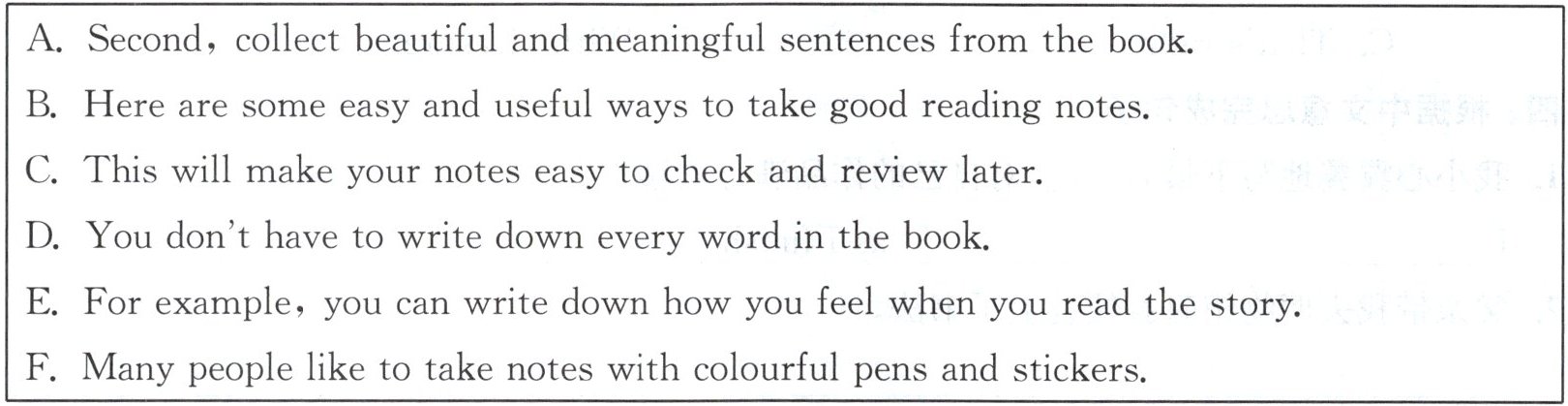
A. Second, collect beautiful and meaningful sentences from the book.
B. Here are some easy and useful ways to take good reading notes.
C. This will make your notes easy to check and review later.
D. You don't have to write down every word in the book.
E. For example, you can write down how you feel when you read the story.
F. Many people like to take notes with colourful pens and stickers.
1.
When you read a good book, do you often take notes while reading? Taking reading notes is a great way to understand the book better and remember what you have read. 1
First, write down the key information of the book. This includes the writer's name, the main characters, the plot and the main idea of the story. 2 You can also write down the important facts and opinions in the book, which will help you get a clear picture of the whole book.
3 When you read a sentence that touches you, or a paragraph that makes you think deeply, write it down in your notebook. You can also mark the page number next to it, so you can find it easily when you want to read it again. These beautiful sentences can not only improve your writing but also bring you new thoughts.
Third, write down your own opinions and feelings about the book. 4 Do you agree with the writer's opinion? What can you learn from the characters? How does the story change your ideas? Writing down your thoughts can help you think more deeply about the book, not just read the words on the page.
Finally, organize your notes clearly. You can use different parts of your notebook for different kinds of notes, such as key information, beautiful sentences and your own opinions. You can also use mind maps to organize the plot and characters of the story. 5
Taking reading notes is not a boring task. It's like having a talk with the writer and the characters in the book. If you keep this good habit, you will find reading more meaningful and enjoyable.
A. Second, collect beautiful and meaningful sentences from the book.
B. Here are some easy and useful ways to take good reading notes.
C. This will make your notes easy to check and review later.
D. You don't have to write down every word in the book.
E. For example, you can write down how you feel when you read the story.
F. Many people like to take notes with colourful pens and stickers.
1.
B
2. D
3. A
4. E
5. C
答案
1. B 2. D 3. A 4. E 5. C
解析
【分析】
本题为英语七选五题型,需结合上下文的逻辑关系、关键词及语篇结构解题:
1. 第1空:前文介绍做读书笔记的好处,后文开始列举具体方法,需总起句引出方法,对应选项B;
2. 第2空:前文提到写关键信息,后文说还可写其他内容,中间需衔接“不用写全部内容”的表述,对应选项D;
3. 第3空:前文用First引出第一个方法,后文讲收集优美句子,需用Second引出第二个方法,对应选项A;
4. 第4空:前文说写自己的观点感受,后文是具体例子,需举例句衔接,对应选项E;
5. 第5空:前文讲整理笔记的方法,需说明整理的好处,对应选项C。
【解析】
1. 第1空:前文说明做读书笔记的意义,后文开始分点介绍方法,选项B“Here are some easy and useful ways to take good reading notes.”起到总起作用,符合语境;
2. 第2空:前文提到“write down the key information”,后文说“You can also write down...”,选项D“You don't have to write down every word in the book.”衔接前后,说明不用全写,符合逻辑;
3. 第3空:前文用First引出第一个方法,后文讲收集优美句子,选项A“Second, collect beautiful and meaningful sentences from the book.”用Second引出第二个方法,符合顺序逻辑;
4. 第4空:前文说“write down your own opinions and feelings”,后文是具体问题例子,选项E“For example, you can write down how you feel when you read the story.”举例说明,符合语境;
5. 第5空:前文讲“organize your notes clearly”的方法,选项C“This will make your notes easy to check and review later.”说明整理的好处,符合逻辑。
【答案】
1.B 2.D 3.A 4.E 5.C
【知识点】
英语阅读理解、七选五题型、语篇逻辑衔接
【点评】
本题为英语七选五典型题型,侧重考查学生对语篇结构、逻辑关系(总起、顺序、举例、衔接)的理解,需结合上下文关键词和行文逻辑解题,难度适中。
【难度系数】
0.5
本题为英语七选五题型,需结合上下文的逻辑关系、关键词及语篇结构解题:
1. 第1空:前文介绍做读书笔记的好处,后文开始列举具体方法,需总起句引出方法,对应选项B;
2. 第2空:前文提到写关键信息,后文说还可写其他内容,中间需衔接“不用写全部内容”的表述,对应选项D;
3. 第3空:前文用First引出第一个方法,后文讲收集优美句子,需用Second引出第二个方法,对应选项A;
4. 第4空:前文说写自己的观点感受,后文是具体例子,需举例句衔接,对应选项E;
5. 第5空:前文讲整理笔记的方法,需说明整理的好处,对应选项C。
【解析】
1. 第1空:前文说明做读书笔记的意义,后文开始分点介绍方法,选项B“Here are some easy and useful ways to take good reading notes.”起到总起作用,符合语境;
2. 第2空:前文提到“write down the key information”,后文说“You can also write down...”,选项D“You don't have to write down every word in the book.”衔接前后,说明不用全写,符合逻辑;
3. 第3空:前文用First引出第一个方法,后文讲收集优美句子,选项A“Second, collect beautiful and meaningful sentences from the book.”用Second引出第二个方法,符合顺序逻辑;
4. 第4空:前文说“write down your own opinions and feelings”,后文是具体问题例子,选项E“For example, you can write down how you feel when you read the story.”举例说明,符合语境;
5. 第5空:前文讲“organize your notes clearly”的方法,选项C“This will make your notes easy to check and review later.”说明整理的好处,符合逻辑。
【答案】
1.B 2.D 3.A 4.E 5.C
【知识点】
英语阅读理解、七选五题型、语篇逻辑衔接
【点评】
本题为英语七选五典型题型,侧重考查学生对语篇结构、逻辑关系(总起、顺序、举例、衔接)的理解,需结合上下文关键词和行文逻辑解题,难度适中。
【难度系数】
0.5
