

 登录
登录
Ⅲ.阅读选择(16分)
A
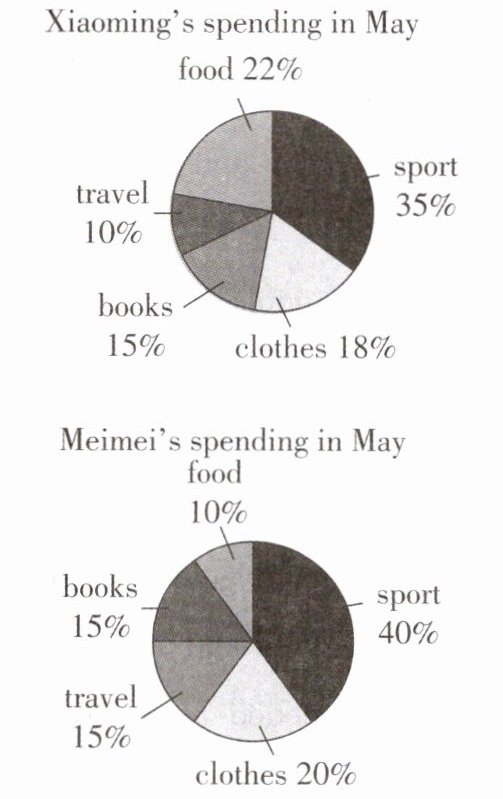
[2026江苏泰州质检]Meimei and Xiaoming have the same amount (数额) of pocket money every month. And they spend their money on different things. Here are two pictures to show how they spend their pocket money.
(
A. Food. B. Clothes.
C. Sport. D. Books.
(
A. Food. B. Clothes.
C. Sport. D. Travel.
(
A. Clothes. B. Sport.
C. Travel. D. Books.
A
[2026江苏泰州质检]Meimei and Xiaoming have the same amount (数额) of pocket money every month. And they spend their money on different things. Here are two pictures to show how they spend their pocket money.
(
C
)26. What does Meimei spend the most of her money on?A. Food. B. Clothes.
C. Sport. D. Books.
(
D
)27. What does Xiaoming spend the least of his money on?A. Food. B. Clothes.
C. Sport. D. Travel.
(
D
)28. What do Meimei and Xiaoming spend the same account of money on?A. Clothes. B. Sport.
C. Travel. D. Books.
答案
阅读A篇·语篇导读 本文通过饼状图展示了小明(音译)和梅梅(音译)五月份零花钱的支出情况。
26.C 细节理解题。根据Meimei’s spending in May下的sport 40%可知,梅梅在运动方面花钱最多。故选C项。
27.D 细节理解题。根据Xiaoming’s spending in May下的travel 10%可知,小明在旅行方面花钱最少。故选D项。
28.D 细节理解题。根据两个饼状图可知,梅梅和小明在书籍上的支出占比均为15%,他们在书籍上花的钱一样多。故选D项。
26.C 细节理解题。根据Meimei’s spending in May下的sport 40%可知,梅梅在运动方面花钱最多。故选C项。
27.D 细节理解题。根据Xiaoming’s spending in May下的travel 10%可知,小明在旅行方面花钱最少。故选D项。
28.D 细节理解题。根据两个饼状图可知,梅梅和小明在书籍上的支出占比均为15%,他们在书籍上花的钱一样多。故选D项。
解析
【分析】这是一道图表类英语阅读理解题,需根据饼状图中两人各项支出的百分比信息解答问题。解题时要先明确每个问题对应的人物,再定位到对应人物的支出饼状图,找到题目要求的“最多”“最少”“相同占比”的信息即可。
【解析】
26. 题目问梅梅花钱最多的项目,查看梅梅的支出饼状图,sport占比40%,是所有项目中最高的,对应选项C,故选C。
27. 题目问小明花钱最少的项目,查看小明的支出饼状图,travel占比10%,是所有项目中最低的,对应选项D,故选D。
28. 题目问两人花钱相同的项目,对比两人的支出占比,books的占比均为15%,因此在书籍上花的钱一样多,对应选项D,故选D。
【答案】
26.C 27.D 28.D
【知识点】
英语阅读理解;细节理解题;图表信息提取
【点评】
本题为图表类英语阅读基础题,主要考查从饼状图中提取关键数据的能力,题目设置直接,只要仔细观察图表中的百分比信息即可正确解答,难度较低。
【难度系数】
0.8
【解析】
26. 题目问梅梅花钱最多的项目,查看梅梅的支出饼状图,sport占比40%,是所有项目中最高的,对应选项C,故选C。
27. 题目问小明花钱最少的项目,查看小明的支出饼状图,travel占比10%,是所有项目中最低的,对应选项D,故选D。
28. 题目问两人花钱相同的项目,对比两人的支出占比,books的占比均为15%,因此在书籍上花的钱一样多,对应选项D,故选D。
【答案】
26.C 27.D 28.D
【知识点】
英语阅读理解;细节理解题;图表信息提取
【点评】
本题为图表类英语阅读基础题,主要考查从饼状图中提取关键数据的能力,题目设置直接,只要仔细观察图表中的百分比信息即可正确解答,难度较低。
【难度系数】
0.8
B
People use money to buy food, books, bicycles and hundreds of other things which they need. When they work, they usually get paid in money.
Most of the money used today is made of metal(金属)or paper. But in ancient times(古代)people used to use all kinds of things as money. One of the first kinds of money was shells(贝壳).
In China cloth and knives were used as
money. Elephant tusks(象牙)and salt were used as money in some parts of Africa. Rice was also a kind of money used by the ancient people on some islands. Cows and other animals were used as money too.
The first copper coins(铜币)were made in China. They were round and had a square(方形的)hole in the centre. Different countries have used different metals for their money. Later, some countries began to make gold and silver(银制的)coins. But both gold and silver were heavy to carry when people needed a lot of coins to buy something expensive. The Chinese were the first to use paper money. The first paper money looked more like a note from one person to another than the paper money used today.
Money has had an interesting history from the days of shell money till today.
(
A. Elephant tusks.
B. Wood.
C. Metal or paper.
D. Cloth.
(
A. knives
B. rice
C. cows
D. salt
(
A. silver
B. gold
C. copper
D. iron
(
A. It is beautiful.
B. It is easy to carry.
C. It looks like a picture.
D. People like it better than gold or silver.
(
A. money can be made of many things
B. the history of money
C. what kind of metal can be used as money
D. how paper money came into being
People use money to buy food, books, bicycles and hundreds of other things which they need. When they work, they usually get paid in money.
Most of the money used today is made of metal(金属)or paper. But in ancient times(古代)people used to use all kinds of things as money. One of the first kinds of money was shells(贝壳).
In China cloth and knives were used as
money. Elephant tusks(象牙)and salt were used as money in some parts of Africa. Rice was also a kind of money used by the ancient people on some islands. Cows and other animals were used as money too.
The first copper coins(铜币)were made in China. They were round and had a square(方形的)hole in the centre. Different countries have used different metals for their money. Later, some countries began to make gold and silver(银制的)coins. But both gold and silver were heavy to carry when people needed a lot of coins to buy something expensive. The Chinese were the first to use paper money. The first paper money looked more like a note from one person to another than the paper money used today.
Money has had an interesting history from the days of shell money till today.
(
C
)29. What is the money we use today made of?A. Elephant tusks.
B. Wood.
C. Metal or paper.
D. Cloth.
(
D
)30. Some Africans used as money according to the passage.A. knives
B. rice
C. cows
D. salt
(
C
)31. China was the first country to use coins.A. silver
B. gold
C. copper
D. iron
(
B
)32. Why does paper money become popular today?A. It is beautiful.
B. It is easy to carry.
C. It looks like a picture.
D. People like it better than gold or silver.
(
B
)33. The passage tells us .A. money can be made of many things
B. the history of money
C. what kind of metal can be used as money
D. how paper money came into being
答案
阅读B篇·语篇导读 本文主要介绍了钱的发展历史。
29.C 细节理解题。根据文章第二段的“Most of the money used today is made of metal or paper.”可知,如今大部分钱都是由金属或纸制成的。
30.D 细节理解题。根据文章第三段的“Elephant tusks and salt were used as money in some parts of Africa.”可知,有些非洲人曾把象牙和盐当作钱来使用。
31.C 细节理解题。根据文章第四段的“The first copper coins were made in China.”可知,中国最早使用铜币。
32.B 推理判断题。根据第四段的“But both gold and silver were heavy to carry... The Chinese were the first to use paper money.”可推知选B项。
33.B 主旨大意题。本文主要介绍了钱的发展历史,故选B项。
29.C 细节理解题。根据文章第二段的“Most of the money used today is made of metal or paper.”可知,如今大部分钱都是由金属或纸制成的。
30.D 细节理解题。根据文章第三段的“Elephant tusks and salt were used as money in some parts of Africa.”可知,有些非洲人曾把象牙和盐当作钱来使用。
31.C 细节理解题。根据文章第四段的“The first copper coins were made in China.”可知,中国最早使用铜币。
32.B 推理判断题。根据第四段的“But both gold and silver were heavy to carry... The Chinese were the first to use paper money.”可推知选B项。
33.B 主旨大意题。本文主要介绍了钱的发展历史,故选B项。
解析
【分析】
这是一篇关于货币发展历史的阅读理解,解题时需根据题目关键词定位原文对应段落,提取关键信息,对比选项得出答案。其中29-31题为细节理解题,需精准定位原文具体语句;32题为推理判断题,需结合上下文逻辑推导;33题为主旨大意题,需梳理全文核心内容。
【解析】
29. 细节理解题:根据文章第二段“Most of the money used today is made of metal or paper.”可知,如今使用的大部分货币由金属或纸制成,对应选项C。
30. 细节理解题:根据文章第三段“Elephant tusks and salt were used as money in some parts of Africa.”可知,部分非洲人曾将盐作为货币,对应选项D。
31. 细节理解题:根据文章第四段“The first copper coins were made in China.”可知,中国是最早使用铜币的国家,对应选项C。
32. 推理判断题:根据文章第四段“But both gold and silver were heavy to carry... The Chinese were the first to use paper money.”可知,金银货币携带不便,纸币因易携带而流行,对应选项B。
33. 主旨大意题:全文从贝壳、金属币到纸币,介绍了货币的发展历史,对应选项B。
【答案】29.C 30.D 31.C 32.B 33.B
【知识点】阅读理解细节理解题、主旨大意题、推理判断题
【点评】本篇阅读围绕货币的发展历史展开,题目设置以细节定位为主,辅以少量推理和主旨题,考查学生快速提取原文信息、把握文章主旨的能力,整体难度适中。
【难度系数】0.7
这是一篇关于货币发展历史的阅读理解,解题时需根据题目关键词定位原文对应段落,提取关键信息,对比选项得出答案。其中29-31题为细节理解题,需精准定位原文具体语句;32题为推理判断题,需结合上下文逻辑推导;33题为主旨大意题,需梳理全文核心内容。
【解析】
29. 细节理解题:根据文章第二段“Most of the money used today is made of metal or paper.”可知,如今使用的大部分货币由金属或纸制成,对应选项C。
30. 细节理解题:根据文章第三段“Elephant tusks and salt were used as money in some parts of Africa.”可知,部分非洲人曾将盐作为货币,对应选项D。
31. 细节理解题:根据文章第四段“The first copper coins were made in China.”可知,中国是最早使用铜币的国家,对应选项C。
32. 推理判断题:根据文章第四段“But both gold and silver were heavy to carry... The Chinese were the first to use paper money.”可知,金银货币携带不便,纸币因易携带而流行,对应选项B。
33. 主旨大意题:全文从贝壳、金属币到纸币,介绍了货币的发展历史,对应选项B。
【答案】29.C 30.D 31.C 32.B 33.B
【知识点】阅读理解细节理解题、主旨大意题、推理判断题
【点评】本篇阅读围绕货币的发展历史展开,题目设置以细节定位为主,辅以少量推理和主旨题,考查学生快速提取原文信息、把握文章主旨的能力,整体难度适中。
【难度系数】0.7
