

 登录
登录
Ⅵ. 首字母填空
根据短文内容及首字母提示,在空格处填入一个适当的词使短文完整。
Teens worldwide connect through video calls to have communication emotionally.
Years ago, Abhay and a group of his Grade 10 classmates at a secondary school in Canada made their first video call to the Arctic. On the o 1 end of the line was Abhay’s brother, Sukhmeet, a volunteer teaching assistant. His class was at a middle school there.
The conversation started with teens’ small talks—asking each other about TV shows, music and school life. But as the teens grew more comfortable, the chat turned s 2, such as family issues and stories of social problems. Some kids shared how hopeless they felt, for they could do n 3 about the danger or threat caused by the climate change.
After both groups said their goodbyes, the brothers had an idea: since the conversation was designed to broaden the students’ views about life outside their h 4, let’s keep it on. Students could continue to benefit from bridging geographical and cultural differences. They called their organization Break The Divide.
The students used social media to spread the word about their task to c 5 eye-opening conversations. Other schools began reaching out, and Break The Divide helped them to start their own stations. They p 6 different useful resources, such as a list of guiding questions to get the conversation started, and technical tips for video calls. Different stations are encouraged to c 7 with each other based on big topics, such as mental health and climate change. There are now over two dozen stations located across Canada as well as schools in other countries.
In 2021, Abhay and Sukhmeet had their first employees, enabling them to d 8 an app that will act as a social platform to connect Break The Divide stations worldwide.
The brothers are happy to find that the organization can play a central role in h 9 youth solve the most difficult problems. “I hope that we can be part of building a world where we are all l 10 to each other for learning and for change,” says Abhay.
1. ____ 2. ____ 3. ____
4. ____ 5. ____ 6. ____
7. ____ 8. ____ 9. ____
10. ____
根据短文内容及首字母提示,在空格处填入一个适当的词使短文完整。
Teens worldwide connect through video calls to have communication emotionally.
Years ago, Abhay and a group of his Grade 10 classmates at a secondary school in Canada made their first video call to the Arctic. On the o 1 end of the line was Abhay’s brother, Sukhmeet, a volunteer teaching assistant. His class was at a middle school there.
The conversation started with teens’ small talks—asking each other about TV shows, music and school life. But as the teens grew more comfortable, the chat turned s 2, such as family issues and stories of social problems. Some kids shared how hopeless they felt, for they could do n 3 about the danger or threat caused by the climate change.
After both groups said their goodbyes, the brothers had an idea: since the conversation was designed to broaden the students’ views about life outside their h 4, let’s keep it on. Students could continue to benefit from bridging geographical and cultural differences. They called their organization Break The Divide.
The students used social media to spread the word about their task to c 5 eye-opening conversations. Other schools began reaching out, and Break The Divide helped them to start their own stations. They p 6 different useful resources, such as a list of guiding questions to get the conversation started, and technical tips for video calls. Different stations are encouraged to c 7 with each other based on big topics, such as mental health and climate change. There are now over two dozen stations located across Canada as well as schools in other countries.
In 2021, Abhay and Sukhmeet had their first employees, enabling them to d 8 an app that will act as a social platform to connect Break The Divide stations worldwide.
The brothers are happy to find that the organization can play a central role in h 9 youth solve the most difficult problems. “I hope that we can be part of building a world where we are all l 10 to each other for learning and for change,” says Abhay.
1. ____ 2. ____ 3. ____
4. ____ 5. ____ 6. ____
7. ____ 8. ____ 9. ____
10. ____
答案
1. other 2. serious 3. nothing 4. hometowns/homelands 5. create 6. provided/prepared
7. connect/communicate 8. develop/design 9. helping 10. listening
7. connect/communicate 8. develop/design 9. helping 10. listening
Ⅶ. 任务型阅读
阅读并根据下面的短文,在表格中的1-7题的空格里填入一个最恰当的单词;8-10题按照题目要求作答。
PEER PRESSURE
Peers are people who are about the same age as you. Peer pressure is when one or more friends or people of your own age make you feel stressed to do something. You feel as if you have to do that thing because your peers are doing it, or are trying to make you do it.
Good peer pressure is when you feel pressured to do something good. You might do something good for you, for others, or for the environment. Bad peer pressure is when you feel pressured to do something you shouldn’t do. For example, it might be something that goes against rules, something dangerous, or something bad for your health. It might also be something that goes against your values, or what you believe is good or right.
If a friend tries to pressure you to do something, you might feel you should do it to please your friend. You might even feel that the person will not be your friend if you do not do it. People often want to be accepted by their peers and not feel as if they stand out because they are different in some ways. Sometimes people are afraid others will make fun of them if they do not do what everyone else is doing.
Here are some questions to ask yourself when you feel peer pressure to do something:
· Could I get into trouble for doing this?
· Might doing this hurt myself or another person, or hurt someone’s feelings?
· Does this go against my values?
· Will I feel sorry or embarrassed if my family, teachers, or others find out about it?
If you answer “yes” to any of these questions, you are feeling bad peer pressure. If people keep pressuring you, say, “I do not want to talk about it anymore.” Then walk away and feel proud that you made a good decision.
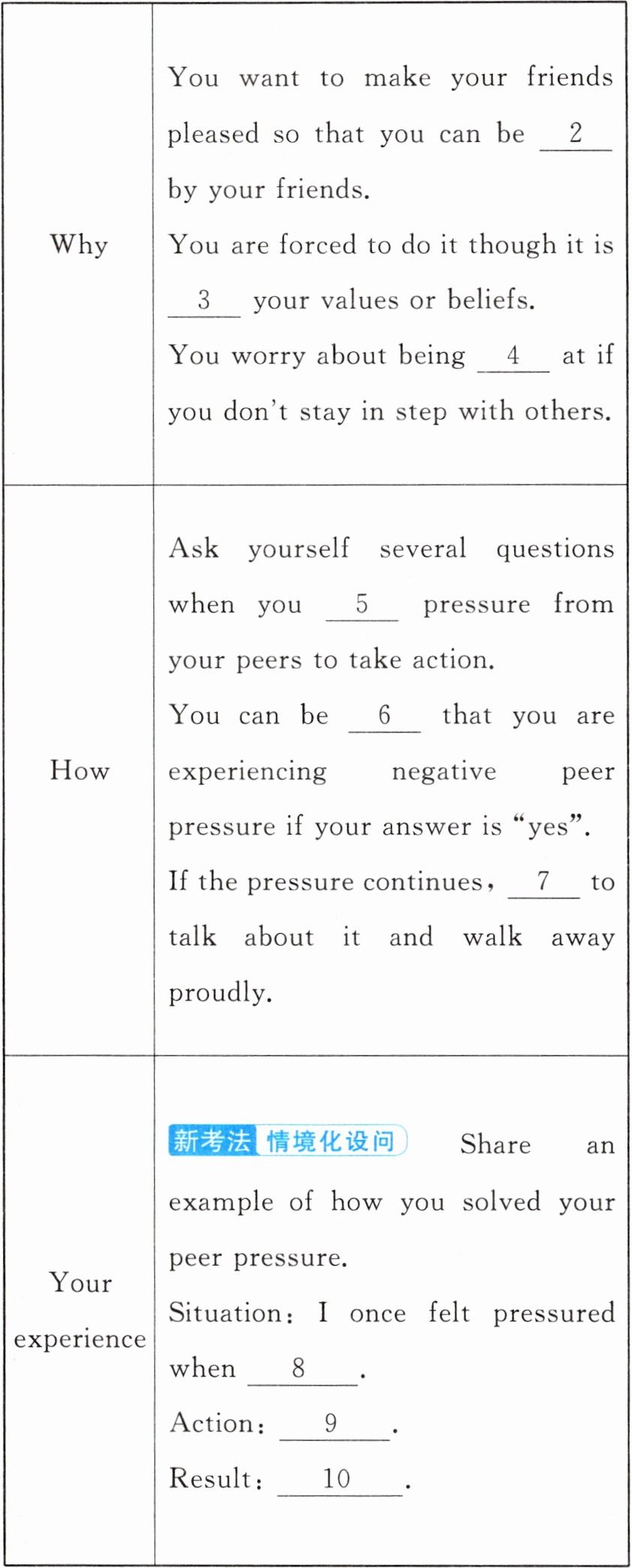
1. ____ 2. ____ 3. ____
4. ____ 5. ____ 6. ____
7. ____
8. ______
9. ______
10. ______
阅读并根据下面的短文,在表格中的1-7题的空格里填入一个最恰当的单词;8-10题按照题目要求作答。
PEER PRESSURE
Peers are people who are about the same age as you. Peer pressure is when one or more friends or people of your own age make you feel stressed to do something. You feel as if you have to do that thing because your peers are doing it, or are trying to make you do it.
Good peer pressure is when you feel pressured to do something good. You might do something good for you, for others, or for the environment. Bad peer pressure is when you feel pressured to do something you shouldn’t do. For example, it might be something that goes against rules, something dangerous, or something bad for your health. It might also be something that goes against your values, or what you believe is good or right.
If a friend tries to pressure you to do something, you might feel you should do it to please your friend. You might even feel that the person will not be your friend if you do not do it. People often want to be accepted by their peers and not feel as if they stand out because they are different in some ways. Sometimes people are afraid others will make fun of them if they do not do what everyone else is doing.
Here are some questions to ask yourself when you feel peer pressure to do something:
· Could I get into trouble for doing this?
· Might doing this hurt myself or another person, or hurt someone’s feelings?
· Does this go against my values?
· Will I feel sorry or embarrassed if my family, teachers, or others find out about it?
If you answer “yes” to any of these questions, you are feeling bad peer pressure. If people keep pressuring you, say, “I do not want to talk about it anymore.” Then walk away and feel proud that you made a good decision.
1. ____ 2. ____ 3. ____
4. ____ 5. ____ 6. ____
7. ____
8. ______
9. ______
10. ______
答案
1. stressed 2. accepted 3. against 4. laughed 5. feel
6. sure 7. refuse 8. my friends smoked and let me do that 9. I said “no”, and then walked away 10. I no longer made friends with them(8-10 题答案不唯一,言之有理即可)
6. sure 7. refuse 8. my friends smoked and let me do that 9. I said “no”, and then walked away 10. I no longer made friends with them(8-10 题答案不唯一,言之有理即可)
