

 登录
登录
一、用所给单词的适当形式填空。
1. Can you pick all the apples by
(you)?
2. To
so early.
3. The head teacher often
students, and she
yesterday.(praise)
4. I visited my grandparents instead of
(take) a trip last weekend.
1. Can you pick all the apples by
yourself
(you)?
2. To
my
(I) surprise, she got to schoolso early.
3. The head teacher often
praises
thestudents, and she
praised
some studentsyesterday.(praise)
4. I visited my grandparents instead of
taking
(take) a trip last weekend.
答案
1. yourself 2. my 3. praises; praised 4. taking
解析
【分析】
本题为英语单词适当形式填空题,解题思路是结合固定搭配、动词时态规则、介词后接动名词的用法来逐一确定每个空的正确形式:1. 第一题考查固定搭配by oneself,需用反身代词;2. 第二题考查固定搭配to one's surprise,需用形容词性物主代词;3. 第三题根据时间状语判断时态,分别用一般现在时和一般过去时的动词形式;4. 第四题考查介词后接动名词的用法,需将动词变为动名词形式。
【解析】
1. 固定搭配by oneself意为“独自”,主语为you,此处需用反身代词,故填yourself;
2. 固定搭配to one's surprise意为“令某人惊讶的是”,此处需用形容词性物主代词修饰名词surprise,I对应的形容词性物主代词为my,故填my;
3. 前半句时间状语为often,表经常性动作,用一般现在时,主语the head teacher是第三人称单数,谓语动词用praise的第三人称单数形式praises;后半句时间状语为yesterday,表过去动作,用一般过去时,praise的过去式为praised,故填praises; praised;
4. instead of是介词短语,后接动词时需用动名词形式,take的动名词为taking,故填taking。
【答案】
1. yourself 2. my 3. praises; praised 4. taking
【知识点】
反身代词;物主代词;动词时态
【点评】
本题考查英语基础的固定搭配、词形变化及动词时态,属于初中英语基础题型,侧重核心知识点的掌握,适合低年级学生巩固练习。
【难度系数】
0.8
本题为英语单词适当形式填空题,解题思路是结合固定搭配、动词时态规则、介词后接动名词的用法来逐一确定每个空的正确形式:1. 第一题考查固定搭配by oneself,需用反身代词;2. 第二题考查固定搭配to one's surprise,需用形容词性物主代词;3. 第三题根据时间状语判断时态,分别用一般现在时和一般过去时的动词形式;4. 第四题考查介词后接动名词的用法,需将动词变为动名词形式。
【解析】
1. 固定搭配by oneself意为“独自”,主语为you,此处需用反身代词,故填yourself;
2. 固定搭配to one's surprise意为“令某人惊讶的是”,此处需用形容词性物主代词修饰名词surprise,I对应的形容词性物主代词为my,故填my;
3. 前半句时间状语为often,表经常性动作,用一般现在时,主语the head teacher是第三人称单数,谓语动词用praise的第三人称单数形式praises;后半句时间状语为yesterday,表过去动作,用一般过去时,praise的过去式为praised,故填praises; praised;
4. instead of是介词短语,后接动词时需用动名词形式,take的动名词为taking,故填taking。
【答案】
1. yourself 2. my 3. praises; praised 4. taking
【知识点】
反身代词;物主代词;动词时态
【点评】
本题考查英语基础的固定搭配、词形变化及动词时态,属于初中英语基础题型,侧重核心知识点的掌握,适合低年级学生巩固练习。
【难度系数】
0.8
1. Our teacher often tells us
A.not waste
B.don't waste
C.not to waste
D.doesn't waste
C
time.A.not waste
B.don't waste
C.not to waste
D.doesn't waste
答案
1. C tell sb. not to do sth.告诉某人不要做某事。
解析
【分析】首先,本题考查动词的固定搭配。需回忆“tell”的常用结构:“tell sb. (not) to do sth.”,意为“告诉某人(不要)做某事”。接着分析各选项:A选项“not waste”缺少不定式符号to,不符合结构;B选项“don't waste”是谓语形式,不符合该搭配要求;C选项“not to waste”符合“tell sb. not to do sth.”的结构;D选项“doesn't waste”为谓语形式,也不符合搭配,由此确定正确选项。
【解析】根据固定搭配“tell sb. not to do sth.”,此处需填入动词不定式的否定形式,即“not to waste”,对应选项C。
【答案】C
【知识点】动词不定式固定搭配、tell的用法
【点评】本题考查英语基础动词搭配,属于初中英语核心知识点,只要牢记“tell”的相关用法即可快速解答,是常见的基础题型。
【难度系数】0.8
【解析】根据固定搭配“tell sb. not to do sth.”,此处需填入动词不定式的否定形式,即“not to waste”,对应选项C。
【答案】C
【知识点】动词不定式固定搭配、tell的用法
【点评】本题考查英语基础动词搭配,属于初中英语核心知识点,只要牢记“tell”的相关用法即可快速解答,是常见的基础题型。
【难度系数】0.8
2. The doctor succeeded in
patient's life.
A.save
B.saved
C.saving
D.to save
C
thepatient's life.
A.save
B.saved
C.saving
D.to save
答案
2. C 医生成功地挽救了这个病人的生命。succeed in
doing sth.成功做某事。
doing sth.成功做某事。
解析
【分析】
这道题考查英语中的固定搭配。首先回忆固定短语“succeed in doing sth.”,意为“成功做某事”,其中介词“in”后面必须接动词的动名词形式(即动词-ing形式)。接下来分析选项:A是动词原形,B是动词过去式,C是动名词,D是动词不定式,只有C符合固定搭配的要求。
【解析】
固定搭配“succeed in doing sth.”表示“成功做某事”,介词“in”后需接动词的动名词形式。选项中save的动名词形式是saving,因此应选C。
【答案】
C
【知识点】
固定搭配;非谓语动词(动名词)
【点评】
本题是基础的固定搭配考查题,属于英语学习中的常见考点,只要牢记“succeed in doing sth.”的用法即可快速选出答案,难度较低。
【难度系数】
0.9
这道题考查英语中的固定搭配。首先回忆固定短语“succeed in doing sth.”,意为“成功做某事”,其中介词“in”后面必须接动词的动名词形式(即动词-ing形式)。接下来分析选项:A是动词原形,B是动词过去式,C是动名词,D是动词不定式,只有C符合固定搭配的要求。
【解析】
固定搭配“succeed in doing sth.”表示“成功做某事”,介词“in”后需接动词的动名词形式。选项中save的动名词形式是saving,因此应选C。
【答案】
C
【知识点】
固定搭配;非谓语动词(动名词)
【点评】
本题是基础的固定搭配考查题,属于英语学习中的常见考点,只要牢记“succeed in doing sth.”的用法即可快速选出答案,难度较低。
【难度系数】
0.9
3. — Linda is not coming for the party
tonight.
— But she
A.promises
B.promised
C.will promise
D.is promising
tonight.
— But she
B
!A.promises
B.promised
C.will promise
D.is promising
答案
3. B 句意:——琳达今晚不来参加聚会了。——但她许
诺过!由语境可知,在说话之前琳达许诺过。故此处是一
般过去时。
诺过!由语境可知,在说话之前琳达许诺过。故此处是一
般过去时。
解析
【分析】本题需结合对话语境判断动词时态,解题思路:先理解对话含义,明确“许诺”这一动作发生的时间,再分析各选项对应的时态含义,选出符合语境的答案。对话中,一方告知琳达今晚不来聚会,另一方用but转折,说明“许诺”是过去发生的动作,需用一般过去时。
【解析】根据语境,“许诺”的动作发生在说话之前,属于过去的动作,因此要用一般过去时。A选项promises是一般现在时,表现在的动作或状态;B选项promised是一般过去时,符合过去动作的要求;C选项will promise是一般将来时,表将要发生的动作;D选项is promising是现在进行时,表正在进行的动作。综上,正确答案为B。
【答案】B
【知识点】一般过去时
【点评】本题结合日常对话考查一般过去时的用法,要求学生能根据语境准确判断动作发生的时间,属于基础时态题,难度适中。
【难度系数】0.6
【解析】根据语境,“许诺”的动作发生在说话之前,属于过去的动作,因此要用一般过去时。A选项promises是一般现在时,表现在的动作或状态;B选项promised是一般过去时,符合过去动作的要求;C选项will promise是一般将来时,表将要发生的动作;D选项is promising是现在进行时,表正在进行的动作。综上,正确答案为B。
【答案】B
【知识点】一般过去时
【点评】本题结合日常对话考查一般过去时的用法,要求学生能根据语境准确判断动作发生的时间,属于基础时态题,难度适中。
【难度系数】0.6
4. — Our classmates are going to the
amusement park(游乐园) after the exams.
—
A.What
B.What an
C.How an
D.How
amusement park(游乐园) after the exams.
—
B
exciting idea!A.What
B.What an
C.How an
D.How
答案
4. B 句意:——考完试后我们班同学们将去游乐园。
——多么令人兴奋的主意啊!题干中心词idea是可数名
词单数,应用what来引导感叹句,exciting以元音音素开
头,需用不定冠词an。
——多么令人兴奋的主意啊!题干中心词idea是可数名
词单数,应用what来引导感叹句,exciting以元音音素开
头,需用不定冠词an。
解析
【分析】
本题考查感叹句的用法,解题思路为:先确定感叹句的中心词,再根据中心词的词性、可数性选择合适的引导词,最后结合冠词的使用规则确定答案。需牢记感叹句的两类引导词结构,以及不定冠词a/an的区别(元音音素开头用an)。
【解析】
感叹句常见结构:①What + (a/an) + 形容词 + 可数名词单数/复数/不可数名词 + 主语+谓语!;②How + 形容词/副词 + 主语+谓语!。本题中,感叹句的中心词是可数名词单数idea,因此需用What引导,排除C、D选项;形容词exciting以元音音素开头,前面需用不定冠词an,故完整表达为What an exciting idea!,对应选项B。
【答案】
B
【知识点】
感叹句的用法;不定冠词的用法
【点评】
本题为英语基础语法题,考查感叹句结构及不定冠词的使用,属于易掌握的知识点,难度较低,适合初中阶段学生巩固基础。
【难度系数】
0.7
本题考查感叹句的用法,解题思路为:先确定感叹句的中心词,再根据中心词的词性、可数性选择合适的引导词,最后结合冠词的使用规则确定答案。需牢记感叹句的两类引导词结构,以及不定冠词a/an的区别(元音音素开头用an)。
【解析】
感叹句常见结构:①What + (a/an) + 形容词 + 可数名词单数/复数/不可数名词 + 主语+谓语!;②How + 形容词/副词 + 主语+谓语!。本题中,感叹句的中心词是可数名词单数idea,因此需用What引导,排除C、D选项;形容词exciting以元音音素开头,前面需用不定冠词an,故完整表达为What an exciting idea!,对应选项B。
【答案】
B
【知识点】
感叹句的用法;不定冠词的用法
【点评】
本题为英语基础语法题,考查感叹句结构及不定冠词的使用,属于易掌握的知识点,难度较低,适合初中阶段学生巩固基础。
【难度系数】
0.7
5. No one can be right all the time. When people
make mistakes, we shouldn't
A.wait for
B.search for
C.come out
D.laugh at
make mistakes, we shouldn't
D
them.A.wait for
B.search for
C.come out
D.laugh at
答案
5. D 句意:没有人永远是正确的。当人们犯错时,我们不
应该嘲笑他们。
应该嘲笑他们。
解析
【分析】首先理解句子语境:“没有人能永远正确,当人们犯错时,我们不应该______他们”,需选择符合语境的动词短语。先明确各选项短语的含义,再结合句意匹配正确选项。
【解析】逐一分析选项:A选项wait for意为“等待”,不符合犯错时的行为逻辑;B选项search for意为“寻找”,语义不通;C选项come out意为“出版、出现”,与语境无关;D选项laugh at意为“嘲笑”,代入句中“当人们犯错时,我们不应该嘲笑他们”,符合句意逻辑,因此选D。
【答案】D
【知识点】动词短语辨析
【点评】本题考查常用动词短语的含义及语境运用,属于基础题型,需准确掌握短语意思并结合句意判断。
【难度系数】0.8
【解析】逐一分析选项:A选项wait for意为“等待”,不符合犯错时的行为逻辑;B选项search for意为“寻找”,语义不通;C选项come out意为“出版、出现”,与语境无关;D选项laugh at意为“嘲笑”,代入句中“当人们犯错时,我们不应该嘲笑他们”,符合句意逻辑,因此选D。
【答案】D
【知识点】动词短语辨析
【点评】本题考查常用动词短语的含义及语境运用,属于基础题型,需准确掌握短语意思并结合句意判断。
【难度系数】0.8
6. — Do you have any places for the coming
vacation?
— Sure. We decide
A.visit
B.visiting
C.visited
D.to visit
vacation?
— Sure. We decide
D
Sansha in July.A.visit
B.visiting
C.visited
D.to visit
答案
6. D decide to do sth.决定做某事。
解析
【分析】这道题考查动词decide的固定搭配用法。解题思路:先回忆decide的用法,它后面需接动词不定式作宾语,不能直接用动词原形、动名词或过去式;再结合选项匹配正确形式即可。
【解析】动词decide意为“决定”,固定搭配为decide to do sth,表“决定做某事”,此处需用动词不定式作decide的宾语。选项中只有D项to visit符合该搭配要求,因此选D。
【答案】D
【知识点】动词不定式;固定搭配
【点评】本题考查英语中动词的固定搭配,属于基础知识点,牢记decide的用法就能轻松解答,是常见的基础题型。
【难度系数】0.6
【解析】动词decide意为“决定”,固定搭配为decide to do sth,表“决定做某事”,此处需用动词不定式作decide的宾语。选项中只有D项to visit符合该搭配要求,因此选D。
【答案】D
【知识点】动词不定式;固定搭配
【点评】本题考查英语中动词的固定搭配,属于基础知识点,牢记decide的用法就能轻松解答,是常见的基础题型。
【难度系数】0.6
写作专题特训
佳作赏析
《龟兔赛跑》是我们从小就耳熟能详的故事,
请你根据以下提示,写一个70词左右的小故事。
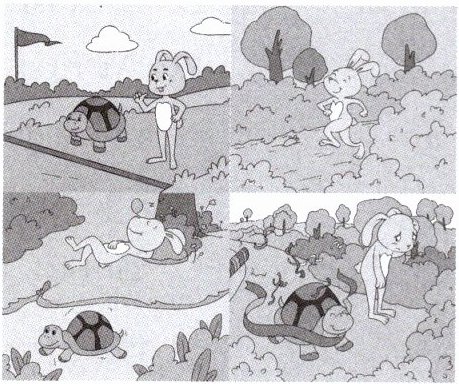
参考词汇: race 赛跑; wake up 醒来; fall
asleep 入睡; tortoise 乌龟; rabbit 兔子; the
finishing line 终点线
Once upon a time, there lived a tortoise
and a rabbit in the forest. ① One day, they
decided to have a race. Lots of animals came to
watch. At first, the rabbit was much faster
than the tortoise. ② The rabbit thought the
tortoise was too slow, and that she could win
easily. So she decided to have a break. And she
fell asleep soon. Although the tortoise was
slower, he didn't stop. When the rabbit woke
up, she ran very fast but it was too late. ③ She
didn't get to the finishing line before the
tortoise.
This story tells us pride comes before a
fall. ④
[名师点评]本文是一篇材料作文。作者根据图
片内容,并适当补充,把《龟兔赛跑》的故事完整
正确地表达了出来,最后引用谚语表达了自己的
观点,简练生动,展示了作者丰富的英语积累。
① 用 once upon a time 引出故事,丰富了文章的
句式。
② at first 和比较级的运用准确描述了故事的开头。
③ when引导的时间状语从句是文章的一大亮
点,短语wake up、too late点明比赛的最终结果。
④ 用谚语收尾,简洁生动,展示了作者丰富的英
语积累。
素材积累
[开头句]
1. Once upon a time, there was a mother duck.
2. My favorite story is Journey to the West.
3. I feel glad to share the story of Yu Gong
with you.
[中间句]
1. They did not want him to live with them.
2. A crow felt so thirsty that he looked for
water.
3. It made the duckling sad, so he decided to
search for a new home.
4. When he wanted to give up, he came up
with a good idea.
5. He picked up a small pebble and dropped it
into the pitcher.
6. Finally, the last sun was afraid and promised
to continue to give light and heat to the earth
and all things.
[结尾句]
1. I realized that one is never too old to learn.
2. You will never know what is possible unless
you try to make it happen.
3. To his surprise, he saw that he was a
beautiful swan, too!
4. When we meet with difficulties, we should
try to solve them instead of giving up.
[名言警句]
1. The best books are the most precious
treasures. 最好的书籍是最贵重的珍宝。
2. Where there is a will, there is a way.
有志者事竟成。
写作演练
同学们对《愚公移山》的故事一定有着很深
的印象吧?请根据本单元所学内容,以“The
story of Yu Gong”为题,把《愚公移山》的故事用
英语简要叙述一下,并谈一谈你从故事中学到了
什么。
[思路点拨]1. 文体:记叙文。2. 时态:一般过
去时。3. 人称:第三人称。4. 要点提示:需包
含上述内容,可以适当增加细节,并突出写作
重点。
[写作提纲]
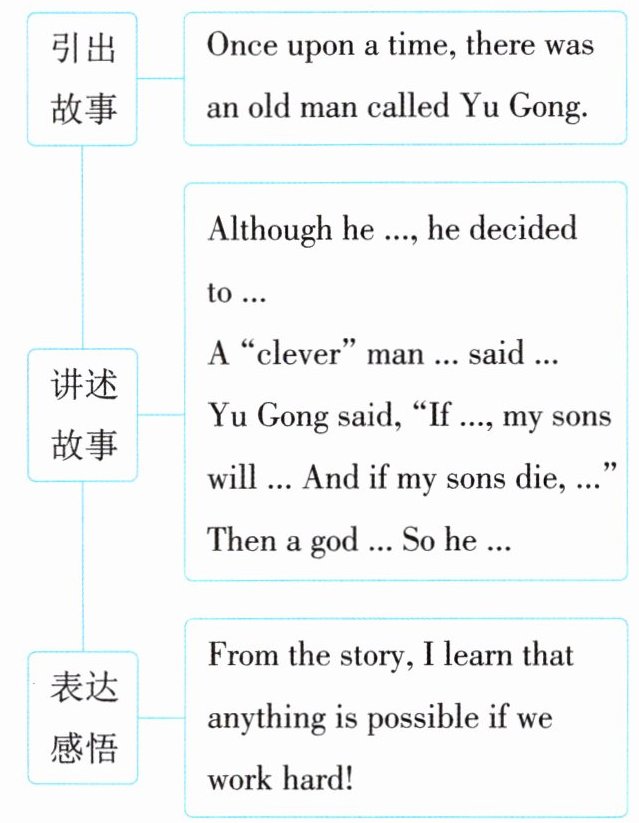
[妙笔生花]
The story of Yu Gong
佳作赏析
《龟兔赛跑》是我们从小就耳熟能详的故事,
请你根据以下提示,写一个70词左右的小故事。
参考词汇: race 赛跑; wake up 醒来; fall
asleep 入睡; tortoise 乌龟; rabbit 兔子; the
finishing line 终点线
Once upon a time, there lived a tortoise
and a rabbit in the forest. ① One day, they
decided to have a race. Lots of animals came to
watch. At first, the rabbit was much faster
than the tortoise. ② The rabbit thought the
tortoise was too slow, and that she could win
easily. So she decided to have a break. And she
fell asleep soon. Although the tortoise was
slower, he didn't stop. When the rabbit woke
up, she ran very fast but it was too late. ③ She
didn't get to the finishing line before the
tortoise.
This story tells us pride comes before a
fall. ④
[名师点评]本文是一篇材料作文。作者根据图
片内容,并适当补充,把《龟兔赛跑》的故事完整
正确地表达了出来,最后引用谚语表达了自己的
观点,简练生动,展示了作者丰富的英语积累。
① 用 once upon a time 引出故事,丰富了文章的
句式。
② at first 和比较级的运用准确描述了故事的开头。
③ when引导的时间状语从句是文章的一大亮
点,短语wake up、too late点明比赛的最终结果。
④ 用谚语收尾,简洁生动,展示了作者丰富的英
语积累。
素材积累
[开头句]
1. Once upon a time, there was a mother duck.
2. My favorite story is Journey to the West.
3. I feel glad to share the story of Yu Gong
with you.
[中间句]
1. They did not want him to live with them.
2. A crow felt so thirsty that he looked for
water.
3. It made the duckling sad, so he decided to
search for a new home.
4. When he wanted to give up, he came up
with a good idea.
5. He picked up a small pebble and dropped it
into the pitcher.
6. Finally, the last sun was afraid and promised
to continue to give light and heat to the earth
and all things.
[结尾句]
1. I realized that one is never too old to learn.
2. You will never know what is possible unless
you try to make it happen.
3. To his surprise, he saw that he was a
beautiful swan, too!
4. When we meet with difficulties, we should
try to solve them instead of giving up.
[名言警句]
1. The best books are the most precious
treasures. 最好的书籍是最贵重的珍宝。
2. Where there is a will, there is a way.
有志者事竟成。
写作演练
同学们对《愚公移山》的故事一定有着很深
的印象吧?请根据本单元所学内容,以“The
story of Yu Gong”为题,把《愚公移山》的故事用
英语简要叙述一下,并谈一谈你从故事中学到了
什么。
[思路点拨]1. 文体:记叙文。2. 时态:一般过
去时。3. 人称:第三人称。4. 要点提示:需包
含上述内容,可以适当增加细节,并突出写作
重点。
[写作提纲]
[妙笔生花]
The story of Yu Gong
Once upon a time, there was an old man called Yu
Gong.
Although he was almost 90, he decided to move the
mountains. A "clever" man called Zhi Sou said, "You are
too old to move the mountains. " Yu Gong said, "If I die,
my sons will still do this. And if my sons die, my
grandsons will continue doing this. " Then a god was moved
by Yu Gong. So he sent two gods to help him.
From the story, I learn that anything is possible if we
work hard!
Gong.
Although he was almost 90, he decided to move the
mountains. A "clever" man called Zhi Sou said, "You are
too old to move the mountains. " Yu Gong said, "If I die,
my sons will still do this. And if my sons die, my
grandsons will continue doing this. " Then a god was moved
by Yu Gong. So he sent two gods to help him.
From the story, I learn that anything is possible if we
work hard!
答案
One possible version:
The story of Yu Gong
Once upon a time, there was an old man called Yu
Gong.
Although he was almost 90, he decided to move the
mountains. A "clever" man called Zhi Sou said, "You are
too old to move the mountains. " Yu Gong said, "If I die,
my sons will still do this. And if my sons die, my
grandsons will continue doing this. " Then a god was moved
by Yu Gong. So he sent two gods to help him.
From the story, I learn that anything is possible if we
work hard!
The story of Yu Gong
Once upon a time, there was an old man called Yu
Gong.
Although he was almost 90, he decided to move the
mountains. A "clever" man called Zhi Sou said, "You are
too old to move the mountains. " Yu Gong said, "If I die,
my sons will still do this. And if my sons die, my
grandsons will continue doing this. " Then a god was moved
by Yu Gong. So he sent two gods to help him.
From the story, I learn that anything is possible if we
work hard!
解析
【分析】
本题为英语记叙文写作题,要求以“The story of Yu Gong”为题,简要叙述《愚公移山》的故事并谈谈感悟。解题思路:1. 确定文体为记叙文,时态用一般过去时,人称以第三人称为主;2. 开头用Once upon a time引出故事主人公愚公;3. 中间核心情节:愚公年近九十仍决定移山,智叟嘲讽其年老无用,愚公以子孙无穷回应;4. 结尾点明故事传达的道理,如只要努力坚持一切皆有可能;5. 确保语句通顺,符合英语表达习惯,内容简洁。
【解析】
写作步骤:① 开头:用Once upon a time引出愚公,点明其近90岁仍决定移山;② 中间:加入智叟的质疑和愚公的回应,补充神仙被感动派神帮忙的情节,完善故事;③ 结尾:提炼故事感悟,如Anything is possible if we work hard;④ 全程使用一般过去时,语句准确,符合词数要求。
【答案】One possible version:
The story of Yu Gong
Once upon a time, there was an old man called Yu Gong.
Although he was almost 90, he decided to move the mountains. A "clever" man called Zhi Sou said, "You are too old to move the mountains. " Yu Gong said, "If I die, my sons will still do this. And if my sons die, my grandsons will continue doing this. " Then a god was moved by Yu Gong. So he sent two gods to help him.
From the story, I learn that anything is possible if we work hard!
【知识点】英语记叙文写作;一般过去时;英语故事类作文
【点评】本文紧扣题目要求,完整叙述《愚公移山》核心情节,语言简洁流畅,结尾点明感悟,符合英语写作规范,是一篇优秀范文。
【难度系数】0.5
本题为英语记叙文写作题,要求以“The story of Yu Gong”为题,简要叙述《愚公移山》的故事并谈谈感悟。解题思路:1. 确定文体为记叙文,时态用一般过去时,人称以第三人称为主;2. 开头用Once upon a time引出故事主人公愚公;3. 中间核心情节:愚公年近九十仍决定移山,智叟嘲讽其年老无用,愚公以子孙无穷回应;4. 结尾点明故事传达的道理,如只要努力坚持一切皆有可能;5. 确保语句通顺,符合英语表达习惯,内容简洁。
【解析】
写作步骤:① 开头:用Once upon a time引出愚公,点明其近90岁仍决定移山;② 中间:加入智叟的质疑和愚公的回应,补充神仙被感动派神帮忙的情节,完善故事;③ 结尾:提炼故事感悟,如Anything is possible if we work hard;④ 全程使用一般过去时,语句准确,符合词数要求。
【答案】One possible version:
The story of Yu Gong
Once upon a time, there was an old man called Yu Gong.
Although he was almost 90, he decided to move the mountains. A "clever" man called Zhi Sou said, "You are too old to move the mountains. " Yu Gong said, "If I die, my sons will still do this. And if my sons die, my grandsons will continue doing this. " Then a god was moved by Yu Gong. So he sent two gods to help him.
From the story, I learn that anything is possible if we work hard!
【知识点】英语记叙文写作;一般过去时;英语故事类作文
【点评】本文紧扣题目要求,完整叙述《愚公移山》核心情节,语言简洁流畅,结尾点明感悟,符合英语写作规范,是一篇优秀范文。
【难度系数】0.5
