

 登录
登录
(
—If you
A.run after
B.kick off
C.sell out
D.throw away
A
)8.—Frank, should I spend more time on schoolwork or hobbies?—If you
run after
two rabbits, you will catch neither.A.run after
B.kick off
C.sell out
D.throw away
答案
8. A
解析
【分析】本题为动词短语辨析题,解题思路如下:①先理解对话语境:问句询问应侧重学业还是爱好,答句是一句谚语,表达“同时做两件事会一事无成”的含义;②逐一辨析四个选项的动词短语含义;③结合谚语的固定表达确定正确选项。
【解析】先翻译对话:问句意为“Frank,我应该花更多时间在学业还是爱好上?”答句意为“如果你同时追两只兔子,你一只也抓不到”。再分析选项:A项run after意为“追赶”,符合谚语中“追兔子”的搭配;B项kick off意为“踢开、(活动)启动”,C项sell out意为“卖光”,D项throw away意为“扔掉”,均不符合语境,故答案为A。
【答案】A
【知识点】动词短语辨析;英语谚语
【点评】本题结合英语谚语考查常用动词短语的含义,需要学生积累常见动词短语及谚语的固定搭配,属于基础题型。
【难度系数】0.4
【解析】先翻译对话:问句意为“Frank,我应该花更多时间在学业还是爱好上?”答句意为“如果你同时追两只兔子,你一只也抓不到”。再分析选项:A项run after意为“追赶”,符合谚语中“追兔子”的搭配;B项kick off意为“踢开、(活动)启动”,C项sell out意为“卖光”,D项throw away意为“扔掉”,均不符合语境,故答案为A。
【答案】A
【知识点】动词短语辨析;英语谚语
【点评】本题结合英语谚语考查常用动词短语的含义,需要学生积累常见动词短语及谚语的固定搭配,属于基础题型。
【难度系数】0.4
(
A.for
B.with
C.for
D.to
B
)9.We know "small" rhymes with
"tall".A.for
B.with
C.for
D.to
答案
9. B
解析
【分析】本题考查英语固定短语搭配,需回忆“rhyme”的常用搭配,明确其含义和用法,再结合句意判断正确介词。
【解析】“rhyme with”是固定短语,意为“与……押韵”,句意为“我们知道‘small’和‘tall’押韵”,因此空格处应填介词with,对应选项B。
【答案】B
【知识点】固定搭配;介词用法
【点评】本题考查基础固定短语搭配,属于英语语法中的基础考点,只要牢记“rhyme with”的用法即可快速选出答案。
【难度系数】0.2
【解析】“rhyme with”是固定短语,意为“与……押韵”,句意为“我们知道‘small’和‘tall’押韵”,因此空格处应填介词with,对应选项B。
【答案】B
【知识点】固定搭配;介词用法
【点评】本题考查基础固定短语搭配,属于英语语法中的基础考点,只要牢记“rhyme with”的用法即可快速选出答案。
【难度系数】0.2
(
A.red; bed
B.tree; dream
C.car; farmer
D.jump; drum
A
)10.Which of these pairs of words rhymes with each other?A.red; bed
B.tree; dream
C.car; farmer
D.jump; drum
答案
10. A
解析
【分析】首先明确英语中“押韵”的定义:两个单词的末尾读音(通常是重读音节后的发音)相同或相似。解题时需逐一读取每个选项的两个单词,对比词尾发音是否一致,以此判断是否押韵。
【解析】根据押韵规则,逐一分析选项:
A. red读音为/red/,bed读音为/bed/,词尾发音均为/ed/,符合押韵要求;
B. tree读音为/triː/,dream读音为/driːm/,词尾发音不同,不押韵;
C. car读音为/kɑː(r)/,farmer读音为/ˈfɑːmə(r)/,词尾发音不同,不押韵;
D. jump读音为/dʒʌmp/,drum读音为/drʌm/,虽元音部分相近,但词尾辅音不同,不押韵。因此正确答案为A。
【答案】A
【知识点】英语单词押韵
【点评】本题考查英语单词的押韵判断,核心是掌握单词的正确发音,对比词尾读音即可得出答案,属于基础题型,难度较低。
【难度系数】0.7
【解析】根据押韵规则,逐一分析选项:
A. red读音为/red/,bed读音为/bed/,词尾发音均为/ed/,符合押韵要求;
B. tree读音为/triː/,dream读音为/driːm/,词尾发音不同,不押韵;
C. car读音为/kɑː(r)/,farmer读音为/ˈfɑːmə(r)/,词尾发音不同,不押韵;
D. jump读音为/dʒʌmp/,drum读音为/drʌm/,虽元音部分相近,但词尾辅音不同,不押韵。因此正确答案为A。
【答案】A
【知识点】英语单词押韵
【点评】本题考查英语单词的押韵判断,核心是掌握单词的正确发音,对比词尾读音即可得出答案,属于基础题型,难度较低。
【难度系数】0.7
四、信息还原
Marley was not a quiet dog. From the first day he came home, he ran around the house, jumped on the sofa, and followed John and Jenny everywhere. 1 But John and Jenny still loved him because there was something special about him.
One weekend, John said, "Maybe we should take him to a dog class." Jenny agreed, hoping Marley would change a little.
At the class, all the other dogs sat quietly next to their owners. The teacher spoke slowly and gave easy tasks, like "sit" and "stay". 2 He barked(狗吠) at other dogs, jumped up and down and even knocked over a chair. Everyone looked at him, some laughing, some surprised.
After the class, the teacher shook her head(摇头) and said, "I don't think this dog can learn." John and Jenny didn't say anything. They looked at Marley, who was sitting on the floor like nothing had happened. 3 On the way home, Jenny smiled and said, "He didn't learn to sit or stay, but he knows how to love." John agreed, "And maybe that's enough."
After that day, they stopped trying to change Marley too much. 4 But he was the dog they needed. Over the years, Marley became their best friend, always by their side, bringing joy and laughter. 5 It's about the happiness that comes with being together.
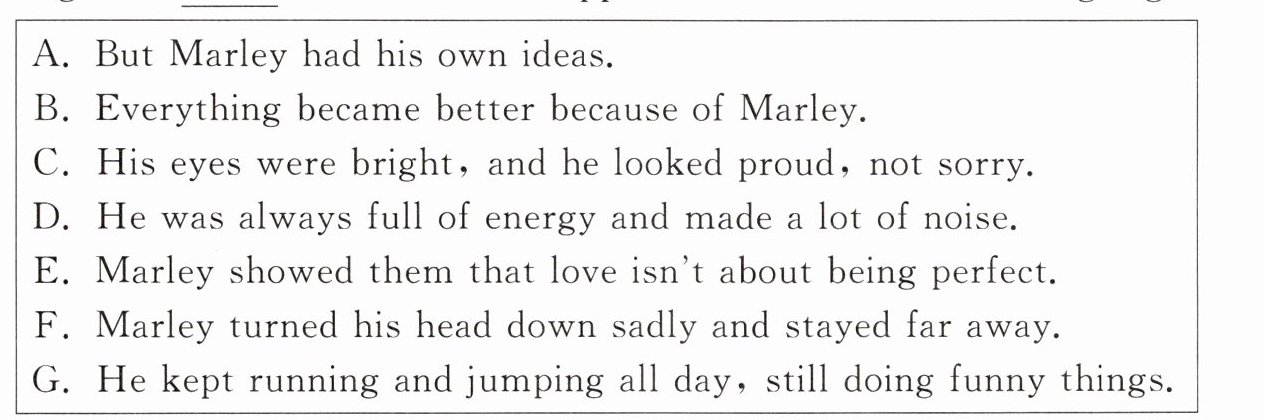
Marley was not a quiet dog. From the first day he came home, he ran around the house, jumped on the sofa, and followed John and Jenny everywhere. 1 But John and Jenny still loved him because there was something special about him.
One weekend, John said, "Maybe we should take him to a dog class." Jenny agreed, hoping Marley would change a little.
At the class, all the other dogs sat quietly next to their owners. The teacher spoke slowly and gave easy tasks, like "sit" and "stay". 2 He barked(狗吠) at other dogs, jumped up and down and even knocked over a chair. Everyone looked at him, some laughing, some surprised.
After the class, the teacher shook her head(摇头) and said, "I don't think this dog can learn." John and Jenny didn't say anything. They looked at Marley, who was sitting on the floor like nothing had happened. 3 On the way home, Jenny smiled and said, "He didn't learn to sit or stay, but he knows how to love." John agreed, "And maybe that's enough."
After that day, they stopped trying to change Marley too much. 4 But he was the dog they needed. Over the years, Marley became their best friend, always by their side, bringing joy and laughter. 5 It's about the happiness that comes with being together.
答案
1—5 DACGE
解析
【分析】本题为英语信息还原题,需结合上下文语境分析句子间的逻辑关系,逐一匹配选项。先通读全文,明确文章讲述活泼的狗Marley的故事,主人从想改变它到接纳它的过程;再针对每个空白处,分析前后文的内容,选择能衔接上下文的句子。
【解析】
1. 第1空:前文提到Marley不是安静的狗,到处跑跳,后文说主人仍爱他。选项D“他总是充满活力,制造很多噪音”承接前文对Marley活泼的描述,符合语境,故选D。
2. 第2空:前文描述狗班其他狗安静、学习简单动作,后文说Marley吠叫、跳、撞椅子。选项A“但Marley有自己的想法”转折说明Marley和其他狗不同,引出后文他的行为,故选A。
3. 第3空:前文老师说Marley学不会,主人看Marley像没事一样,后文主人说Marley懂爱。选项C“他眼睛明亮,看起来骄傲,不是抱歉”体现Marley不觉得自己做错的状态,衔接自然,故选C。
4. 第4空:前文说主人不再努力改变Marley,后文说他是主人需要的狗。选项G“他整天跑跳,还是做有趣的事”说明Marley依旧保持自己的样子,承接前文,故选G。
5. 第5空:后文说这是在一起的快乐,选项E“Marley向他们展示爱不是关于完美”引出后文关于爱的主题,符合语境,故选E。
综上,答案依次为D、A、C、G、E。
【答案】DACGE
【知识点】英语阅读还原、上下文语境理解
【点评】本题通过讲述小狗Marley的故事,考查学生对文章逻辑和语境的把握,需要学生结合前后文的内容衔接来选择合适的句子,体现了英语阅读中对语篇连贯性的考查。
【难度系数】0.6
【解析】
1. 第1空:前文提到Marley不是安静的狗,到处跑跳,后文说主人仍爱他。选项D“他总是充满活力,制造很多噪音”承接前文对Marley活泼的描述,符合语境,故选D。
2. 第2空:前文描述狗班其他狗安静、学习简单动作,后文说Marley吠叫、跳、撞椅子。选项A“但Marley有自己的想法”转折说明Marley和其他狗不同,引出后文他的行为,故选A。
3. 第3空:前文老师说Marley学不会,主人看Marley像没事一样,后文主人说Marley懂爱。选项C“他眼睛明亮,看起来骄傲,不是抱歉”体现Marley不觉得自己做错的状态,衔接自然,故选C。
4. 第4空:前文说主人不再努力改变Marley,后文说他是主人需要的狗。选项G“他整天跑跳,还是做有趣的事”说明Marley依旧保持自己的样子,承接前文,故选G。
5. 第5空:后文说这是在一起的快乐,选项E“Marley向他们展示爱不是关于完美”引出后文关于爱的主题,符合语境,故选E。
综上,答案依次为D、A、C、G、E。
【答案】DACGE
【知识点】英语阅读还原、上下文语境理解
【点评】本题通过讲述小狗Marley的故事,考查学生对文章逻辑和语境的把握,需要学生结合前后文的内容衔接来选择合适的句子,体现了英语阅读中对语篇连贯性的考查。
【难度系数】0.6
五、短文填空
A bad man once stole(偷走) my little dog Dash from me. After 1 (be) away for some months, he one day came back 2 a long rope around his neck. He had broken away from the man who had stolen him. How glad I was 3 (see) my good dog back again! The thief was taken to the court. He said that the dog was 4 (he), and I was asked whether I could give any proof(证据) that the dog was 5 (I). I put my mouth to the dog's ear, and 6 (say) something. Dash at once 7 (stand) up and finished some tricks I had taught him. I guided him with my stick, and cheered the whole court 8.
The thief was asked to make the dog do the same thing, 9 Dash went away, and would not go near him. Everybody 10 (see) that the dog was mine. The thief was sent to prison and Dash was set free.
1.
6.
A bad man once stole(偷走) my little dog Dash from me. After 1 (be) away for some months, he one day came back 2 a long rope around his neck. He had broken away from the man who had stolen him. How glad I was 3 (see) my good dog back again! The thief was taken to the court. He said that the dog was 4 (he), and I was asked whether I could give any proof(证据) that the dog was 5 (I). I put my mouth to the dog's ear, and 6 (say) something. Dash at once 7 (stand) up and finished some tricks I had taught him. I guided him with my stick, and cheered the whole court 8.
The thief was asked to make the dog do the same thing, 9 Dash went away, and would not go near him. Everybody 10 (see) that the dog was mine. The thief was sent to prison and Dash was set free.
1.
being
2. with
3. to see
4. his
5. mine
6.
said
7. stood
8. up
9. but
10. saw
答案
1. being 2. with 3. to see 4. his 5. mine 6. said 7. stood 8. up 9. but 10. saw
解析
【分析】首先通读短文,理解文章讲述小狗被偷后自行返回,主人通过方法证明小狗归属的故事。再逐个分析空格:1. 介词after后需接动名词,故将be变形;2. 表伴随状态用介词with;3. 固定搭配be glad to do sth需用不定式;4. 此处需名词性物主代词指代“他的狗”;5. 名词性物主代词指代“我的狗”;6. 与前面put(过去式)并列,需用动词过去式;7. 描述过去动作,用stand的过去式;8. 固定搭配cheer up需填up;9. 前后为转折关系,用连词but;10. 描述过去动作,用see的过去式。
【解析】1. 介词after后接动名词作宾语,故填being;2. 表伴随状态,用介词with,构成“with+名词短语”结构,故填with;3. 固定搭配be glad to do sth,故填to see;4. 此处需名词性物主代词作表语,指代“他的狗”,故填his;5. 名词性物主代词作表语,指代“我的狗”,故填mine;6. 与前面put(过去式)为并列谓语,需用say的过去式said;7. 描述过去发生的动作,用stand的过去式stood;8. 固定搭配cheer up意为“欢呼”,故填up;9. 前后分句为转折关系,用连词but;10. 描述过去发生的动作,用see的过去式saw。
【答案】1. being 2. with 3. to see 4. his 5. mine 6. said 7. stood 8. up 9. but 10. saw
【知识点】介词用法、非谓语动词、物主代词、动词过去式、固定搭配
【点评】本题为记叙文类短文填空,侧重考查初中英语基础语法(介词、非谓语、物主代词、动词时态)及常用固定搭配,难度适中,适合基础阶段学生练习。
【难度系数】0.7
【解析】1. 介词after后接动名词作宾语,故填being;2. 表伴随状态,用介词with,构成“with+名词短语”结构,故填with;3. 固定搭配be glad to do sth,故填to see;4. 此处需名词性物主代词作表语,指代“他的狗”,故填his;5. 名词性物主代词作表语,指代“我的狗”,故填mine;6. 与前面put(过去式)为并列谓语,需用say的过去式said;7. 描述过去发生的动作,用stand的过去式stood;8. 固定搭配cheer up意为“欢呼”,故填up;9. 前后分句为转折关系,用连词but;10. 描述过去发生的动作,用see的过去式saw。
【答案】1. being 2. with 3. to see 4. his 5. mine 6. said 7. stood 8. up 9. but 10. saw
【知识点】介词用法、非谓语动词、物主代词、动词过去式、固定搭配
【点评】本题为记叙文类短文填空,侧重考查初中英语基础语法(介词、非谓语、物主代词、动词时态)及常用固定搭配,难度适中,适合基础阶段学生练习。
【难度系数】0.7
