

 登录
登录
1. 如图,在$△ ABC$中,$∠ B=∠ C$,点P从点B运动到点C,且$∠ APD=∠ C$.
(1)求证:$AB· CD=CP· BP$;
(2)若$AB=6$,$BC=10$,求当BP的长为多少时,$PD// AB$.
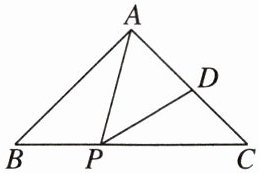
(1)求证:$AB· CD=CP· BP$;
(2)若$AB=6$,$BC=10$,求当BP的长为多少时,$PD// AB$.
答案
(1)【证明】$\because ∠B=∠C,∠APD=∠C,\therefore ∠B=∠APD.$
$\because ∠APC=∠B+∠BAP,∠APC=∠APD+∠DPC,$
$\therefore ∠BAP=∠DPC,\therefore △ABP∽△PCD,$
$\therefore \frac{AB}{CP}=\frac{BP}{CD},\therefore AB· CD=CP· BP.$
(2)【解】$\because PD// AB,\therefore ∠BAP=∠APD=∠C.$
又$\because ∠B=∠B,\therefore △BAP∽△BCA,\therefore \frac{AB}{BC}=\frac{BP}{AB}.$
$\because AB=6,BC=10,\therefore \frac{6}{10}=\frac{BP}{6},\therefore BP=\frac{18}{5}.$
$\therefore 当BP=\frac{18}{5}时,PD// AB.$
$\because ∠APC=∠B+∠BAP,∠APC=∠APD+∠DPC,$
$\therefore ∠BAP=∠DPC,\therefore △ABP∽△PCD,$
$\therefore \frac{AB}{CP}=\frac{BP}{CD},\therefore AB· CD=CP· BP.$
(2)【解】$\because PD// AB,\therefore ∠BAP=∠APD=∠C.$
又$\because ∠B=∠B,\therefore △BAP∽△BCA,\therefore \frac{AB}{BC}=\frac{BP}{AB}.$
$\because AB=6,BC=10,\therefore \frac{6}{10}=\frac{BP}{6},\therefore BP=\frac{18}{5}.$
$\therefore 当BP=\frac{18}{5}时,PD// AB.$
2. 如图,D是$△ ABC$的边BC上一点,点E在$△ ABC$外部,且$∠ BAE = ∠ CAD$,$∠ ACD = ∠ ADC = ∠ ADE$,DE交AB于点F。若AD = AF,求证:$EF^2 = BF · AB$。
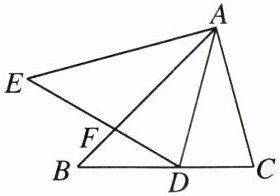
答案
【证明】$\because ∠ACD=∠ADC,$
$\therefore AC=AD,∠CAD=180°-2∠ADC.$
$\because ∠BAE=∠CAD,\therefore ∠BAC=∠EAD.$
$\because ∠ACB=∠ADE,\therefore △ABC≌△AED,\therefore AB=AE.$
$\because AD=AF,\therefore ∠ADF=∠AFD,$
$\therefore ∠DAF=180°-2∠ADF.$
$\because ∠ADC=∠ADE,\therefore ∠CAD=∠DAF.$
$\because ∠BAE=∠CAD,\therefore ∠DAF=∠BAE.$
$\therefore △ABD≌△AEF,\therefore BD=EF.$
$\because ∠BDF=180°-∠ADF-∠ADC=180°-2∠ADF,$
$\therefore ∠BDF=∠BAD.$
又$\because ∠B=∠B,\therefore △BDF∽△BAD,$
$\therefore \frac{BD}{BA}=\frac{BF}{BD}.\therefore \frac{EF}{BA}=\frac{BF}{EF},即EF^2=BF· AB.$
$\therefore AC=AD,∠CAD=180°-2∠ADC.$
$\because ∠BAE=∠CAD,\therefore ∠BAC=∠EAD.$
$\because ∠ACB=∠ADE,\therefore △ABC≌△AED,\therefore AB=AE.$
$\because AD=AF,\therefore ∠ADF=∠AFD,$
$\therefore ∠DAF=180°-2∠ADF.$
$\because ∠ADC=∠ADE,\therefore ∠CAD=∠DAF.$
$\because ∠BAE=∠CAD,\therefore ∠DAF=∠BAE.$
$\therefore △ABD≌△AEF,\therefore BD=EF.$
$\because ∠BDF=180°-∠ADF-∠ADC=180°-2∠ADF,$
$\therefore ∠BDF=∠BAD.$
又$\because ∠B=∠B,\therefore △BDF∽△BAD,$
$\therefore \frac{BD}{BA}=\frac{BF}{BD}.\therefore \frac{EF}{BA}=\frac{BF}{EF},即EF^2=BF· AB.$
3. 如图,在四边形ABCD中,AB//CD,对角线AC,BD交于点E,点F在边AB上,连结CF交线段BE于点$G,CG^2=GE·GD.$
(1)求证:∠ACF=∠ABD;
(2)连结EF,求证:BC·FG=EF·BG.
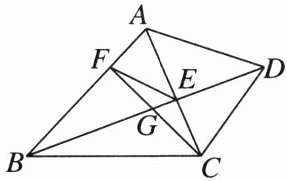
(1)求证:∠ACF=∠ABD;
(2)连结EF,求证:BC·FG=EF·BG.
答案
【证明】(1)$\because CG^2=GE· GD,\therefore \frac{CG}{GE}=\frac{GD}{CG}.$
又$\because ∠CGD=∠EGC,\therefore △GCD∽△GEC.$
$\therefore ∠GDC=∠GCE.$
$\because AB// CD,\therefore ∠ABD=∠BDC. \therefore ∠ACF=∠ABD.$
(2)$\because ∠FBG=∠ECG,∠BGF=∠CGE,$
$\therefore △BGF∽△CGE.\therefore \frac{FG}{EG}=\frac{BG}{CG},即\frac{FG}{BG}=\frac{EG}{CG}.$
又$\because ∠FGE=∠BGC,\therefore △FGE∽△BGC.$
$\therefore \frac{FE}{BC}=\frac{EG}{CG}.\therefore \frac{FG}{BG}=\frac{FE}{BC}.\therefore BC· FG=EF· BG.$
又$\because ∠CGD=∠EGC,\therefore △GCD∽△GEC.$
$\therefore ∠GDC=∠GCE.$
$\because AB// CD,\therefore ∠ABD=∠BDC. \therefore ∠ACF=∠ABD.$
(2)$\because ∠FBG=∠ECG,∠BGF=∠CGE,$
$\therefore △BGF∽△CGE.\therefore \frac{FG}{EG}=\frac{BG}{CG},即\frac{FG}{BG}=\frac{EG}{CG}.$
又$\because ∠FGE=∠BGC,\therefore △FGE∽△BGC.$
$\therefore \frac{FE}{BC}=\frac{EG}{CG}.\therefore \frac{FG}{BG}=\frac{FE}{BC}.\therefore BC· FG=EF· BG.$
4.[济南槐荫区期末] 如图,CE是Rt△ABC斜边AB上的高,在EC的延长线上任取一点P,连结AP,过B作BG⊥AP,垂足为G,交CE于点D. 求证:$CE^2 = PE · DE$. 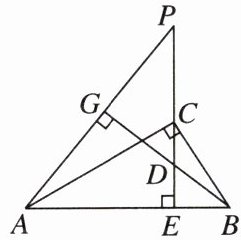
答案
【证明】由题意知$∠ACB=90°,CE⊥AB,$
$\therefore ∠ACE+∠BCE=90°,∠AEC=∠BEC=90°.$
$\therefore ∠ACE+∠CAE=90°.$
$\therefore ∠CAE=∠BCE,\therefore △ACE∽△CBE,$
$\therefore \frac{CE}{BE}=\frac{AE}{CE},即CE^2=AE· BE.$
$\because BG⊥AP,∠PEA=∠DEB=90°,$
$\therefore ∠DEB=∠DGP=∠PEA=90°.$
$\because ∠PDG=∠BDE,\therefore ∠P=∠DBE,$
$\therefore △AEP∽△DEB,\therefore \frac{PE}{BE}=\frac{AE}{DE},即PE· DE=AE· BE.$
$\therefore CE^2=PE· DE.$
$\therefore ∠ACE+∠BCE=90°,∠AEC=∠BEC=90°.$
$\therefore ∠ACE+∠CAE=90°.$
$\therefore ∠CAE=∠BCE,\therefore △ACE∽△CBE,$
$\therefore \frac{CE}{BE}=\frac{AE}{CE},即CE^2=AE· BE.$
$\because BG⊥AP,∠PEA=∠DEB=90°,$
$\therefore ∠DEB=∠DGP=∠PEA=90°.$
$\because ∠PDG=∠BDE,\therefore ∠P=∠DBE,$
$\therefore △AEP∽△DEB,\therefore \frac{PE}{BE}=\frac{AE}{DE},即PE· DE=AE· BE.$
$\therefore CE^2=PE· DE.$
