登录
登录
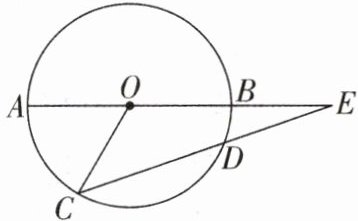
1[中]如图,AB是$\odot O$的直径,CD是$\odot O$的弦,AB,CD的延长线交于点E,连结OC。若$AB=2DE$,$∠ C=40°$,求$∠ E$及$∠ AOC$的度数。
答案
1.【解】连结OD. $\because OC = OD, ∠ C = 40°, \therefore ∠ ODC=∠ C=40°. \because AB = 2DE, AB = 2OD, \therefore OD = DE,$
$\therefore △ DOE$是等腰三角形. $\because ∠ ODC$ 是 $△ DOE$ 的外角, $\therefore ∠ E = ∠ EOD = \frac{1}{2} ∠ ODC = \frac{1}{2} × 40° = 20°.$
$\because ∠ AOC$ 是 $△ COE$ 的外角, $\therefore ∠ AOC = ∠ C + ∠ E = 40°+20° = 60°.$
$\therefore △ DOE$是等腰三角形. $\because ∠ ODC$ 是 $△ DOE$ 的外角, $\therefore ∠ E = ∠ EOD = \frac{1}{2} ∠ ODC = \frac{1}{2} × 40° = 20°.$
$\because ∠ AOC$ 是 $△ COE$ 的外角, $\therefore ∠ AOC = ∠ C + ∠ E = 40°+20° = 60°.$
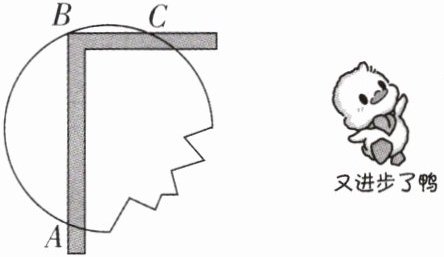
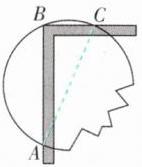
2[中]一圆形玻璃镜面损坏了一部分,为得到同样大小的镜面,工人师傅用直角尺作如图所示的测量,测得AB=12 cm,BC=5 cm,则圆形镜面的半径为
又进步了鸭
$\frac{13}{2}$
cm.又进步了鸭
答案
思路分析
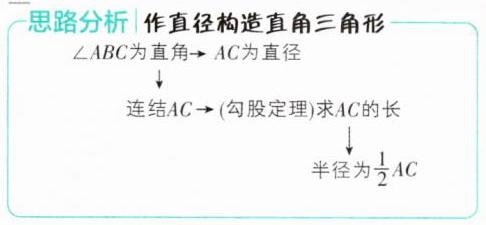
作直径构造直角三角形
$∠ ABC$为直角→$AC$为直径
↓
连结$AC$→(勾股定理)求$AC$的长
↓
半径为$\frac{1}{2}AC$
【解析】连结AC,如图. $\because ∠ ABC=90°$,且$∠ ABC$是圆周角,$\therefore AC$是圆形镜面的直径. 由勾股定理得
$AC = \sqrt{AB^2+BC^2} = \sqrt{12^2+5^2} = 13(\mathrm{cm}),\therefore$ 圆形镜面的半径为$\frac{13}{2}$ cm.
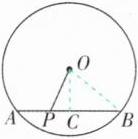
3[中]已知$\odot O$的半径为7,AB是$\odot O$的弦,点P在弦AB上.若$PA=4,PB=6$,则$OP=$(
A.$\sqrt{14}$
B.4
C.$\sqrt{23}$
D.5
D
)A.$\sqrt{14}$
B.4
C.$\sqrt{23}$
D.5
答案
3.【解析】如图,过点 $O$ 作 $OC ⊥ AB$ 于点 $C$,连结 $OB$,则 $OB=7$. $\because PA=4,PB=6,\therefore AB=PA+PB=10$.
$\because OC ⊥ AB,\therefore AC=BC=5,\therefore PC=PB-BC=1$. 在 $\mathrm{Rt}△ OBC$ 中,根据勾股定理得 $OC^2=OB^2-BC^2=7^2-5^2=24$. 在 $\mathrm{Rt}△ OPC$ 中,根据勾股定理得 $OP = \sqrt{OC^2+PC^2} = \sqrt{24+1}=5$,故选 D.
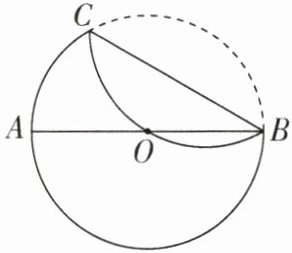
4[中]如图,AB是$\odot O$的直径,BC是$\odot O$的弦,$BC=3$,将$\overset{\frown}{BC}$沿着BC折叠后恰好经过点O,则AB的长为
$2\sqrt{3}$
。答案
关键点拨
过圆心作弦的垂线并连结圆心与弦的端点构造直角三角形是求弦长时常作的辅助线.
思路分析
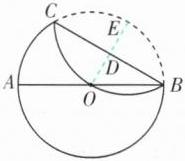
过点 $O$ 作 $OD ⊥ BC$,垂足为 $D$,延长 $OD$ 交 $\overset{\frown}{BC}$ 于点 $E$,根据垂径定理可得 $CD=BD=\frac{3}{2}$,再根据折叠的性质可得 $OD = DE = \frac{1}{2}OE$,从而可得 $OD=\frac{1}{2}OB$,然后在 $\mathrm{Rt}△ ODB$ 中,利用勾股定理进行计算,即可解答.
【解析】过点 $O$ 作 $OD ⊥ BC$,垂足为 $D$,延长 $OD$ 交 $\overset{\frown}{BC}$ 于点 $E$,如图,则 $CD=BD=\frac{1}{2}BC = \frac{3}{2}$. 由折叠得 $OD = DE = \frac{1}{2}OE$. $\because OE=OB,\therefore OD=\frac{1}{2}OB$. 在 $\mathrm{Rt}△ ODB$ 中,$OD^2+DB^2=OB^2,\therefore (\frac{1}{2}OB)^2 + (\frac{3}{2})^2 = OB^2$,解得 $OB=\sqrt{3},\therefore AB=2OB=2\sqrt{3}$,故答案为 $2\sqrt{3}$.
5[中]如图,$\odot O$是锐角$△ ABC$的外接圆,弦$AE ⊥ BC$,垂足为$D$. 在$AD$上取点$F$,使$DF=DE$,连结$CF$并延长交$AB$于点$G$. 求证:$CG ⊥ AB$. 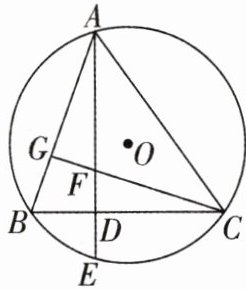
答案
5.【证明】连结 $CE$,则 $∠ BAE = ∠ ECB$. $\because AE ⊥ BC, DF=DE,\therefore$ 直线 $BC$ 是线段 $EF$ 的垂直平分线, $\therefore CF = CE$. $\because AE ⊥ BC, \therefore ∠ ECB = ∠ BCG,$
$\therefore ∠ BAE = ∠ BCG. \because ∠ BAE + ∠ ABD = 90°,$
$\therefore ∠ BCG+∠ ABD=90°,\therefore ∠ BGC=90°,$即 $CG ⊥ AB.$
$\therefore ∠ BAE = ∠ BCG. \because ∠ BAE + ∠ ABD = 90°,$
$\therefore ∠ BCG+∠ ABD=90°,\therefore ∠ BGC=90°,$即 $CG ⊥ AB.$
6[中]如图,$AB$是$\odot O$的直径,$BD$是$\odot O$的弦,延长$BD$到点$C$,使$DC=BD$,连结$AC$.
(1)求证:$AB=AC$;
(2)过点$D$作$DE⊥AC$,垂足为$E$.若$\odot O$的半径为$5$,$∠BAC=60^{\circ }$,求$DE$的长.
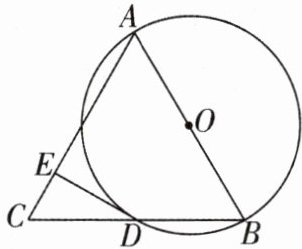
(1)求证:$AB=AC$;
(2)过点$D$作$DE⊥AC$,垂足为$E$.若$\odot O$的半径为$5$,$∠BAC=60^{\circ }$,求$DE$的长.
答案
6. (1)【证明】连结 $AD$. $\because AB$ 是 $\odot O$ 的直径,
$\therefore ∠ ADB=90°$. 又$\because BD=CD,\therefore$ 直线 $AD$ 是 $BC$ 的垂直平分线,$\therefore AB=AC.$
(2)【解】$\because AB=AC,∠ BAC=60°,\therefore △ ABC$ 是等边三角形, $\therefore ∠ C=60°$. $\because \odot O$ 的半径为 $5,\therefore AB=BC=10, \therefore CD = \frac{1}{2}BC = 5$. 又 $\because ∠ C = 60°,$
$\therefore ∠ EDC=30°,\therefore$ 易得 $DE= \frac{5\sqrt{3}}{2}.$
$\therefore ∠ ADB=90°$. 又$\because BD=CD,\therefore$ 直线 $AD$ 是 $BC$ 的垂直平分线,$\therefore AB=AC.$
(2)【解】$\because AB=AC,∠ BAC=60°,\therefore △ ABC$ 是等边三角形, $\therefore ∠ C=60°$. $\because \odot O$ 的半径为 $5,\therefore AB=BC=10, \therefore CD = \frac{1}{2}BC = 5$. 又 $\because ∠ C = 60°,$
$\therefore ∠ EDC=30°,\therefore$ 易得 $DE= \frac{5\sqrt{3}}{2}.$
7 [中]如图,$\odot O$是一个钢珠的纵截面示意图,测得AB是8 mm,钢珠顶端离AB的距离为8 mm,则$\odot O$的直径是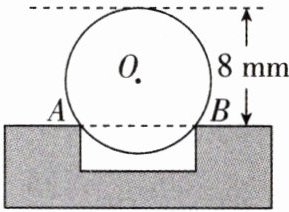
10
mm. 答案
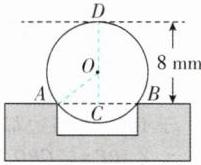
7.【解析】如图,过 $O$ 作 $OC ⊥ AB$ 于 $C$,$CO$ 的延长线交 $\odot O$ 于 $D$,连结 $AO$,则 $AC = BC = \frac{1}{2}AB = 4$ mm, $CD = 8$ mm. 设 $\odot O$ 的半径为 $r$ mm,则 $OC = CD - OD = (8 - r)$ mm. 在 $\mathrm{Rt}△ AOC$ 中,由勾股定理得 $4^2+(8 - r)^2 = r^2$,解得 $r = 5$,即 $\odot O$ 的半径为 5 mm,$\therefore \odot O$ 的直径为 10 mm. 故答案为 10.
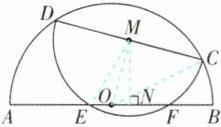
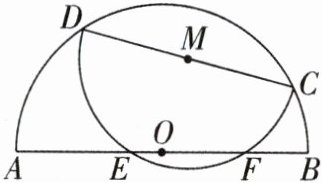
8 [2025 浙江温州期中,较难]如图,AB是半圆O的直径,半圆O的弦CD在直线AB的上方,且$CD=2\sqrt{14}$,以CD为直径向下作半圆(圆心为M)交AB于E,F两点,若$AE:EF:FB=2:2:1$,则AB=
10
。答案
8.【解析】$\because AE:EF:FB=2:2:1,\therefore$ 设 $FB=k$,则 $AE=EF=2k,\therefore AB=AE+EF+FB=5k,\therefore OA=OB=\frac{1}{2}AB=\frac{5}{2}k,\therefore OE=OA - AE=\frac{1}{2}k$. 如图,连结 $OM$,$OC$,$EM$,过点 $M$ 作 $MN ⊥ AB$ 于 $N$,则 $OC=OA=\frac{5}{2}k,∠ ENM=90°$. $\because EF$ 为半圆 $M$ 的一条弦,且 $MN ⊥ AB,\therefore EN=\frac{1}{2}EF=k$,
$\therefore ON=EN-OE=\frac{1}{2}k$. 由题意知,$M$ 是 $CD$ 的中点,且 $CD$ 为半圆 $M$ 的直径,$\therefore CM=ME=\frac{1}{2}CD=\sqrt{14}$.
由垂径定理的推论知 $OM ⊥ CD,\therefore$ 在 $\mathrm{Rt}△ OCM$ 中,由勾股定理得 $OM^2=OC^2-CM^2=\frac{25}{4}k^2 -14,\therefore$ 在 $\mathrm{Rt}△ OMN$ 中,由勾股定理得 $MN^2=OM^2-ON^2=6k^2-14$. 在 $\mathrm{Rt}△ EMN$ 中,由勾股定理得 $MN^2=EM^2-EN^2=14 -k^2,\therefore 6k^2-14=14 -k^2,\therefore k^2=4$. $\because k>0,$
$\therefore k=2,\therefore AB=5k=10.$