

 登录
阅读理解 先买后付
素养:思维品质 难度:中 用时:8分钟
[2025 泰州海陵区一模改编]“Buy Now, Pay Later”(BNPL) is a popular way to pay for things online. Instead of paying all the money right away, people can split their payments.
New research shows that people who use BNPL are more likely to buy things. The chance of buying goes up from 17% to 26%. Also, when they shop, they buy 10% more things than usual.
BNPL makes people feel less stressed about money. This feeling makes people add more things to their shopping carts (购物车). They think, “If I pay a little now, I can afford more!” Tom, a college student, wanted a $600 phone. Paying all at once made him feel terrible, but BNPL let him pay $150 four times. He thought, “Only $150 now? That’s easy!” Tom believed he could manage his money well, so he added earphones ($80) and a phone case($20). “I’ll just pay $25 more each time!” Soon the total (总额) became $700 instead of $600.
At first, BNPL seems good for everyone. Shops sell more, and buyers get what they want quickly. But there’s a problem. People who already struggle (挣扎) with money might overuse BNPL. And if used carelessly, BNPL can be the cause of money trouble. Everyone should ask themselves, “Do I need this now? Can I pay later without stress?” Remember, small payments add up quickly!
1. What does the underlined word “split” in Paragraph 1 probably mean?
A. To divide sth into smaller parts.
B. To pay less interest.
C. To reduce the number.
D. To make a plan.
2. According to the research, what can we learn about BNPL?
A. It gives good discounts to online shoppers.
B. It makes people buy more things than usual.
C. It reminds people to manage their money wisely.
D. It helps online shoppers buy things more carefully.
3. How much should Tom pay every time after he added earphones and a phone case?
A. $100.B. $150.
C. $175.D. $250.
4. What does the writer think of BNPL?
A. It should be stopped to avoid money trouble.
B. It is only useful for high-priced products.
C. It is helpful, but we must use it wisely.
D. It is a perfect payment method for everyone.
答案
1. A 词义猜测题。根据第三段中 Tom 的例子“Tom, a college student, wanted a $600 phone. Paying all at once made him feel terrible, but BNPL let him pay $150 four times”可知,BNPL 让人们不用一次性支付所有钱,而是把款额分成较小的部分。故 A 项符合题意。
2. B 细节理解题。根据第二段中的“The chance of buying goes up...buy 10% more things than usual”可知,使用 BNPL 后购买概率从 17%上升到 26%,人们会比平时多买 10%的东西。故 B 项符合文意。
3. C
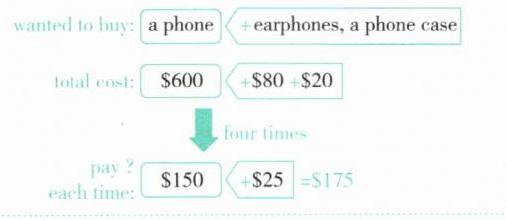
4. C 推理判断题。根据文章最后一段内容可判断,作者肯定了“先买后付”的积极作用,但也提醒人们要谨慎使用“先买后付”。C 项“它很有帮助,但我们必须明智地使用它”符合题意。
解析
【分析】
1. 第1题(词义猜测题):需结合上下文及文中Tom的例子理解划线词“split”的含义,文中提到BNPL是不用一次性付款,Tom将600美元分四次支付,由此推断“split”是“分成更小部分”的意思。
2. 第2题(细节理解题):需定位到文章第二段,查找关于BNPL对购买行为影响的描述,对比选项选出正确答案。
3. 第3题(计算题):先计算添加耳机和手机壳后的总额外费用,再结合“分四次支付”的规则算出每次额外支付金额,最后与原每次支付金额相加得到结果。
4. 第4题(推理判断题):需通读文章最后一段,分析作者对BNPL的态度,既要看到其积极作用,也要注意潜在问题,据此选出符合作者观点的选项。
【解析】
1. 第1题:根据第三段Tom的例子“BNPL let him pay $150 four times”可知,BNPL是将总款项分成多次支付,即把钱分成更小的部分,故“split”意为“把某物分成更小的部分”,选A。2. 第2题:根据第二段“the chance of buying goes up from 17% to 26%...buy 10% more things than usual”可知,使用BNPL会让人们比平时买更多东西,选B。3. 第3题:首先计算额外费用:$80 + $20 = $100;分四次支付,每次额外支付:$100 ÷ 4 = $25;原每次支付$150,故现在每次支付$150 + $25 = $175,选C。
4. 第4题:最后一段指出BNPL对商家和买家都有好处,但也提醒人们若使用不当会引发金钱问题,需谨慎使用,符合作者观点的是“它很有帮助,但我们必须明智地使用它”,选C。
【答案】
1. A
2. B
3. C
4. C
【知识点】
词义猜测题、细节理解题、推理判断题
【点评】
本题为阅读理解题,围绕“先买后付(BNPL)”展开,考查词义猜测、细节查找和观点推理能力,需学生结合文章具体内容分析作答,难度中等,有助于培养学生的逻辑思维和信息处理能力。
【难度系数】
0.5
【语篇解构】 阅读文章,补充下面的结构图(每空一词)
People feel 1.
Attitude
3.
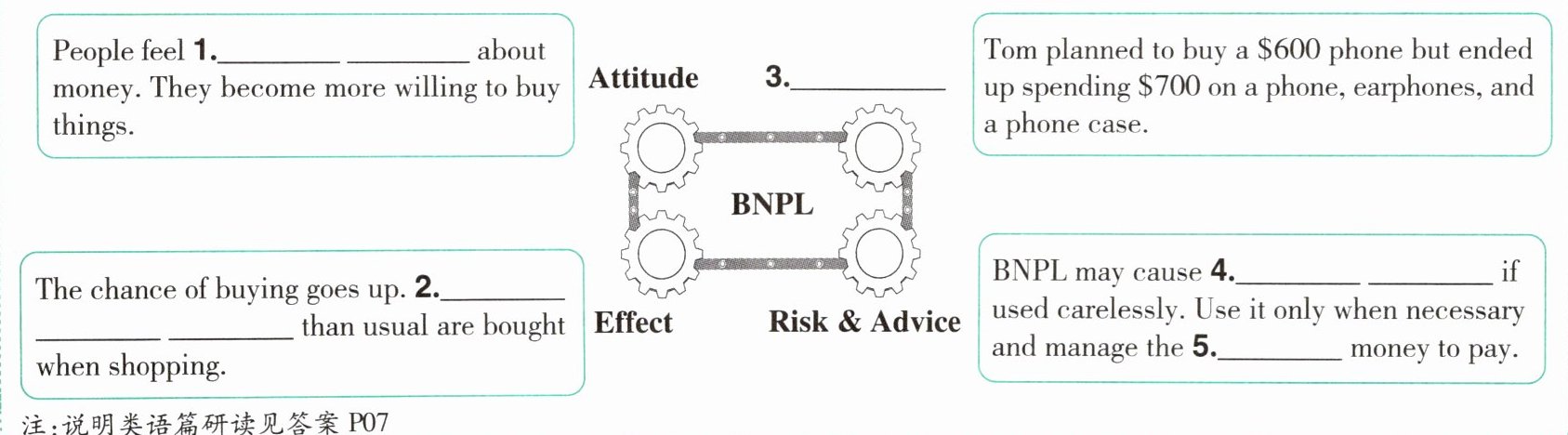
Effect
Risk & Advice
Tom planned to buy a $600 phone but ended up spending $700 on a phone, earphones, and a phone case.
The chance of buying goes up. 2.
BNPL may cause 4.
注:说明类语篇研读见答案 P07
People feel 1.
less
stressed
about money. They become more willing to buy things.Attitude
3.
Example
Effect
Risk & Advice
Tom planned to buy a $600 phone but ended up spending $700 on a phone, earphones, and a phone case.
The chance of buying goes up. 2.
10%
more
things
than usual are bought when shopping.BNPL may cause 4.
money
trouble
if used carelessly. Use it only when necessary and manage the 5.total
money to pay.注:说明类语篇研读见答案 P07
答案
1. less stressed
2. 10% more things
3. Example
4. money trouble
5. total
2. 10% more things
3. Example
4. money trouble
5. total
解析
【分析】首先观察结构图主题为BNPL(先买后付)的相关内容,分为态度、影响、风险与建议三部分,结合每个空前后语境及示例推导答案:1空描述人们对金钱的感受,后文提到更愿意购物,对应“压力更小”;2空结合Tom的消费示例(计划买600元手机,实际花700元买更多物品),需体现“比平时多买的东西”;3空连接态度部分与右侧具体示例,对应“例子”;4空是BNPL的风险,对应“金钱问题”;5空是建议管理的支付金额,对应“总金额”。
【解析】1. 根据后文“They become more willing to buy things”,可知人们对金钱的压力更小,故填less stressed;2. 由Tom的消费情况,结合“than usual”,可知买的东西比平时多10%,故填10% more things;3. 右侧是具体示例,对应态度部分的“例子”,故填Example;4. BNPL使用不当会引发金钱问题,故填money trouble;5. 建议管理要支付的总金额,故填total。
【答案】1. less stressed 2. 10% more things 3. Example 4. money trouble 5. total
【知识点】词汇运用、语篇理解
【点评】本题为说明类语篇的结构填空,考查对语篇细节和逻辑关系的把握,结合语境与示例即可推导答案,难度适中。
【难度系数】0.6
