

 登录
登录
11. 新题型 新定义 对于任意不相等的两个实数$a$、$b$,定义一种运算※:$a※b = \frac{\sqrt{a + b}}{a - b}$,如$3※2 = \frac{\sqrt{3 + 2}}{3 - 2}=\sqrt{5}$,那么$(7※5)\times(-2※50)=$______.
答案
$-\frac{3}{13}$ 解析:由题可知$7※5=\frac{\sqrt{7 + 5}}{7 - 5}=\frac{\sqrt{12}}{2}=\frac{2\sqrt{3}}{2}=\sqrt{3}$,$-2※50=\frac{\sqrt{-2 + 50}}{-2 - 50}=\frac{\sqrt{48}}{-52}=\frac{4\sqrt{3}}{-52}=-\frac{\sqrt{3}}{13}$,$\therefore(7※5)\times(-2※50)=\sqrt{3}\times(-\frac{\sqrt{3}}{13})=-\frac{3}{13}$.
12. 化简:
(1)$3\sqrt{\frac{1}{3}}$; (2)$x\sqrt{\frac{1}{x}}$;
(3)$(x - 1)\sqrt{\frac{1}{1 - x}}$.
(1)$3\sqrt{\frac{1}{3}}$; (2)$x\sqrt{\frac{1}{x}}$;
(3)$(x - 1)\sqrt{\frac{1}{1 - x}}$.
答案
(1)原式$=\sqrt{3^{2}}\times\sqrt{\frac{1}{3}}=\sqrt{3^{2}\times\frac{1}{3}}=\sqrt{3}$.
(2)由$-\frac{1}{x}>0$,得$x < 0$. 原式$=-(-x)\sqrt{-\frac{1}{x}}=-\sqrt{(-x)^{2}}\cdot\sqrt{-\frac{1}{x}}=-\sqrt{x^{2}\cdot(-\frac{1}{x})}=-\sqrt{-x}$.
(3)由$\frac{1}{1 - x}>0$,得$1 - x>0$,$\therefore x - 1 < 0$. 原式$=-\sqrt{(1 - x)^{2}\cdot\frac{1}{1 - x}}=-\sqrt{1 - x}$.
(2)由$-\frac{1}{x}>0$,得$x < 0$. 原式$=-(-x)\sqrt{-\frac{1}{x}}=-\sqrt{(-x)^{2}}\cdot\sqrt{-\frac{1}{x}}=-\sqrt{x^{2}\cdot(-\frac{1}{x})}=-\sqrt{-x}$.
(3)由$\frac{1}{1 - x}>0$,得$1 - x>0$,$\therefore x - 1 < 0$. 原式$=-\sqrt{(1 - x)^{2}\cdot\frac{1}{1 - x}}=-\sqrt{1 - x}$.
13. 小刚设计了一幅长方形图片,已知长方形的长是$\sqrt{96}$ cm,宽是$\sqrt{54}$ cm. 他又想设计一个面积与其相等的圆. 请你帮助小刚求出圆的半径.
答案
设圆的半径是$r$ cm. 根据题意,得$\pi r^{2}=\sqrt{96\pi}\times\sqrt{54\pi}=\sqrt{16\times6\pi}\times\sqrt{9\times6\pi}=4\sqrt{6\pi}\times3\sqrt{6\pi}=12\times6\pi = 72\pi$,$\therefore r^{2}=72$.$\because r>0$,$\therefore r=\sqrt{72}=\sqrt{36\times2}=6\sqrt{2}$(cm),$\therefore$所求圆的半径为$6\sqrt{2}$ cm.
14. 如图,在$3\times3$的正方形网格中,每个小正方形的边长都是1,每个小正方形的顶点叫格点,以格点为顶点,分别按下列要求画三角形:
(1)请在图①中画出一个三边长分别为3,$2\sqrt{2}$,$\sqrt{5}$的三角形,它的面积为______;
(2)请在图②中画出一个三边长均为无理数,且面积为$\frac{3}{2}$的钝角三角形.
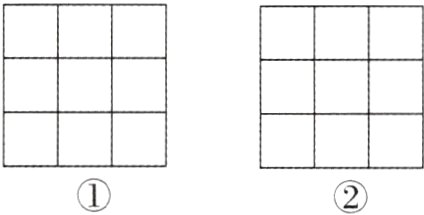
(1)请在图①中画出一个三边长分别为3,$2\sqrt{2}$,$\sqrt{5}$的三角形,它的面积为______;
(2)请在图②中画出一个三边长均为无理数,且面积为$\frac{3}{2}$的钝角三角形.
答案
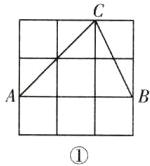
(1)画法不唯一,示例如图①所示. 3 解析:如图①,在$\triangle ABC$中,$AB = 3$,$BC=\sqrt{1^{2}+2^{2}}=\sqrt{5}$,$AC=\sqrt{2^{2}+2^{2}}=2\sqrt{2}$,面积为$\frac{1}{2}\times3\times2 = 3$.
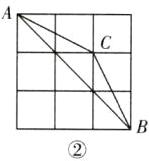
(2)画法不唯一,示例如图②所示.
15. 新趋势 数学文化 (2024·成都期中)已知$\triangle ABC$三条边的长度分别是$\sqrt{x + 1}$,$\sqrt{(5 - x)^{2}}$,$4 - (\sqrt{4 - x})^{2}$,记$\triangle ABC$的周长为$C_{\triangle ABC}$.
(1)当$x = 2$时,$\triangle ABC$的最长边的长度是______(请直接写出答案);
(2)求$C_{\triangle ABC}$(用含$x$的代数式表示,结果要求化简);
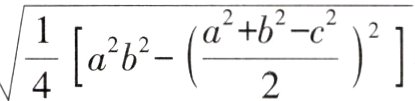
(3)我国南宋时期数学家秦九韶曾提出利用三角形的三边长求面积的秦九韶公式:$S = \sqrt{\frac{1}{4}[a^{2}b^{2}-(\frac{a^{2}+b^{2}-c^{2}}{2})^{2}]}$. 其中三角形的边长分别为$a$、$b$、$c$,三角形的面积为$S$. 若$x$为整数,当$C_{\triangle ABC}$取得最大值时,请用秦九韶公式求出$\triangle ABC$的面积.

(1)当$x = 2$时,$\triangle ABC$的最长边的长度是______(请直接写出答案);
(2)求$C_{\triangle ABC}$(用含$x$的代数式表示,结果要求化简);
(3)我国南宋时期数学家秦九韶曾提出利用三角形的三边长求面积的秦九韶公式:$S = \sqrt{\frac{1}{4}[a^{2}b^{2}-(\frac{a^{2}+b^{2}-c^{2}}{2})^{2}]}$. 其中三角形的边长分别为$a$、$b$、$c$,三角形的面积为$S$. 若$x$为整数,当$C_{\triangle ABC}$取得最大值时,请用秦九韶公式求出$\triangle ABC$的面积.
答案
(1)3
(2)由二次根式有意义可得$\begin{cases}x + 1\geqslant0\\4 - x\geqslant0\end{cases}$,即$-1\leqslant x\leqslant4$,$\therefore\sqrt{(5 - x)^{2}}=5 - x$,$4-(\sqrt{4 - x})^{2}=x$.$C_{\triangle ABC}=\sqrt{x + 1}+\sqrt{(5 - x)^{2}}+4-(\sqrt{4 - x})^{2}=\sqrt{x + 1}+5 - x+x=\sqrt{x + 1}+5$.
(3)由(2)可得,$C_{\triangle ABC}=\sqrt{x + 1}+5$,且$-1\leqslant x\leqslant4$.
$\because x$为整数,且要使$C_{\triangle ABC}$取得最大值,$\therefore x$的值可以从大到小依次验证.
当$x = 4$时,三条边的长度分别是$\sqrt{5}$,$1$,$4$,
但此时$\sqrt{5}+1 < 4$,不满足三角形三边关系,$\therefore x\neq4$.
当$x = 3$时,三条边的长度分别是$2$,$2$,$3$,满足三角形三边关系,
故此时$C_{\triangle ABC}$取得最大值为$7$,符合题意.
不妨设$a = 2$,$b = 2$,$c = 3$,得$S=\sqrt{\frac{1}{4}[a^{2}b^{2}-(\frac{a^{2}+b^{2}-c^{2}}{2})^{2}]}=\sqrt{\frac{1}{4}[2^{2}\times2^{2}-(\frac{2^{2}+2^{2}-3^{2}}{2})^{2}]}=\sqrt{\frac{1}{4}(16-\frac{1}{4})}=\frac{3}{4}\sqrt{7}$.
(2)由二次根式有意义可得$\begin{cases}x + 1\geqslant0\\4 - x\geqslant0\end{cases}$,即$-1\leqslant x\leqslant4$,$\therefore\sqrt{(5 - x)^{2}}=5 - x$,$4-(\sqrt{4 - x})^{2}=x$.$C_{\triangle ABC}=\sqrt{x + 1}+\sqrt{(5 - x)^{2}}+4-(\sqrt{4 - x})^{2}=\sqrt{x + 1}+5 - x+x=\sqrt{x + 1}+5$.
(3)由(2)可得,$C_{\triangle ABC}=\sqrt{x + 1}+5$,且$-1\leqslant x\leqslant4$.
$\because x$为整数,且要使$C_{\triangle ABC}$取得最大值,$\therefore x$的值可以从大到小依次验证.
当$x = 4$时,三条边的长度分别是$\sqrt{5}$,$1$,$4$,
但此时$\sqrt{5}+1 < 4$,不满足三角形三边关系,$\therefore x\neq4$.
当$x = 3$时,三条边的长度分别是$2$,$2$,$3$,满足三角形三边关系,
故此时$C_{\triangle ABC}$取得最大值为$7$,符合题意.
不妨设$a = 2$,$b = 2$,$c = 3$,得$S=\sqrt{\frac{1}{4}[a^{2}b^{2}-(\frac{a^{2}+b^{2}-c^{2}}{2})^{2}]}=\sqrt{\frac{1}{4}[2^{2}\times2^{2}-(\frac{2^{2}+2^{2}-3^{2}}{2})^{2}]}=\sqrt{\frac{1}{4}(16-\frac{1}{4})}=\frac{3}{4}\sqrt{7}$.
