

 登录
登录
典例1(2023·扬州)已知二次函数$y = ax^{2}-2x+\frac{1}{2}$($a$为常数,且$a>0$). 有下列结论:① 函数图像一定经过第一、二、四象限;② 函数图像一定不经过第三象限;③ 当$x<0$时,$y$随$x$的增大而减小;④ 当$x>0$时,$y$随$x$的增大而增大. 其中,正确的是( )
A. ①②
B. ②③
C. ②
D. ③④
A. ①②
B. ②③
C. ②
D. ③④
答案
$\because a>0$,$\therefore$ 函数图像的开口向上,对称轴为直线 $x = -\frac{-2}{2a}=\frac{1}{a}$.$\therefore \frac{1}{a}>0$.$\therefore$ 当 $x<0$ 时,$y$ 随 $x$ 的增大而减小,当 $x>\frac{1}{a}$ 时,$y$ 随 $x$ 的增大而增大,函数图像一定不经过第三象限,函数图像可能经过第一、二、四象限.$\therefore$ 正确的是②③. 故选 B.
典例2(2024·盐城亭湖三模)已知抛物线$y = ax^{2}+4ax + c$($a<0$)过点$A(3,y_{1})$,$B(-1,y_{2})$,$C(2,y_{3})$,则$y_{1}$,$y_{2}$,$y_{3}$的大小关系为( )
A. $y_{3}<y_{1}<y_{2}$
B. $y_{2}<y_{1}<y_{3}$
C. $y_{1}<y_{3}<y_{2}$
D. $y_{1}<y_{2}<y_{3}$
A. $y_{3}<y_{1}<y_{2}$
B. $y_{2}<y_{1}<y_{3}$
C. $y_{1}<y_{3}<y_{2}$
D. $y_{1}<y_{2}<y_{3}$
答案
$\because y = ax^{2}+4ax + c(a<0)$,$\therefore$ 函数图像的开口向下,对称轴是直线 $x = -\frac{4a}{2a}=-2$.$\therefore$ 当 $x>-2$ 时,$y$ 随 $x$ 的增大而减小.$\because -2<-1<2<3$,$\therefore y_{1}<y_{3}<y_{2}$. 故选 C.
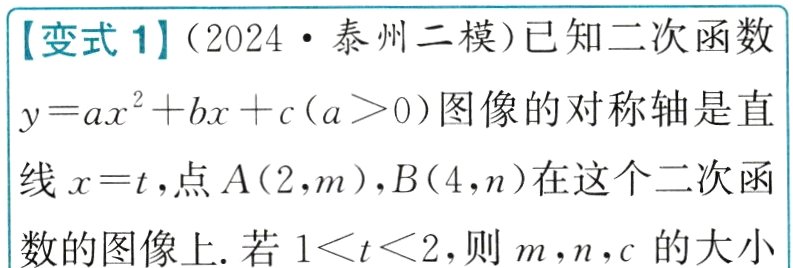
【变式1】(2024·泰州二模)已知二次函数$y = ax^{2}+bx + c$($a>0$)图像的对称轴是直线$x = t$,点$A(2,m)$,$B(4,n)$在这个二次函数的图像上. 若$1<t<2$,则$m$,$n$,$c$的大小关系是( )
A. $m<c<n$
B. $m<n<c$
C. $c<m<n$
D. $m<n=c$
A. $m<c<n$
B. $m<n<c$
C. $c<m<n$
D. $m<n=c$
答案
$\because$ 对称轴是直线 $x = t$,$\therefore$ 易得当 $x = 0$ 时的函数值与当 $x = 2t$ 时的函数值相同,均为 $c$. 又 $\because a>0$,$\therefore$ 抛物线的开口向上.$\therefore$ 当 $x>t$ 时,$y$ 随 $x$ 的增大而增大.$\because 1<t<2$,$\therefore 2<2t<4$.$\therefore m<c<n$. 故选 A.
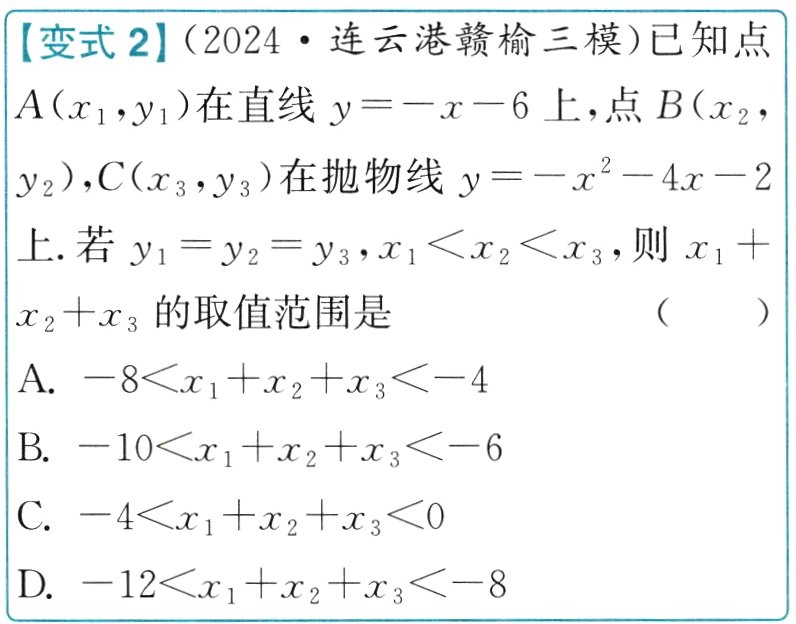
【变式2】(2024·连云港赣榆三模)已知点$A(x_{1},y_{1})$在直线$y = -x - 6$上,点$B(x_{2},y_{2})$,$C(x_{3},y_{3})$在抛物线$y = -x^{2}-4x - 2$上. 若$y_{1}=y_{2}=y_{3}$,$x_{1}<x_{2}<x_{3}$,则$x_{1}+x_{2}+x_{3}$的取值范围是( )
A. $-8<x_{1}+x_{2}+x_{3}<-4$
B. $-10<x_{1}+x_{2}+x_{3}<-6$
C. $-4<x_{1}+x_{2}+x_{3}<0$
D. $-12<x_{1}+x_{2}+x_{3}<-8$
A. $-8<x_{1}+x_{2}+x_{3}<-4$
B. $-10<x_{1}+x_{2}+x_{3}<-6$
C. $-4<x_{1}+x_{2}+x_{3}<0$
D. $-12<x_{1}+x_{2}+x_{3}<-8$
答案
令 $-x - 6=-x^{2}-4x - 2$,整理,得 $x^{2}+3x - 4 = 0$,解得 $x_{1}=1$,$x_{2}=-4$.$\therefore$ 直线 $y = -x - 6$ 与抛物线 $y = -x^{2}-4x - 2$ 的交点的横坐标为 $1$,$-4$.$\because y = -x^{2}-4x - 2=-(x + 2)^{2}+2$,$\therefore$ 抛物线的开口向下,对称轴为直线 $x = -2$,顶点为 $(-2,2)$. 把 $y = 2$ 代入 $y = -x - 6$,解得 $x = -8$. 若 $y_{1}=y_{2}=y_{3}$,$x_{1}<x_{2}<x_{3}$,则 $-8<x_{1}<-4$,$x_{2}+x_{3}=-4$.$\therefore -12<x_{1}+x_{2}+x_{3}<-8$. 故选 D.
典例3(2024·宿迁沭阳模拟)将抛物线$y = -x^{2}+1$先向左平移2个单位长度,再向下平移1个单位长度,所得新抛物线对应的函数表达式为( )
A. $y = -(x + 2)^{2}+2$
B. $y = -(x - 2)^{2}$
C. $y = -(x + 2)^{2}$
D. $y = -(x - 2)^{2}+2$
A. $y = -(x + 2)^{2}+2$
B. $y = -(x - 2)^{2}$
C. $y = -(x + 2)^{2}$
D. $y = -(x - 2)^{2}+2$
答案
C.
典例4(2024·无锡模拟)已知抛物线$y = x^{2}-2mx$($-1\leqslant m\leqslant 2$)经过点$A(p,t)$,$B(p + 2,t)$,则$t$的最小值是________.
答案
$\because$ 抛物线 $y = x^{2}-2mx$,$\therefore$ 抛物线的对称轴为直线 $x = -\frac{-2m}{2\times1}=m$.$\because$ 抛物线 $y = x^{2}-2mx(-1\leqslant m\leqslant2)$ 经过点 $A(p,t)$,$B(p + 2,t)$,$\therefore$ 点 $A(p,t)$,$B(p + 2,t)$ 关于对称轴对称,$t = p^{2}-2mp$.$\therefore \frac{p + p + 2}{2}=m$,即 $p + 1=m$.$\therefore p = m - 1$.$\therefore t=(m - 1)^{2}-2m(m - 1)=-m^{2}+1$.$\because -1\leqslant m\leqslant2$,$\therefore$ 易得当 $m = 2$ 时,$t$ 取得最小值,为 $-4 + 1=-3$.
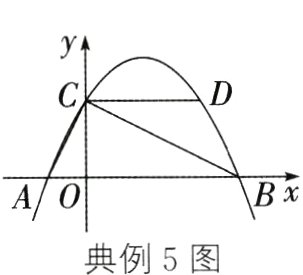
典例5(2024·苏州虎丘二模)如图,二次函数$y = ax^{2}+bx + c$的图像与$x$轴相交于点$A$,$B$,与$y$轴相交于点$C$,过点$C$作$CD\perp y$轴,交该图像于点$D$. 若点$B$,$D$的坐标分别为$(8,0)$,$(6,4)$,则$\triangle ABC$的面积为________.
答案
$\because A$,$B$ 为函数图像与 $x$ 轴的交点,$CD// x$ 轴,$\therefore$ 点 $A$,$B$ 关于函数图像的对称轴对称,点 $C$,$D$ 关于函数图像的对称轴对称.$\because D(6,4)$,点 $C$ 在 $y$ 轴上,$\therefore C(0,4)$.$\therefore OC = 4$,函数图像的对称轴为直线 $x = 3$.$\because B(8,0)$.$\therefore A(-2,0)$.$\therefore AB = 10$.$\therefore S_{\triangle ABC}=\frac{1}{2}AB\cdot OC=\frac{1}{2}\times10\times4 = 20$.
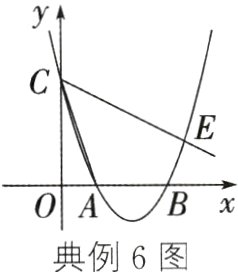
典例6(2024·无锡模拟)如图,二次函数$y = x^{2}-4x + 3$的图像交$x$轴于$A$,$B$两点(点$A$在点$B$的左侧),交$y$轴于点$C$,连接$AC$. 将$AC$绕点$C$按逆时针方向旋转$45^{\circ}$,其所在直线与二次函数的图像交于点$E$,则点$E$的坐标为________.
答案
令 $y = 0$,则 $x^{2}-4x + 3 = 0$,解得 $x_{1}=1$,$x_{2}=3$.$\therefore A(1,0)$,$B(3,0)$.$\therefore OA = 1$,$OB = 3$. 令 $x = 0$,则 $y = 3$,$\therefore C(0,3)$.$\therefore OC = 3$. 过点 $A$ 作 $AC$ 的垂线,交 $CE$ 于点 $F$,过 $F$ 作 $x$ 轴的垂线,交 $x$ 轴于点 $D$.$\because \angle ACF = 45^{\circ}$,$\angle CAF = 90^{\circ}$,$\therefore$ 易得 $AC = AF$.$\because \angle FAD+\angle CAO = 90^{\circ}$,$\angle ACO+\angle CAO = 90^{\circ}$,$\therefore \angle FAD=\angle ACO$. 又 $\because \angle ADF=\angle COA = 90^{\circ}$,$\therefore \triangle FAD\cong\triangle ACO$.$\therefore FD = AO = 1$,$AD = CO = 3$.$\therefore OD = OA + AD = 4$.$\therefore F(4,1)$. 设直线 $CE$ 对应的函数表达式为 $y = kx + b$. 把 $C(0,3)$,$F(4,1)$ 代入,得 $\begin{cases}b = 3,\\4k + b = 1,\end{cases}$ 解得 $\begin{cases}k = -\frac{1}{2},\\b = 3.\end{cases}$ $\therefore$ 直线 $CE$ 对应的函数表达式为 $y = -\frac{1}{2}x + 3$. 联立 $\begin{cases}y = -\frac{1}{2}x + 3,\\y = x^{2}-4x + 3,\end{cases}$ 解得 $\begin{cases}x = 0,\\y = 3\end{cases}$ 或 $\begin{cases}x = \frac{7}{2},\\y = \frac{5}{4}.\end{cases}$ $\therefore$ 点 $E$ 的坐标为 $(\frac{7}{2},\frac{5}{4})$.
