

 登录
登录
考点① 辨析 alone 与 lonely
根据语境,用 alone 或 lonely 填空。
1. After moving to the new city, he felt very
2. Although my grandparents live
根据语境,用 alone 或 lonely 填空。
1. After moving to the new city, he felt very
lonely
at first because he knew nobody.2. Although my grandparents live
alone
in the countryside, they never feel lonely
because they have many friends nearby.答案
1. lonely 2. alone, lonely
解析
【分析】
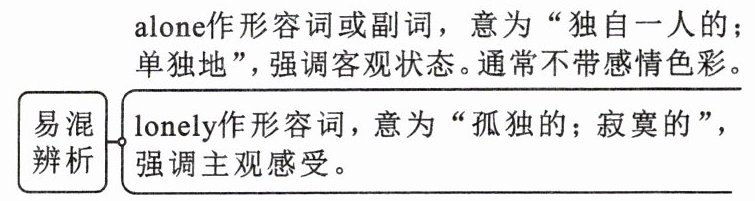
首先明确alone和lonely的核心区别:alone侧重客观上独自一人,无感情色彩,可作形容词或副词;lonely侧重主观上感到孤独、寂寞,带有感情色彩,仅作形容词。再结合句子语境判断:第1句中“felt”后需体现主观感受;第2句第一空修饰动词表客观状态,第二空体现主观感受。
【解析】
1. 句中“felt”是系动词,后接形容词作表语,根据“因为他不认识任何人”的语境,体现主观上的孤独感受,故填lonely。
2. 第一空修饰动词“live”,表示客观上“独自地”居住,用副词alone;第二空“feel”是系动词,后接形容词,结合“从不感到……”的语境,体现主观上的孤独感受,故填lonely。
【答案】1. lonely 2. alone; lonely
【知识点】形容词与副词辨析,alone和lonely的用法
【点评】本题是易混词辨析的基础题,重点考察对alone(客观状态)和lonely(主观感受)核心区别的掌握,属于英语词汇基础考点。
【难度系数】0.2
首先明确alone和lonely的核心区别:alone侧重客观上独自一人,无感情色彩,可作形容词或副词;lonely侧重主观上感到孤独、寂寞,带有感情色彩,仅作形容词。再结合句子语境判断:第1句中“felt”后需体现主观感受;第2句第一空修饰动词表客观状态,第二空体现主观感受。
【解析】
1. 句中“felt”是系动词,后接形容词作表语,根据“因为他不认识任何人”的语境,体现主观上的孤独感受,故填lonely。
2. 第一空修饰动词“live”,表示客观上“独自地”居住,用副词alone;第二空“feel”是系动词,后接形容词,结合“从不感到……”的语境,体现主观上的孤独感受,故填lonely。
【答案】1. lonely 2. alone; lonely
【知识点】形容词与副词辨析,alone和lonely的用法
【点评】本题是易混词辨析的基础题,重点考察对alone(客观状态)和lonely(主观感受)核心区别的掌握,属于英语词汇基础考点。
【难度系数】0.2
考点2 辨析somebody,anybody,everybody与nobody
根据语境,从方框中选择恰当的单词填空。
$\{\begin{array}{l} \mathrm{somebody, anybody, everybody, nobody} \end{array} $
1. $\underline{\hspace{5cm}}$ needs a friend to talk to when they feel upset.
2. Is there $\underline{\hspace{5cm}}$ who can help me solve this maths problem?
3. $\underline{\hspace{5cm}}$ likes being laughed at. It really hurts.
4. I think I heard $\underline{\hspace{5cm}}$ knocking at the door just now. Go and see who it is.
根据语境,从方框中选择恰当的单词填空。
$\{\begin{array}{l} \mathrm{somebody, anybody, everybody, nobody} \end{array} $
1. $\underline{\hspace{5cm}}$ needs a friend to talk to when they feel upset.
2. Is there $\underline{\hspace{5cm}}$ who can help me solve this maths problem?
3. $\underline{\hspace{5cm}}$ likes being laughed at. It really hurts.
4. I think I heard $\underline{\hspace{5cm}}$ knocking at the door just now. Go and see who it is.
答案
1. Everybody 2. anybody 3. Nobody 4. somebody
解析
【分析】
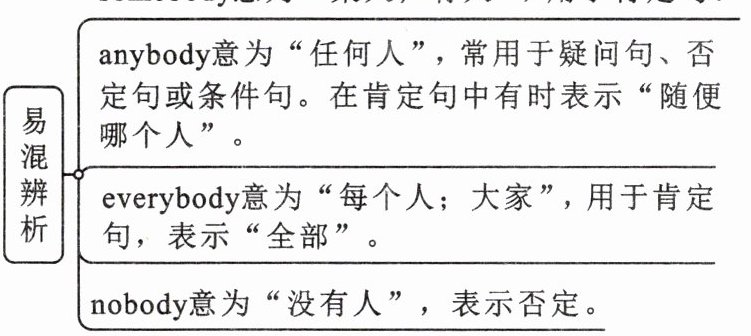
要解决这道题,需结合语境和不定代词的用法辨析:1. 第1句语境表达“难过时需要朋友倾诉”,对应表“每个人”的不定代词;2. 第2句是疑问句,需用常用于疑问句的不定代词;3. 第3句语境表否定含义,对应表“没有人”的不定代词;4. 第4句语境表不确定的“某人”,对应表“某人”的不定代词。
【解析】
1. 句意为“当他们感到难过时,每个人都需要朋友倾诉”,需用表“每个人”的everybody;
2. 句意为“有能帮我解这道数学题的人吗?”,疑问句中用anybody;
3. 句意为“没有人喜欢被嘲笑,那真的很伤人”,表否定,用nobody;
4. 句意为“我刚才听到有人敲门,去看看是谁”,表不确定的某人,用somebody。
【答案】
1. Everybody 2. anybody 3. Nobody 4. somebody
【知识点】
不定代词辨析;不定代词用法
【点评】
本题考查易混不定代词的语境运用,需掌握各不定代词的含义及适用句式,结合语境匹配对应词汇,属于英语基础题型。
【难度系数】
0.4
要解决这道题,需结合语境和不定代词的用法辨析:1. 第1句语境表达“难过时需要朋友倾诉”,对应表“每个人”的不定代词;2. 第2句是疑问句,需用常用于疑问句的不定代词;3. 第3句语境表否定含义,对应表“没有人”的不定代词;4. 第4句语境表不确定的“某人”,对应表“某人”的不定代词。
【解析】
1. 句意为“当他们感到难过时,每个人都需要朋友倾诉”,需用表“每个人”的everybody;
2. 句意为“有能帮我解这道数学题的人吗?”,疑问句中用anybody;
3. 句意为“没有人喜欢被嘲笑,那真的很伤人”,表否定,用nobody;
4. 句意为“我刚才听到有人敲门,去看看是谁”,表不确定的某人,用somebody。
【答案】
1. Everybody 2. anybody 3. Nobody 4. somebody
【知识点】
不定代词辨析;不定代词用法
【点评】
本题考查易混不定代词的语境运用,需掌握各不定代词的含义及适用句式,结合语境匹配对应词汇,属于英语基础题型。
【难度系数】
0.4
1. His sudden
He spoke
2. People think
It's important to respect
That makes a big
anger
made everyone silent.He spoke
angrily
and looked very angry
. We didn't know why. (anger)2. People think
differently
about the same problem.It's important to respect
different
opinions.That makes a big
difference
. (different)答案
1. anger, angrily, angry 2. differently, different, difference
解析
【分析】本题考查同根词的词性转换及在句子中的正确运用,需根据每个空格在句中的成分(如修饰动词、作表语、修饰名词等)确定所需词性,再结合所给单词变形。第一题所给词为anger,需依次变为名词、副词、形容词;第二题所给词为different,需依次变为副词、形容词、名词。
【解析】1. 第一个空位于形容词sudden之后,需填名词作宾语,故用anger;第二个空修饰动词spoke,需用副词,故变为angrily;第三个空在系动词looked后作表语,需用形容词,故用angry。2. 第一个空修饰动词think,需用副词,故变为differently;第二个空修饰名词opinions,需用形容词,故用different;第三个空前有不定冠词a,需填名词,故变为difference。
【答案】1. anger, angrily, angry 2. differently, different, difference
【知识点】词性转换、形容词用法、副词用法
【点评】本题为基础词性运用题,重点考查同根词不同词性的语法功能,难度适中,明确句子成分即可正确作答。
【难度系数】0.6
【解析】1. 第一个空位于形容词sudden之后,需填名词作宾语,故用anger;第二个空修饰动词spoke,需用副词,故变为angrily;第三个空在系动词looked后作表语,需用形容词,故用angry。2. 第一个空修饰动词think,需用副词,故变为differently;第二个空修饰名词opinions,需用形容词,故用different;第三个空前有不定冠词a,需填名词,故变为difference。
【答案】1. anger, angrily, angry 2. differently, different, difference
【知识点】词性转换、形容词用法、副词用法
【点评】本题为基础词性运用题,重点考查同根词不同词性的语法功能,难度适中,明确句子成分即可正确作答。
【难度系数】0.6
negative, but, a, mean, feeling,
angry, normal, decide, harm, lucky
Although getting mad at others is
1.
to control our 2.
it in 3.
control may cause us to shout at others or say
4.
fire. It can be 5.
relationships with others. 6.
are some ways to help us remain calm. Taking
7.
you a moment to calm down and feel a bit less
angry. You could also go for a walk, write about
your 8.
all the time, 9.
with that anger is your 10.
to you to find positive solutions!
angry, normal, decide, harm, lucky
Although getting mad at others is
1.
normal
from time to time, we must learnto control our 2.
anger
instead of expressingit in 3.
negative
ways. Because losingcontrol may cause us to shout at others or say
4.
mean
words. After all, anger is like afire. It can be 5.
harmful
to ourrelationships with others. 6.
Luckily
, thereare some ways to help us remain calm. Taking
7.
a
deep breath, for example, givesyou a moment to calm down and feel a bit less
angry. You could also go for a walk, write about
your 8.
feelings
, or run. Feeling angry happensall the time, 9.
but
how you choose to dealwith that anger is your 10.
decision
. It's upto you to find positive solutions!
答案
1. normal 2. anger 3. negative 4. mean 5. harmful 6. Luckily 7. a 8. feelings
9. but 10. decision
9. but 10. decision
解析
【分析】
首先通读全文,理解文章关于控制愤怒情绪的主旨。解题时需结合上下文语境、词性要求、固定搭配,从给定单词中选择合适词汇,同时注意单词的形式变化(如词性转换、单复数、大小写等)。
【解析】
1. 此处需形容词作表语,结合语境“时不时对他人生气是正常的”,选normal;
2. 此处需名词作control的宾语,结合前文围绕愤怒展开,选anger;
3. 此处需形容词修饰ways,结合“而非用消极方式表达”,选negative;
4. 此处需形容词修饰words,结合“说刻薄的话”,选mean;
5. 此处需形容词作表语,构成固定搭配be harmful to(对……有害),harm的形容词形式为harmful;
6. 此处需副词作状语,表转折的幸运情况,lucky的副词形式为Luckily,句首需大写;
7. 固定搭配take a deep breath(深呼吸),需填冠词a;
8. 此处需名词,结合语境“写下你的情绪”,feeling用复数形式feelings;
9. 此处需连词表转折,前文说生气常发生,后文强调处理方式由自己决定,选but;
10. 此处需名词,your后接名词,decide的名词形式为decision,意为“你的决定”。
【答案】
1. normal 2. anger 3. negative 4. mean 5. harmful 6. Luckily 7. a 8. feelings 9. but 10. decision
【知识点】
英语词汇运用、词性转换、固定搭配
【点评】
本题为选词填空题,考查学生对词汇在语境中的灵活运用能力,涉及词性转换、固定搭配等知识点,需要学生结合上下文语义准确选择并调整单词形式,是初中英语常见基础题型,注重核心词汇的掌握。
【难度系数】
0.5
首先通读全文,理解文章关于控制愤怒情绪的主旨。解题时需结合上下文语境、词性要求、固定搭配,从给定单词中选择合适词汇,同时注意单词的形式变化(如词性转换、单复数、大小写等)。
【解析】
1. 此处需形容词作表语,结合语境“时不时对他人生气是正常的”,选normal;
2. 此处需名词作control的宾语,结合前文围绕愤怒展开,选anger;
3. 此处需形容词修饰ways,结合“而非用消极方式表达”,选negative;
4. 此处需形容词修饰words,结合“说刻薄的话”,选mean;
5. 此处需形容词作表语,构成固定搭配be harmful to(对……有害),harm的形容词形式为harmful;
6. 此处需副词作状语,表转折的幸运情况,lucky的副词形式为Luckily,句首需大写;
7. 固定搭配take a deep breath(深呼吸),需填冠词a;
8. 此处需名词,结合语境“写下你的情绪”,feeling用复数形式feelings;
9. 此处需连词表转折,前文说生气常发生,后文强调处理方式由自己决定,选but;
10. 此处需名词,your后接名词,decide的名词形式为decision,意为“你的决定”。
【答案】
1. normal 2. anger 3. negative 4. mean 5. harmful 6. Luckily 7. a 8. feelings 9. but 10. decision
【知识点】
英语词汇运用、词性转换、固定搭配
【点评】
本题为选词填空题,考查学生对词汇在语境中的灵活运用能力,涉及词性转换、固定搭配等知识点,需要学生结合上下文语义准确选择并调整单词形式,是初中英语常见基础题型,注重核心词汇的掌握。
【难度系数】
0.5
